
Translated material
Again about Friday
Apology of superstitions by Daniil Harms and Alexander Vvedensky
As a funny joke about a ship called Friday, invented by Fenimor Cooper, he fell into Harms's notebook and Vvedensky’s oral story, what were the members of the Thirteen Club ridiculed with Chesterton, and why the number 37 is bad? On Friday, the 13th contrary to all superstitions is told by philologist Ilya Vinitsky.Starting from February 24, 2022, we were all in the face of the advancing barbarism, violence and lies. In this situation, it is extremely important to preserve at least the remnants of culture and support the values of humanism - including for the sake of the future of Russia. Therefore, the editorial office of Gorky will continue to talk about books, reminding our readers that the world remains in the world and fiction.
December 12th. I read in the newspapers that it was as if [ on Friday ] to one peasant who stood tilting over the water, a small pike jumped into her mouth and, stuck with the gills, could not be pulled out, which is why this rotosa and died. What, after this, cannot be believed in Russia?
N. S. Leskov . Soboryans
And they sob, the poor, and swear trouble.
Song from the movie "Diamond hand", performed by Gasha Kozlodoev on the deck of the ship "Victory" (aka Mikhail Svetlov)
1
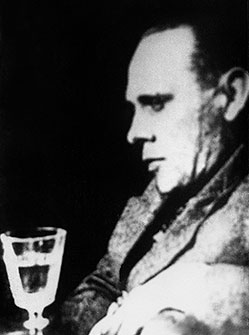 Daniil Harms, 1930s
Daniil Harms diary entry, beginning with the words “these are the sailors” (between July 14–16, 1933), it says: it says:
“The British decided to prove that faith on an unhappy Friday simple superstition. To do this, they built a ship and began to build it on Friday. On Friday, they lowered him into the water. They called the ship Friday Friday, went on Friday on Friday, and on Friday the ship crashed and drowned. ”
This story, recorded next to the numerological calculations of Harms, is devoted to a recent commentary to A. A. Kobrinsky * Kobrinsky A. Commenting Harms // Literary fact. 2021. No. 1 (19), ss. 344–349. . According to the researcher, its plot goes back to the next note in the novel by Fenimore Cooper “The Red Rover”, 1827):
“One educated merchant from Connecticut wanted, for his part, to contribute to the extermination of this prejudice, sometimes very harmful. He laid the construction of the ship on Friday; He lowered him at sea on Friday, called him Friday, finally, on Friday, he sent him on his first journey. By the misfortune for this well -intentioned attempt, both the ship and the crew never returned back and went missing! ”
This Kupeperi joke, as the commentator convincingly showed, picked up different authors who added numerous jachabone details to him, such as the captain of the unfortunate ship named Freidede or two sailors Fry and de.
In this note, we will try to clarify the historical and cultural genealogy of this joke, entering the latter into a wider “superstitological” context that is relevant for the creativity of poets-estarius.
2
Of course, into the cultural turn, the joke about the Friday ship was introduced by Fenimor Cooper in 1827, but, as we try to show, Harms borrowed it, most likely, not from the inconspicuous remark of the novel in the publication of 1832 (as Kobrinsky indicates, in English, the poet did not read, and in most Russian translations of the Cooper there is no Cooper. Notes).
First of all, we indicate that Russian readers have well known the version of this story, presented in the famous Charles Dickens “Fateful Days” from “HouseHold Words”, first published in 1852 in “Contemporary” under the name “A few words about prejudices in England are fatal days”:

“Friday among sailors is still considered the most fatal day. A few years ago, in order to reduce evil, often stinging from such a conclusion about Friday, in England a ship was built, which was laid on Friday, launched on Friday, gave him the name “Friday” and appointed him on the day of his voyage on Friday. After many difficulties, there was a captain, who was also called Friday, and even more work was worth making a crew, because people were required less than all devoted to prejudices. Unfortunately, this experience instead of eradicating the superstitious concept of Friday, approved him even more. "Friday" died; At least from the date of departure at sea is still nothing about her. ”
According to Dickens, “hope in the fatality of days” serves “to the expression of an inexperienced and extreme weak mind” and is “the most ordinary and at the same time the most unjustified, most ridiculous prejudice”.
Harms hardly read the old books of “Contemporary”, but he could well hear the story about the ship “Friday” from his father, who was interested in all sorts of signs and predictions and wrote about them the chapter in the book “War and Vera: Essays on the World War of 1914-1915.” (Petrograd, 1917). (Note, by the way, that the actualization of the Friday in the minds of Harms in the late 1920s and early 1930s could be facilitated by regular creative “Fridays” in the Union of Poets, which he reported in his notebooks; on Fridays he used to appoint dates).
However, the Dickens version of the joke, responding in many later retelling of it, also cannot be called the source of the Harmsa entry (as Kobrinsky rightly remarked, the latter has no indication of the captain named Friday, mentioned in other versions of history of the unfortunate ship).
It is more likely that the poet borrowed this story from the memoirs of the Russian Theosofka and violinist Anna Vasilievna UNKOVSKAYA (nee Zakharyina, 1857-1927), published in the magazine “Bulletin of Theosophy” (mentioned in notebooks) and separately in the book “Memoirs”, published in 1917.
UNKOVSKAYA:
“... For a successful beginner of serious business and Friday, she already showed themselves to the British enough, who wanted to prove that all this was prejudice: they deliberately began to build a ship on Friday, launched it on Friday and called it“ Friday ” ; On Friday he went to sea and crashed on Friday and drowned ... The sailors were told about this and they say that it was a real truth. "
Harms:
“ This is what the sailors say
The British decided to prove that faith on an unhappy Friday simple superstition. To do this, they built a ship and began to build it on Friday . On Friday, they lowered him into the water. They called the ship Friday Friday , went on Friday on Friday, and on Friday the ship crashed and drowned . ”
As we see, not only plot, but also the stylistic elements of Harms history are reproduced in the given quote from UNKOVSKA: the English, not the American source (we believe that in this context the “English” of the joke for Harms was significant), the words “decided to prove”, “broke up and sank” (recall that Cooper and dickens were missing), the source of information, the source of information) “[O] The sailors told this” (cf. with the “name” of the Harmses text), and the same dublet - the Russian and Latin spelling of the name of the ship (at Harms - the steamer).
Although the name of UNKOVSKA is never found in the writer's notebooks, the above story is textually so close to the option printed in them that it is logical to consider a direct source of the latter. (Of course, in theory it can be assumed that UNKOVSKAYA literally included in her memoirs someone's story about the fifth ship, who also attracted the attention of Harms, or that her story was rewritten later and came into the field of view of the poet). It is remarkable that in the same notebook that includes this story, Harms enters a list of questions that interests it, including, among other things, “insight, inspiration, enlightenment, superconsciousness”, “signs”, “individual superstitions” and “miracles” (p. 18 rp).
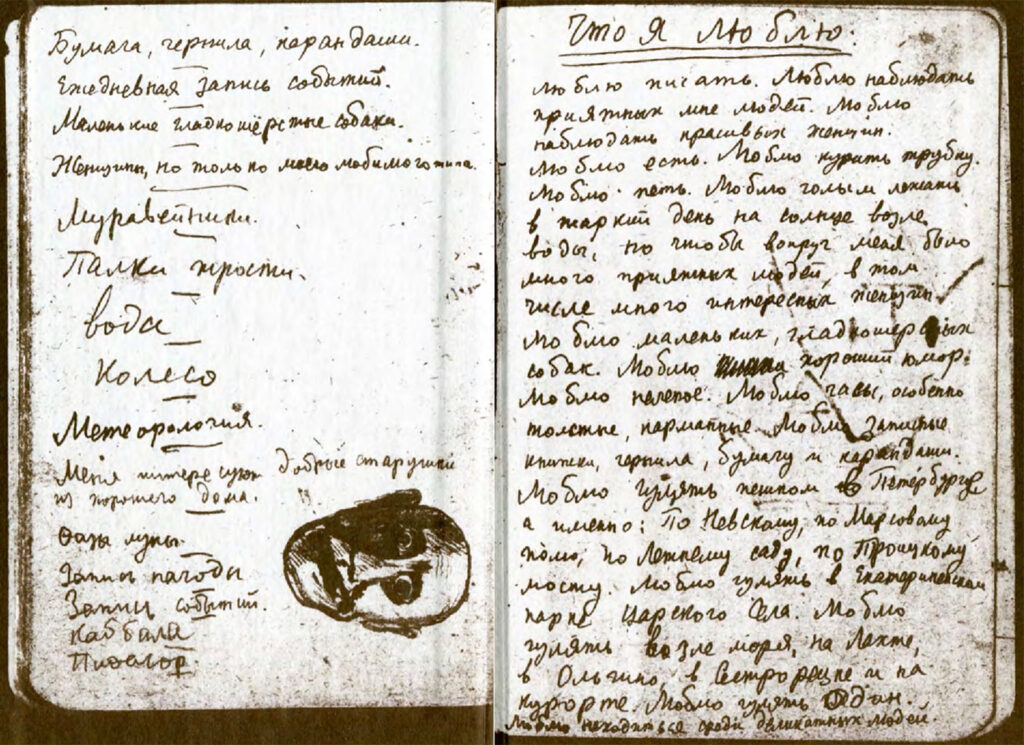 U -turn from Harms's notebook with a listing “What interests me”, “What I love”
3
We now turn to the ideological (or, as we said above, the “superstitical”) plan of this record. According to the commentator, the Harms recording the word “Friday” in the notebook dating to her in the notebook on July 14, 1933. “The context of this record on the same page,” the researcher continues, “is fantastic reasoning that the number 37 is“ bad ”, since, being multiplied by 3, it gives 111, and 111 is“ Basic 666 ”(111 × 6 = 666).” According to Kobrinsky, “Harms gives free rein to his superstitious ideas about numerology, and then recalls the story with the ship“ Friday ”(possibly, as Kobrinsky noticed on Friday July 14, 1933; on the irony of fate on the same Friday, the Soviet steamer“ Chelyuskin ”with an expedition led by O. Yu. Leningrad on the first ice campaign and in February sank; we will add for the general context that in November 1931, the Aquitani ship, on the board of which was a Canadian Prime Minister, showed a lot of prudence, refused to go to the sea on Friday on the 13th and went sail exactly a minute after midnight on November 14).
Finally, the researcher connects this story with the oral story of Harms friend Alexander Vvedensky about the damn dozen recorded by Mikhail Meilah from the words of T. A. Lipavskaya:
“Thirteen people organized an alliance to combat superstitions. They started all the things on a difficult day - Monday, lit a papyros three and necessarily the third from the same match. All thirteen together, no more and no less gathered. Once on Monday they gathered to fight superstitions, but there is no thirteenth. And then they were imbued with superstitious horror. ”
As we show later, the semantic connection of this story with the Friday plot of Harms is much closer and more interesting. So, in one of the American periodicals of the late 19th century, it was reported that the joke introduced into the cultural turnover as anecdote dates back to the activities of a certain “The Friday Club club”, founded in 1820 in New York, enlightened fighters with superstitions and prejudices. The charter of this club was dated Friday, the club members met on Fridays; On Friday, they ordered to build a ship; On the same day of the week, its construction began; Of course, on Friday, of course, of course, “Friday”, was launched into the water. On one of the Fridays, it hit the road from the port and - no one has ever heard anything else about him.
Meanwhile, we could not find any traces of this club in the 1820s, and it can be assumed that the author of the newspaper publication given in it combined the ship's plot, known according to the novel of Cooper, with the activities of the later (well-known) American “Thirteen” (The Club of Thirteen), which was also collected on Fridays and struck with all possible superstitions.
The first meeting of this club was held on January 13, 1882 in the Nickel-Coker Cottage on the sixth Avenue: “Dinner was covered in the 13th room. The table was decorated with 13 large plates with a lobster salad folded in the form of ... a coffin. The salad was surrounded by 13 lobsters. The table with abundantly scattered salt was lit by 13 candles. A large red poster hung over it with the inscription with white letters “Nos Morituri TE Salutamus” (“We welcome you to death!” ”( The source of the quote ). The organizers argued that over the year of the club’s existence, not a single participant died or even fell ill. With time, the new branches of the club (male and female) have opened in other cities and countries (it is known that among its members there were five US presidents; more about this can be read here ).
Every year, the club of thirteen issued its reports (“Reports”) with “short and witty” speeches of venerable members. In one of these speeches, “Superstition at the Sea”, uttered on August 13, 1895 by a sailor S. Grant Smith, Mariner) a well -known story of a ship named “Friday” is given from the Iland horses:
“They say that one brave man laid the ship on Friday, launched it on Friday, gave him a name on Friday and sent him on his first voyage with a team of sailors of thirteen on Friday, which fell on the thirteenth day of the month, and that not a single mortal could not see this ship anymore. But this story is an invention composed by some kind of loafer (Bumboat Man, letters. Board-marker) in order to scare superstitious people. ”
Apparently, this "loafer" James Fenimore Cooper was called.
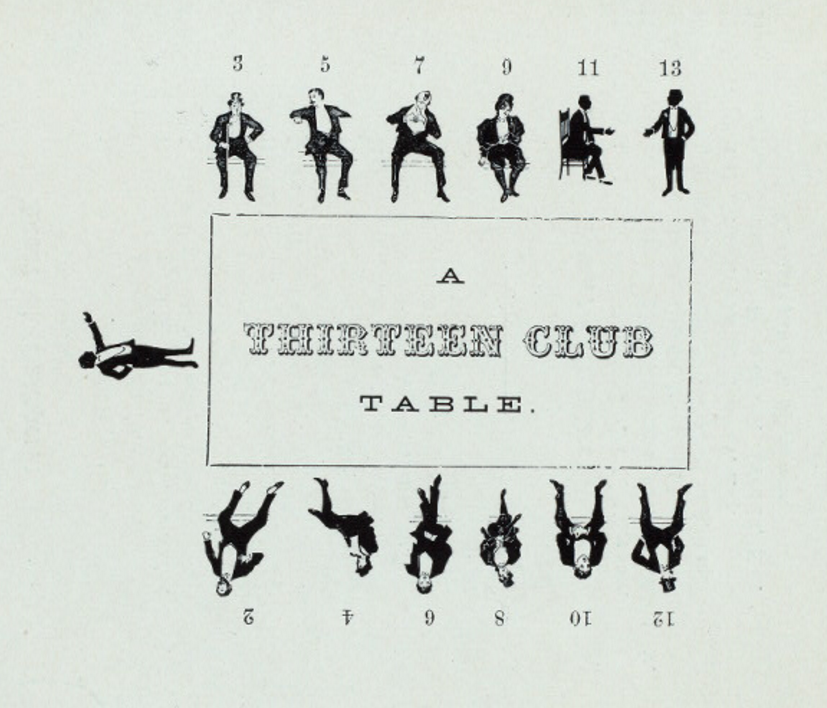 Meanwhile, in the English -language press, reports of the activities of this club were constantly enveloped in a mystical fleur. In his book about the “Damn Dozen” Nathaniel Lakenmeier gives sensational names of publications in American newspapers about unhappy meetings of this club and related to the last frightening stories:
“... Once I came across a clipping in which it was a kind of“ club of thirteen ”: destroyed by dynamite. “The Club of Thirteen” took off into the air, the three were injured. Woodberry, New Jersey, March 18. <...> The atrocity has not yet been disclosed. An unknown person, perhaps, was involved in the case, sailing past the building on a boat a few minutes before the explosion.
<...> It is curious what kind of club it was and why did anyone need to blow it up. I turned the page, believing that there, as usual, there would be clippings on completely different topics-about some terrible murder or another miraculous medicine-but I was mistaken. On the next page, two more notes were pasted on the “Club of Thirteen”: “Calling the ancient superstition” and “Thirteen at the same table”. I once again turned the page: “The death of a member of the“ club of thirteen ””; “The Club of Thirteen is organized by the court of heresy.” In total, there were eleven notes on the “club of thirteen”; All of them were cut out of the New York Times, everyone dates back to years from 1885 to 1899. ”
In one of the above notes, “Thirteen Club Mamber's Death” (New York Times, March 15, 1899, p. 14) tells about the mysterious death of a 57-year-old member of the club thirteen William K. Schwaebe), who died in Stamford (Connecticut) at 13 o’clock in the afternoon of March 13, 1899. This or some kind of similar story about the death of the thirteenth member was reflected in fiction.
In 1922, G.K. Chesterton, the author of the novel “The Man who was Thursday” (“The Man Who Was Thursday”, 1908) and the Father Brown, well -known and close in spirit Harms and his company, ”the remarkable religious detective“ Pavli House ”dedicated to this club. Peacock "), in which he ridiculed the London meeting of thirteen fighters with prejudices that were obsessed with the logic and common sense:
“Meanwhile, the members of the Thirteen Club entered the room and sat in places. Most of them differed in briskness, and some - and arrogance. For the youngest, in appearance similar to very small employees, their faces were stupid and restless, as if they participated in a dangerous game. And only two out of twelve were clearly decent people: a dry, wrinkled old man in a huge red wig and a tall strong man of indefinite age and undoubted mind. ”
The hero of the story of a young poet-detective Gail turns to one of the enlightened club participants:
“You studied superstitions all over the world and saw things, in comparison with which all these rumors about knives and on solo - just a children's game. You visited dark forests, where they believe in vampires, which are more huge than the dragon, and in the mountains, where they are afraid of werewolves and are waiting for animal eyes on the face of a girlfriend or friend. You knew the true superstitions who believed in black, terrible things, you lived among them, and I want to ask you about them. <...> Doesn't it seem to you that these superstitious people are happier than you? <...> It doesn't seem to you that they sang more songs, and danced more dancing, and drank more wine, and rejoiced sincere than you? And all because they believed in evil. Let only into evil spells, into an unkind eye, into a bad sign - yes, evil is under stupid and inconsistent appearance. But they think about him! They clearly see white and black, and life for them is a battlefield. And you are unhappy because you did not believe in evil and believed that the true philosopher is obliged to see everything in the gray light ” * Translation of Natalia Traubberg. .
4
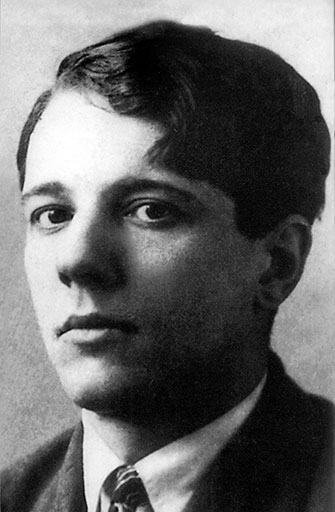 Alexander Vvedensky, 1930s
It must be assumed that the information about the activities of this Pickworth in their spirit reached Vvedensky and his friends (in Russia about the club of thirteen, in particular, S. A. Nilus, who considered its participants to Satanists). It should also be noted that the carnival-parodic nature of the activity of this “union”, which received the nickname “Club of Ecadaks” in the press, attractive to the Oeriuts.
“Everything that is considered to be a foreshadowing misfortune, ” we read in one of the many newspaper descriptions of the club’s activities, ” was deliberately exhibited and consciously redone. There was a lot of figurines on the table, bringing misfortune, animals, once: white elephants, toads, owls, spiders, lizards, etc. And, in addition, several human skeletons. The chairman of the club Albert Mark, before sitting down at the table, deliberately opened the umbrella. Another club member, Sir Arbutnot Len introduced a solemn procession of 13 guests, each of which also had an open umbrella. Quite to the entrance, a staircase was leaned to the entrance and all guests had to go under it. The chairman solemnly broke the mirror. The table was decorated with unlucky iris and thirteen telegrams were sent thirteen missing members ... "
We have no doubt that it is precisely to this society and its legend that the oral story of Vvedensky about the union of thirteen has cooled. (In one of the journal descriptions of the meetings of the London Club of Thirteen, it was said that it was customary to light three cigarettes from one match, that from the time of the Boer war it was considered a bad omen: the bourgehoe saw a light, a bourgeois was aimed, the Bur fired). Most likely, replacing Friday on Monday in Vvedensky's story is a mistake of the memoirist.
Выскажем осторожное предположение, что сюжетной основой этого рассказа послужила упомянутая новелла Честертона, в которой тринадцатый член клуба не приходит на торжественный обед . Тело этого гостя, зверски убитого председателем клуба фанатиком Крэндлом, находят в мусорном ящике. Это убийство не только повергает членов общества в ужас («В жизни такого ужаса не видел»), но и приводит их к религиозному озарению, толкователем которого является раскрывший преступление детектив Гейл. К сожалению, нам пока не удалось установить, был ли знаком Введенский с этим рассказом, но в 1920-е годы переводы книг Честертона выходили в СССР один за другим * (Таинственные рассказы. Пер. с англ. К. Жихаревой. Москва; Ленинград: Гос. изд-во, 1927; Клуб изобретательных людей. Пер. с англ. В. И. Сметанича. Ленинград: Мысль, 1924; Избранные рассказы для начального чтения на английском языке. Под ред. А. Викстида и Н. Сеттингсона. Москва; Ленинград: Гос. изд-во, 1930). . Названия нескольких произведений английского писателя упоминаются в записных книжках Хармса начала 1930-х: «Клуб изобретательных людей», «Новый Дон-Кихот», «Перелетный кабак», «Мудрость отца Брауна», «Неверия патера Брауна», «Человек который [был Четвергом] слишком много знал» (Хармс приятельствовал с переводчиком Честертона В. И. Сметаничем (Стеничем), которого упомянул в прозаическом отрывке «Ольга Форш nодошла к Алексею Толстому»).
Так или иначе, думается, не будет преувеличением (а даже если и будет, то преувеличение есть мать практического изучения) назвать кружок обэриутов своего рода пародическим двойником-антиподом Клуба Тринадцати эксцентричных позитивистов — в карнавализированном ленинградском союзе примерно (чертовой) дюжины поэтов и философов самые странные, абсурдные и трагические суеверия «реабилитировались» как чудесные проявления общих законов человеческой жизни и истории.
* * *
В заключение добавим, что приводимые исследователем соседние с записью о корабле-пятнице «фантастические рассуждения» Хармса о «плохом» числе 37 едва ли свидетельствуют о собственных нумерологических экспериментах поэта. Скорее всего, истоки этого рассуждения имеют тот же теософский и оккультный (в данном случае апокалиптический) характер, что и другие записи о тайных законах бытия, дурных приметах и простодушных верованиях. Так, они очень близки к размышлениям мистика А. Кроули о числе 37, помноженном на 111 и ведущем к «числу зверя». То есть мы имеем здесь дело не просто с суевериями и индивидуальными нумерологическими выкладками Хармса, а с усвоением (и испытанием) оккультно-мистической традиции, в центре которой находятся проблемы случая и рока (фатальные даты), а также с характерной для поэта и его единомышленников игровой полемикой с позитивистским скептицизмом, воплощением которого был Клуб Тринадцати эксцентричных борцов с предрассудками и приметами, согласными с чувствами души как Даниила Ивановича, так и Александра Ивановича.