
Translated material
If the stars are set on fire
The military enlistment offices are burning in Russia. What happened?
On May 13, the Omsk resource OM1.ru said that unknown people threw the military commissariat in Molotov cocktails in the city center (in the regional department of the Ministry of Internal Affairs they refused to comment on this incident). It was already the ninth case of an attack on the military enlistment offices since the beginning of a full -scale war in Ukraine. Over the past two months, arson tried to arrange in Cherepovts, Nizhnevartovsk, Balashikha near Moscow and other cities of Russia. “New newspaper. Europe ”talked with a political scientist, activist and lawyers to figure out what the Russians do not like the military enlistment offices.
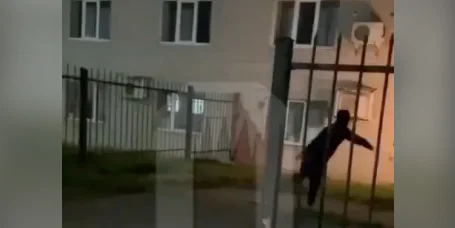
On Wednesday, May 11, the Shot Telegram channel announced the detention of two sixteen-year-old teenagers in Cherepovets. In the post, to which two shut -off photos of the guys were attached, the channel administrators claimed that a few days earlier these young people threw bottles with incendiary mixture into the building of the military registration and enlistment office on Krasnodontsev Street. The telegram channel claimed that they did it not for free, but supposedly for thirty thousand rubles. Who exactly could pay teenagers, was not specified.
Video with arson of an administrative building from Cherepovets began to spread on the network on May 9. On the record, a dark figure of an unknown person with a closed face threw three Molotov cocktails into the windows on the ground floor. After each bottle of the window, it was covered with fire. The voice behind the scenes encouraged: "Come on, let's fuck." On the fourth bottle in the hands of the unknown, the record broke off - the arsonists ran away. As added in the video signature, the event occurred on the night of May 7 to 8. The fabric time was confirmed by regional media: as reported by the Vologda Region in the press service of the Main Directorate of the Ministry of Emergencies in the Vologda region, they received a message about the fire on May 8 at 01:08.
A few hours after the publication in the SHOT telegram channel, information about the detention of adolescents was confirmed by the mayor of Cherepovets Vadim Germanov. On his VKontakte page, Germanov wrote that employees of regional Ministry of Internal Affairs and the FSB found the guys, and also added that they were not at all the military registration and enlistment office, but the premises of Rosreestr, which was in the same building. With arson, no one was injured.
- The guys did not take into account that it is possible to break the double -glazed window with a bottle only in the cinema. As a result, all the combustible liquid was ignited on the street, and the fire went out before the arrival of the firefighters. In addition, young pyromanians mixed up the windows and threw Molotov cocktails into the premises of Rosreestr, not the military registration and enlistment office, ”Germanov wrote on a social network. - And most importantly: they forgot that the Safe City system allows you to find everyone who is poorly behaved on the streets.
As the media wrote, a criminal case on the deliberate destruction or damage of property was opened against adolescents. This information is not officially confirmed.
Russia is in fire
Over the past calendar year, the media wrote only three fires in the military commissariats, two of which occurred in unexplosed buildings, the Russian BBC service calculated .
After the start of the full -scale war of Russia in Ukraine, against the backdrop of permanent rumors about the beginning of mobilization, the news about the arson of military enlistments began to appear noticeably more often.
Now it is publicly known about nine cases in different regions of Russia.
The first incident occurred in the city of Lukhovitsy in the Moscow region , probably at the end of February. As Moscow Komsomolets wrote (MK), on February 28, a 21-year-old local resident Cyril broke two windows of military registration and enlistment offices, threw bottles of incendiary mixture there, and then disappeared. In addition, the publication noted that after the arson, the gates of the building “were painted in the colors of the Ukrainian flag, a provocative record of the special operation of the RF Armed Forces was left on them.”
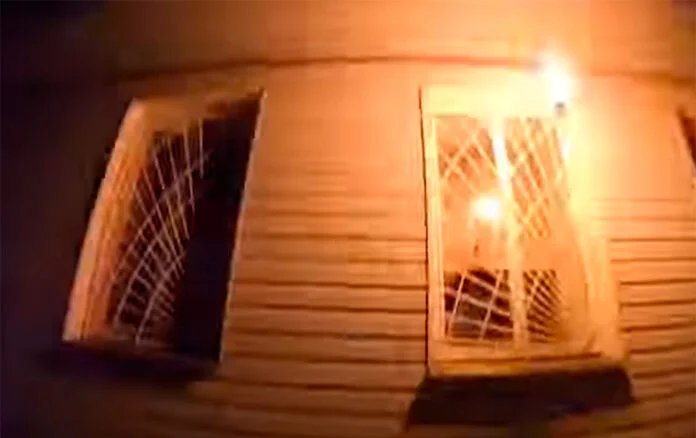
The note about the attacker in MK, however, was published by the post-fact, after his detention (the regional media itself was replicated on March 9 along with the recording of the arson, which appeared on the eve of the telegram channel "Vatahanters"). As the journalists wrote, the young man was detained on March 8 on the border of Belarus and Lithuania, from where he allegedly tried to get into the territory of Ukraine. After he was extracted to Russia and taken to the Lukhovitsky police department, the guy escaped again, allegedly leaving the toilet. However, for the second time, its whereabouts were quickly established. Now a criminal case has been instituted against Cyril under Article 214 of the Criminal Code of Russia (vandalism). With arson, no one was injured.
In early March, there was also an attack on the military registration and enlistment office in Voronezh . According to the DEPREL TELL-channel, the unknown divided the bank from the flammable liquid on the door of the selection point for military service under the contract. There were no victims of arson, the fire hit only part of the door. The video, which allegedly captures the man who made arson, later published the telegram channel “Security”. On March 5, Molotov’s cocktail threw a 24-year-old consultant to the electronics store at the Berezovsky Sverdlovsk Region . As the source of the Ural media E1 reported, when detained, the man admitted that he wanted to disrupt the draft campaign. Now he is in jail. He was accused of attempted murder under Part 3 of Art. 30, p.p. “D”, “E”, “and” Part 2 of Art. 105 of the Criminal Code of Russia (the case was qualified under this article due to the fact that the watchman was present in the building, the sources of MK said). A man faces up to 15 years in prison. After these events, on the night of March 18 to 19, the military enlistment office tried to set fire to a resident of Shui in the Ivanovo region.
The next case of arsonwas recorded a month later in the village of Zubov Polyan (Mordovia) on the night of April 17 to 18. In May, cases have become more frequent. In the first two weeks, the arson has already occurred in Nizhnevartovsk , already mentioned by Cherepovets , Moscow, Balashikha and Omsk . In Omsk, an attempt to arson, according to OM1.ru, was made on the night of May 13. There were no injured in these incidents.
Direct action method
Despite the fact that formally, not all cases of arson are related to the war in Ukraine, the beginning of full -scale hostilities remains the main trigger for them, the anti -fascist, the former prisoner of Moscow business, Vlad Barabanov and political strategist Abbas Gallyamov.
According to drums, radicalization and transition to a direct action method is a logical consequence of “twisting of nuts”, in which people simply have no opportunity to legally conduct a public protest, and any attempt to conduct it is suppressed. At the same time, such a decision can make such a decision as experienced activists and people who did not appear in public politics before. It is very unlikely that some single organization does it. Barabanov notes that there were no calls to set fire to the military registration and enlistment offices. In addition, taking into account the actions of the special services, who considered the “terrorist community” even the “Marxist circle” in Ufa, now it was almost impossible to create such an underground organization.
As explains Gate, most likely, two categories of people go to arson. Firstly, these are those who can directly suffer from the war (that is, conscripts or their parents and friends) who are trying to burn the archives. Secondly, they can also protest just those who disagree with the war, which now do not see another way to express discontent. According to the political strategist,
An important consequence of February 24 is the emergence of a contradiction between the civil world and the world of the military. The military enlistment offices are at their intersection. In addition, unlike other military facilities, they remain affordable.
- What else to protest against? Against the military units? To begin with, this is technically very difficult and the chances of failure are much higher. And the result will definitely be zero - the fence will burn for a couple of minutes and that’s it, ”Galyamov argues. - In addition, the object of hatred is definitely not an ordinary composition that is located in military units. Protesters are usually negatively configured against [Russian President] Vladimir Putin, [Minister of Defense] Sergey Shoigu, those who arranged terror in Buch, but not against these eighteen -year -old soldiers. The military registration and enlistment office is literally a place where civilian people come and become soldiers. Given the contradiction between the civil and military spheres, this is the most natural choice.
Another moment is the geography of arson. A significant part of them occurred in small cities. In the Lukhovitsy, where there was the first recorded case, now 30 thousand people live. In Shua - 56 thousand people. In Berezovsky - 60 thousand. In a tooth meadow - about 10 thousand people. This is no longer a protest of the intelligentsia of large cities and a creative class, notes Gatei. “Deep protest” is everywhere more cruel.
According to Barabanov, territorial coverage is associated immediately with two factors. To begin with, compared to Moscow, these regions are much poorer - there is less salary, lower than the standard of living. Their residents perceive the blow to the economy faster. In addition, in such large cities, the concentration of security forces is much lower.
- Moscow is such a center of Mordor, where almost totalitarian control is installed, a bunch of cameras. If you approach this without a specific level of training, this is immediately imprisonment. So it was already in the case of Vitaliy Koltsov, who threw the Molotov cocktail at a car Zakak on the Revolution Square (this case occurred in Moscow on the second of March, the Muscovite was accused of an encroachment on the life of a law enforcement officer (Article 317 of the Criminal Code) - Ed.). Although I think that he knew what he was going on, - Tarabanov points out.
From hooliganism to terrorism
The range of criminal articles under which radical protesters can fall is quite large. Already, the arsonists are accused of both intentional destruction or damage to property (Article 167 of the Criminal Code) and in hooliganism (Article 213 of the Criminal Code), and in the attempt on murder (Article 105 of the Criminal Code). The human rights activist and lawyer Anastasia Burakova say that the accusation depends on the motives revealed by the investigation - whether the arsonist knew about the finding of people in the building, whether there was hatred or enmity to a certain social group, or whether the person pursued the goal of destroying property, for example, personal affairs of the recruits.
“The arson of administrative buildings had previously qualified as hooliganism, for example, in mathematician Azat Miftakhov,” Burakova notes (in 2021, the Golovinsky District Court of Moscow sentenced Miftakhov to six years in prison on charges of attacking the United Russia office - ed.). - The corporateist Peter Pavlensky was accused for the arson of the door of the FSB building under an article on vandalism, and later the case was retrained to damage the cultural heritage object, which is the building of the special services in Lubyanka.
As the senior partner of the Pen & Paper lawyers college Konstantin Dobrynin, the arsonists are most likely to be held accountable under Part 2 of Art. 167 of the Criminal Code of Russia (intentional destruction or damage to other people's property committed from hooligan motives or by arson). In this case, they are facing a punishment of up to 5 years of compulsory work or imprisonment. If the criminals directly and unequivocally explained their actions, for example, in their opinion, quite justified civil protest against a special operation in Ukraine and the obstruction of the possible mobilization of Russians, then the signs of a more serious crime - sabotage (Article 281 of the Criminal Code of the Russian Federation) can be easily seen in it. In this case, the punishment may be from 10 to 15 years in prison.
At the same time, the Ukrainian director Oleg Sentsov in 2015 was accused of creating a terrorist community (part 1 of Article 205.4 of the Criminal Code), the commission of two terrorist acts (paragraph “A” of part 2 of Article 205 of the Criminal Code), preparation for the commission of two terrorist acts (part 1 of Article 30 and paragraph “a” of part 2 of article 205 of the Criminal Code), as well as in two episodes of illegal turnover of weapons and explosives (part 3 Articles 222 of the Criminal Code), imputing him arson of the door of the United Russia office and supposedly preparing similar terrorist attacks. He was sentenced to 20 years in prison and released only within the framework of the exchange of holding persons between Russia and Ukraine in 2019.
There is no fundamental importance that the attacks took place precisely on the military registration and enlistment office, for the prosecution, there is no
Notes Burakova, “no separate qualifications against military registration and enlistment offices or other state objects are provided by law.” However, Dobrynin notes that for the criminal law assessment, the military enlistment office may well be considered as part of the state defense infrastructure. According to him, if the investigation authorities take such a position, the probability of the qualification of arson as a “sabotage” will increase significantly. The size of the city for punishment does not matter and can only affect the speed of the investigation, since in large cities, for objective reasons, more administrative resources are concentrated.
At the same time, as Dobrynin points out, it is naive to believe that the arson of the military enlistment office archive will entail a complete loss of data on conscripts, because the primary military accounting is carried out not only in it. However, the arsonists have the risks of holding accountable in addition under Article 324 of the Criminal Code of Russia for "the destruction of official documents made of personal interest."