
Translated material
What happened to the ruble exchange rate

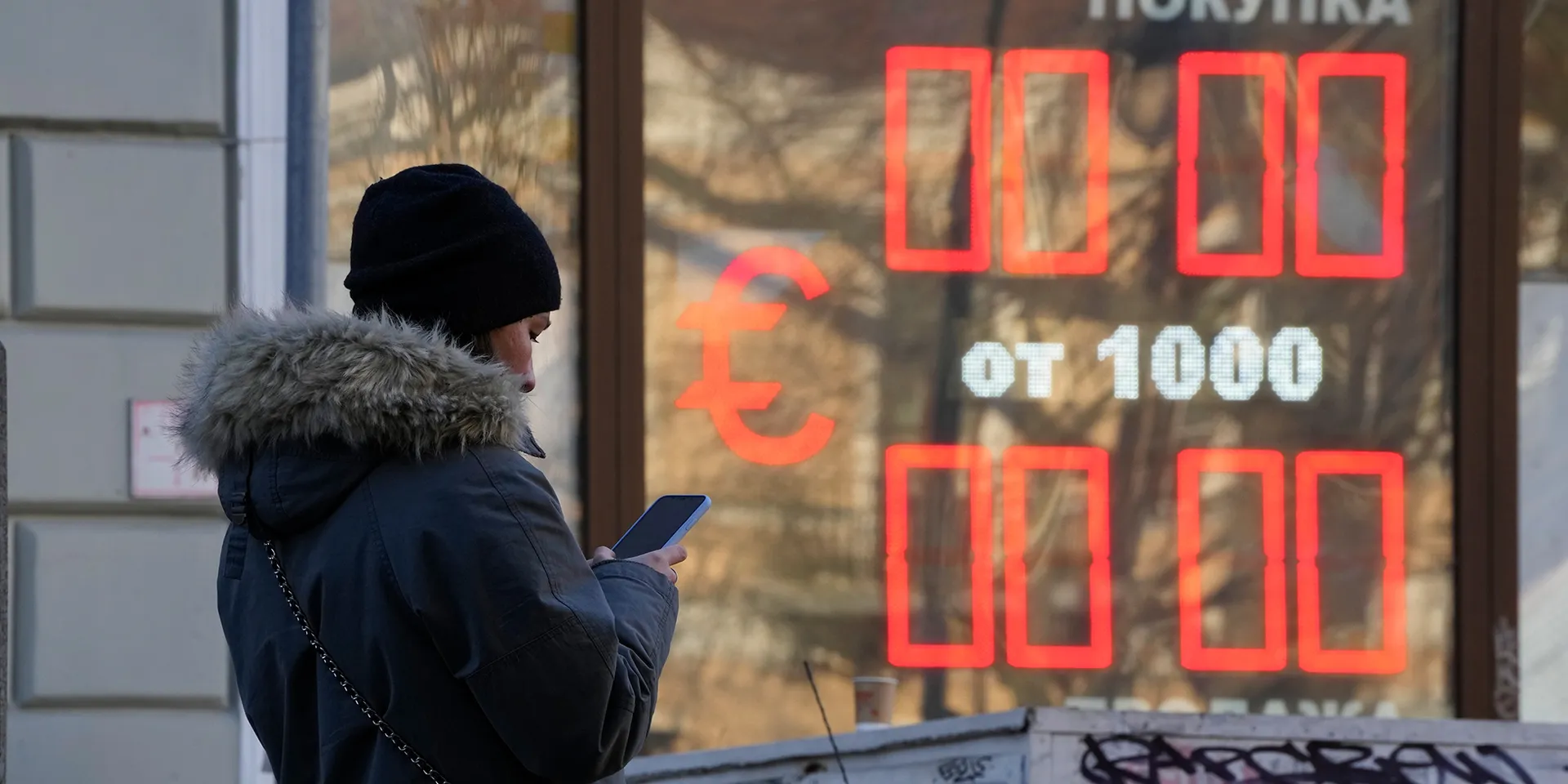 Photo: AP / Scanpix / LETA
What happened to the ruble exchange rate
The Russian currency is already more expensive not only than before the war, but also than before the pandemic. What happens to the course and does this course mean anything?
It seems to be complete nonsense: war, sanctions, Europe is seriously discussing the abandonment of Russian oil, and the ruble is getting stronger. The dollar exchange rate on the Moscow Exchange is about 63 rubles (the last time this happened was in February 2020), the euro is about 66 (and this is generally the level of 2017). Politicians present this as proof that the country has coped with the sanctions. This is, of course, not true. The ruble exchange rate is now artificial.
The ruble is reminiscent of the heroine of a Russian folk tale, whom the harmful king ordered to appear to him neither naked nor clothed, neither on horseback nor on foot, neither with a gift nor without a gift. So is the ruble exchange rate: it is both market and not market; You can use it to buy currency, but there is little you can do with it; there is one for cash currency and another for non-cash currency.
Why is the ruble strengthening?
It's simple. The exchange rate is determined by the relationship between supply and demand: someone buys currency, someone sells; if there are more buyers, the ruble falls, if there are sellers, it rises. Who are these buyers and sellers?
First of all, importers and exporters. To buy, for example, an iPhone or a German machine, they must be paid for in dollars or euros, and the importer must buy this currency. And the oil company sells oil for foreign currency, but produces it in Russia, where its expenses are in rubles (taxes, salaries, etc.) - so it sells part of this currency. Russia's exports have always been higher than imports (last year - $550 and $379 billion, respectively), but the ruble fell more often than it rose (before the 1998 default, the dollar was worth 6 rubles, now it is 10 times more).
This is because of another group of market participants who buy and sell currencies not for trading, but in order to earn or save money. If a foreign investor wants to invest in Russia, it will definitely not be rubles, but currency. Either he will give it to the company (as a loan or as capital), and convert that part into rubles (how else to work in Russia?), or he will sell it himself and invest the received rubles. When the time comes to receive income from these investments or return them, everything will be the other way around: the investor does not need rubles, he will convert them into foreign currency. Here, by the way, it doesn’t matter what kind of investor he is: a “real” investor (who invests specifically in business) or a “speculator” (in securities or other instruments). Russia is promising - there is an influx of investment, foreign currency sales are growing; The future of Russia is gloomy - the opposite is true: demand for currency is growing.
Subscribe to the “Important Stories” newsletter The newsletter will not be blocked, but reading it is not prohibitedThe Russians themselves act in a similar way, and this is the third important group of currency sellers and buyers. In developing countries, which include Russia, foreign currency is an important savings tool. Both for ordinary citizens, who transfer part of their savings into foreign currency, and for wealthy people - few of the Russians who made serious money did not withdraw part of it abroad (in foreign currency, of course).
And finally, the Central Bank balances the market: when there are too many sellers, it can enter the market and buy currency so that the ruble does not strengthen too much, and when there are too many buyers, on the contrary, it can sell currency from reserves (a bias in either direction can be harmful for the economy).
Now let's see what the war has changed. The Central Bank has left the market: its reserves in dollars and euros are frozen - neither sold nor bought. As he left, he slammed the door loudly: numerous restrictions were introduced on the purchase of currency and on its withdrawal from the country, which provided currency sellers with a huge advantage over buyers.
Here are the main measures:
On February 28, a presidential decree obliged exporters to sell 80% of foreign currency earnings within three days;
On March 2, the Central Bank prohibited Russians from exporting more than $10,000 in cash currency, crediting currency to their accounts in foreign banks, transferring money without opening an account through foreign payment systems (such as Western Union), lending foreign currency in foreign currency (a popular scheme for withdrawing currency), and without special permission buying securities and real estate from citizens and companies from countries that have imposed sanctions against Russia. Foreigners from countries that imposed sanctions against Russia were prohibited from withdrawing money (even to their foreign accounts) and transferring more than $5,000 per month abroad without opening an account;
On March 3, brokers, at the request of the Central Bank, introduced a draconian commission for the purchase of currency on the exchange. By the way, such currency purchases are no longer exotic: last year the Central Bank discovered that Russians buy more currency on the stock exchange than in banks. About a million people do this every month;
On March 5, another presidential decree effectively prohibited Russian companies from returning foreign currency loans to foreign creditors. This money now needs to be transferred in rubles to special accounts, the rules for which are established by the Central Bank and the Ministry of Finance;
Finally, the Central Bank introduced a temporary procedure for transactions with cash currency for six months: from March 9 to September 9, Russians are allowed to withdraw no more than $10,000 from their account - and only the money that was already in the account before March 9 (if you have accounts in several banks, then you can withdraw $10,000 from each, but if several accounts are in one bank, then the $10,000 limit applies to all accounts combined). And banks were prohibited from selling cash currency to the population.
“The currency was locked in Russia. Therefore, the exchange rate is determined by trade flows,” Natalia Orlova, chief economist at Alfa Bank, explained to VPost. Exports, as already mentioned, we have always had more imports, but now the gap between them is greater than ever. Due to sanctions, exports in barrels, cubic meters and tons decreased, but due to the jump in prices, revenue almost did not fall, but imports collapsed. This year a record gap is possible - $145 billion, said Central Bank Chairman Elvira Nabiullina.
This is how it turned out that the dollar and euro in Russia found themselves in free fall.

How far will the ruble strengthen?
Nobody knows this. If you don’t change anything, the exchange rate can fall to any level: 60, 50 rubles per dollar, or less. In a normal situation, too much strengthening of the ruble increases the demand for currency: imported goods become cheaper, they are bought more, imports grow, the population and investors also invest in the depreciated currency in the hope of growth. This brings the rate back to a more reasonable level over time. But these mechanisms do not work in our country now.
Only unscrewing the nuts can balance the situation. They have already been slightly unscrewed: the prohibitive 12 percent commission on the purchase of currency on the exchange has been abolished; non-commodity exporters were allowed to sell foreign exchange earnings within two months, and not three days, as was the case; the population, albeit with restrictions, was allowed to buy cash currency. The latest indulgence: people were allowed to transfer abroad five times more currency, until September 30 this is $50,000 per month. So far it doesn't help much.
What else could be done? The most obvious measure is to extend the deadline for selling export proceeds for raw materials (read: oil and gas) companies to the same 60 days. But this will not fundamentally change anything and will only extend sales over time: the dollar and euro may even jump in celebration, but then the ruble will continue to strengthen, perhaps a little more slowly. It is possible to lower the standard for the sale of foreign currency earnings, but this will not help much: even in calm times, exporters sold most of the earnings, because their expenses are in rubles. Previously, this was compensated by mirror purchases of currency by the Central Bank for the Ministry of Finance under the so-called budget rule (the funds went to the National Welfare Fund), but it had to be canceled, and now the Central Bank proceeds from the fact that the rule will return in 2025.
“At some point, too strong a ruble will become a problem. First of all, for exporters, whose revenue will decrease in terms of rubles, and for the federal budget: it is also set in rubles, and plus or minus a third of income is from raw materials, and they are naturally tied to the dollar exchange rate.”
What else? Allowing foreigners to withdraw money is impossible either politically (our reserves are frozen) or economically: first the stock market will collapse, and then the ruble. Foreigners will sell almost all the securities they have and buy foreign currency with this money. And they only have federal loan bonds worth three trillion rubles.
The Central Bank, by the way, has spoken out on this matter. For him, the main thing is the stability of the ruble (this is its main function according to the law on the Central Bank) and the financial system. But by the stability of the ruble, as Nabiullina has explained more than once, we do not mean its exchange rate against the dollar or some other currency, but inflation (in a sense, this is the exchange rate of the ruble against the consumer basket). And as for the rest... “The decision to relax capital flow control measures is made on the basis of an analysis of risks to financial stability, and not the dynamics of the ruble exchange rate,” says the regulator’s commentary , which is called: “On the formation of the ruble exchange rate in the new conditions.”
At some point, too strong a ruble will become a problem. First of all, for exporters, whose revenue will decrease in terms of rubles, and for the federal budget: it is also set up in rubles, and plus or minus a third of income is from raw materials, and they are naturally tied to the dollar exchange rate. In April, oil and gas budget revenues turned out to be 133 billion rubles less than expected, the Ministry of Finance reported . This shortfall is partly explained by the high exchange rate of the ruble.
Is the course fake?
However, can we even call this a course? And how many courses are there now?
For example, the Trade Association for the Emerging Markets (EMTA) recently recommended using WM/Refinitiv data instead of the Moscow Exchange to determine the ruble exchange rate from June 6. The “internal” and “external” ruble exchange rates began to diverge in March - then the gap between them was tens of rubles, but now it does not exceed two rubles. Here is a graph of this difference - since the end of April it has been small, and the rate is higher both on the Moscow Exchange and abroad.
In Russia there is another ruble exchange rate - to cash currency. It is in short supply, its withdrawal from accounts and purchases at bank cash desks are limited, and the export of dollar and euro banknotes to Russia is prohibited - sanctions. Therefore, cash currency is more expensive than non-cash currency. It’s hard to say how much: the market is unorganized. An acquaintance of an editorial employee said that in April he sold cash currency at a rate that was seven to eight rubles higher than the exchange rate. Since then the situation has not changed.
It turns out that the rate is “half market”. It is still determined by supply and demand - only they are artificially limited. It is very different from the value of cash currency - the kind that can be hidden “under the mattress” - but these rates are related. At this rate, each of us can buy dollars and euros using quotes from our bank (through its mobile application) or on the stock exchange (through a broker’s application), but the ability to further manage them is very limited. In general, as in the joke from Soviet times: “Tell me, do I have the right? - You have. - So can I? - No".
So what should we do now?
Is it worth buying dollars or euros in the expectation that the currency of Russia, which has entered into a confrontation with half of the world and, according to the official forecast , expects the economy to fall by about 10%, will sooner or later weaken? Theoretically, the answer is obvious: of course, yes. But practically... No one now knows how the situation will develop (for example, what will happen with the embargo on Russian oil) and what other steps our authorities will take: whether they will gradually lift restrictions or, on the contrary, they will have to introduce new ones. Will you be able to withdraw the purchased currency, transfer it to another bank or abroad, or simply sell it if it rises in price?
“A week ago, The Wall Street Journal, one of the most authoritative business publications, published a column proposing nothing less than the withdrawal of hundred-dollar bills from circulation—Russians should finally feel the pain of sanctions.”
The memory of the “dashing 90s” has not yet been forgotten, when one of the best and certainly the most popular means of savings was the cash dollar. But there is no crystal ball, and who knows what surprises await us? It is not only our authorities who are capable of taking original steps. Who, leaving Russia in early March, could imagine the cessation of Visa and Mastercard operations abroad? A week ago, The Wall Street Journal, one of the most authoritative business publications, published a column with a proposal to no less than withdraw hundred-dollar bills from circulation - Russians should finally feel the pain of sanctions. This is just an expert's opinion, which is unlikely to come true (after all, it's not just the Russians and drug lords who have $100 bills), but it shows the direction in which the work is going.
Professor at the University of Chicago and the Higher School of Economics Konstantin Sonin advises converting savings into foreign currency: “Buy dollars or euros and store them in a reliable bank, or even better - in a safe deposit box, where the state will not be so easy to look into. If you have to buy currency on the black market, it’s still better than keeping your savings in rubles.”
But again: looking into the cell may not be so easy, but not impossible (by the way, renting it costs money) - now you can expect any trick. If so, then perhaps it’s worth following the old principle of “don’t put all your eggs in one basket” and dividing your savings into parts.
A ruble stash on which you can live for a while (at least a month or two). For this, a savings account is best suited, from which you can withdraw money without losing interest; If you don’t have one, then it’s better to open it as soon as possible: rates in rubles are falling quickly.
Cash currency is in a safe place. Preferably different ones, at least dollars and euros. Their rates to each other also change: most recently the euro was 10% more expensive than the dollar, but now they are almost equal.
The currency in the account can also be useful. For example, for transfers or as an opportunity to save part of your savings in case of restrictions on cash currency. But cash currency is still preferable: depositing it into an account (and thereby turning it into non-cash currency) is much easier than withdrawing it.
“Most likely, the ruble will remain strong for some time and then weaken. You can try to take advantage of this, but this is a risky game,” Sofia Donets, chief economist for Russia and the CIS at Renaissance Capital, told VPost. — The market lives by rules that can change every day. And dollar investments may turn out to be ruble ones, and the bank may convert them at a non-market rate.”