
Translated material
Own audio model of the universe
The pioneer of electronic music Wangelis died. This is how he spoke with the Cosmos - and far from only in the soundtrack to the "Runner on the blade"
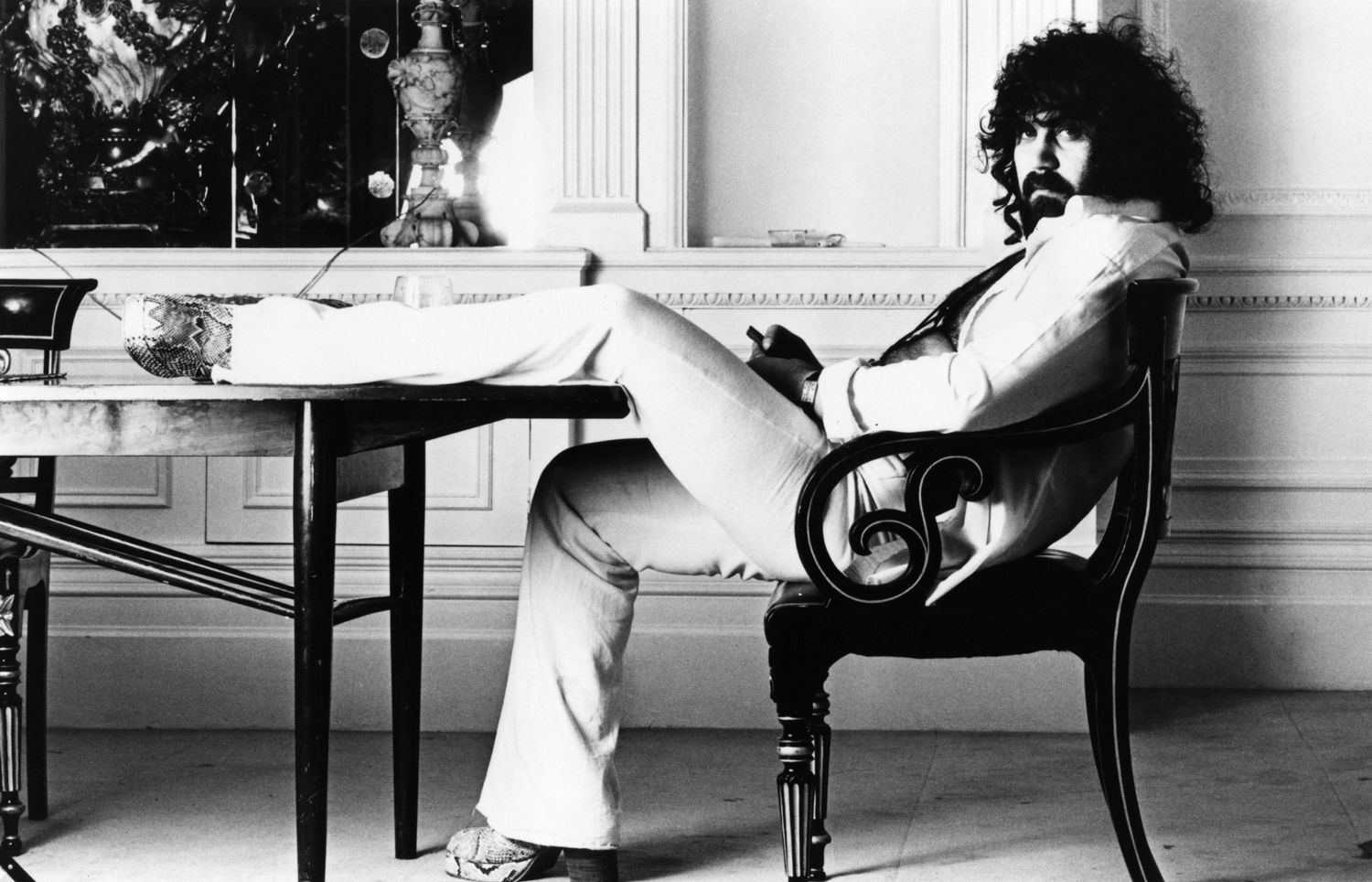
Electronic music pioneer, Greek composer Vangelis died on May 17 at the 80th year of his life. At the request of Medusa, the musical critic Denis Boyarinov recalls the experimenter’s path: from the APHRODITEQIA CHILD group with Demis Roussos (their album “666” is considered the classic progressive-rock) to the soundtracks to scientific and fiction films and musical initiations in the XXI century.
The famous Wangelis made music to the cinema. First of all, I recall the “Running Blade” - both the futuristic noir Ridley Scott, and his soundtrack, piercing the listener with an ice needle, is now deservedly considered exemplary, despite the fact that he liked few people immediately after the premiere.
The sad synthesis visions of the future, presented by the Greek composer, accepted warmer than the film itself, but also did not care. Neither the film, nor the music for it received nominations for the Oscar-the tape was noted only for special effects, and the disk with the sound path to the “Running Blade” was released only ten years after the premiere, and even then not in the full version-it appeared only on the 25th anniversary of the film. However, without Vangelis’s music, giving sharpness, gloomy and sensuality of the 2019 neono-Swear Los Angeles, this professional cinema would not have become a cult.
The Oscar, Vangelis, was already at the time of the release of the “Running Blade”: for the music for the film “Fiery Chariots” , which few people will remember now-the story of the runners representing the UK at the 1924 Olympic Games. The main theme of the film, which proclaims the triumph in every consonance, was so at the target that it still sounds at sports events, as well as a buried, in the joint track of the Jay-Z-Z and Kanye Illest Motherfucker Alive .
Another film by Ridley Scott - about the discovery of America to Columbus - “1492: the conquest of Paradise”, who drowned in collective memory, also did not do without the pompous overture of Wangelis , who was dispersed to quotes and survived the picture itself. If you know the music of Wangelis only by soundtracks, then it may seem that he is a master of intelligible epic, in which sentimental synthesizer roulades are served with a sweeping symphonic accompaniment.
This is absolutely true, but Vangelis knew how to and much more.
Greek Evangelos Odyssias Papafanasiu became noticeable as a composer a decade before how he got to the American film industry. In 1968, a 25-year-old self-taught musician who played in Athens Rock and Roll, fled from the dictatorship of the Black Colonels first in London, where he was not accepted, and then to Paris. The APHRODITEY Child group founded by him in France, in which Demis Russos was the vocalist, achieved considerable success in Europe immediately after the first single - “Rain and Tears” , in the text of which was the monologue of the replicant Roy from the finale “Running Blade”.
APHRODITEQIA CHILD participants were drawn in different directions: DEMIS RUSSOS sought hits and eventually came to the tour of the ex-pranks of the USSR with the From Souvenirs to Souvenirs' hits, Vangelis was interested in complex music and intricate concepts. In the very beginning of the 1970s, the experimenting keyboard player came up with a double album "666", created with references to the revelation of John the Theologian. The idea was ambitious-one of the most surreal texts of the Holy Scripture found art-rok psychedelic embodiment. Estetes accepted the plate with a bang - even Salvador Dali dreamed of arranging an incredible action under it (in which elephants and hippos were to fall into the audience).
However, sales of the album were low, the recording company was unhappy, and the author himself decided that it should be even more radical. So, having separated from Aphroditeʼs Child, he recorded an album-collage about France of 1968 Fais Que Rêve Soit Plus Long Que La Nuit, embraced by student protests. This record, at the junction of documentary journalism, Musique Concrète and impressionism, first denotes a creative line, which Vangelis will adhere throughout his career: it turned out to be somewhere on the border between popular and intellectual music, attracting praise and reproaches on both sides.
In the 1970s, starting to sign with the usual name, Vangelis began to master synthesizer electronics-and went down in history as one of its pioneers, fanatically passionate about the inexhaustible capabilities of electronic sound.
Composing music, the composer was more reliable on intuition and improvisation. Over the years, he developed a technique resembling an automatic letter . It consisted in the moment of insight “connect” to a certain cloud of musical ideas - and capture one of them, even unconsciously. “If my composition lasts 6 minutes 30 seconds, then, as a rule, it was so much time to create it,” Vangelis told about his method in one of the rare interviews .
Working on the soundtracks, he preferred to rely on the first impression of the image and avoided reading the script. At the same time, one successful double, which turned into a composition, was preceded by countless tests: almost every day Vangelis spent in the studio, recording and leaving his works. “For me, creating music is the same natural and instinctive process as breathing,” he said.
Confessing such an extremely artistic approach, the Greek composer nevertheless referred to the creation of music systemically and strictly as one of the types of scientific activity. He inherited from Pythagoras and Plato the idea that music is regulated by the same laws that the physical world and the universe as a whole; The antique image of music as Losevsky "sounding number." In his albums, Vangelis tried to identify this connection, capturing the "music of the universe." He represented himself as a kind of transmitter capturing it-this metaphor was visualized on the cover of his classic Spiral album, where an audio player sticks out of the clouds, as if connected to the stratosphere.
#/media/File:Vangelis_Spiral.jpg)
In life, he behaved like a stereotypical scientist, completely immersed in his own research: he looked unsociable and unsociable, avoided interviews, preferring to lock himself in the studio. At the same time, close friends knew him as a man who loved to eat, drink, smoke cigars and joke-hedonist with the manners of an eccentric rock star. The leader and vocalist of YES John Anderson, who recorded several sophisticated electronic art-pop-albums in a duet with the composer, laughed with a laugh that during their acquaintance, Vangelis was dressed in an embroidered caftan and armed from which he let the arrow from time to time. On the amazed gaze of the British rocker, his future partner replied: "I'm a Greek!"
In the soundtracks, Vangelis presented a master of a bright, laconic motive, thanks to the orchestration of a deployed anthem-somewhere between the abandonment of a commercial opera letter and Mediterranean, lush symphony in the spirit of Ottorino Respiga. But in solo albums, he was fascinated by completely different: if you look for analogies in “serious” music, on the surface-a comparison with the futuristic sonorous finds of his senior contemporary and compatriot Janis Ksenakis, the largest avant-garde composer, a radical innovator, in whose artistic method music, architecture, mathematics and computer technologies fused.
Using his branded pulses, rhythmic combinations and electronic timbres, Vangelis literally made astrophysical processes audible. He created his own audio model of the universe - and tried to penetrate the secret of her creation with the help of sound recording. Vanjelis’s electronic plays were much more accessible than that of Xenakis, so they often fell into scientific and educational television programs, becoming the musical symbols of a fantastic future for the mass viewer.
Since the late 1970s, his albums have been waiting for commercial success. At the same time, the composer did not follow the tastes of the audience and requests of record companies: Vangelis composed what had occurred to him. Therefore, its discography is vast, diverse and there are surprises in it, such as, for example, abstract experimental work “Beaubourg” and “Invisible Connection” , or the sacred Grail of Vangelisomanov-the “The Tegos Tapes” cycle, recorded in the 1990s as a soundtrack for a video course for a video course on Microsurgery. Nine hours of the esoteric emboss, which would ideally fit for astrophysicist lessons (or astrology), were never officially published, but enthusiasts found original cassettes, digested, cleansed, and posted on the Internet.
The secrets of space attracted Vangelis throughout life. Closer to her finale, he even focused on this topic: all his major studio work in the 21st century, with the exception of soundtracks, were dedicated to the stage space projects: Vangelis composed a vocal-symphonic epic on the NASA expedition to Mars ( Mythodea ) and dedicated the plate of life and the death of an automatic inter-planning station Rosetta, launched in 2004, explore comets ( Rosetta ).
His last album, published in the 2021th Juno to Jupiter, was inspired by the ancient Greek myths and the flight of the Juno space probe to Jupiter: in it the composer weaved his recognizable synthesizer cascades, thoroughly written out parties of orchestral instruments, soprano of the opera diva of the Andgela Georgiu and Records of electromagnetic signals of astronomical bodies and commands of the flight control center. In this record you can find echoes of all the music created by him in half a century - from piano and synthesizer to symphonic and choral.
In 2018, Vangelis wrote Elegy to the death of the great researcher of the secrets of the universe and popularizer of science Stephen Hawking. It sounded at a farewell ceremony with a British scientist organized by a European space agency, and with the help of a radio signal was sent somewhere to the interstellar space: towards black holes, the research of which he became famous.
Under the sad-light music of Vangelis, the Hawking’s computer voice said the last message to people: “One of the greatest discoveries of the cosmic era was the idea of mankind about themselves. When we see the earth from space, we see ourselves as a whole; We see unity, not a difference. Here is a simple image with a convincing message: one planet is one human race. We are here together, and we need to live together, showing tolerance and respect. We must become citizens of the world. ”
It seems that, before going on a final journey into space, the researcher and popularizer of electronic music Vangelis would say goodbye to humanity in the same way.
Denis Boyarinov