
Translated material
Day of the day: Mikhail Sholokhov
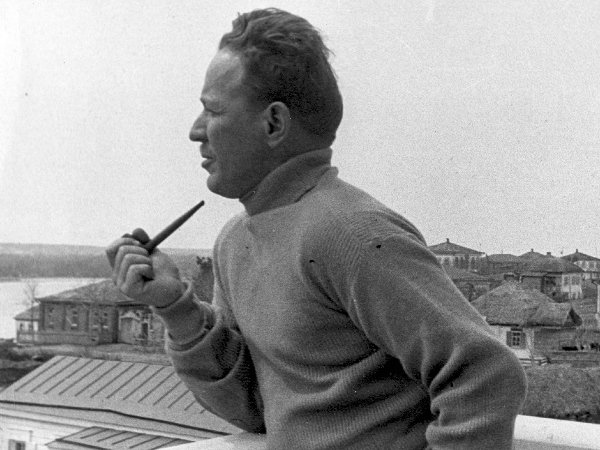
On May 24, 1905, writer Mikhail Sholokhov, Nobel Prize in Literature, was born
Personal business
Mikhail Aleksandrovich Sholokhov (1905-1984) was born on the Kruzhilin farm of the Donetsk district of the Donskoy army (now the farm Kruzhilinsky Sholokhovsky district of the Rostov region). Contrary to the widespread opinion, his father did not belong to the Cossacks: Alexander Mikhailovich was a livestock buyer, sowed bread on a purchased Cossack land, served as a clerk in a commercial enterprise of a farm, managing a steam mill. Mother Anastasia Danilovna Chernikova (Chernyak) was a Cossack on her mother. She was forcibly married to the landowner Popova, who served, for the son of the Stanichnaya Ataman Kuznetsov, but then left her wife and went to Alexander Sholokhov. Michael was born illegitimate and was recorded in the name of the official husband of the mother. Only after the death of the official husband in 1912, the boy’s parents were able to marry, and Mikhail received the surname Sholokhov.
Education began to receive at home, in 1914 he studied in Moscow in the preparatory class of the male gymnasium. From 1915 to 1918 he went to the gymnasium of the city of the Boguchara Voronezh province. He quit his studies before the city was busy with German troops.
In 1920, the family moved to the village of Karginskaya, where the father received the post of head of the procurement office, and Mikhail became the clerk of the Stanichnaya Revolutionary Committee. Graduated from tax courses and received the position of food inspector in the village of Bukanovskaya; Participated in the surplus.
On August 31, 1922, during the work of the Stanichnaya Taxpassor, Sholokhov was arrested and sentenced to death. Father gave him a large money security deposit and took it to the bail to the trial home. Parents brought a new metric to the court, and he was released as a minor (in a new metric, age decreased by two and a half years). It was not difficult to believe that he was a minor, since Mikhail was small in stature and looked like a boy. The execution was replaced by the year of correctional labor in the colony for minors; The guy was sent to Bolshevo near Moscow.
In Moscow, Sholokhov tried to continue his education, and also tried his strength in writing. However, it was not possible to enter the preparatory courses of the rabfak due to the lack of work experience and direction from the Komsomol. He switched to self -education, participated in the work of the literary group "Young Guard", attended the training sessions that Viktor Shklovsky, Osip Brik and Nikolai Aseev attended.
The literary debut took place in September 1923: signed “Mich. Sholokh ”in the Komsomol newspaper“ Youth Pravda ”(now“ Moscow Komsomolets ”), the“ Test ”feuilleton was printed.
In December 1923, Sholokhov got up to Lydia Gromoslavskaya - one of the daughters of the former Stanichnaya Ataman Peter Yakovlevich Gromoslavsky, but he gave up his eldest daughter Maria.
In December 1924, the story “Mole” was released in the newspaper “Young Leninets”, which opened the cycle of the Don stories: “Shepherd”, “Ilyukha”, “Foal”, “Lateral Steppe”, “Family Man”, “Mortal Enemy”, “Two -Judgment”, and others.
Sholokhov brought world fame the novel “Quiet Don” about the fate of the Don Cossacks. The first two volumes were released in 1928, the third saw the light in 1932, the fourth in 1940. A significant place in the novel is reserved for the White Cossacks, and its main character Grigory Melekhov at the end of the story does not “come to the Reds”. This caused the complaints of communist criticism; However, the novel was read by Stalin and approved by him to print.
The second significant work of Sholokhov was the novel “Raised virgins”, dedicated to collectivization in the Don and the movement of “25 thousands”. In 1958, Boris Pasternak was nominated for the Nobel Prize for Literature. The country was visited by a delegation of the Union of Writers of the USSR. The Secretary of the Board of the Writers' Union Georgy Markov said, “that among the highest circles of the“ Swedish> Academy there is a certain opinion in favor of Pasternak ”, which would be necessary to contrast the publication of the materials“ On the international popularity of Sholokhov, about its wide fame in the Scandinavian countries ”(spelling preserved).
Despite all the efforts of Soviet figures in 1958, Boris Pasternak was awarded the Nobel Prize in literature. Under the threat of deprivation of citizenship and expulsion from the USSR, the writer was forced to abandon the prize.
As a result, Sholokhov received the Nobel Prize in literature in 1965 "For the artistic power and integrity of the epic about the Don Cossacks at a turning point for Russia."
In 1966, Sholokhov spoke at the XXIII Congress of the CPSU and spoke hard against Sinyavsky and Daniel. In 1973, he signed an open letter from a group of Soviet writers as a editorial office of the newspaper Pravda in connection with “anti -Soviet actions and speeches by A. I. Solzhenitsyn and A. D. Sakharov”.
Since the 1960s, he actually moved away from literature. He died of laryngeal cancer on February 21, 1984. He was buried in the village of Veshenskaya on the shores of the Don in the courtyard of his house.
What is famous
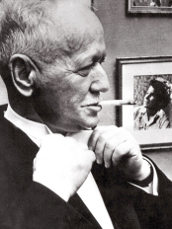 Before presenting the Nobel Prize. Photo by Leon Mazrukho. Source: www.sholokhov.ru
The Soviet writer, Laureate of the Nobel Prize in Literature, the Stalin Prize of the first degree for the novel “Quiet Don”, Lenin Prize for the novel “Raised virgin”. Twice Hero of Socialist Labor (1967, 1980), awarded six Orders of Lenin, many other awards.
What you need to know about
The problem of authorship of texts published under the name Sholokhov rose back in the 1920s, when the “Quiet Don” was first published. Critics doubted that the young author could create such a grandiose work. The counterargument - that the novel was written by Sholokhov not at the age of 20, but was written for almost fifteen years. The author spent a lot of time in the archives.
In 1929, at the direction of Stalin, a commission was formed that confirmed Sholokhov's authorship on the basis of the manuscripts of the novel provided by him. Then the manuscript was lost and was discovered only in 1999. In the 1970s, the Norwegian Slavist and Mathematician Gayr Hirets conducted a computer analysis of the indisputable texts of Sholokhov and the “Quiet Don” and came to the conclusion about Sholokhov’s authorship. A significant argument was also that the novel’s action takes place in their relatives for Sholokhov, and many heroes of the book have their prototypes of people whom Sholokhov personally knew.
In 1999, after many years of searching for the Institute of World Literature. A. M. Gorky of the Russian Academy of Sciences managed to find the manuscripts of the 1st and 2nd books of the Quiet Don considered lost. Three examinations were conducted: graphological, textological and identification, which certified the authenticity of the manuscript, its belonging to their time. Supporters of Sholokhov’s authorship found their position unconditionally proven. In 2006, a facsimile edition of the manuscript was released
However, a number of supporters of the version of plagiarism remained in their opinion. It boils down to the fact that Sholokhov found the manuscript of an unknown white Cossack and processed it.
Direct speech
About my arrest: “I led a steep line, and the time was cool; I commissar very well, we were convicted by the Revil Bunal for the excess of power ... I waited for death for two days ... And then they came and released ... "
About why, upon receipt of the Nobel Prize, he did not bow to the Swedish King Gustav Adolf VI, who handed it to the Swedish king: “We, Cossacks, do not bow to anyone. Here in front of the people - please, but I will not be in front of the king and that's it ... "
About the trial of Sinyavsky and Daniel: “You have these fellows with a black conscience in the commemorative 20 years, when they tried not relying on strictly delimited articles of the Criminal Code, but guided by revolutionary legal awareness ... Oh, the wrong punishment would have received these werewolves! And here, you see, they still talk about the severity of the sentence! I would also like to turn to the foreign defenders of the pasquilants: do not worry, expensive, for the safety of our criticism. We support and develop criticism, it sounds acutely at our current congress. But slander is not criticism, but dirt from a puddle is not paints from the artist's palette! ”
8 facts about Mikhail Sholokhov
- Sholokhov is the only Soviet writer who received the Nobel Prize with the consent of the USSR leadership.
- According to the protocol, at the presentation of the Nobel Prize, Mikhail Sholokhov was supposed to be in a tailcoat. 3 thousand American dollars were allocated to the acquisition of a tailcoat and equipment of the faces of Sholokhov.
- 2005 was declared UNESCO the year of Sholokhov
- Sholokhov’s name was assigned to the Moscow State Humanitarian University
- The monument to Sholokhov is erected on Gogolovsky Boulevard - the writer sits in a boat surrounded by floating horses
- “Quiet Don” was filmed four times; Films were also shot on the “Fate of Man”, “Raised virgin” and “Nahanka”.
- The name of Sholokhov was named Street in Moscow, Avenue in Rostov-on-Don, streets in Veshenskaya, Alma-Ate, Aksai, Boguchara, Dnepropetrovsk.
- One of the varieties of lilac was called "Mikhail Sholokhov."
Materials about Mikhail Sholokhov
Biography of Mikhail Sholokhov
"To remember." Mikhail Sholokhov
Article about Mikhail Sholokhov on Wikipedia