
Translated material
The most complete map of looters. Mediazona traced how the military sent 58 tons of parcels from the border with Ukraine in three months (and one Orlan)
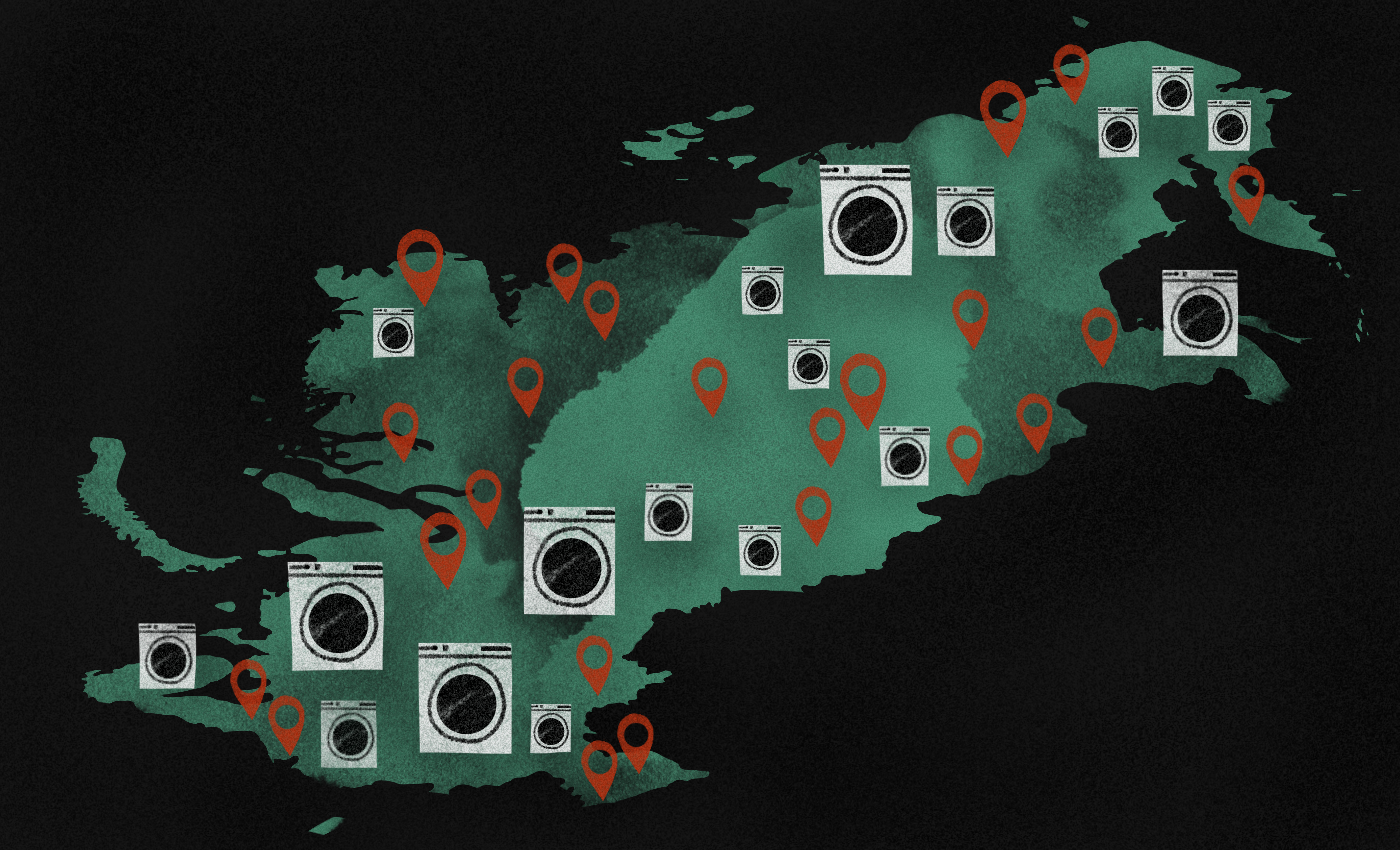
After the story with the mass sending of parcels from the Belarusian Mozyr, Mediazon continued to monitor how the Russian military use the services of SDEK. Our monitoring fell on the border of Ukraine with Russia and Belarus. We discovered not only an abnormal one, which coincided with the outbreak of war, but also unusual connections between cities, confirming the version of general looting. And in one case, the Russian military used SDEC to transport a military drone - and, possibly, robbed not only Ukrainians, but also their own army.
In April, blogger Anton Moloko published a video with the Russian military, which send parcels with equipment and things through the SDEC department in Belarusian Mozyr.
Then the Mediazona compiled a card of departments from the mozyr and found another item where the influx of people in uniform was observed - in Novozybkov, the Bryansk region.
After this publication, Mediazona expanded the list of cities for monitoring. All the border points of the SDEK fell into it. We drew up a new card of departments, recorded and analyzed several dozen hours of video from the border point in Valuyki.
The interactive map below shows the volume of goods sent to different cities of Russia.
You can bring the card with a mouse wheel or two fingers on mobile devices. Turn - by holding the right mouse button or using the slider on mobile devices.
How did we get data
SDEK allows customers to track departures, so by order of the order number the company's website shows a detailed route from the reception point to the issue point. This is impersonal information - the Service does not report any data from the sender and issues only the initials of the recipient. Although the weight of the parcel on the site is not displayed, it is visible in the page code.
The largest order we discovered weighed 381 kilograms, he was sent from the border to the suburbs of Yekaterinburg.
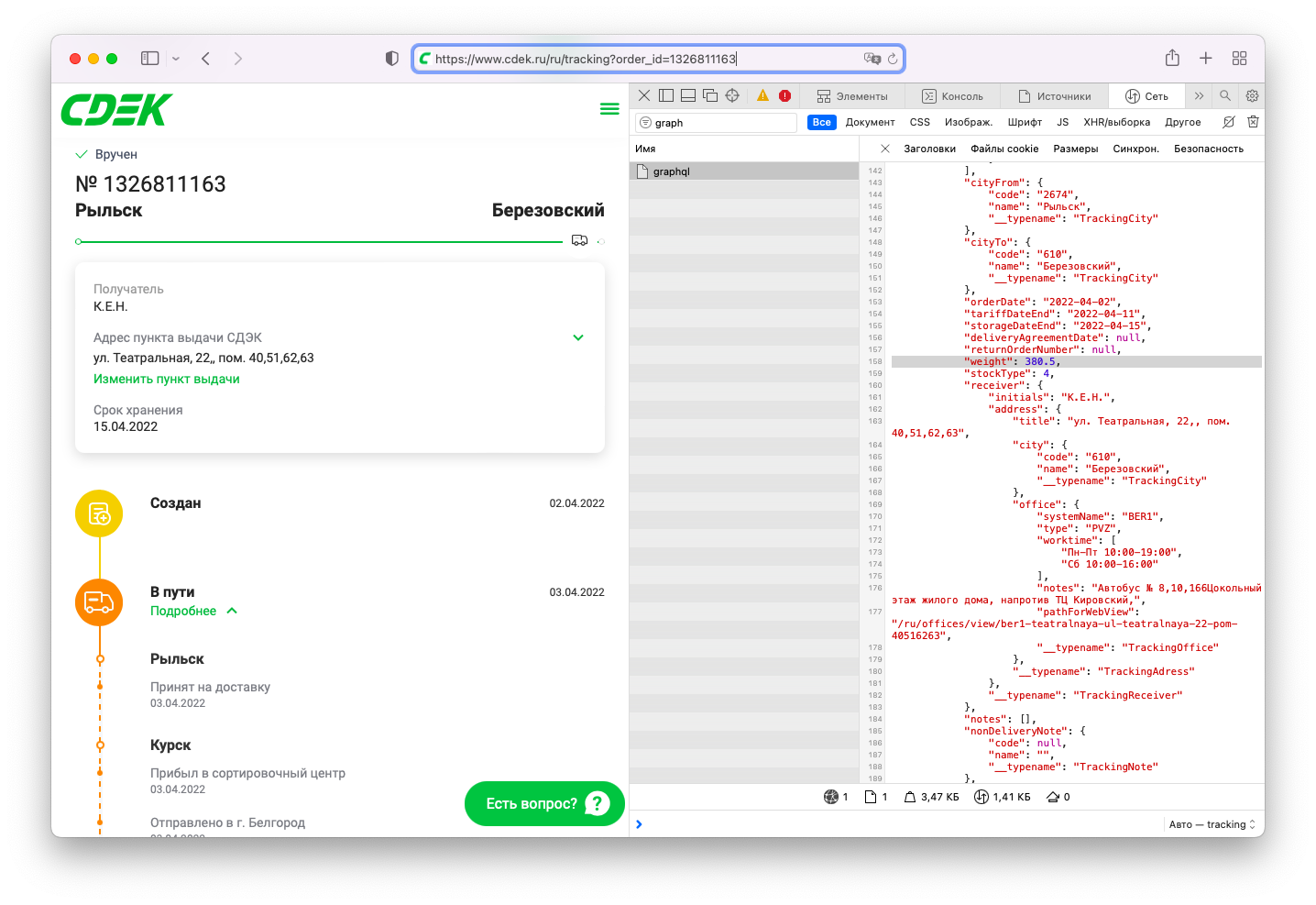
Order from Rylsk weighing 381 kilograms. Screenshot: Mediazone
SDEK assigns an individual number after registration of departure in a single system. The numbering goes in order: the first number receives the first number in line from any department of the SDEC.
Order issuance of numbers is confirmed by the total number of orders. On his website, SDEK writes that it processes about 300 thousand departments per day. If you sort out the numbers and monitor the change in the date of sending, then you can accurately determine the first and last orders sent.
Sortering the rooms in order, we collected about all SDEK departments since February 21, 2022. The share of numbers is 1.75%.
In our calculations, we take into account only orders that at the time of data collection were accepted for sending. That is, orders with status are excluded from the general calculation of the weight of the parcels.
How we were looking for suspicious parcels
We chose 46 SDEC departments in the settlements of Belarus, Russia and Crimea closest to the border with Ukraine. In order to track the chains of parcels, there were cases when more than two orders were sent from these border departments in one day to the same place. So we made a list of 60 suspicious. We did not specifically consider parcels to Moscow and St. Petersburg because of the too large flow of departures to these cities from any branches. We also excluded the parcels within the border regions and Crimea from the search.
As a result, suspicious parcels were found at 13 border points of the SDEK: in Armyansk and Dzhankoy in the Crimea, in the Pokrovsky Rostov region, in the Boguchara and Rossoshi of the Voronezh region, in Valoiki of the Belgorod Region, in Zheleznogorsk and Rylsk, in Klimovo, Klintsy, Novozybkovo and Useche of the Bryansk region and in Belarusian Mozyre.
If you look from Ukraine, then Valuyki is the Kharkov direction, Klintsy, Novozybkov and Mozyr-Kiev-Chernigovskoye, Rylsk-Sumy, and Dzhanka and Armenian-Kherson-Melitopolskoye.
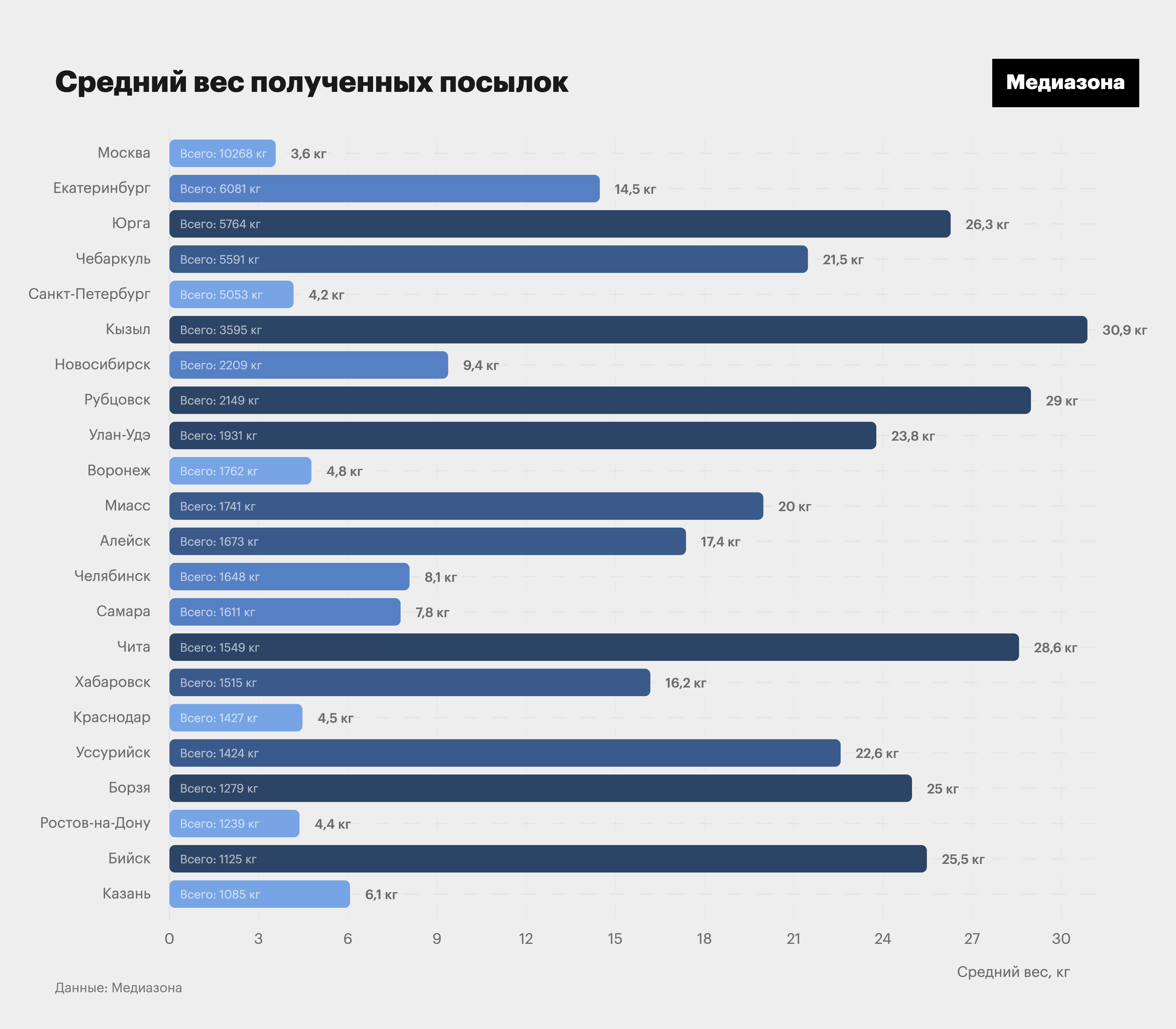
You can clearly distinguish an ordinary destination from the suspicious by the middle weight of the parcel. The schedule below shows all the cities that from the end of February received more than a ton of parcels from these border points in total. They are sorted, and Moscow takes the first place. But the average weight of the Moscow parcel is small, that is, a lot is sent to the capital. But immediately the sensational Rubtsovsk is noticeable, which received more than two tons of parcels from the border. Their average weight is eight times higher than Moscow. In the same way, Yurga, Chebarkul, Miass and other cities, which received many tons of parcels, are distinguished.
Who sent the suspicious
On March 29, the Ukrainian authorities reported on the withdrawal of some Russian troops from the Kiev region. On April 7, the Pentagon confirmed that the Russian army completely left the northern regions of Ukraine.
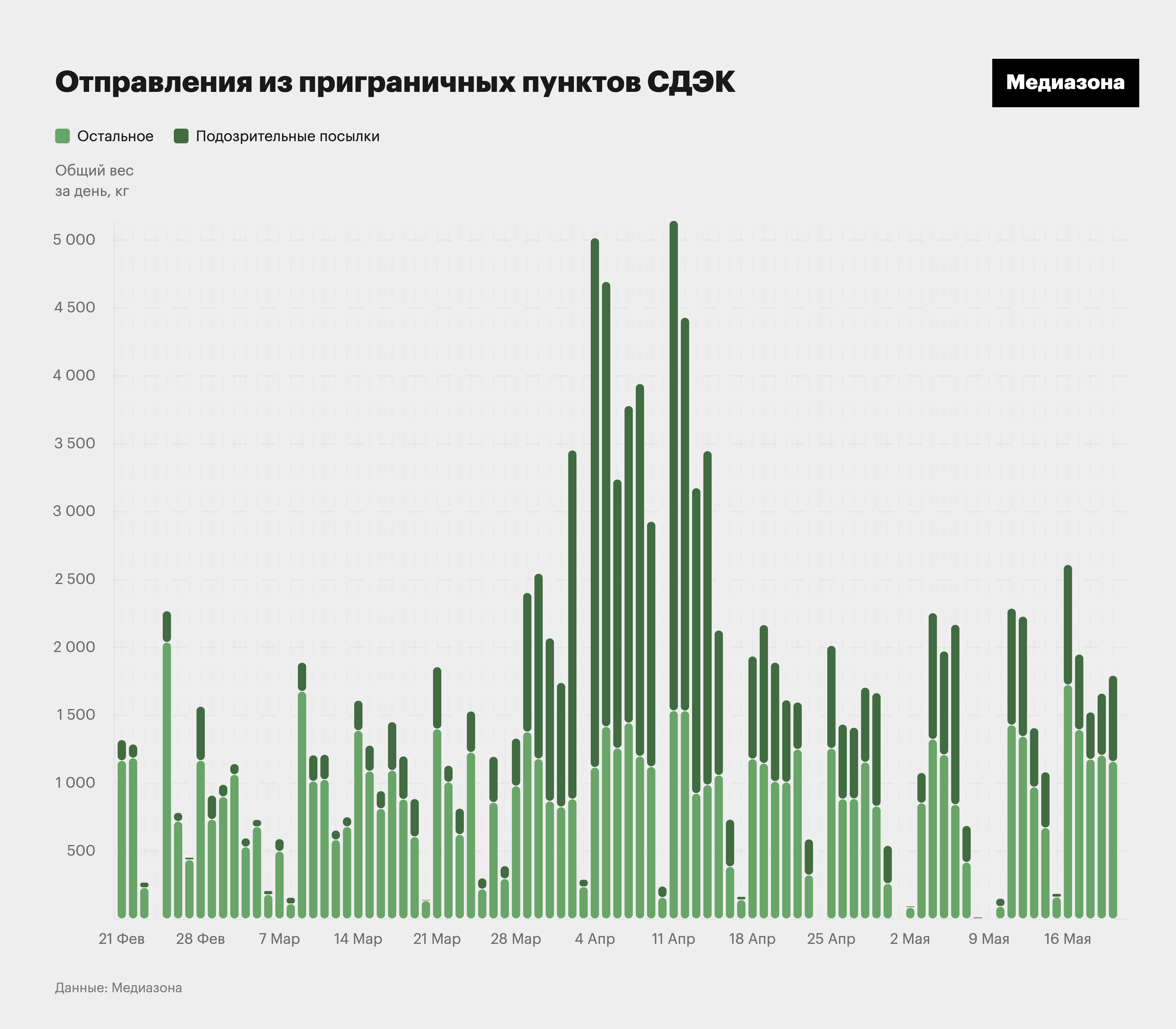
Simultaneously with the conclusion, the volume of suspicious orders from the border cities gradually increased. If on March 26 there were 338 kilograms, then on March 29 the weight exceeded a ton, and on April 2 exceeded 2.5 tons.
The peak of this kind of premises came on April 4 - almost. After a short decline, exactly a week later the weight of suspicious orders again merged to three tons, after which the decrease began.
According to the mediazone, more than 15 tons of suspicious goods were sent from the city from February 21 to May 21 to May 21 to February 21. The city is located 30 kilometers from the border with Ukraine and 20 kilometers from the self -proclaimed LPR.
From the city 60 kilometers from the Ukrainian border, more time was sent for the same period of time.
From the already famous, the tons of suspicious goods were sent.
On the Belarusian Mozyr, in which the military was originally noticed. Next follow, and.
Counter check
To prove that such large volumes of premises are not a sign of stable social ties between border and Siberian cities, we checked how many parcels went in the opposite direction. About 5.8 tons of parcels came from the border to Yurga, back - only 51 kilograms. Chebarkul, where more than 5.5 tons were sent, sent less than 10 kilograms to the border in all three months. Not a single parcel was sent from to the border.
Such a counter-check works even for the largest million-plus cities. Yekaterinburg received six tons from the border, but sent a little more than 2.5 tons back. Novosibirsk received 2.2 tons, and sent a little less than 1.5 tons.
The SDEK website has a calculator that allows you to calculate the cost of delivery depending on the route, the weight of the parcel and tariff. Delivery of cargo by basically 120x120x80 cm and weighing up to 200 kg from Mozyr to Rubtsovsk costs 12,325 rubles. According to the “Parse” tariff, a small load up to 12 kg (33x34x26 cm) from Mozyr to Rubtsovsk will be delivered for only 907 rubles. But the delivery of 200 kg from Rylsk to YurGU will cost 21 thousand rubles.
The victorious cities
For the period from February 21 to May 20, the most goods from border cities were sent to Moscow and Yekaterinburg - and, accordingly. There were enough orders to Petersburg.
The leader among the “suspicious” cities was Yurga, the city in the north-west of the Kemerovo region. From the border of Ukraine, it went to the city, where only 80 thousand people live.
In Yurga there are three large military units: the 106th separate brigade of material and technical support, the 74th separate guards motorized rifle-shooter Zvenigorod-Berlin Order of Suvorov Brigade and the 120th artillery brigade.
After the withdrawal of Russian troops from the Kiev region, an adviser to the head of the office of the President of Ukraine, Alexei Armorovich, published a list of units standing in Buch, Gostole and Irpen; Among them was the 74th motorized rifle brigade from Yurga. In the early days of the war, it became known about the priest of this unit. According to Mediazons, at least 27 soldiers from this city died in hostilities.
The second place in went to the city of Chebarkul in the Chelyabinsk region. Two tank regiments are deployed there: 6th and 239th. In March, it became known about the death of the commander of the 6th tank regiment of Colonel Alexander Zakharov. According to Mediazons, 27 military from this city died in Ukraine.
In Kyzyl, the capital of the Tyu, they sent 116 suspicious parcels with a total mass. The 55th separate motorized rifle brigade is deployed in Kyzyl. "Mediazone" is known about 11 dead from this city.
Among other suspicious cities, one can distinguish, in the Chelyabinsk region, and others.
In Rubtsovsk, who became the leader in the sending of goods (two -thirds of which did not reach the addressees) from the mozyr on April 1 and 2, during the observations it took a relatively few parcels: 74 departure weighing about about.
Infographics below shows the connections between lecture cities and recipients. Recycling cities are grouped by regions and highlighted in color.
The wider the line, the more cargo was sent. When clicking on the “Launch” button, the infographic will show how the shipment of goods was distributed from February 24 to May 20.
Clicking or spit can be distinguished by the sender or recipient to see detailed information, from below you can choose a specific city.
How "Orlan" became prey
Many points of issuing SDEK orders are conducted around round -the -clock observation. Paying attention to the abnormal number of shipments from the shafts, the Mediazone recorded what was happening there since April 20. Every day, people in uniform entered the point of delivery, wrapped military backpacks in film and left at the checkout. In most cases, it was impossible to find out what the military was sent.
On April 29 at 17:18, the officer, judging by the epaulettes, was entered at the SDEK point. He pulled a heavy box along the floor. Two employees of SDEK went out to see what this time brought people in uniform. The military opened the container: in it lay a drone similar to the "Orlan."
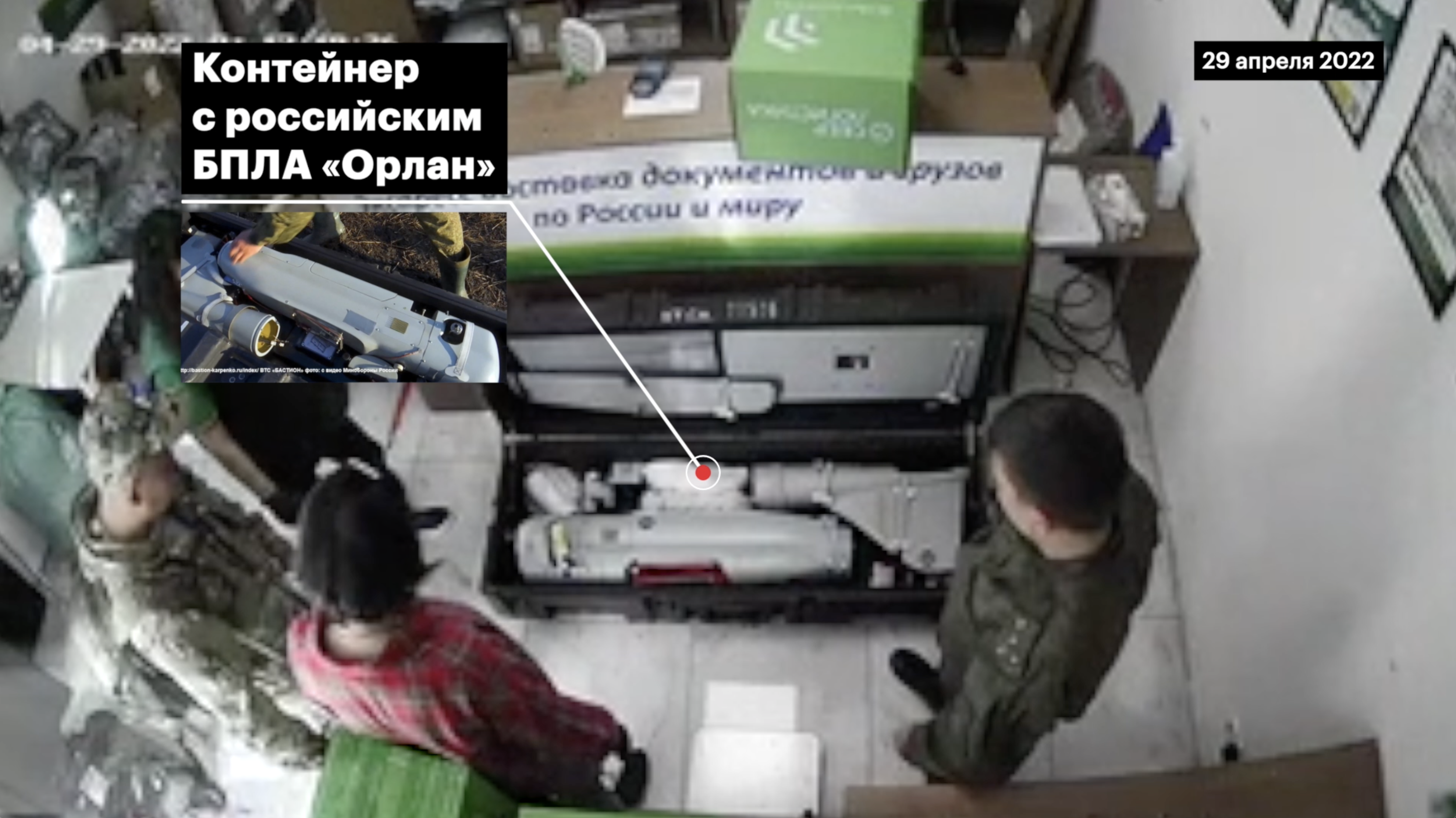
SDEK item in Valuyki April 29. Screenshot: Mediazone
After a short dispute - as far as you can judge by active gestures - women have gone to place an order. The drone was weighed and measured by a tape measure. At this time, other visitors freely entered the office. After five minutes, the captain, along with the other military, was taking the box into the office of the office.
UPLP "Orlan-10" is used by the Armed Forces of the Russian Federation in Ukraine to support convoys, detect goals and adjust fire. On May 17, the Ministry of Defense laid out shots using UAVs in the “shock version” with bombs on board. According to the Pentagon, the price of drone, along with ground equipment, can be from 87 to 120 thousand US dollars.
The Mediazone failed to track the receipt of the "eagle" at the destination. On this day, orders were more heavier from the bells of baulus to Bataisk, Berdsk, Vyborg, Zelenogorsk, Kyzyl, Moscow, Murmansk, Novosibirsk, Ulan-Ude, Ussuriysk and Khabarovsk. On video stamps from departments in these cities, parcels with similar dimensions did not appear.
In addition to sending Orelna, Mediazona, she noticed at the SDAK point in Valuyk people in military uniforms who sent sneakers, tires, microphone, TV, sausage and canned food, a guitar, a tent and much more. You can familiarize yourself with the selected moments in the video below.
At the time of publication of the article, the SDEC did not respond to the request "Mediazons".
All parcels from all border points of the SDEC are collected in this file.
Editor: Dmitry Treshchin