
Translated material
In just a week, the situation in the Donbass has changed dramatically. Russia is advancing in three directions and can surround 10 thousand Ukrainian military
We analyze in detail how this could happen - and what Kyiv plans to answer
Having abandoned the ambitious and impossible plans and concentrated forces, Russian troops in the Donbass seized the initiative. After several breakthroughs of Ukrainian defense, they try to surround a large group in Severodonetsk. Its supply depends on literally one (well -shot) road. The Ukrainian army is forced to decide whether to give the territory - or to risk "a repetition of Mariupol."
In this text, the editorial office is trying to evaluate the combat situation in Ukraine on the basis of available data. "Medusa" consistently opposes the war.
The Russian army two months after the official beginning of the battle for the Donbass reached the first significant results in this general battle of the war. After multiple failures in different directions of the forces of self -proclaimed LPR and the DPR, mercenaries from the Wagner PMC and the official troops of the Russian Federation were able to break through the defense of Popasnaya in the Luhansk region. They went to the rear of a large - about 10 thousand people - the Ukrainian group in Severodonetsk and Lisichansk (these two cities, in each of which about 100 thousand people live, are divided by the Seversky Donets river).
The defense of the Ukrainian army here has already broken up into several centers, and only one small road connects the whole group with the “large land”. The Ukrainians were on the verge of the encirclement - even larger than it was in Mariupol.
There are several Russian breakthroughs in the Donbass at once. Ukraine may lose a number of important cities. The troops of the Russian Federation went to Slavyansk
Problems for the Ukrainian command are aggravated by the fact that Severodonetsk is not the only (albeit the most dangerous) Russian breakthrough in the Donbass. At the same time, Russian troops, capturing the city of Liman , came out of the east to Slavyansk, where the main Ukrainian forces are located. Slavyansk is of important ideological importance for both sides: from the moment when the city was captured in 2014 by Igor Strelkov’s detachment, many count the beginning of the “Russian Spring”.
In addition, Ukrainian troops, under the threat of the environment, left Svetlodarsk, and the Russian units, having passed through this city, are approaching another important center of Ukrainian defense - Bakhmut. If the Ukrainian army does not manage to block all these offenses and restore the administration of the troops, it may suffer a major defeat at the current stage of the general battle and lose a large number of troops.
Now more
- Popasnaya was taken by Russian troops and mercenaries from Wagner PMC by May 8. A few days later, large reinforcements were transferred to the city, including parts of the Pskov Airborne Forces (they previously fought west of Kyiv, and then they were seen at the Izuyum bridgehead - that is, much north of Popasnaya). These reinforcements attacked the remnants of the 24th Ukrainian mechanized brigade, knocked out of the Popasnaya and suffered heavy losses. The transfer of detachments from the Lviv Teroborne was not able to stop the Russian breakthrough to the aid of the brigade.
- From the Popasnaya, the Russian troops, taking advantage of the departure of the Ukrainian units, began an offensive in diverging directions: to the northeast (to the Kamyshevakhi area) in order to surround parts of the 17th Panzer Brigade of the Armed Forces in the Gorsky and Golden region (it protects approaches to Lisichansk from the south); to the north-west in order to block the main supply line on the Bakhmut-Soledar-Lisichansk highway; and southwest against the Ukrainian group in Svetlodarsk.
- All three offenses developed, from the point of view of the Russian military, successfully. Russian troops took part of Kamyshevakhi, which created a threat to Gorsky's environment. The highway from Bakhmut was cut near Soledar; It is not known exactly whether the Russian units came to the road itself, but traveling along it is definitely impossible due to artillery fire (the journey along the highway looks like this ). Finally, the Ukrainian troops had to leave Svetlodarsk, and the advancing Russian units advanced to the outskirts of Bakhmut. This city is the most important logistics center of the entire APU group in the Donbass. Its fall may stop the supply of troops in Lisichansk and Severodonetsk.
- After the loss of control over the road near Soledar, the Ukrainian group in Lisichansk and Severodonetsk (numbering four brigades plus several separate parts - the same 10 thousand people already mentioned) is supplied along the only remaining road Bakhmut - Seversk.
- Probably, according to the Russian plan, this road to the current stage of the operation should have already passed under the control of the Russian troops. For this, a blow was planned from the north with the forcing of the Seversky Donets River on a wide front from Seversk to Lisichansk. However, all attempts to bring the crossing ended with disaster for Russian troops. Combat groups, crossing the right bank of the Seversky Donets, were defeated by Ukrainian artillery and reinforcements transferred to the crossings.
- Now the Russian command is trying to cut the road to Seversk with a blow from the south. Before it, Russian troops operating in the Nagornaya area remained to go about 13 kilometers. Geography favors this offensive: Russian troops now occupy a hill over Seversky. In addition, Ukrainian troops are forced to defend two fronts here: they need to take into account that Russian troops may try to cross the Seversky Donets again from the north.
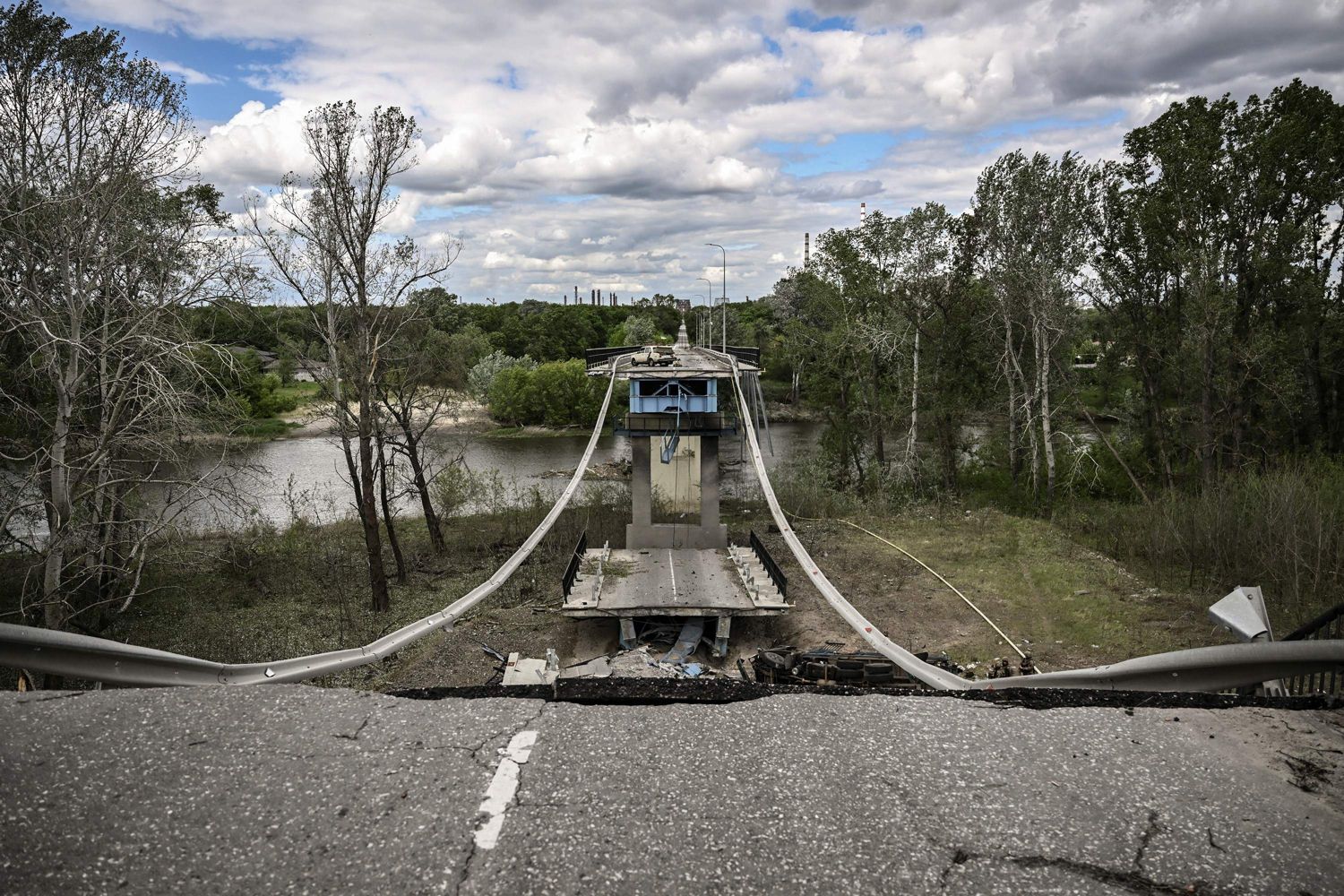
- The situation in Severodonetsk and Lisichansk continues to deteriorate. Severodonetsk (temporary Ukrainian capital of the Luhansk region and a large industrial center) is located on the left bank of the Seversky Donets; The only remaining bridge over the river between Severodonetsk and Lisichansky after Russian artillery shelling looks like a sieve - which obviously complicates the supply of troops. The troops in Lisichansk have their own problems: they should remember the danger of breaking through the Russian troops from the south - from Gorsky and Toshkovka (already occupied by Russian forces).
- It is not clear whether the troops are still capable of in Lisichansk and especially in Severodonetsk for an organized retreat through Seversk: the throughput of the remaining rear road is small, it is under artillery shelling from the other side of the Seversky Donets. It is likely that an organized departure is no longer possible, and therefore the only affordable defense option, which at least theoretically allow the Ukrainian command to avoid disaster, is the transfer of reserves to Soledar, Bakhmut and Seversk in order to avoid the surroundings of troops in Lisichansk and Severodonetsk.
- The problem is that this direction is not the only thing on which it is necessary to restrain the Russian offensive. To the south of the Russian troops, who seized Svetlodarsk, they directly threaten Bakhmut, and north they occupied the estuary, which defended the 79th landing-nursing brigade, and now (theoretically) they can try to force the Seversky Donets and attack the headquarters of the entire Donbass Ukrainian group in Slavyansk and Kramatorsk.
- As a result, Ukrainian reserves are stretched along the front of several hundred kilometers. The Ukrainian command in this region has no initiative anywhere - even in the Kharkov area, where in April and early May it took an offensive towards the border with Russia, and now reflects Russian counterattacks. It is possible to say reliably about the plans of the Ukrainian group only that she is trying to collect reserves in the Bakhmut area (but it is also unclear why - to protect the city or for a counterattack near Popasnaya).
How do we all know this?
From the video and photos that eyewitnesses of battles publish on social networks. This makes it possible to objectively record at least part of the events of any modern conflict. We applied a significant part of the main “documentary evidence” of the war on the map.
Is it possible to say that the defeat of Ukraine in the Donbass is predetermined?
Not at all necessary.
The Russian army also has big problems, it also has losses. It is impossible to carry out an offensive with ambitious goals (for example, the simultaneous environment of the entire Ukrainian army in the east of the country). Local successes are achieved due to the weakening of other sections of the front: for example, in order to achieve success under the Popasnaya, the Russian command had to actually dismantle the shock group south of Izum (it was from here that Pskov paratroopers went to the Popasny).
There are also supply problems: although the troops near Popasnaya and Bakhmut (unlike troops in raisins) rely on supply from the friendly and relatively safe territory of the DPR and LPR, this does not mean that fuel, ammunition and allowance can be easily and unlimited to be delivered to the forefront. So, several columns of supply and advanced warehouses near Popasnaya have already become victims of Ukrainian artillery.
In addition, the Russian army probably lacks transport to supply a large group. Probably, frequent stops of the offensive are connected with this: for so, in recent days, Russian troops could not advance either in Kamyshevakha or at the Bakhmut - Soledar - Lisichansk highway.
What can Ukraine count on?
Now - by the fact that by entering reserves it will be possible to stop the Russian operation in the environment or to allocate troops from Lisichansk and Severodonetsk with minimal losses. In general, the fact that the struggle will accept the uniforms for exhaustion, in which Ukraine has important trump cards: internal mobilization and all increasing supply of weapons from the West (primarily from the United States).
The calculation here is simple:
- Even the defeat of Ukrainian troops near Severodonetsk will not mean defeat in the war.
- The plan of the Russian command, apparently, lies in consistent offenses in different directions, which should collapse the Ukrainian front in parts; This strategy requires operational pauses for the transfer of troops to a new direction, the creation of logistics for their supply, etc. While the Russian army spends resources and time for these offensive, the Ukrainian command will try to create new formations that can go on the offensive a few months later.
However, this plan does not guarantee victory to Kyiv. Firstly, the weapon set by the West has not yet been able to fundamentally change the balance of forces: it is not enough. It is not the fact that this will make it even a sharp increase in volumes (according to the American Law on Lend-Lis ).
Now the Ukrainian command, together with Western partners, is looking for a solution to the main problem - the numerical advantage of Russian artillery, which allowed to make a breakthrough near Popasnaya and occupy the estuary. Until now, there has been a hope that the transfer of Western production howitzers to the front (which have an advantage in the effective range of fire over most of the Russian systems) would level the gap in the number of trunks. It was believed that long -range howitzers (and controlled shells) will be able to help the Ukrainian troops suppress Russian artillery - but this has not yet happened.
The situation theoretically can turnthe supply of the MLRS/Himars volley system, capable of hitting targets at ranges up to 100 and even up to 300 kilometers (depending on ammunition). In combination with Western intelligence and target designations, they can defeat Russian artillery and disorganize management and supply. But here the quantity is important: units of even perfect systems (despite the fact that the Russian army has analogues), the Ukrainian army will not win the war. To go on the offensive, she needs hundreds of tanks and artillery systems, hundreds of thousands of units of modern ammunition - and, of course, aviation.
Meanwhile, the Russian command is trying to immediately make up for a lag behind Ukrainian at the pace of mobilization: it seems that new units from “volunteers” and reservists from unrecognized republics of Donbass are created. They will probably receive outdated weapons (for example, in Melitopol a train with T-62 tanks is noticed , which Russia has successfully used in Syria in recent years to strengthen the Bashar Assad army). At the same time, in Russia, obviously, preparations for a larger mobilization began: it is planned to create more than ten new formations until the end of 2022 - and thereby respond to Ukrainian mobilization.
Department "Parsing"