
Translated material
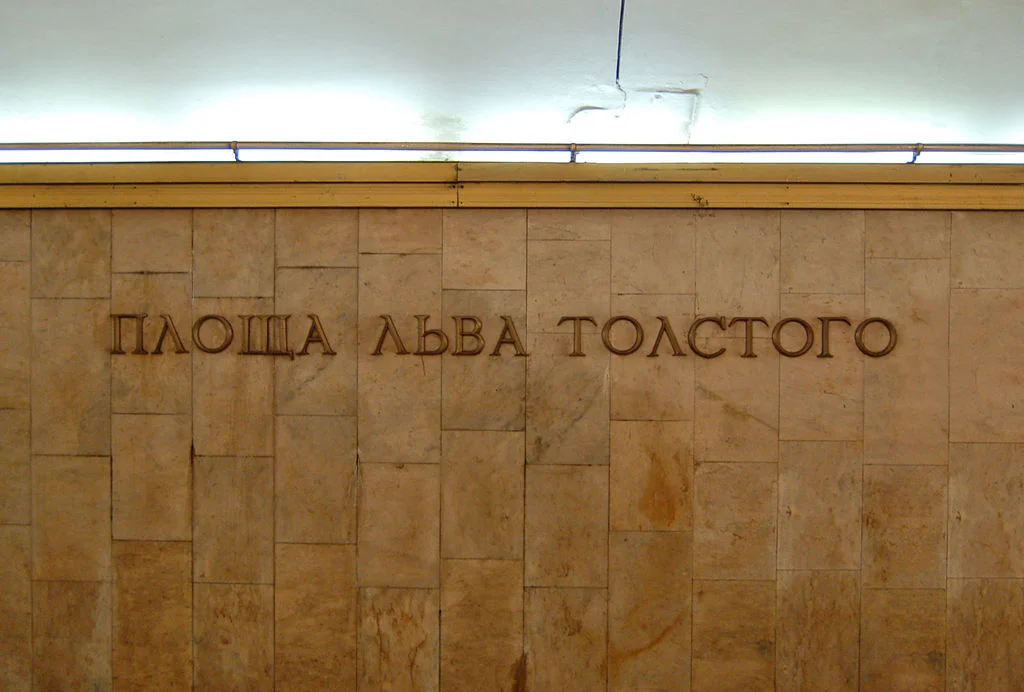
Tolstoy Square
Does the Great Russian Culture share responsibility for the Pskov paratroopers?
From the editorial office
The discussion about how the catastrophic and shameful war of the Russian Federation against Ukraine was possible was especially acute in the first weeks after February 24. Many talked about how the soldiers who seemed to read our classics at school, who learned to the “little man”, went to kill civilians in Buch. And is there a special imperial trace of the Russian culture itself, as if its internally inherent colonia, "imperiality". Now Kanseling is becoming a Rutina Russian culture: it is difficult to admire Chekhov when a Russian cruise missile flies into you. The understanding of the cultural causes of the war will take time, and it is important not so much for citizens of Ukraine, but primarily for those Russians who do not want to “repeat”. We publish the text of Ukrainian journalist Yuri Makarov about the connection of Leo Tolstoy and military violence. The editors may not agree with some estimates of the author, but believes that it is important to continue this discussion.
In Kyiv, there are hot disputes about the change of the name of one of the central squares - the Square of Leo Tolstoy, as well as the same adjacent street and metro station. As for the renaming itself, almost a consensus, now in general, all Russian is renamed, argue mostly in honor of whom to name. The most original proposal: "Steven King." In addition to horror films, he wrote an outstanding “Escape from the Showson” (by the way, the paraphrase of the Tolstoye “Caucasian captive”) and from the first days of the war for Ukraine.
The Ukrainian spontaneous impulse of Cancel Culture is no obscurantism, no matter what Loznitsa and Shenderovich say, this is a manifestation of adequacy in the fact of a cultural clash. The soldiers of the Russian army, perhaps, did not read Tolstoy, but they explained to them that they bring the light of truth to the Busurmans, and carry it on behalf of Tolstoy, Pushkin and Tchaikovsky. Such a dialectic. Is Tolstoy to blame? The one who wrote: “The fountain was puzzled, obviously on purpose, so that the water could not be taken from it. The mosque was also piled up, and the mullah with mutualms cleared it. The old people gathered in the square and, squatting, discussed their position. Nobody spoke about hatred of the Russians. The feeling that all Chechens experienced from small to great was stronger than hatred. It was not hatred, but the non -recognition of these Russian dogs and such disgust, dulweight and bewilderment to the absurd cruelty of these creatures that the desire for their extermination, as a desire for the extermination of rats, poisonous spiders and wolves, was as natural as a sense of self -preservation. ” You probably read this text many times. Today, do not deign to doubt that Lev Nikolayevich would be attracted under the article by the Criminal Code of the Russian Federation 207.3 “Public distribution of knowingly false information about the use of the Armed Forces of the Russian Federation”. And yet.
Tolstoy is one of the most anti -war writers, despite the abundance of battle scenes in his books. He can not answer in any way that the descendants of a non-euma (including one straight one) lifted him to the shield with inappropriate intentions. Or after all? .. It hurts me very much. I spent most of my long life with the “war and the world”, “Anna Karenina”, as with the “Copper Horseman”, “Noble Nest”, “Karamazov brothers”, they are part of me. But now, out of habit, it is not possible to remove your favorite pages from the shelf ... unthinkable, painful, impossible. Perhaps he will still let go. If I have time. But right now, I want to get all the reminders. Nothing, I suppose Standal and Faulkner will remain, and our own, Ukrainian, still inattentively read.
So I hear: to refuse Tolstoy? Yes, you are there and there are real Nazis! Here, I feel, I will have to explain if anyone is ready to listen.
Ukraine is not the country where something is prohibited, even right now. In bookstores, like libraries, all Russian classics are present without seizure, published both in Russia and with us.
In cable networks - Soviet and Russian cinema, except perhaps the latest. Cinemas, sorry, do not work. In theaters, of course, the Russian repertoire wilted, it would be strange. Well, the Internet to help, the .ru domain, of course, was blocked, but on that is, VPN. In general, spiritual thirst is completely subject to thickening in a private manner, but only ... it’s not even about the fact that we are killed by the name of Tolstoy, and try to distract from this when the explosives in the quarter in the neighborhood arrive. But the fact is that Russian culture, when you fall to it, and in particular literature, and specifically Tolstoy in this situation speak especially unbearably instructively. They teach, they preach. So here it is not a subtle impulse to spit on the pedestal, but unwillingness to listen to moral lessons.
Tolstoy is to the impossibility of ideological. Instead of just loving, he teaches to love. So appreciating and with such an enthusiasm, describing the moments of sudden understanding as insight (like Pierre and Natasha, when Levin and Anna, or guessing with the letters with Kiti), he himself fundamentally refuses to understand anyone. And he only ascribes to others his own fanaberia, which he respects very much. For example, about the initial transcendence of the soul, supposedly characteristic of a man, although in reality he is just at the subsidiary of the consciousness. This phenomenon, as of the second half of the 19th century, is quite an anomaly, a delay in development, and for it - an object of admiration. Fucking.
Turgenev writes to Annenkov: “Here is a man! With excellent legs, he certainly wants to walk on his head. " But Turgenev with his “notes of the hunter” is good, having two thousand serf souls. Ferry and Kalinch, you know! All of them, starting with Pushkin, admired the people, praised him, then called for something to do something for the people, but they themselves managed not to make a trait. One Tolstoy began, it was, a useful business - an Yasnaya Polyan school. As a child, I read his edifying stories, I think he was a good teacher, but for a short while he was enough. The school existed for three years, and then the teacher was distracted - he was leaving for Germany to get acquainted with advanced experience, then to heal the weak lungs on Koumiss. In the end, he abandoned and surrendered to the Scripture of War and Peace. Thank you, of course.
In Russia, in 1917, according to various estimates, either 27, or 56 percent, in itself, in itself, the scatter itself says a lot. So why shouldn't they burn the estate?!
Here you listen to Count Lev Nikolayevich: "By introducing literacy on the environment, we had to contribute to, help the people express his inner essence, say their word, and we had to listen to this word, and not bring anything to our people." Well, it is true, to make a fig, because he is a God -bearer, as well as a carrier of transcendence. It was weak to give him the land, but please listen. So these two faces, like Janus, existed in Russian culture until this day. The adopted culture of the slaves of slave owners and the infernal culture of slaves. There were intermediate forms. Say, the “socialist realism” of the first half of the twentieth century or the literature of the “rusticians” of the second half - in many ways of the second -person exercise of Janus, which was pretended to be the first.
The cult of the great Russian people after 1917 was somewhat modified, but it was the appearance of it: the division into the highest caste - the proletariat, the inhabitants of the working settlement, the same carriers of communal consciousness, only slightly emancipated; The second in privilege - peasants, the virgin in their primitiveness serfs (except those who tried to keep up with time, become masters and subjects, they simply physically cleaned); Well, the third estate - employees and the intelligentsia attributed to them, officially not entirely full, except for the nomenclature, of course.
The people were taught to read-write, they were provided with some social elevators, but in general they continued to fool around,
And if they tried to instill something beautiful-hearted (a man-man friend, comrade and brother, proletarian internationalism, etc.), then it is so hypocritical that the contradiction with the prose of life gave stably the same result that the decalogue gave in the previous centuries. Well, today there is no need to pretend, there is a “blasphemy” and AUE, the moral code of the builder of totalitarianism.
There will be another quote, also well -known, excuse me. “I think that the Russian people are exclusively - just as exclusively as the Englishman, a sense of humor - is characterized by a sense of special cruelty, cold -blooded and, as it were, experiencing human patience to pain, as if studying the tenacity, stamina of life. In Russian cruelty, there is a devilish sophistication, it has something thin, refined. This property can hardly be explained by the words psychosis, sadism, words, which, in essence, do not explain anything at all. (...) If the facts of cruelty were an expression of perverted psychology of units, one could not talk about them, in this case they were the material of a psychiatrist, and not the householder. But I mean only collective fun of human torment. (...) Dressing the captured officer of the Donag, pulled off his pieces of leather, in the form of shoulder straps, and nails drove in the place of stars; Ripped the skin along the lines of porn and stripes - this operation was called "dress in shape." She undoubtedly required a lot of time and great art. (...) But - where - finally - that good -natured, thoughtful Russian peasant, the indefatigable seeker of truth and justice, about which Russian literature of the 19th century told the world so convincingly and beautifully? In my youth, I intensively searched for such a person in the villages of Russia and did not find him. ” M. Gorky. About the Russian peasantry. Berlin, 1922.
The individual behavior of immigrants from the underworld is that in the revolution, that in the Second World War, that in subsequent wars, up to the Ukrainian, did not change in any way. As the skin was pulled into the civilian and drove nails into the shoulders (the testimony of my own grandfather, miraculously escaped), and now under Kharkov, they are caressed, documented. That's where, in which part of the collective brain it was stored for a hundred years? Yes, in the same place as the previous millennia.
Today, Tolstoy’s sermon is to be seen - a direct call to begin to understand the Pskov paratrooper. If you turn to literature so that you do not treat yourself under a lamp, with a seagull, but to understand! - Then the approach is different. You ask yourself which of your favorite classics how to react to today's events? Pushkin - it is clear: "This is the dispute of the Slavs among themselves." Dostoevsky-even more understandable: “Geok-Tepe is taken” (from the “Writer’s Diary”, inquired). Turgenev-“... if I am regretting something now, then only that I have not chosen a military field for myself-maybe I could shed my blood, protecting my homeland.” It is also clear whether my country is right or not. I do not condemn, I reason. Chekhov-so he would definitely not merge in delight: “... After all, our victory would mean strengthening the autocracy, strengthening the oppression in which we suffocate” (this is about Russian-Japanese). Because he just knew the price of the people well (“in the ravine”, I remind you), perhaps also because he was “from the lower classes”, and also partly from the side (“I am a crest”). I'm trying to find who else would understand. Saltykov-Shchedrin? Likely. Platonov? Surely. Shalamov? One hundred percent. Who else? Bloc of the last months? "We glided by tram."
Again about Tolstoy. This time I quote the vigilant Dmitry Bykov: “For Tolstoy, a key thought is the idea of the loss of my own personality. The personality should be blurred. The loss of the boundaries of the personality is what we must strive for, because it is a victory over death. The final, mortal personality dies, and the soul, when it crosses its boundaries, flows into the next drop, so it gains freedom and immortality. (...) You can defeat death in one way: getting rid of the personality. ” Well, got rid of. I do not begin to judge how much this metaphysics corresponds to the spirit and letter of Orthodoxy, the Protestant point of view is closer to me, a simple one, like an angle of the house: a person is given a soul as a point of application of forces and faith, each itself cultivates and ultimately answers that it has grown up, of course, to whom, and there is no need to merge, erod their responsibility.
The ghouls-prisoners, of course, do not ask theological questions, especially since some of them are like Buddhists. But the great Russian culture did not teach them not to steal, not to kill, not adultery,
And also to defecate in the toilet - remember how the delegates of the rustic poor, settled in the Winter Palace, had all the vases, although the closets were working in the essay on Lenin. I have not taught, because I did not set myself such a task - to teach to grow a person. She, on the contrary, was in the face of the educated class in front of the ghouls, out of the guilt, having stolen her own complex of guilt. So they grew up: impersonal, more precisely, sort of reflection, but with reflexes still tribal, such initial-first, recognizing only the cult of ancestors, the cult of the leader and the cult of power, with anal accentuation.
Not the hell, gentlemen, your culture of its purpose did not fulfill, because it was not going to fulfill. This is what an abyss is not wanting to forgive you for the abyss. And what is wonderful: at every step I hear your condescending reservations about our anthropological horror here: "Ukrainians-of course, have the right, they are injured, and you, you, Europeans, what?" So Europeans should first of all be “what”. We are just familiar, still neighbors, and all this causal relationship is not obvious to them. They do not understand either connivance or hidden pride: "We are so terrible, but that is why we are good." "We are good!" "Guys, have we had nothing to do with it?" Moreover, and what! Do not appeal to those who turned away in horror. No need to teach, it is better to shut up for some time. I tell you like Russian.
Yuri Makarov, journalist, TV presenter, executive producer of the NSTU (National Public Television and Radio Company of Ukraine), observer of Ukrainian Tizhenya magazine, chairman of the Taras Shevchenko National Prize of Ukraine