
Translated material
The famous portrait of Harms was painted over in St. Petersburg
The author of Graffiti wrote that this decision was “pushed” by Daniil Petrov, the grandson of a friend of Harms, living in the poet’s apartment
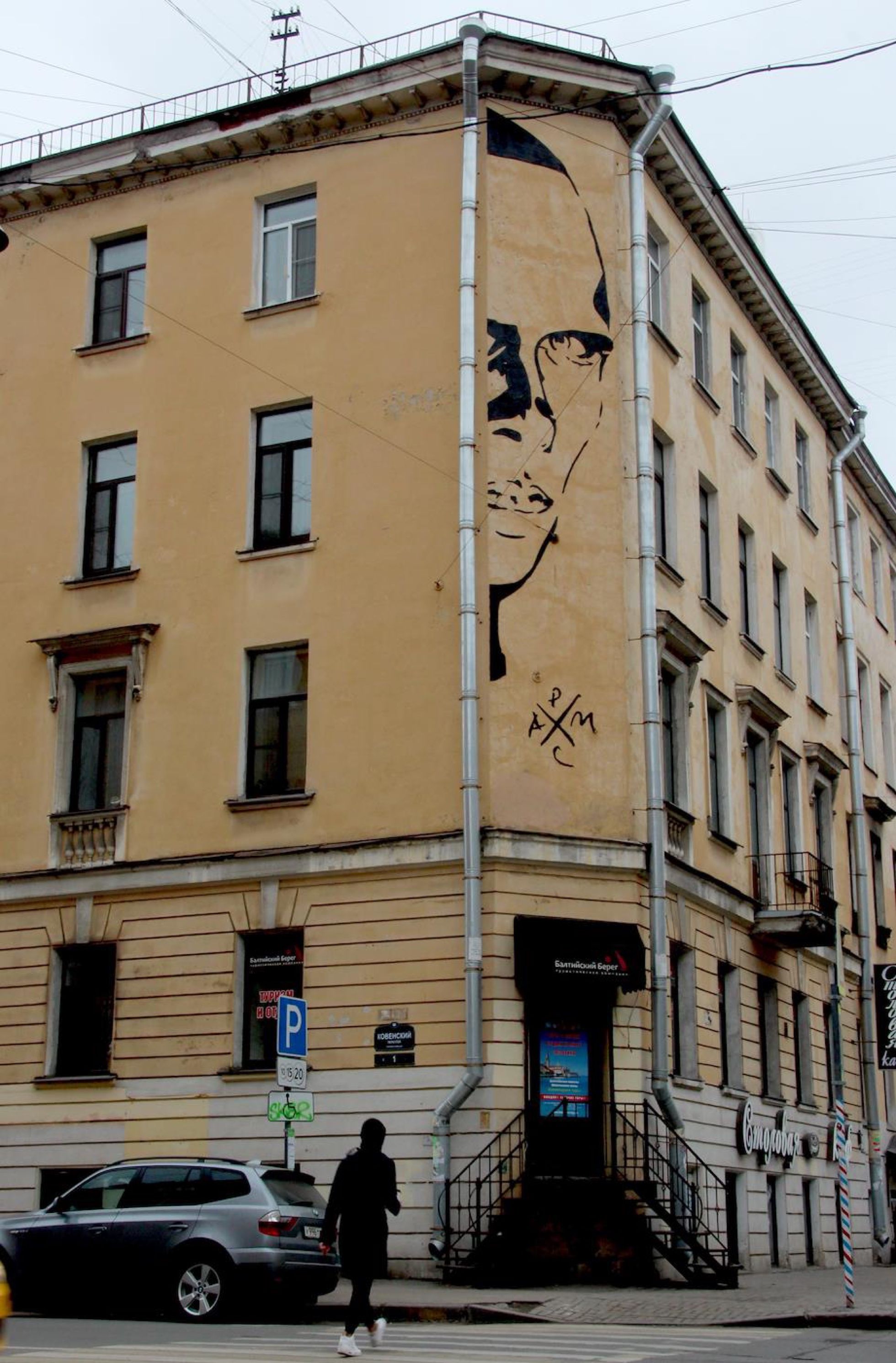
In St. Petersburg, a portrait of Daniil Harms was painted over, which since 2016 was on the wall of the house on the corner of Mayakovsky and Kovensky Lane. The debate around the ants of three floors was conducted between the city authorities, the inhabitants of the house and the city activists for several years. As a result, the portrait of the writer was painted with gray paint, now in his place there will be a photo project , which is externally different from the mural.
The destruction of the work was sharply criticized. Street artist Vladimir Abikh wrote on his Facebook that the portrait “became a local attraction” “successfully inscribed in the architecture of the house”:
Nevertheless, this work was destroyed in the most shameful way - clumsily painted with paint of a different color. Moreover, directly under the work, the visor of the front line, wrapped in a construction grid, on the right - the balcony in an emergency state, on the left, on the left - falling off the cornice of stucco molding. But the priority is not the repair of the building, but to paint over any manifestation of independence and solidarization of residents. This gesture clearly shows that the townspeople and the city exist exclusively for the authorities, and not vice versa.
As a portrait of Harms became a city attraction
Graffiti appeared at the end of the house on 11a Mayakovsky Street, in 2016. The authors of the work are artists Pasha Kas and Pavel Mokich. Harms lived in this house before arrest in 1941, but there was no monument to the poet- eerius on the street, so Kas and Mokich decided to perpetuate his memory- on the anniversary of death. The work was not agreed with the city, however, the authors agreed with it with the residents of the house and the chairman of the HOA, the BBC reports. In one night, the portrait was applied to the firewall of the house , after which it became one of the symbols of the city and an exemplary example of Street Art.
“The work was inscribed in the existing architectural layout of the building, where the portrait looked at the citizens passing by, and people themselves could notice it with due attention. Or pass by and not lose anything. This is valuable work. Everything looked organically and naturally, ”the guide and popularizer of Street Art Nikolai Stecolnikov explained to the publication“ Paper ”, the value of graffiti Kas and Mokich.
However, the illegally applied Mural did not arrange everyone. The first residents of St. Petersburg, journalists Vadim Kuzmitsky (“Business Petersburg”) and Dmitry Ratnikov (editor -in -chief of the Kanoner) spoke out against him. Kuzmitsky called the work “frightening” and stated that she was “approved and paying him such attention because the Harms is now in fashion. Like Brodsky. " Ratnikova did not arrange the precedent himself: “The fact that he is“ cool ”does not mean that on the facades in the city center you can draw everything that someone wants.”
Kuzmitsky and Ratnikov back in 2016 sent a request for the legality of work to the city administration. However, she remained in place-in favor of the conservation , the head of the Hermitage Mikhail Piotrovsky, Alexander Rosenbaum, the head of the department of the latest trends of the State Russian Museum Alexander Borovsky, as well as the then governor of St. Petersburg, Georgy Poltavchenko, spoke out in favor of the preservation.
In 2021, the disputes around the portrait of Harms resumed. The administration of the Central District of St. Petersburg filed a lawsuit against the HOA “Mayakovsky, 11” with the request “to eliminate unauthorized inscriptions and drawings from the facade of the house”. The reason for the lawsuit was an anonymous complaint , said Boris Vishnevsky, deputy ZakSA deputy on October 26, 2021. The New Gazeta wrote that the sender signed the Fatima.
Vishnevsky in his post noticed that the authorities gave the HOA time to hold a meeting and coordinate the placement of the portrait, but the residents could not hold the meeting.
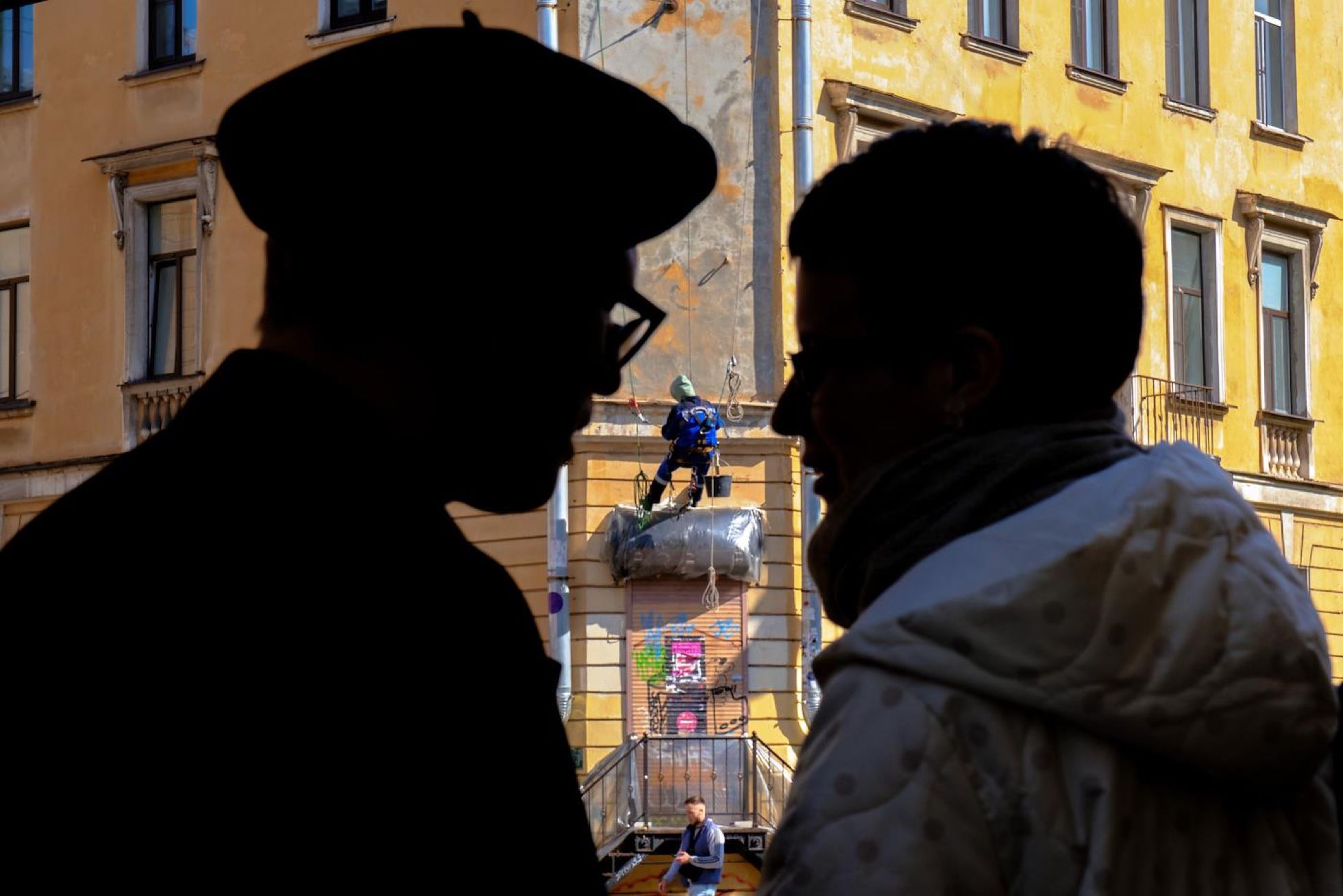
As a result, the parties came to the agreement - they decided to paint the mural in the summer of 2022, and by this time to coordinate the image option for light projection at the same place of the house. She was instructed to make the Lensvet enterprise subordinate to the city together with the Committee on Urban Planning and Architecture. Residents of St. Petersburg, who did not like the proposed visual decision, in response launched a petition demanding to replace the light projection of the governor of St. Petersburg Alexander Beglov.
Who is Daniil Petrov. And how it is related to the portrait
Harms lived in a house on Mayakovsky since 1925 - in several rooms of a communal apartment on the fourth floor. Here he was arrested in 1941 for the spread of "slanderous and amazing sentiments" against the background of the war. He fell into the investigative insulator in the “Crosses”, where he died of exhaustion in 1942 during the blockade of Leningrad.
In the 1960s, his friend, art critic Vsevolod Petrov , drove into the Harms apartment. Today, housing belongs to his grandson - Daniil Petrov.
In March 2022, Daniil Petrov told Fontanka that the historian Lev Gumilev, after liberation from prison, accused Vsevolod Petrov, “that Harms was imprisoned by his denunciation”: “It is easy to imagine, knowing his grandfather, what an insult was for him. He began to call Gumilyov a court of honor, even [Gumilyov’s mother] Akhmatov asked to participate in this story as an arbitral tribunal. But Gumilev never explained. ”
According to the descendant of the art critic, in the 1960s Vsevolod Petrov went 40 times to the head of the board of the Leningrad branch of the Union of Artists with a request to give him the Harms apartment: “Grandfather asked for the apartment in which his friend lived and from where in 1941 they took into“ Crosses ”. [Chairman of the Union of Artists Mikhail] Anikushin, apparently, took pity - thus an apartment and went to our family. ”
According to Petrov, he was called Daniel in honor of the poet. He himself talks about Harms' slanderous moods: “There is evidence that in the blockade of the city of Harms went and distributed panic moods. According to the laws of wartime, he was supposed to slap on the spot. But a lot was allowed to Harms. His father was treated with a certain food, perhaps this attitude switched to him. ”
When the debate began around Mural on Mayakovsky Street, Petrov connected to the process - and began to work on the settlement of the conflict in favor of a settlement agreement (which involved the replacement of graffiti with a light projection). He spoke in detail about this in an interview with The Village . According to him, together with the initiative group, he talked "with different representatives of the administration" and "realized that they act exclusively in the legal field."
“You see, Harms are clearly not the greatest personality of Russia. He will be agreed-the next day, the Committee on Urban Planning and Architecture will come with Brodsky, with Dostoevsky, who were also painted over , and then, what good, and Stas Mikhailov will want to perpetuate, ”says the descendant of Vsevolod Petrov.
Petrov told Fontanka: he is glad that the owners of the house and the city authorities managed to come to a compromise. “Mural Defense” for him is a “case of honor”, he added in an interview with The Village : “The story of my family is connected with Harms, I live in the former apartment of Harms, and I also wear the name Daniil Ivanovich. How else? "
One of the authors of Mural Pasha Kas, in turn, wrote on his Instagram that Petrov "has nothing to do with our project and its protection." According to Kas, Petrov “pushed” the project with the replacement of graffiti with a projection without informing the artists themselves:
[Petrov] collected the signatures of the residents for permission to paint over graffiti and establish a projection, met with deputies. I talked with him, said that I am against the painting of Harms and the use of our project. I asked to stop the process that started, to which I received an answer: “If you are against it, then we will announce a competition and other artists will draw a design for projection.” I am awesome. <...> Absolute hypocrisy and disrespect for the authors.
“The city administration gives itself the moral right to destroy the object of art, replacing it with a flashlight, which will cease to work after a year,” the artist concluded.