
Translated material
The look of an outsider
Talking about good and bad Russians. The column of Leo Ponomarev
Disclaimer
This message (material) was created and (or) widespread by a foreign media that performs the functions of a foreign agent, and (or) a Russian legal entity that performs the functions of a foreign agent.
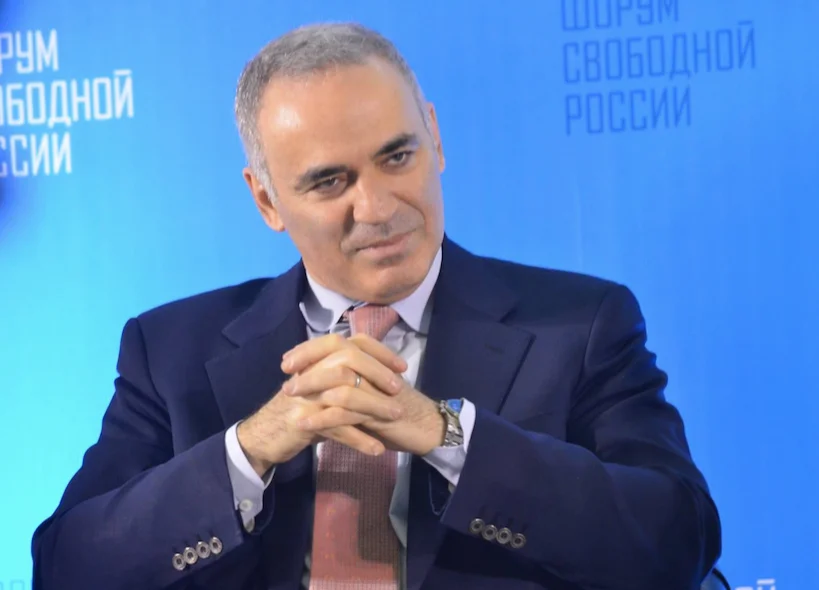
I want to speak about the initiatives of Harry Kasparov, which he proposed at the 2nd anti-war conference and subsequent interviews. I do this in order to put the beginning of a substantial conversation.
Harry Kasparov is one of the first to harshly criticized Putin and contributed to his desecalization. He created the petition “Putin must leave,” which I was one of the first to sign.
The second time I ran into him when he invited me to expand the Liberals of the Movement “Another Russia”, led by Eduard Limonov. But I was a supporter of strengthening the liberal wing of the opposition. And there was a democratic movement “Solidarity”, which had three legs - the Kasparovskiy United Civil Front, members of the Union of Right Forces, disappointed by the party’s policy that supported Putin’s nomination, and human rights activists from different regions.
Solidarity was active for several years. It exists now, but has lost its effectiveness when contradictions arose inside the movement: should solidarity participate in the elections or abandon it - as Kasparov believed. He was sure that participation in the opposition’s election only strengthens the Putin regime and legitimizes it. Boris Nemtsov counted the other way around.
As a result, the PARNAS party appeared, and the solidarity began to fade away, in some composition it remains in Moscow, but has not been conducting active political activity for a long time.
After Harry’s speech at the 2nd anti-war conference, several statements caused a wide discussion. He later made excuses that some of his words were torn from context. In an interview with Zygarya, he only confirmed those theses to which there were claims of the liberal opposition, primarily in Russia, after his speech at the conference.
Firstly, he completely defends his point of view about the need to refuse the so-called non-playing opposition to participate in the elections. But he does not answer the question of what the refusal of the elections weakens the regime.
Secondly, he proposed the concept of the “passport of good Russian”, relying on those who signed a certain opposition declaration. It is they who will be entrusted with building Russia of the future. But it is not clear how the opposition leaders are now going to help the opposition-decreased citizens who remain in Russia.
I will dwell on each of these theses.
Should the opposition participate in the elections and legitimizes this Putin regime? This question has been tormented by the opposition for 20 years. I have always been a supporter of participation. But even Boris Nemtsov, being a supporter of participation in the elections, at some point called for spoiling ballots. To the State Duma elections in 2011 and the 2012 presidential election, he headed the Nahny campaign to spoil the ballots.
According to the results of this campaign, the volume of damaged ballots was insignificant. Realizing, apparently, that this was not a way out, he moved to the Yaroslavl Duma and became a deputy.
These throwings showed and obviously prove that the strategies of the boycott of elections or damage to the ballots do not work. They can be successful only when the opposition has a significant advantage and wide support in society. The only correct strategy was the observation of the elections and control. The communities of observers, the organization "Voice" arose.
Thanks to observers, it is possible to get into municipal councils and regional legislatures to the opposition independent deputies.
Thanks to the wide observation movement in the elections, peaceful revolutions occurred, the so -called “orange” in the post -Soviet countries: in Ukraine, Georgia, Kyrgyzstan. In these countries, the population now trusts the election institution.
It is according to the results of the elections that people go out into the streets, protecting their votes, and a peaceful change in power takes place. Participation in the elections, observation and protection of stolen voices unite people.
The same thing in Russia. Thanks to the observation in the elections and nomination of candidates from the opposition, mass violations were recorded and people were protested in December 2011 after the Duma elections and in 2012 - after the presidential. But those who went out into the streets in prosperous and well -fed Moscow were not enough.
It was these people: Harry Kasparov called “liberal shusher” participating in the elections and observing them, insulting them. At the same time, he put an equal sign between those liberals of the 90s that now serve Putin in state authorities, and those who are commonly called the non-systemic opposition, those, mainly young people who continue to be advanced to representative authorities.
The question suggests itself: how should the dissidents behave in Soviet times? According to this logic, there was no point in creating a Moscow Helsinki group, which did not propose immediately to overthrow the criminal Soviet regime, but only recorded violations by the Soviet authorities of international obligations signed under the Helsinki agreements. It is no accident that then the slogan appeared: "Do what you can, and be what will happen."
Further, "Passport of a good Russian." It is assumed that people who signed the anti -war declaration deserve to protect the anti -war committee and it is they, when the regime collapses, will build future Russia. There is a contradiction right there. For example, all participants in numerous elections and observation of them, according to Kasparov’s logic, are part of the criminal Putin state, since they participate in its procedures. But most of them absolutely exactly consider the regime criminal. Or the same human rights activists who protect citizens in the courts. They consider the Putin regime criminal and protect people from him.
But the most important thing for which the declaration was created for is to consider the signatories “good Russians” and to make them support from abroad as much as possible. Since the blockchain where the information about the signatures is recorded is not available to the Russian special services, I can imagine how many Russians supporting Putin will sign a declaration to get a tool, for example, to withdraw money from Russian accounts abroad.
For these grounds, I can definitely say that I will not sign the declaration. And moreover, I believe that this declaration will only extend the life of the Putin regime when it will be signed by those who are its support.
And what needs to be done, and to do urgently?
It is necessary to help, first of all, hundreds, and even thousands of people who are forced to escape from Russia due to political persecution.
Speaking against the Putin war openly, participating in pickets and shares, they are forced to escape from criminal prosecution. I, being in Georgia, see many young people around me who have no savings, there is no currency to organize their life abroad. They need to give the opportunity to open an account with a bank, get a Schengen visa, it is possible to provide housing for the first time and most importantly - to help get a job, including receiving an appropriate visa or permission. All this is now provided for refugees from Ukraine. This is good and correct. But these young people from Russia are also refugees and most often from real prison. And therefore, it seems to me that the task of the anti -war committee is to lobby for the interest of these political emigrants in Western countries. Germany has already announced a similar program.
At first, a group of support for Russian emigrants "Ark", created by the anti -war committee, supports such people. But it works in only two countries, and by no means in full support.
It is possible to create an appropriate working group in which the experience and weight of Harry Kasparov and other participants in the anti -war committee in international circles will definitely be useful.
But there is another, no less important area of work.
Tens of millions of Russians condemn the war, but they are disconnected and feel lonely. The repressions are so strong that they allow only single public performances. The main task of those who want to influence the future of the country is to work on strengthening ties within this still silent majority. Feeling their strength, it is these people that will determine the future of the country. At the decisive moment, it is precisely these people to fight to become real public force, so that Russia chose the world, progress and human rights (according to the formula of Andrei Sakharov) as a new system matrix to replace the Putin Imperial, which has already led Russia to disaster.
Harry Kasparov’s sharp critical statements about the events within the country, about people living there are clear. But sometimes they seem to be an outsider. The struggle within Russia and beyond - the struggle for unification of people, for overcoming fear, for public opinion and mutual support - must strengthen and complement each other. Such a struggle can only be effective if the lower spontaneous movement of people in Russia will meet real support and understanding of authoritative and influential people, which, of course, include Harry Kasparov.