
Translated material
Warm reception
Ukraine and the EU: Waiting for a encouraging signal of hope
While the leaders of the European Union countries talk about dozens of years before the possible acceptance of Ukraine in the EU and the country's unpreparedness to become even a candidate, public opinion represented by the European Parliament to immediately give her candidate status. Let the advance as an encouraging signal of hope so far. This manifested itself at the plenary session in Strasbourg last week.
Resolutions of the EU representative assembly are advisory in nature, are optional to execution, but reflect moods in societies, and those who make decisions are considered to be with them. In this case, the European Parliament turned out to be more radical and anti -Putin than the governments of the countries and the EU leadership, which are careful and pragmatic. All the most important decisions in the EU Council are made by consensus. Any member of the Union has the right to veto. The search for consensus is the most important thing in the functioning of a complex mechanism, what is the European Union.
The Chairman of the Verkhovna Rada Ruslan Stefanchuk was met under the vaults of the European Parliament with applause. He asked the deputies to do everything possible to be recognized as a candidate for joining the EU in June.
“I am not hiding that my mission that I commit, going around the parliaments of European countries and speaking here, in the European Parliament, to convince each of you that Ukraine is worthy of the status of a candidate for the European Union,” he said.
The session adopted a joint statement by the leaders of political groups (fractions) - left, right, liberals, conservatives, “green”, nationalists. Such unanimity in itself is a rarity for the European Parliament, which is created as a place for discussions and disputes. The application is addressed to the heads of state and governments of 27 EU countries, which will gather on June 23 and 24 for a summit in Brussels to consider the applications of Ukraine, Moldova and Georgia for joining the Union.
“The European Union should show courage, determination and foresight in today's context of a brutal aggressive war against our European neighbor of Ukraine and the deterioration of the international situation,” parliamentarians said.
They urgently urge to grant the status of candidates for EU members primarily to Ukraine and Moldova. In accordance with Article 49 of the EU Treaty, this should be the beginning of the process, the pace and duration of which will be based on specific merits of the candidate countries.
Obviously, parliamentarians believe that Ukraine has already earned this with its stubborn resistance on the battlefield, Moldova is inextricably linked with it and also suffered during the Russian “special operation”. As for Georgia, parliamentarians urge the EU leaders to "work to provide it with the same status, performing the legitimate aspirations of the Georgian people."
That is, the deputies put Ukraine and other post -Soviet applicants even ahead of the West Balkan countries, which had much previously promised a “European perspective”.
In fact, in front of Turkey, the official candidate status of which is now rarely remembered.
Events in Ukraine can adjust the rules for expanding the EU. At least at the stage of admission to candidates. More and more often in discussions, along with established criteria, the word "merit" appears. This refers to merits to the European democratic community.
Never in previous waves of expansion there was no such condition. But never in the history of the community, it was a question of admission to the candidates of a warring country. The European community of coal and steel (the “six” hated by Moscow as part of the victorious and defeated) arose on the ruins of the Second World War in order to prevent a new war in Europe. It worked. The war of the 1990s was limited by the territory of the former Yugoslavia, and the attempt of Miloshevich to restore the “mini-imperia” by force was deeply disgusted by the very idea of voluntary European integration. Now the EU leaders are horrified to “outplay the war in Europe,” and the resistance of Ukrainians is called the protection of Europe from authoritarianism.
In order to join the European Union, the Jacket state must comply with political and economic criteria, known as Copenhagen (at the place of their adoption at the Copenhagen summit in 1993). This is the stability of state institutions that guarantee democracy, the rule of law and the protection of human rights, respect and protection of various kinds of minorities, a functioning market economy, the ability to cope with competitive pressure and market forces within the EU. Perhaps the only criterion that Ukraine corresponded before the revolution of the dignity of 2013-2014 was its presence in geographical Europe.
So far, Ukraine has not been subjected to the Russian “special operation”, five years after the coming of the Association of Euromaidan - the Association Agreement between it and the EU - Brussels regularly put the slowness in Kyiv in the conduct of economic and political structural reforms and even delayed the payment of the laid -up trenches. Kyiv justified this sluggishness with a chronic conflict in the east of the country. For Brussels, these excuses were not enough. With such a pace, the purpose of Ukraine obtained candidate status was pushed into infinity.
The Russian "special operation" dramatically changed the situation. The reason for this is not only a surge in Europe compassion for unfairly offended, not only admiration for the courage and stamina of Ukrainians in protecting national independence and territorial integrity. Europeans felt a real threat that they themselves suffered and created seventy years after a big war: security, personal freedom, civil law and well -being. Ukraine appeared to be a shield of Europe, and for the sake of helping it they are ready to sacrifice many.
The deputies of the European Parliament, with the exception of very few votes from the extremely right and extremely left flanks of the Strasbourg amphitheater welcomed the unity that the heads of their states and governments showed by adopting the sixth package of sanctions against Russia on May 30. Although they reproached their governments with insufficient efforts to overcome the negative consequences of the war in everyday life. Especially because of a sharp increase in products for food and energy. But the intensity of reproaches and critics was not so strong for this hall. So, people who make up the electorate of these parliamentarians are ready to endure.
Finally,
Some emphasized the urgent need to better arm Ukraine, which is unusual in European parliamentarians.
Although sanctions, in their opinion, are a good weapon against Russia, the effect of them will manifest only in the long run, and not in the coming months. Few people's deputies who are usually considered to be “Putin's friends”, either also condemned Russia's actions, or called for neutrality, or were silent.
Thierry Mariani of the Lepenovsky National Association of France, a favorite of Russian propagandists, an unchanged self -proclaimed “observer from the European Parliament” on “referenda”, “election” and other events organized by Moscow in the Crimea and the Donbass, did not support “special operations”. He only spoke out in the spirit of Euro-attacks against the "dictatorship of Brussels in the planting of anti-Russian sanctions", as well as against the "exploitation of war in Ukraine" in order to promote projects of the EU federal structure (to the detriment of the sovereignty of member states).
The representative of the Alternative for Germany, Bernhard Zimnic, rested that the sanctions contradict the interests of Europeans, raise energy prices, and the supply of weapons to Ukraine leads to even greater destruction and victims. Like, Russia is a nuclear power, and Europe should not get involved in the war on the side of Zelensky, because both warring regimes are corrupt.
Mariani and Zimniks performed on behalf of the Euro -Speech faction when discussing the project of the defense component of the EU. Their voices drowned in the chorus of the majority. As a result, the wording in the resolution was even enhanced compared to the project: instead of the “invasion”, an “aggressive war” was recorded.
The theme of Ukraine stained in yellow-blue colors almost the entire agenda of the European Parliament session. First of all, the discussions and recommendations directly related to the challenge that “special operation” has become for Europe. These are several topics and documents:
Evaluation of the EU emergency summit on May 30-31 in the Ukrainian situation and the sixth package of sanctions against the Russian Federation (see the joint statement of political groups mentioned at the beginning).
Recommendations on a strategic compass - a program for strengthening the defense component of the European Union (we are not talking about de Gaulle's dream about creating a European army without Americans, but about a powerful European autonomous addition to NATO).
Recommendations on the strengthening of the EU eastern partnership policy (relations with post -Soviet neighbors, their inclusion in European orbit, including in defense and security).
The Ukrainian situation is implied even in the discussions and documents not directly related to it. For example, in the program for decommissioning in Europe, cars with gasoline and diesel engines and other parts of the Fit For 55 package in ecological transit of the economy until 2055. This is another industrial revolution, accelerated by new circumstances. Because a new war in Europe means a tectonic shift, which can change the whole future fate of this part of the world.
During the debate, the name of Russian President Vladimir Putin often sounded. It seems that it became in this assembly something like frightened, the personification of absolute evil. Including in the discussion of purely intra -union problems.
“Putin here opens a bottle of champagne,” said Bogdan Zhonka, in the heat of the rule of law in Poland, in the heat of the rule of law in Poland.
Ready to reduce the bonds of the candidate for Ukraine, members of the European Parliament strongly against the indulgences of the current EU members who are departing from the values of the Union. The non -compliance by Poland was discussed by the principle of independence of the judiciary. Warsaw does not fulfill the decision of the EU court on the abolition of legislative innovations that break democratic norms. Poland, like Hungary, is also accused of infringement of freedom of the media and other civil freedoms. For violations, financial sanctions are laid.
Deputies from the Polish ruling party “Law and Justice” fought back from criticism of the European Parliamentary majority by arguments like “But Poland helps Ukraine most of all,” “has taken upon itself the main burden of concern for Ukrainian refugees.” The argument was not accepted. On the contrary, the majority desperately criticized the head of the European Commission Ursul von der Lyain for agreeing to pay Poland blocked 35.4 billion euros from the Union Fund for Restoration and Sustainability. The official felt uncomfortable. Before that, in Warsaw, she promised Polish leaders to defrost the translation. An advance, in response to promises.
The speaker according to the resolution of Katarina Barley from Germany called not to mix everything in one heap. “I highly appreciate the help of the Polish people to Ukrainians, but this is not related to bringing the Polish legislation to the EU norms regarding the independence of the judicial system, the fight against corruption and freedom of the media,” she snapped. Only then will the Polish government receive money from European taxpayers when it complies with the requirement of the European law. Otherwise - not a cent. “You know where the non -compliance with the rule of law leads to authoritarianism,” Rosa Thun ore Hoenstein echoed her from the “Civil Platform” of Poland. And so the majority.
The restraint of many leaders of the EU countries regarding the candidate status of Ukraine is explained precisely by the uncertainty of prospects. The “explosive” extension of 2004, when the EU grew by former members of the Soviet Bloc from Central and Eastern Europe, as well as the Baltic countries, was already in many ways an advance dictated by political will. Then for a long time there were problems with corruption in Romania and Bulgaria. Now - the departure from the Swist of law in Poland, sliding to authoritarianism in Hungary. Greece, who became a candidate as early as 1961, was accepted into the Union only in 1981, and in 2010 he had to be pulled out of the debt crisis that arose through the fault of her government with the whole world. After a long wait, Turkey received the status of a candidate in 1999, began negotiations on entry in 2005, and in 2015 evolved to such a state that President Tayyip Erdogan said that the country did not want to change according to the European model and was no longer interested in joining the EU.
What will Ukraine be in the foreseeable future? Politically, territorially? How will it carry out the necessary reforms, which are still perceived in the country painfully? How to cope with corruption, oligarchy? For EU leaders, this is a task with many unknown. Other possible problems are in principle solved. Even in the case of temporary dismemberment of the country. The divided Cyprus was accepted, although the north of the island is occupied by Turkey, and reunion prospects are still visible. Yes, and the "Germany" version of the Cold War should not be forgotten.
Some EU member states are still opposed to open the European door for Kyiv. This camp is headed by the Netherlands. Their skepticism is separated by Denmark, Sweden, to a lesser extent - Belgium and Portugal. On the other hand, the countries of Central and Eastern Europe, such as Poland, or the Baltic States, as well as Greece, Finland and Italy, who seek to offer Ukrainians what they most need to continue the confrontation of Russia: hope. There are such as Germany, which have not yet been determined. The position of France also raises questions.
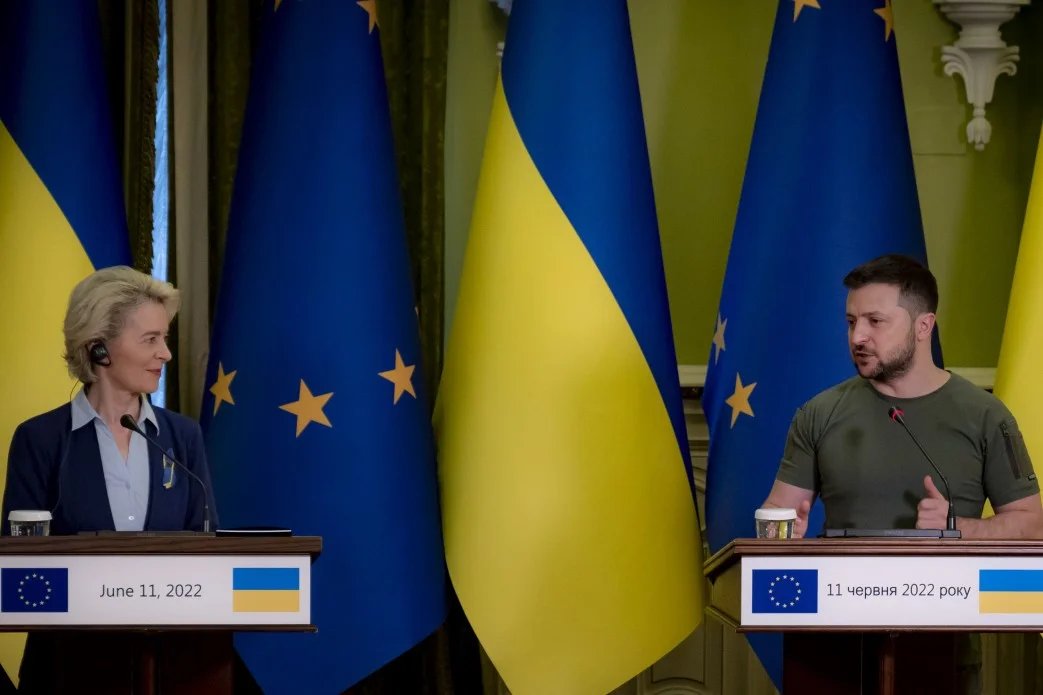
Ursula von der Layen last weekend traveled to Kyiv in order to supervise the latest information before making a decision, formulating conditions that could reassure skeptical states. To inform Vladimir Zelensky about the course of (very complex) debate in the EU about Ukraine. As for the support of the European Parliament, and therefore the EU civil society, it is today.