
Translated material
Family therapy for domestic violence is prohibited. Why?
Briefly
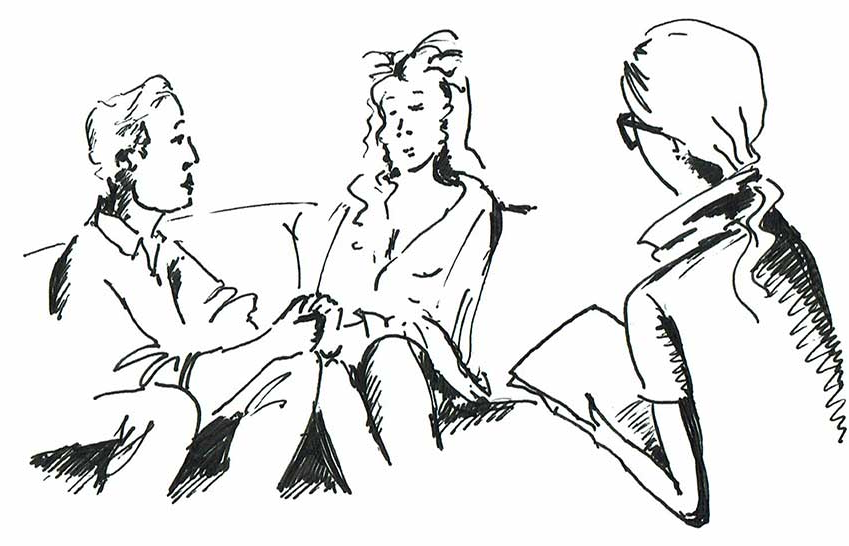
One of the ways to fix the broken relationship is to go to paired or family psychotherapy. It would seem that this is a conscious and logical step in almost any situation. But with domestic violence, pair psychotherapy is prohibited. Why? How can a rapist and psychologist do even more harm during family consultations? Especially for Utopia , the psychologist Nyra Parsadanyan answered these questions and dismantled the popular myths about why the victim did not leave.I work with the victims of domestic violence and often hear the same story from clients. Before individual counseling, they turned to pair or family therapists with a partner for help and almost always left there with the thought that they were to blame. I can’t evaluate the work of colleagues: I don’t know what specific psychologists my clients went to, what exactly at the sessions they themselves, partners, specialists spoke, how it was all interpreted. I see only the final result - in front of me on the couch, an exhausted woman who was desperate to find the one who finally heard her.
The most important thing is that in a situation of domestic violence, partners should not go to the paired therapist under any circumstances! The injured party will not feel safe and will not be able to express everything that happens to her. And the one who performs violent actions will be ashamed of his actions and be silent, downplay the significance of what is happening in a relationship, gaz -to -threate or generally deny everything. Such work is not effective for anyone: neither for the victims, nor for the authors of violence, who, in certain cases, in individual work can help change the destructive pattern of behavior.
If the expert does not have sufficient knowledge of domestic violence, it will be very difficult for him to keep in a neutral position in pair work. Unfortunately, the psychologist often sides the partner committing violence.
Let's look at the popular myths “Why the victim is to blame” and analyze them.
- The well -known theory of Stephen Carpman says: in a relationship, a victim (that is, the victim) sooner or later becomes a persecutor punishing his offender (author of violence). And then, depending on the situation, it can take the role of the Savior and begin to protect and “cause good” to another.
The model of the “triangle of fate” with a victim-reserve-rescuer, when a person moves from one role to another, is successfully used in a transaction analysis. But it cannot be used in situations of domestic violence, which Karpman also spoke about. With domestic violence, there is no dramatic triangle - only a victim and a pursuer. In my opinion, it is not even a “role”, but rather a “position”, and the victim did not choose it. She was assigned to this position without consent and knowledge. Positions are most often rigidly recorded and in a situation of violence do not change.
- The victim does not leave abusive relations, because she has secondary benefits, for example, it is convenient to live in a good apartment, sit at home with children and not work.
Having a roof over your head is not a benefit, but a basic physical need. To take care of minor children, postponing a career, is not a benefit, but the parental obligation provided for by Russian law .
- It is so -dependent and itself supports abushy dynamics in pairs.
Co-dependence means dependence on a person, which in turn depends on something else: drugs, alcohol, game addiction. The victim can be dependent, for example, financially, when control over the family budget is concentrated in the hands of a partner. Or dependent on the place of residence - nowhere else to go.
But there is no co -dependence in this. Claire Murphy, a consultant for working with domestic violence, in his article debunks a myth of co -dependence. She explains that with domestic violence, this is the result of constant psychological pressure, humiliation and/or physical violence.
- The victim is a masochist, she likes to be next to such a partner, she feels the need for his dominant position.
This is a very controversial statement in the context of domestic violence. Clinical psychologist Paula Joan Kaplan says it is easier to reduce the problem to the “masochism” of a woman than to look deeper into the causes. “The behavior of women, which is often considered masochistic, should be attributed to the following features: the ability to postpone satisfaction and wait for remuneration, the ability to put the needs of others above their own, the faith based on past experience in limited expectations, the desire to avoid punishment, rejection or guilt,” she explains.
- She herself provokes violence with her tantrums, dissatisfaction, all the time “saws the brain” and takes out nonsense.
You can provoke as much as you like, but not to provoke someone to actions. To humiliate, insult, intimidate, hit - the choice is always among the one who performs the action. “Hysterics” is most often an attempt to say the injured side to clarify what is happening in a relationship. To express your opinion, arguments, the desire to be heard and hear the other side with a further transition to a compromise or decision. But in violent relationships, one who establishes power and control is most often not ready to refuse them. The compromise is perceived as weakness, and therefore the loss of a strong position.
- If the victim was really so bad in a relationship, then she would have gone long ago. And if it does not leave, then everything is not so terrible.
There are many reasons why the victims do not leave violent relations. I will list several: she has nowhere to go, she is in social isolation, she has no money to provide herself and children. Pressure from friends and relatives is also added here, they convince that everything is not so bad. She is afraid that it will only be worse that she will be pursued, blackmail or threaten the life and health of children and relatives. She does not believe that they can help her, she may not know that there is, in principle, there is help. And many other factors stopping or returning the victim back to these relations.
All of the above can turn the paired session into a double condemnation of the victim, this is also called Victimblem. Therefore, first, each of the partners should work with the therapist individually, to understand what is happening, who did what, who is responsible for what and whether he is bearing. For violence, the one who committed it is always responsible! What to do with relations if violence happens, what to do with your feelings, is it possible to establish non-violent communication and much, much more. And only then, perhaps, if desired and readiness to go to a paired consultant. The most important thing is that one who commits violence must take responsibility. Without this, there will be no sense in therapy at all.