
Translated material
Children during the war: how they were saved and hidden
Briefly
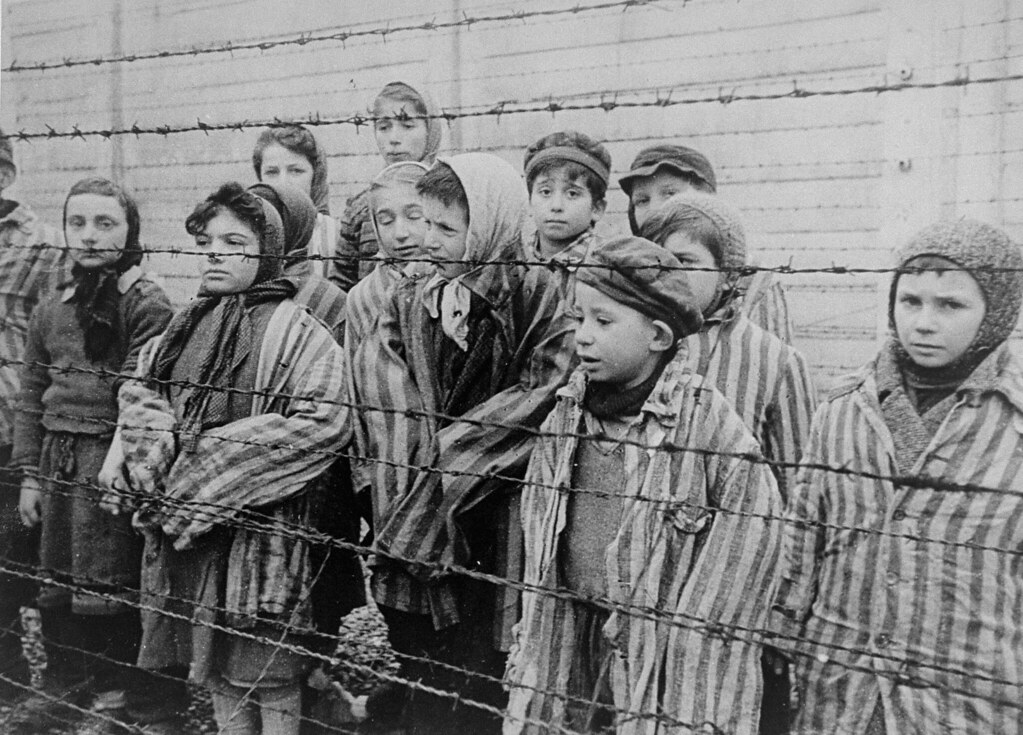
In large military conflicts, civilian ones always suffer most of all: humanitarian disasters, murders, violence, captivity, hunger. During wars, children get no less than adults, and often even more, they are defenseless in the most aggressive and cruel conditions. But there are always those who with the risk for their own lives saving children. Who and how saved children in the largest military conflict of the twentieth century - the Second World War.Even before the start of World War II in Germany, persecution on a national basis began in accordance with the policy of the Third Reich by racial hygiene. “The wrong” children came under it: Jewish, gypsy and all children with developmental features.
Almost any objectionable person could get into concentration camps and ghetto, it was almost impossible to get out of there. The fate of all “wrong” was unenviable, but if you can’t work on the Reich, it was completely hopeless. Children were not considered suitable even for forced labor, so they could wait for a quick deportation to the concentration camp. There, the majority were immediately sent to gas chambers, along with pregnant women and elderly people, someone for medical experiments.
Sometimes adolescents were nevertheless used for forced labor in which they died from unbearable working and disease. There are many evidence, some children were diaries and described the horrors that they had to endure, and how they could escape. Among others, there are memories of Ruth Webber. When Germany occupied Poland, she was four years old and with the whole family they moved to the ghetto of Ostrovts. Rut parents managed to get a job in a work camp outside the ghetto. When the ghetto was liquidated, the parents were separated, and Ruth was sent to the concentration camp. After many deportations and moving, she ended up in Auschwitz, but managed to survive.
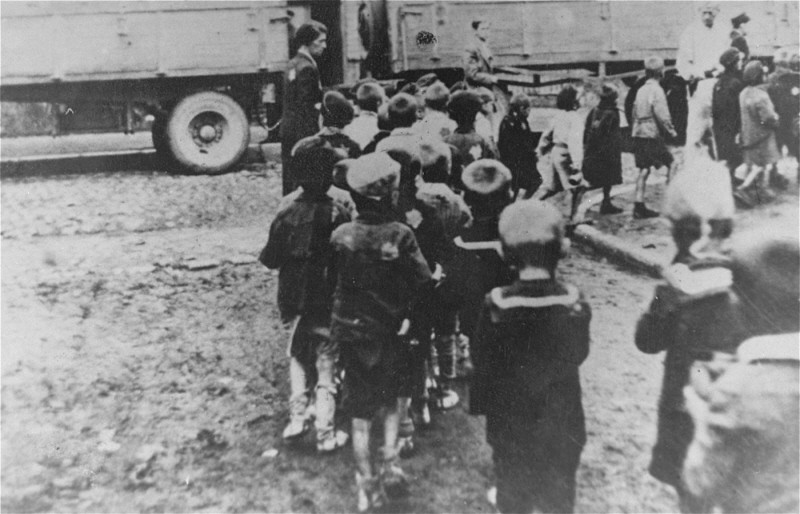
“Transport with a large number of people came, and all of them moved in a certain direction, and then disappeared. Even at that age, I understood that there is something behind the fence, which is covered by trees and a blanket, there is something ... You enter there and do not go out anymore. What exactly happened, I did not know - all that I knew that you were getting out of the pipe. When the crematoriums worked, there was a terrible sweet, sickening taste in his mouth, so strong that even at times he drowned hunger. ”
From the memoirs of Ruth Webber about Auschwitz. Source: Washington Memorial Museum of the Holocaust.
Thousands of children were able to survive in the occupied territories, including someone managed to flee the ghetto or camp, many were taken out. The indifferent residents of cities and villages hid children at home or in institutions where they worked. Activists helped organize salvation systems, find places where you can attach children.
Dog in the back to drown out children's crying
Before the war, Irena Sendler was a social worker in Warsaw. When the Warsaw ghetto was created in 1940, she agreed that she would visit him and control sanitary conditions. So she began to help activists and secretly removed people from the ghetto, mostly children. The methods were the most sophisticated: for example, babies were taken out in boxes and bags on an ambulance. Or in the car that was brought by disinfectors, a special dog sat in the back, which barking to drown out children's crying.
In 1942, after the mass deportation of people from the ghetto to Treblinka, the Referee Jews Committee was created, and Irena became an active participant. Together with his associates, they handed children from the ghetto to Polish families, shelters, monasteries - wherever they managed to agree. Often I had to do fake documents, teach children to the Polish language, prayers and songs. In order for the opportunity to return to families or find surviving relatives, Sendler recorded all the data: the encrypted Jewish and new Polish name of each child and stored in a bottle.
In the fall of 1943, Irena Sendler or sister Yolanta - under this pseudonym, she worked at Zheigot - arrested. She managed to hide all the evidence: addresses and names of children, money, but she still received a death sentence. The activists of the “Zhegoty” managed to redeem her and secretly withdraw from prison, so she continued the underground. How many children were saved by Irene and her associates is unknown. For her activity, she was awarded the title of the righteous of the peoples of the world.
Orphanages, hide and seek and typhoid
Because of the war, the children became orphans and fell into orphanages, which worked even in the occupied territories. For Jewish children, this was often the only salvation - there they could be hidden and protected from deportation to the ghetto and concentration camp. That is how more than a hundred children saved in Minsk. Orphans were regularly brought to the city council, among them Jewish children often found themselves. According to the instructions, they had to be sent to the ghetto, but the administration officer Vasily Orlov hid the real origin of the children and gave them a referral to the orphanage, without which it was impossible to get there.
But even after getting into the orphanage, the problems did not end - I had to hide during regular inspections. Sometimes the children betrayed themselves, for example, accidentally pronounced the word in Yiddish. The head of the orphanage No. 7, Vera Sparning instructed the Jewish children who came to her, how to not give themselves, and during the checks she hid children in the insulator under the guise of patients, bandaged their heads so that hair and faces were not visible.
"Vera Sparning pursued a policy:" We have no Jews! " - And strictly punished for manifestations of childhood anti -Semitism. When checks were expected to identify the Jews, she tried to hide children with typical Semitic faces away or put them in bed and said that they were sick. Thus, more than thirty Jewish children in this orphanage waited for the arrival of the Soviet Army (out of 120 orphanages). ”
From the memoirs of David Taubkin, a former prisoner of the Minsk ghetto, who survived the war in the orphanage No. 7. Source: poison of yours, a memorial complex of the history of the Holocaust.
In another Minsk orphanage No. 2 there were about 70 children, and half of them were Jews. The head of Maria Voronich also hid children with a bright appearance, and before the checks she hung a poster with the inscription “Tif” to scare away the inspectors. In addition, the preacher of the local Gospel community Anton Ketsko helped these orphanages. Sometimes during the checks, he replaced Jewish children with his and the children of the community, and the German officer Gerhard Krueger warned him in advance about the upcoming check.
In addition to the fact that children were brought from the streets, in the Minsk ghetto organized a system of evacuation of children and their premises in orphanages.
“Mikhail Goebelev established a connection with a reliable person who worked in the Department of the Education of the Okopyapple City Council. We agreed with this person: if between the 9th and 11th in the morning to the 20th room of the German city council they will bring an allegedly thrown child, this means that the child is Jewish and that he must be sent to one of the city orphanages. For this purpose, two female groups are organized: one in the ghetto - for the transportation of children, the other outside the ghetto, from Belarusian women - to receive our children and transfer them to a agreed place. "
From the memoirs of the Smolyar Girsch, the head of the underground of the Minsk ghetto. Source: poison of yours, a memorial complex of the history of the Holocaust.
Organized emigration and refusal to accept refugees
In addition to local initiatives of local residents, there were large state projects to save children. Shortly before the outbreak of World War II, the operation of the rescue of Kindertransport was carried out, when children (but without parents) were organized to the UK.
Kindertransport began shortly after the Jewish pogrom of the "Crystal Night" in 1938. According to this program, not only Jewish children were exported: out of 10,000 thousand refugees who were saved from Poland, Czechoslovakia, Austria, about 7,500 were Jews.
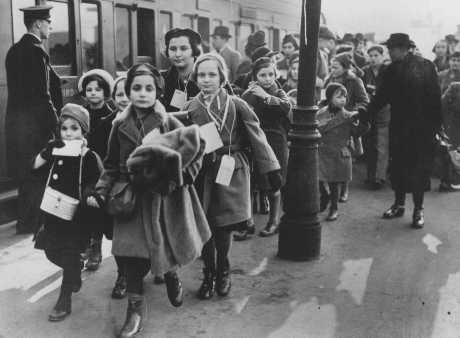
Alisa (Eberstakova) Masters, who grew up in a religious Jewish family in Czechoslovakia, recalls how her parents sent her with two sisters of Kinderma Transport to England:
“ We got on a train, my older sister was 15 years old, I just turned 14, and the youngest was 10. We were joined by another little girl, the daughter of my uncle’s friend, her name was Eve Rotberger, she was 10. There were many children in the compartment, we were scared, excited and did not know what to expect. Father told us that we would go through Holland. When we arrived there, we were told that local authorities did not want us to leave the train. Instead, many local people came to the railway station with hot chocolate, chocolate tiles, cookies and gave us these things through the windows of the train. I was very grateful, although, of course, I felt terribly because the authorities did not want to see us. In any case, we were delighted that we left Germany, and said: "Now everything is in order with us, we are safe, safe ."
By sending the children to the “kinderth transport” to another country, the parents hoped that the children would just wait for the war and return home. No one could have imagined that most children would never see their parents again. The last Kindertransport from Germany went on September 1, 1939, on the day of the World War II. On the day of the surrender of the Dutch army on May 14, 1940, the program closed finally.
Einstein, new names and Vichy
During the war there was another program of salvation of children that organized a society to help children ( Oeuvre de Secours aux Enfants or abbreviated OSE). They managed to save about 1,200 children throughout Europe. Initially, OSE helped Jewish communities affected by Soviet pogroms. After 1917, the organization moved to Poland and the Baltic countries, and in 1922 created an international network of groups in Berlin, they were called Union-axe. The first president was Albert Einstein.
In 1933, the society suffered a headquarters from Berlin to Paris to help those who are persecuted in Germany. They provided at home Jewish refugee children, it seemed to parents that France was safer. The main goal of the organization during World War II is to save children from concentration camps and transfer to orphanages throughout France.
“ Once my mother took me and took me somewhere, where there were other children. We were all loaded into a truck and taken out of the camp. Then I did not know that I was saying goodbye to my mother forever. It was OSE, they took out as many children from concentration camps as they could. They had houses in the southern part of France, which are similar to castles or large mansions. There were one hundred or one hundred and fifty children in one of these houses. They tried to teach us French and gave us French names: for example, my name Beata turned into Beatrice. There were so many children that sometimes we lacked beds and furniture, so the boys made furniture, and the girls cultivated the ground so that there was something . ”
From the memoirs of Beatrice Stern, saved by OSE. Source: Washington Memorial Museum.
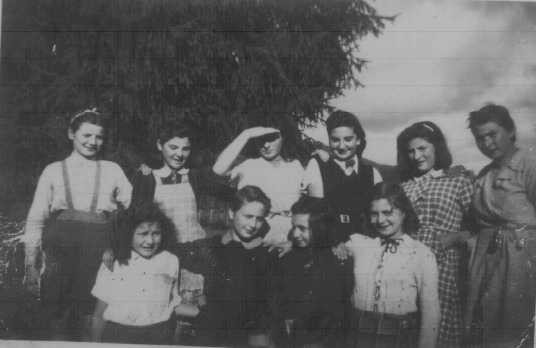
In the south of France, in Vichy, during the war, the organization had 14 orphanages. Children tried to provide good conditions, as far as possible, for example, hired by Jewish doctors who were banned from practice. In 1942, after Germany took control of Vichy, these institutions were closed so that the children were not seized. So that after the raids the children would not be sent to concentration camps, they were transported across the Swiss border to neutral territory.
Monasteries, pastors, bread and freedom
Together with organized committees and underground organizations, children were hidden by individual caring people. They hid children with a risk to life: they killed Jews for help. Entire families were hidden in the villages in the cellars, sometimes it was possible to give people out of their relatives. Often, churches and monasteries became asylum.
So, many refugees were covered in the French village of Shambon-Sur-Lignon, where the Protestant pastor Andre Trokme called on the inhabitants of the village to provide asylum to all those in need. The authority of the pastor was great, and local residents began to hide refugees in houses, monasteries and orphanages, helped cross the border and get into neutral Switzerland.
Older children helped to care for young children. Elizabeth Kaufman - the author of the famous diary - lived for some time at Pastor Trockme and helped to look after the wards.
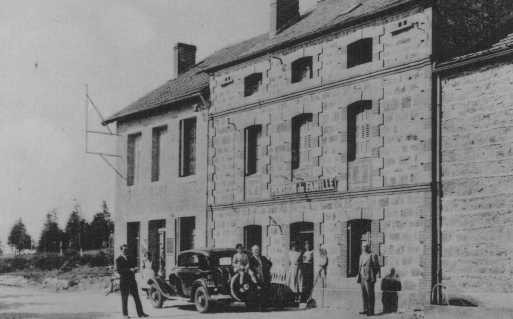
In 1940, Hannah Hirsch and his family were deported to the Gürs concentration camp. There she learned from a social worker that the pastor from the village of Le Shambon wants to withdraw children, he was helped by the same OSE organization.
“ A social worker from OSE told my mother about the village in which they were looking for children to get them out of the camp. Mom asked if I wanted to go, of course, I agreed. And she let me go, although not all parents were able to do so. Together with other six children in September 1941, we went to Le Shambon. It was paradise for us - we were free, lived in the house, we had food. We could not even eat all the bread that we had: we were constantly worried about what was happening in the camp. They dried bread, made small bundles and sent him to the camp . ”
From the memoirs of Hannah Hirsch. Source: Washington Memorial Museum of the Holocaust.
By 1942, the German raids reached Le Chambon. Hannah was sent to hide on the farms - the wife of Pastor Magda Trrome found families for refugees and agreed with schools, they entered there under fictional names. In early 1943, Hannah fled to Switzerland. After the war, she married Max Leibman, whom she met in Gürs. Hannah's mother could not get out of the camp, she was transported to Auschwitz, where she died.
After the end of World War II, the mass search for relatives who survived began. Someone was lucky-it was possible to find relatives and restore the family, to establish communication with almost forgotten relatives. Remember who they are and where. But often the children did not remember their parents - they were given in infancy - they did not know another family, except for the family of the saviors, and no longer wanted to move anywhere. Some were shocked when they learned about their origin. And, of course, there was no one to meet countless people to meet. According to various estimates, up to 80 million people died in the Second World War.