
Translated material
USSR by 1984. Social policy
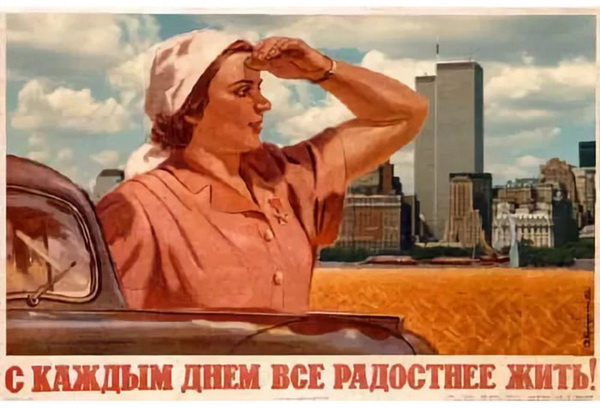
In the 1970-1980s, the growing lag of the USSR from countries with a market economy grew into a systemic crisis that exacerbated social problems. At the beginning of the Brezhnev rule, the living standards, although slowly, increased. The essence of the peculiar silent “agreement” between the Brezhnev regime and the population was the orientation of society to consumer standards. “Oil” money, replacing the resources coming from the traditional sector, made it possible to slightly bring the standard of living in the USSR to the standard of living in developed capitalist countries. But much of the fact that propaganda was presented as the greatest conquest of socialism, in reality was only good wishes.
Firstly, all the years of the existence of the Soviet system, the economy was not aimed at satisfying the needs of people, but at maintaining the existing political system-at the expense of past generations (camp work at the “construction sites”) or at the expense of future (the sale of raw materials resources). By the beginning of the 1980s, such serious distortions had accumulated in wages that incentives for work were largely undermined [84] . The inefficiency of the Soviet economic system allowed it under the most favorable conditions to ensure only a very low, according to Western standards, the level of consumption of the vast majority of the population.
Secondly, since the late 1970s, the growth of welfare has practically stopped. With a general increase in expenses for the development of the socio-cultural sphere, their share in national income and the state budget was continuously reduced. The share of housing costs in the total volume of capital investments for 1970-1984 decreased from 17.1 to 15.4%, and from the construction of science, culture, art and public education institutions - from 5.5 to 4.6%. The share of allocations for socio-cultural events and science in the total expenses of the state budget was reduced in 1970-1985 from 36.1 to 31.5% [85] . Party-proclaimed from high stands by the party “by 2000 to each family-a separate apartment” was never completed, although in the tenth (1976–1980) and the eleventh) and the eleventh) and the eleventh) (1981-1985) Five -year plans annually introduced at least 100 million square meters. m housing. By the beginning of the 1980s, the gap between the need for housing and its satisfaction was still significant [86] .
Thirdly, perhaps the most significant was that the declared principles of social policy (distribution depending on the labor contribution, the equality of access to education, housing, health services, etc.), which for many years contributed to the legitimization of the political regime within the country and beyond its borders, were not implemented. Social inequality has deepened since the 1960s. In the context of the general shortage of goods (this is the generic line of Soviet socialism), differentiation of the living standards of the population passed not so much through the line of official statements of issuing salaries or pensions, but if possible access to material goods. This access was determined by the position in the party-state structure and belonging to privileged layers and population groups. Therefore, despite the "equality in poverty", there were many those who "feed on a shortage." According to some estimates, every fourth-fifth family possessed such opportunities. These are trading workers and speculators who have resold goods purchased from the submoppers, as well as the party and Soviet nomenclature closely related to them [87] . This also includes the generals of the army and the KGB, the leaders of collective farms and state farms, the population of closed cities of the military -industrial complex.
The differentiation of housing provision was high. In the late 1970s, as in 1968, less than 5 square meters. m per person had 10% of families, more than 15 square meters. m -17%. The share of the housing in the queue for 10 years did not decrease and amounted to the previous 20%, as before they were waiting for the apartment for 10-15 years. The most valuable party and government officials for the state, the Army Generals and the KGB, the leading workers of the military -industrial complex were endowed with apartments out of turn. The state was the main customer of housing construction, it distributed housing. The problem was that it was almost impossible to control the movement in housing lines, since there were many exceptions for the extraordinary provision of housing (military personnel, social labor heroes, large families, etc.), as well as many abuse of housing distribution. As a result, free apartments in prestigious areas went primarily to privileged social layers.
The quality of housing was also very different. Almost 50% of the families did not have either a water supply, or sewage, or both together, 25% of families used these benefits [88] . In Moscow and regional centers, there were quarters of the so -called "Tsekovsky" houses of improved layout.
Public funds for consumption, in theory, designed to smooth out inequality, in practice did badly, as eloquently evidenced by the materials of budget examinations. So, in the statistical department of the Gorky region, the inspection was noted in 1966 that pensions, vacations, subsidies for tickets to the sanatoriums, rest houses, pioneering camps and the maintenance of children in children's institutions in the families of workers and employees were 3.5 times higher than in the families of collective farmers [89] .
At the turn of the 1980s, flagrant social inequality was also manifested in health care, which formally possessed a number of advantages. A wide national network of district and city hospitals for inpatient treatment, clinics, outpatient and paramedic points in the village was created. In addition, there were departmental medical institutions at factories, factories, institutes, organizations. Since the 1960s, mandatory professional examinations of various categories of employees have been introduced that have allowed to identify diseases in the early stages. In 1986-1988, according to the number of doctors per 1000 people of the population of the USSR (43.8), France (24.8), Japan (20.7), Germany (32.6) and the USA (27.2) [90] [90] .
Theoretically, medical care was available to everyone, but there was a huge difference between residents of large cities and villagers, especially in remote areas. Due to the residual financing, the level of medical services provided left much to be desired, there was constantly not enough medical staff, modern equipment and medicines-not only on the periphery, but also in large cities. Every year, the medical service system has become more and more electrical and corruption.
Similar processes took place in the field of education, which, due to the evolution of political and other spheres of Soviet society, lost its best qualities.
The visibility of well-being in the national economy, some growth of well-being in the 1970s were provided thanks to "oil doping". Oil exports, the prices of which in the world market increased almost 20 times, allowed the country to exist relatively comfortable, “solve” food, space and other “complex” programs. The internal needs of society for freedom, the expansion of civil rights, pluralism of opinions and activities were manifested in the creation of new parallel structures in the economy, and the social organization of Soviet society, and in ideology.