
Translated material
Intimidation potential
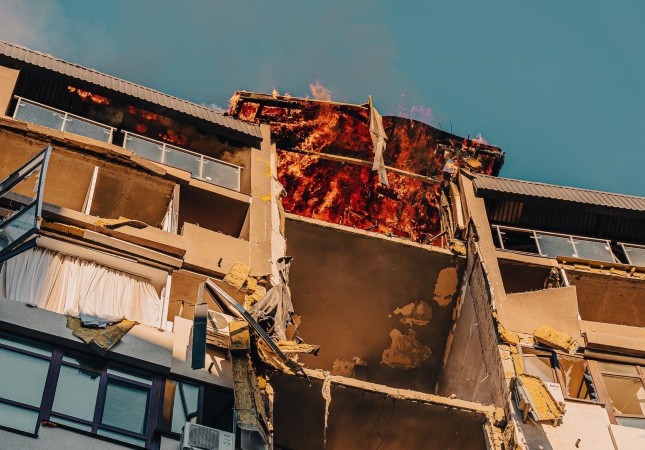
The consequences of a missile strike on the Kyiv high -rise building. Photo: Dmitro Sanin/@defenseu
The last shelling of Kyiv, Kremenchug, the Dnieper, Nikolaev, Odessa and other Ukrainian cities were clearly timed to the meeting of the Grand Seven in Munich and the NATO summit in Madrid. As a result, dozens of dead and wounded civilians. In a shopping center in Kremenchug alone, the Russian rocket killed at least 20 people, dozens are listed as missing.
The missiles with which Russia fired at the Ukrainian cities are not a high -precision weapon, and during their use, large sacrifices among the civilian population are inevitable. But Putin’s goal is precisely in order to intimidate Ukrainians with the help of massive missile shelling of cities, break their will to fight and force them to surrender. With the help of missile shelling, the Kremlin dwarf is trying to intimidate the Western allies of Ukraine, especially in the light of the conflict inflated by Moscow around the ban on transit through Lithuania of sanctions goods to the Kaliningrad region. According to the Kremlin strategists, European inhabitants, seeing the destructive consequences of Russian bombing in Ukraine, must imagine that tomorrow Russian missiles can collapse in the same way into European cities. And having become afraid, they will demand from their governments to agree with Putin in Ukraine as soon as possible.
On the other hand, in Moscow they strive to give a certain argument to those politicians in the West who believes that Putin should continue to talk and look for an acceptable compromise for him. First of all, this applies to the leaders of Germany, France and Italy. According to the Kremlin’s plan, they should use the fact of the intensifying shelling of Ukrainian cities in order to convince that part of the public of their countries, which requires unconditional support of Ukraine (and there are most of them in Europe), in the need for a speedy achievement of a compromise with the Kremlin in order to avoid further victims among the civilians. At the same time, Moscow no longer care about any plausible propaganda justification for the missile shelling of Ukrainian cities - both for the internal and external audience. Russian propagandists act on the principle formulated by the Roman emperor Caligula: "Let them hate, if only they were afraid!"
Vladimir Zelensky, who rightly called Russia a terrorist state after raids on Kyiv and Kremenchug, said in an interview with NBC to the American television channel: “One on one with Russia is difficult for us. And we will not stand it, therefore, the support of Europe and the USA is very important ... We must understand that this is not our war. Not only Russia's war with Ukraine, this is the war of the entire civilized world with the Russian Federation, with its military-political leadership, with its military-political leadership, with its military-political leadership, with its We will not be able to the army alone, and thank God that they help us. "
The West's mights seem to gradually overcome the fear of Russia and refuse to "peaceful" Putin. At the meeting of the Great Seven in Munich, it was stated that all these states, which account for more than half of the global GDP, would continue to provide Ukraine with military, economic and humanitarian assistance as much as it will be necessary. In fact, this statement puts the end of Moscow's hopes on the possible neutral status of Ukraine.
The NATO Madrid summit began with the long -awaited agreement on the entry into the Alliance of Finland and Sweden. Of course, Erdogan for refusing Veto received an expensive price in the form of a withdrawal of an arms embargo and the consent of the two Scandinavian countries to help Turkey in the fight against the Kurdistan Workers' Party. But on the other hand, NATO demonstrated unity at a difficult moment, making vain attempts by Putin to split this largest military-political bloc.
The general position of NATO countries was formulated by the Prime Minister of Belgium Alexander de Kro: "This war can only be won on the battlefield. We must continue to support the President of Zelensky and the Ukrainian people in order to win the battlefield against Russian aggression."
If these words will be backed up in the very near future in the form of quick and large -scale supplies of heavy weapons, then a military victory over the aggressor can be achieved in a relatively short time. The tightening of the war for several years will not only bring new disasters to the people of Ukraine, but will also put the West in the face of a protracted economic crisis. It is better to spend money now than getting a long war for exhaustion.