
Translated material
The Ministry of Justice explained to PMUUF who he recognizes “foreign agents”

On Wednesday, June 29, the representative of the Ministry of Justice Roman Tsyganov spoke at the St. Petersburg International Law Forum . He explained to whom the department considers “foreign agents”. So, according to him, “foreign agents” are NGOs that do not recognize Crimea, examine the problems of the impunity of crimes and are in support of the “memorial”.
Deputy Maria Butina, who was one of the developers of the bill on “foreign agents”, also performed at the forum. She told why now they decided to tighten the legislation. And she suggested accelerating the onset of criminal liability for “foreign agents”.
"Paper" watched the broadcast of the event and retells the position of representatives of the Russian authorities. Evaluate the arguments in support of the law, which allows you to close independent media and NPOs.
The Ministry of Justice said that NPOs received billions of rubles from abroad. They were recognized as “foreign agents”, including for the contradiction of stateliness
The lecture for PMUF-2022 was held by the deputy director of the Department for Non-Profit Organizations of the Ministry of Justice Roman Tsyganov. All 30 minutes the official read the text from the paper with a monotonous voice.
He began by the fact that the “right of citizens to unite” is provided for by the Constitution of Russia. But, according to him, "he began to pay attention to the fact that the activities of a number of non -profit organizations are political in nature and is paid by foreign states."
According to Tsyganov, in 2020, 3581 NPOs received 72 billion rubles from foreign sources, and in 2021 - 5675 NPOs received 73 billion. Where did this data come from, he did not specify.
“In order to carry out activities that put pressure on the socially significant spheres of society by foreign states and structures, new ways of bypass began to be used,” the official said.
Tsyganov argued that the concept of “foreign agent” was introduced into the legislation of the Russian Federation from the desire to ensure transparency and openness of the NPO, which are engaged in political activities in Russia. And also in order to strengthen sovereignty and political independence.
“Any attempts to find any contexts are deprived of constitutional and legal grounds in the phrase“ foreign agent ”and this concept is unbearable, Tsyganov said. Moreover, he later noted that organizations are included in the register of foreign agents so that “interested parties” can “somehow evaluate them”.
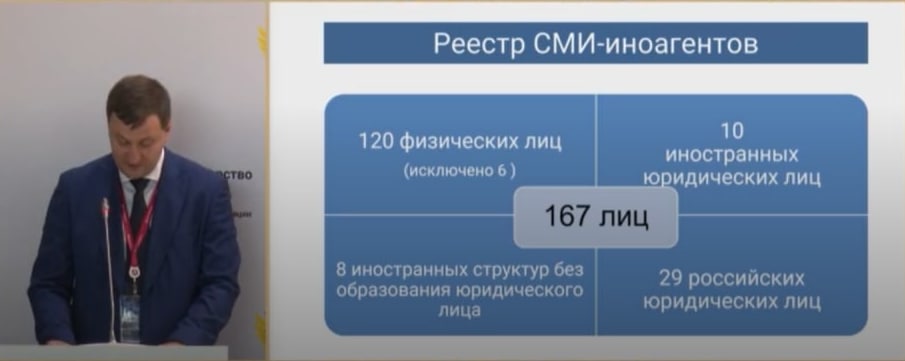
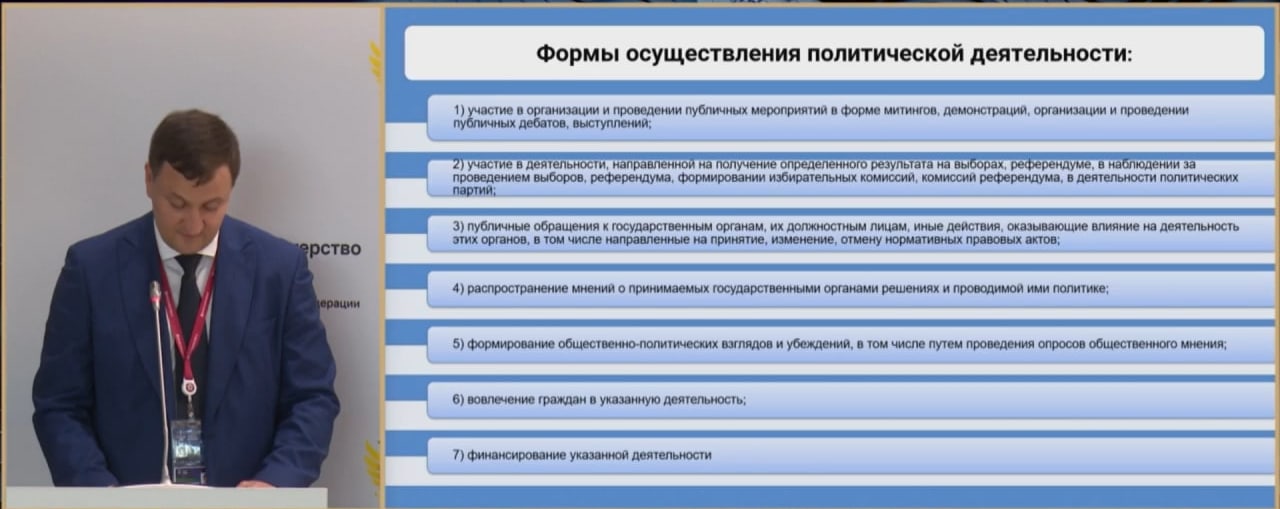
According to Tsyganov, NPOs, who are now in the register, recognized as “foreign agents” for the fact that they are:
- publicly appealed to the Russian authorities demanding the abolition or amendment of laws;
- “Expressed opinions” about the policy pursued by Russian state bodies;
- They formed a public opinion contrary to the state policy of Russia.


The Ministry of Justice dismantled the three examples of the NGOs, which were recognized as "foreign agents." They were guilty of the non -recognition of Crimea and the study of the problems of impunity of crimes
Roman Tsyganov said: “Contrary to the common opinion <...> the Ministry of Justice of Russia does not pursue the goal of suppressing political activity. We are designed to ensure compliance with the law and transparency. ”
The representative of the Ministry of Justice explained with three examples, for which NGOs are recognized as “foreign agents” (the official did not mention their name):
- “For example, one of the organizations included in the register, despite the statutory goals in the form of the provision of culture services in the framework of Russian-German projects, took part in public events, which were evaluated by foreign policy on the entry of Crimea in Russia.”
- “Another organization on an ongoing basis carried out measures aimed at criticism in the field of protecting the foundations of the constitutional system, <...> as well as the legislative regulation of human and citizen rights and freedoms. In particular, the organization published a report, which presents the results of a study of the legal problems of the impunity of crimes that are authorized by the government, and proposed measures to overcome the consequences. The organization also extended opinions regarding a violation of human rights, ranging from Crimean subjects and ending with a widespread violation of the rights of lawyers of the Russian Federation by state authorities. ”
- “The purpose of the activity of another organization is to provide services in the field of social protection, <...> as well as the development of socially significant volunteer initiatives. However, despite the indicated goals of the activity, the head of the organization, among other things, took an active part in protest shares, advocated the abolition of legislation prohibiting the propaganda of non -traditional sexual relations among minors, as well as the collection of signatures under the petition in support of the International Public Organization “Memorial” ”.

The co -authorship of the bill on “foreign agents” spoke about toughening the rules and proposed to introduce criminal liability
State Duma deputy Maria Butina, who was one of the developers of the bill on “foreign agents”, told the same session why the rules decided to tighten.
What a tightening of the law on "foreign agents" ↓
On June 29, the State Duma adopted in the third reading a new bill on "foreign agents"
The law will begin to operate on December 1, 2022, according to the State Duma website. Now, any Russian organizations or ordinary citizens will be able to become “foreign agents” (even if they did not receive foreign financing). A unified register of “foreign agents” will be introduced (instead of the existing four).
“Inoage” will not be able to be the organizers of rallies and other public events, conduct teaching, educational and educational activities in relation to minors, receive state support and invest in strategic enterprises in Russia.
“We think about the future and make a decision exclusively in the interests of the citizens of our country, our state,” the new law was commented by the State Duma speaker Vyacheslav Volodin.
"Paper" spoke in detail about the new bill, and also asked the media to the media, Svetlana Kuzevanov to explain who the new restrictions could affect.
Butina said that she received appeals from citizens who complained about history textbooks, where there were references to falsify history - therefore, according to her, “foreign agents” were banned from educational activities.
Foreign influence appeared in the law, because the lawmakers did not want to substitute the Ministry of Justice so that he did not have to “run and look for how foreign agents are financed,” Butina said. “What if they buy an apartment for the inoagent? And what to do? Therefore, a foreign influence, ”she explained.
Butina also advocated the tightening of the existing law. She said that, in her opinion, it was wrong, that for the refusal to voluntarily register as a foreign agent, a small administrative liability is provided. She believes that a criminal is needed.
- The only point that we have not taken into account and which, I hope, will be finalized. <...> Let the registration of foreign agents be voluntary, but if you have qualifying features as a foreign agent and do not register, today there is minimal administrative responsibility. In my opinion, this is wrong. It should be about criminal liability if the organization, either an individual, or the media works for a foreign account. We remember with you what the essence of the spirit of our law is. We want people to know at whose expense this banquet.
After Botina’s performance, the session ended. The lecture did not mean questions.
Photo on the cover: Ekaterina Kuzmina / RBC / TASS
What else to read:
- What is the status of a foreign agent for readers of independent media? Does it affect trust to journalists? And what does society think about this law? Study .
- What is it like to live in the status of "foreign -agent"? Read a big interview with Daria Apakhonchich - about its work and promotions, the emotional experience of the "stigma" from the state and about how the status of "foreigner" affects its life