
Translated material
War of music
Kyiv violinists play Lacrimose of Maxim Shalygin in the Swiss locomotive depot. Listen to her and you
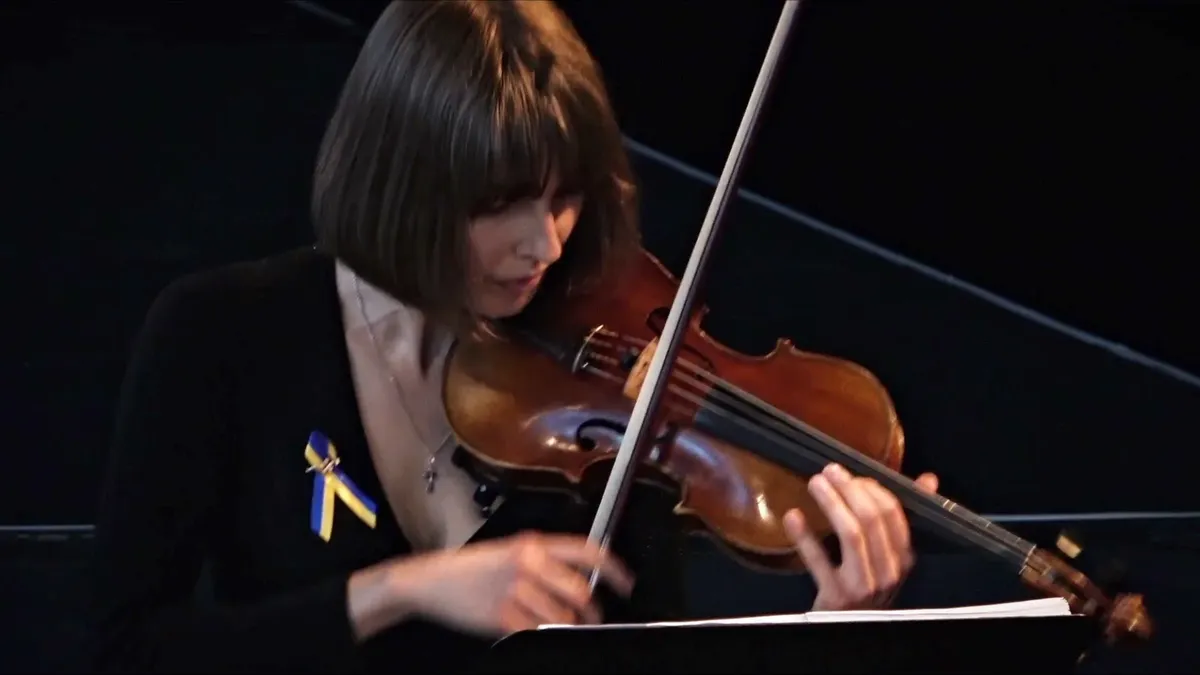
Seven violins.
The seven best violinist of Kyiv in the Swiss city of St. Gallen.
At an altitude of 700 meters above sea level, at a distance of 2000 kilometers from the war.
The violinists play "lacrimose, or 13 magic songs" of the Ukrainian-Niderland composer Maxim Shalygin.
Lacrimosa is a funeral mass, part of the detail. Lokremiz is a locomotive depot.
"Lacrimose" play in Lokremiz. Life rhymes war and peace.
The first song: Light
The glass in the giant openings between the concrete walls of the depot is different - some transparent, other muddy, and there is no logic in their chaotic alternation. It was as if all the glasses were muddy at first (to hide the tired locomotives from human eyes), then the explosion thundered, and some of the glass knocked out, but not all, but replaced the missing ones than it were, there were no muddy. So the mosaic came out. And by pieces of cowline life, visible through transparent glasses, the audience themselves recreate the world. Draw him.
The second song: beeps
Passers -by flickering there. There, the setting sun highlights the bright orange upper three floors of the house opposite, and then two, and then one. A silent tram slips there, short and fast. Cars are driving. The train slides. But only music is heard. Almost just music. Almost music. Unbearable sounds.
Song Third: Air
The locomotive drives into a turning circle and rides like a carousel until he burns his face on his own gates. Each locomotive has its own stall. Here they rest after a working day. The depot is large and round, the stalls are radially located.
So it was before. The turning circle probably creaked pretty. Now violins creak into the depot. There is nothing to breathe.
Fourth song: insects
A conductor in a white shirt is a bright spot in the center of the hall. He gathered these violinists scattered around the world. Scattered by the war. Around the world.
And so they stand in front of him in a semicircle and obey his hands. And the Shcherbata wall behind them is also a semicircle, because it is a circular locomotive depot.
A giant caterpillar of sounds creeps slowly.
Seven beautiful thin figures shudder from strange movements. Seven grasshoppers in black.
Song Fifth: Rainbow
“When there are no tears in your eyes, there will be no rainbow in your soul,” Maxim Shalygin chose such a saying to the indigenous Americans as an epigrone for Lacrima. The choice is clear. “But why, from the whole variety of the almost polar music of the composer Shalygin long before the concert, in peacetime, the conductor Mikheil Menabde chose a war?” - is surprised by Julia Di Bella, the founder and president of the non -profit association Cosmokultur St.gallen, the organizer of the concert.
Song Sixth: Lullaby
A woman in the front row is pressed against a man and puts her head on his shoulder.
People can’t stand it. People leave. They do not go on tiptoe, but walking along the wooden steps. The stress of the exiting does not interfere. It is difficult to interfere with such music.
A man in the front row squeezes his shoulder with a woman pressing against him.
Seventh song: Stream
This is the second concert of Ukrainian composers from the IM Spiegel series, that is, “In the Mirror”. On the 73rd day of the war, Valentin Silvestrov himself played in the same locomotive depot. He then said: "Now is not up to music." However, he himself sat down at the instrument and played what he composed after the start of the war. And people almost forgot to breathe - so they all were before music.
Song eight: rain
Two months with the parents of the conductor’s wife, there was no connection. The parents of the wife were in Mariupol. How did they survive on the fifth floor? Half of the house is no longer there, and half is worth it. And two months from them not a single news. So how?
The parents of the conductor’s wife survived a miracle.
Each of the seven violins also has their own history of war. But when they play, they think about music, and not about the war.
Song ninth: crazy
This cannot be, but Magic Songs Maxim Shalygin wrote five years ago. This cannot be, because they are a mirror of today.
Tenth song: melancholy
The music lasts 70 minutes. The war goes on four months.
Song Eleventh: Sirens
Is it possible to play war?
The concrete walls of the locomotive depot are interrupted as if with fragments. Trams and trains go outside the window. They can be seen, but not heard. Nothing is heard. Sires howl.
The violin cannot make such sounds.
Grandmother in the front row wipes off a tear. And then he gets up and leaves. It is very difficult to stand this music. It is very difficult to look at the war.
Song Twelfth: Prayers
The war is played in St. Gallen. In the city of St. Gall, the monk Galla. Who came here from afar. Who prayed here.
Sounds cut us. The world that is behind the mosaic of different -caliber glasses cut off us. The world that highlights the evening sun. We are in a concrete depot. We are like in a bunker.
Song Thirteenth: Round dance
The train is going. Not knocking at the junctions - not an old train. A modern Swiss train is traveling. Approaches. It is well audible. It is strange, it seems that no one opened these muddy and transparently mixing the window. Why did the trains glide in inaudible before, they all saw them, but they seemed to be not? And now a physically tangible train is going. But it is not outside the window. Music is going. Unbearable. Impossible.
And leaving. And silence.
A terrible music that brings relief, ending.
Applause
A composer comes out of the audience to the musicians with a slight step. Bearded, smiling, all in black, but in red socks and for some reason without boots. The conductor from behind the curtains makes a huge yellow-blue flag. The conductor smiles. The musicians are smiling. Spectators smile too.
Joy. Life defeated again.
ABC
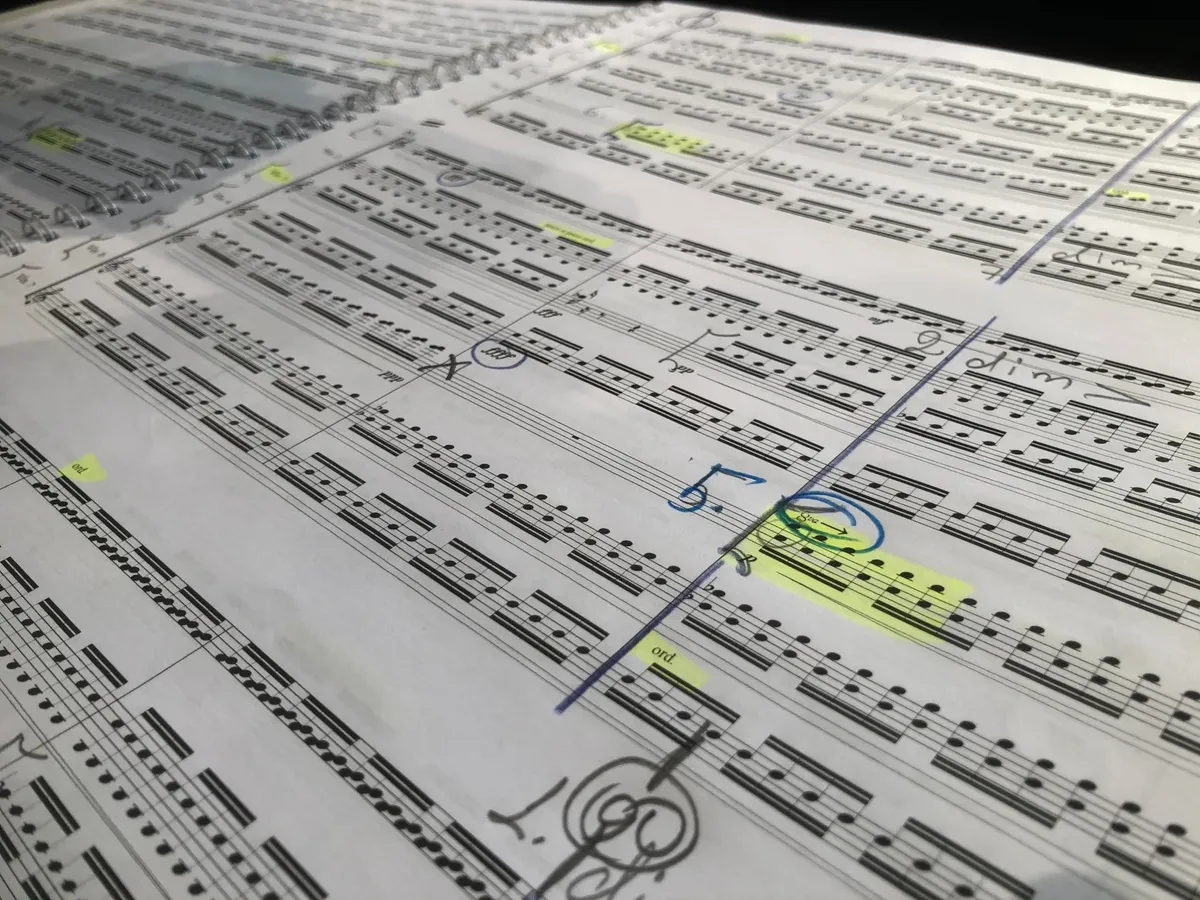
The composer leaves. The conductor leaves. The musicians are leaving. On the pupiter, notes remain open. A strange sight is some points and dashes instead of human notes. Some kind of music by Morze. ABC of wartime.
The concert can be seen here here
Conductor: "Now everything sounds differently"
Mikheil Menabde is a constant invited conductor in the Kiev Philharmonic and the National Symphony Orchestra of Georgia. Since 2017, he has been living in Vienna.
The chamber orchestra of Armonia Ludus, which came to Switzerland to play Lacrimose, Mikheil created in Kyiv in 2014.
- They say that it was not easy to collect all the musicians during the war.
- There was a problem with men, as Ukraine has martial law. But we wrote in instance and received permission. Four came from Kyiv, the rest were already abroad like refugees. These are the seven best violinists of Ukraine. Young, talented, burning. We planned all this in peacetime. I had to go to Kyiv, there to rehearse with them, and then come here and play. But now it is impossible to rehearse in Kyiv, so I had to take them all out - first to my Austria. There they gave us a whole house for free in the mountains, and we lived in it for a week, rehearsed six hours a day. They also conducted a general rehearsal - in the church, for local residents. We beat, so to speak. And then we arrived in Switzerland.
- What is your very story with Kyiv?
-I lived there from 2006 to 2016. He studied, married twice, worked in the Philharmonic.
- When was the last time in Kyiv?
- I had a concert there on February 14. Everyone had already expected that they would bomb, but the hall was complete.
- What music did you play at that time?
- “Romeo and Juliet” of three composers: Prokofiev, Tchaikovsky and Lyatoshinsky. It was Valentine's Day. Every day, people were preparing for something bad, and in such a stress state they held a concert.
- Why now, for a Swiss concert, you have chosen such music?
- Why? Well, you heard everything there? Have you heard horror? Beauty too? And flying away and falling, right? That's why I chose it. Because life, it is so - now up, then down, then tramples you, then lifts you. This music is good, but very complicated. Complex both physically and emotionally. The composer Shalygin is this: either you leave the hall with a bang, or remain to the end.
- The organizers of the concert say that you chose Lacrimose in peacetime.
- Yes, a year ago.
-Not because of the war, then?
- No. But she works very much now.
“You knew her before the war.” Now does it sound differently?
- Certainly. Now everything sounds different. There are direct, even banal, associations. Sirens, for example. Although this music was written in 2017 and is not related to the war. Everyone decides for himself what it is connected with.
- This is heavy music. Some could not stand it and left.
- There is also a goal to shock. Honestly, I thought, no one would come at all. Sometimes, they rushed with tomatoes. We are still lucky.
Composer: "War is the father of all things"
Maxim Shalygin is one of the most common Ukrainian composers in the West. The premiere of "Lacrimose" took place in 2017 in the Netherlands, where he has been living for 12 years.
- You wrote Lacrimose five years ago. Today it was played as it was written? Or changed a little?
- What to change there? Everything is already clear.
- It seems that they changed. Or that she is written now.
- Why?
- Well, you could not write military sirens in advance!
- In my Holland, this military siren every first Monday of the month at 12 o’clock in the afternoon sounds. It sounds throughout Holland. Check it.
- So, this siren is not from Ukraine?
- Well, the war is not only in Ukraine - they are constantly going. This horror is going on all the time. Moves around the globe. And no one knows how to deal with him, how to stop it all. I, here, write the work "Capricchio of the world." There, each part is dedicated to a separate country. I began to write it in 2019, but I have not yet finished. And there I also planned Russia, I began to write it during quarantine, and I had only bombs there, all kinds of military sounds. I have not finished it yet: I did not know what to do with the Clarnet party, I have not come up with yet. There is also Japan, England, Syria and Africa - has not yet chosen the country.
- Are these warring countries?
- No, I chose countries in which I could find rich sound spectra.
- That is, the "Capricchio of the globe"?
- Yes, just Mira.
- Do you play Lacrimose for the first time during the war?
- Yes.
-Now you perceive this music differently? Thinking, hearing her, about the war?
- Yes, I have thoughts about the war all the time. Even when it was not in Ukraine, I always had such thoughts. War is the father of all things. It is bad that people think about the war only when it comes to them. You always need to think about this. The war just does not come like that. It must be tried to prevent it by all means. So far, people do not stop killing animals - I have such a theory - until then they will have wars. In some countries there are more aggression, in some less. We must stop killing and trying to live.
- Are you good in Holland?
- Yes, this is my house already. There are problems. But now there is a fairly peaceful people live.
- You cried in these four months?
- Yes, in the beginning. And then the tears were over. I have sensations, I have, like all Ukrainians: there was life before that life after. You will never return to the world in which you lived before. It is impossible to forget, erase from memory. Moreover, this all continues.
- Do you have relatives in Ukraine?
- Parents there, next to the Dnieper, 300 km from the fighting. Bombs do not fall on them, although I do not know what can be called a safe place there. They cannot leave: they have animals, work, an old grandmother. And my sister in Holland is now with children. Well, sirens are constant there, why worry all this. Children are hard to emotionally. But we hope. Every morning I wake up, open the phone with one thought - that the war is over. But so far it is not visible how it can end.