
Translated material
Grapefruit in the world of the park
The New Yorker tells the story of the life and work of Yoko it - artists who remained in the shadow of her husband
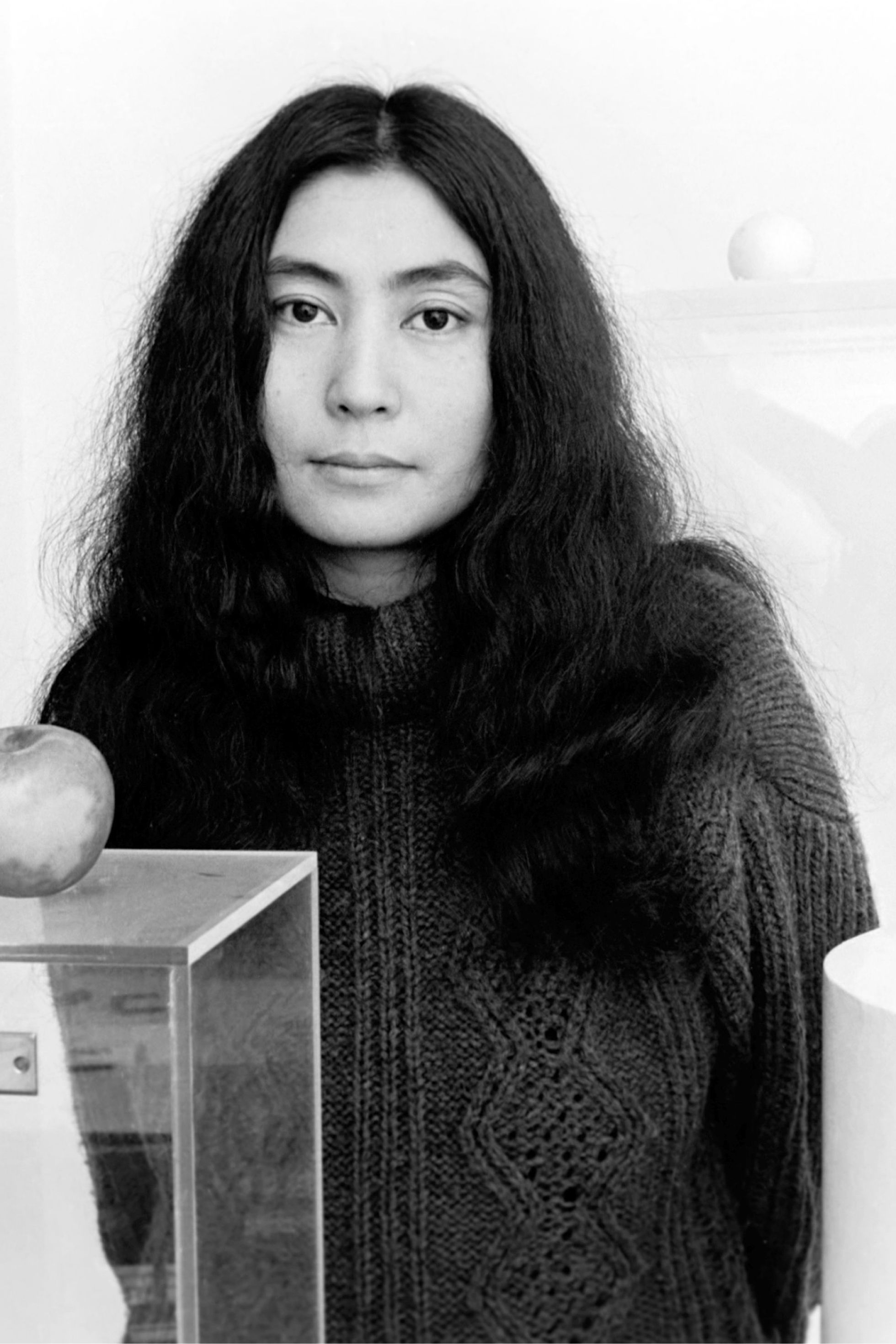
Yoko it is one of the most famous contemporary artists. But many learned about her only after her marriage with one of The Beatles, British musician John Lennon. Although creativity it is of interest in itself. She was among the first conceptual artists, was engaged in feminist art when almost no one paid attention to this. And later she acted as a co -author of the main hit of the post -Bitter career of Lennon - the song “Imagine”. The New Yorker tells about the creative path of Yoko it. Read our translation (with minor reductions) of this article.
On March 9, 1945, more than 300 B-29 bombers traveled a path of two and a half thousand kilometers over the Pacific Ocean and attacked Tokyo from the air. From midnight, about 1665 tons of incendiary bombs fell to the city.
Most of the buildings in Tokyo were built of wood and bamboo - and in a matter of hours the whole areas of the city were covered with fire. The planes aimed at the working quarters in the center of the capital - in this way it was supposed to disable Japan's military industry. As a result of these bombing, at least 100 thousand people were killed, another million Tokyans were left without a house. Later, the raid participants said that, flying over the city at an altitude of one and a half kilometers, they felt the smell of burning flesh.
That night, Yoko, it was lying in bed with temperature. While her mother and younger brother Caisuke were hiding in a bomb shelter under the garden of their house, Yoko remained in her room. She could see from the window how the city blazes. The girl only turned 12.
The family was wealthy and lived with 30 servants in the quarter of Adzabu, near the imperial palace, far from bombing. Fires did not reach there. However, the mother of Yoko, fearing the repetition of attacks (and not in vain), decided to evacuate the family out of town.
In the village, they were faced with a lack of food. Children exchanged their things for food, and sometimes completely starved. Later, she said that he and Caisuke were lying and looked at the sky through the hole in the roof of the house. She asked her brother what he would like to eat for dinner, and then said to imagine it. He seemed to become a little happier. “Perhaps this was my first art work,” she said.
Like any artist, Yoko, it wanted recognition, but it never moved the desire for wealth or glory. However, she strove for whether it really was, today it has both. Her works are exhibited around the world: last year - in the Serpentine Gallery in London (Yoko Ono : I Love You Earth ), and in this - in the art gallery of Vancouver ) and in the Zurichsky Kunsthaus The Same Speed as the Clouds ). She began managing family finances in 1971, after moving with her husband John Lennon to New York. And today, the state of Yoko is estimated at hundreds of millions of dollars.
There is no doubt that museums and galleries arrange these exhibitions-and people come to them-because once Yoko it was married to Beatle. None of the artists and composers, among whom it rotated before marriage with Lennon, today has no such success.
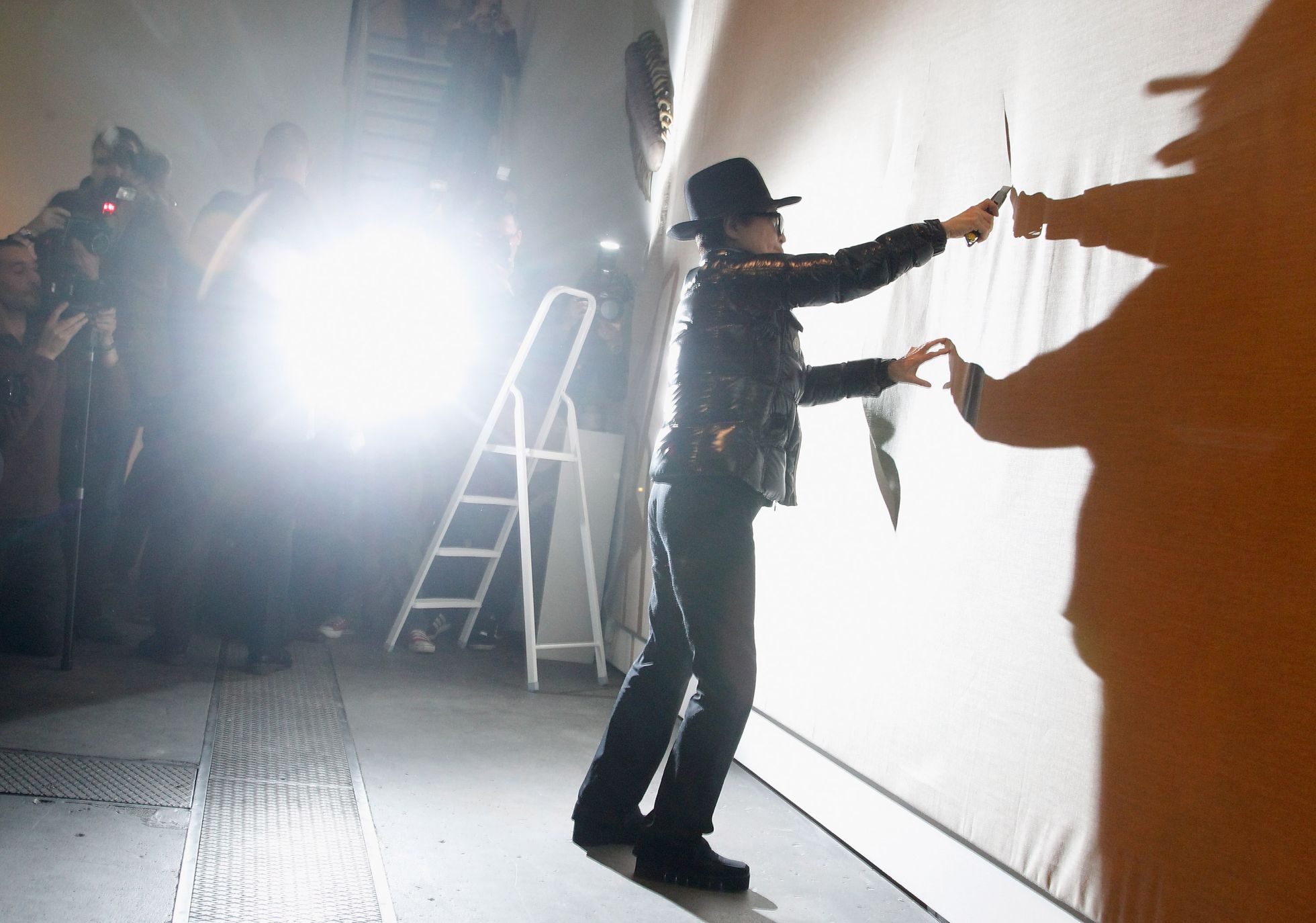
Apparently, Yoko, it skillfully took advantage of its fame - but what? She never made her art. Public opinion about her as a woman who honors the memory of the deceased husband made Yoko an icon in the eyes of people who once treated her as a succubus who ruined The Beatles. At the same time, a much less numerous group of people who know her as an artist, musician and activist, appreciate her for fidelity to their principles and identity. It doesn’t matter who thinks about the power of art is difficult not to admire the author of these works.
Grapefruit
Yoko's parents, according to her, were emotionally suspended. The mother was from the Yasuda family-the founders of Yasuda-Bank (later Fuji-Bank), the owners of one of the four largest financial conglomerates in Japan. Father worked in Yokoham Spesi Bank, which after the war became called the Tokyo Bank, and often served in its foreign branches. When Yoko was born, her father was in San Francisco; She did not see him until her three years. And in 1945, during the Tokyo bombing, he was in Hanoi.
Yoko it received an exclusive education. From the youngest years, she was taught Christian doctrine (Father Yoko was a Christian, of which there were few in Japan), Buddhism and playing the piano. She attended a school, known for her level of musical education, once the girl was asked to shift everyday noise and sounds such as bird singing to notes. After the war, Yoko studied at a private school, where her classmates were two sons of the emperor. After school, it was enrolled in the University of Gakusuin - it became the first student of the Faculty of Philosophy in the history of this educational institution.
Yoko left after two semesters. She said that the university created her feeling that she was "livestock, which is fed with information." So for the first time it was allergic to everything organized and institutionalized. One of the classmates had another version: "She was satisfied only if she was treated as a queen."
Perhaps it left the university also because her parents moved to Skarsdale -her father was transferred to the New York representative office of the bank. Soon it joined them and in 1953 began to study at the college of Sarah Lawrence in Bronxville. The college at that time was female and extremely progressive - no requirements and assessments. It chose music and art, but it seems that it did not really fit. One teacher recalls her as "very restrained and seriously configured to study." “Other students were more relaxed. Yoko was not relaxed, ”he adds.
No matter how flexible and free the approach to education in Sarah Lawrence, the college provoked a branded allergy attack. “It was like an institution with which I should argue, and I could not overcome it,” Yoko complained. Then she decided that she had to go away from her family. She later said that she had “tremendous pressure”: it was assumed that it would become a worthy representative of the noble family of Yasud/it. “If I had not rebelled, I would not have survived,” she said. Yoko met Toshi St. Isaiga, then a student of the Julian school, one of the largest American educational institutions in the field of art and music. In 1956, she left the college, married him-her parents were not enthusiastic-and moved to Manhattan. It began to provide itself with random part -time jobs. The next 10 years she lived mainly in New York.
Shortly before throwing college, it published a story in a student newspaper called “Grapefruit in the world of the park”. The text is about young people who cannot decide what to do with the grapefruit remaining after the picnic. The allegory is a little mysterious, but it is clear that Grapefruit personifies is a hybrid, just like Yoko herself.
Attic to Chamber-Street, 112
Someone will say that the art and music of Yoko is inherent in an amateurish character, "everyone can." Critic Lester Bangs was somehow indignant that it was "a powerful bear in his ear." However, this is a deliberate deception. It’s not that Yoko did not receive a good musical education - she studied the composition and harmony, while still a little girl, and she knew a musical notation (that is, she could read notes and record notes of music), unlike the Beatles themselves. In the college, Yoko spent time in the phonotex, listening to the works of Dodecafonist composers such as Arnold Shenberg .
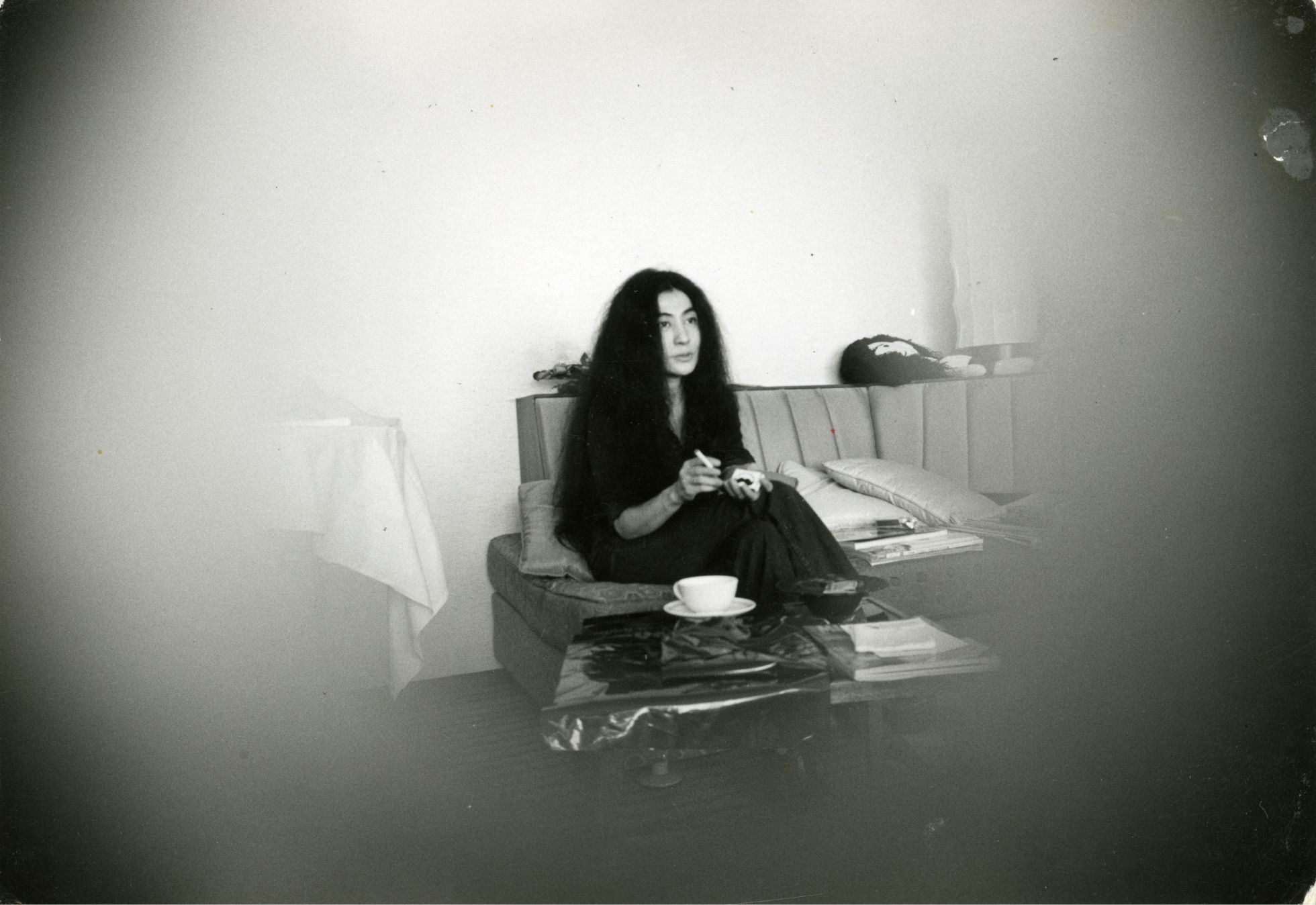
It grew up with bilingual and was educated in two cultural traditions. She studied at the school and university in Japan during the period of “horizontal westernization”, when the artistic and intellectual life was rapidly liberalized, the country tried to drop the shackles of its militaristic and ultra -nationalist past. She and her friends read German, French and Russian literature translated into Japanese, and young philosophers, whom they knew, were obsessed with existentialism. She also knew Japanese culture. As one of the part-time jobs in New York Yoko, it taught the performance of Japanese folk songs and calligraphy. She knew how to write a tank and owned the art of Kabuki . That is, it was perfectly prepared to enter the New York avant-garde circles in the fifties, because they were also hybrid, diverse. That avant-garde was inspired by the French artist Marcel Dyushan and the eastern religion, Zen Buddhism.
The embodiment of these two hobbies was the composer John Cage, a student of Schlenberg, an adherent of Eastern philosophy and the adore of Duchan. She met with Cage through her wife Toshi St. Isaac, who visited the Cage course at the University of New School. Cage did not expect his students from his students that they would imitate his own work. According to his admission, one of the most important things that he realized from his teaching activity was that the Ityanagi once said to him in response to some recommendation: “I am not you.” Cage encouraged experiments.
And students experimented. The characteristic work is the “candle play for the radio” of George Brecht. Radio receivers, one and a half receiver on the contractor are placed along the walls of the room. On each radio lies a deck of cards with printed instructions, for example, “Logger”, “South”, R or L (right or left, that is, a direction in which the regulator is twisted). Each performer is given a lit candle, and at the signal they begin to sort out the cards in the deck and follow the instructions on any radio nearby. The play ends when the last candle goes out.
This is what the hippenings look like. This is not a performance where anything can happen. Happing (with rare exceptions) has a script, a “score”. Each participant follows the exact instructions that and when to perform actions.
In 1960, Yoko, for 50 dollars and 50 cents a month, rented a attic on Chamber-Street, 112-the fourth floor without an elevator, heating and electricity, and the windows were so dirty soot that they barely passed the light. But there was a glazed roof. From furniture - orange lattice boxes and piano. It turned the loft into half living space, half a room for performances. Together with the composer and musician La Monte Yang (it was he who invented a monotonous buzzing sound, which in some of his songs used Velvet Underground) Yoko organized a number of concerts and performances. From December 1960 to June 1961, 11 artists and musicians performed in the loft. It mentioned that sometimes the number of spectators reached 200 people. There were Cage and Dyushan. Suddenly she ended up in the heart of the art scenes of the center of New York.
At some events, it performed itself, with its own works. One of the works: Yoko hung a sheet of paper on the wall, opened the refrigerator, took out products - such as jelly - and threw it into the sheet. At the end of the performance, I set fire to the paper. The art devoured itself. Cage advised it to process the sheet with a fire -retardant composition so as not to burn the building.
Fluxus
In the New York World of Art of the 1960 model, even in the most radical incarnation, men predominated. Among the 11 artists who performed at Chamber-Street, there was only one woman. To strong displeasure, it, the organizer and director of concerts, called her partner, musician La Monte Yang, and she was defined as a loft mistress.
She experienced even more irritation when she found out that a person who attended several concerts on her site planned to take exactly the same series of events in his gallery in a more distant area of the city. That Gallery on Medison Avenue was called AG Gallery, and the man was George Machunas.
Machunas came to the States from Lithuania in 1948, being a teenager; He studied the history of art for 11 years. Approximately in 1960, he set out to re -make art by removing it from the pedestal. Duchan and Cage had a strong influence on the artist. There is an interesting and convincing documentary about Machunas, George: the story of George Machunas and Fluxus. "
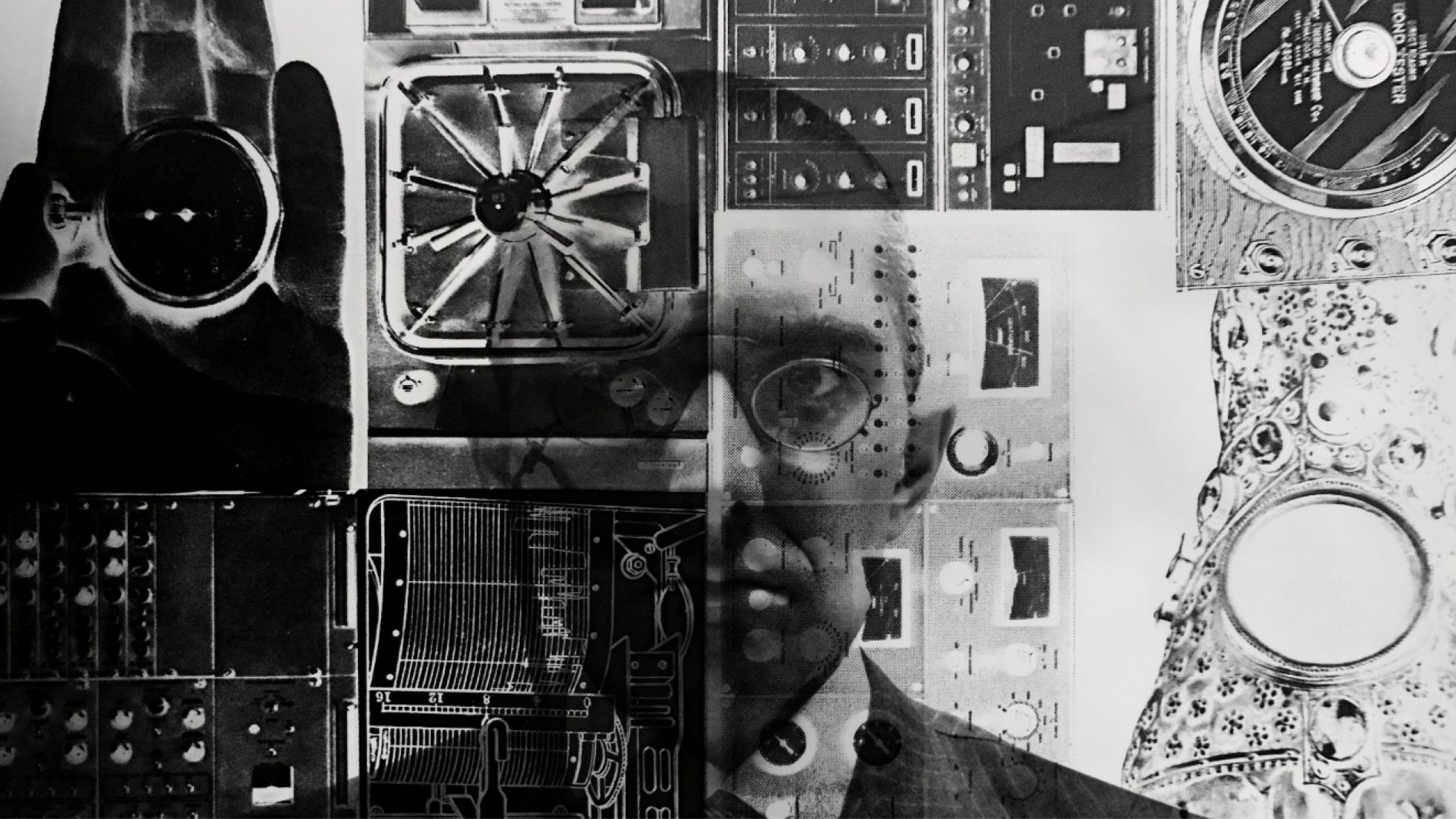
Yoko it softened when Machunas invited her to make an exhibition. He never had money - which did not prevent him from renting real estate, having a phone and everything else. He simply did not pay bills. By the time the exhibition was organized, in July 1961, the gallery could only be visited in the daytime, because the electricity was turned off there. The exposition it was the last exhibition in the gallery.
Yoko, it drove guests in the exhibition, explaining her work, because some exhibits demanded the participation of the viewer - for example, “the picture on which you need to step on”, a piece of canvas on the floor. This work, like Dyushan, seemed far -fetched, meaningless. But, like Dyushan, there was a hidden meaning here. “The picture that you need to step on” refers to two traditions. This is a hint of very famous photos printed at the end of the forties by Life magazine, and not only: Jackson Polelock draws his drip-charters, moving along the canvas spread on the floor. These pictures, representing painting as a performance, have been inspired by artists for decades - including Allan Kaprou Happing.
The second context, which was noted by the art critic Alexander Manro, is Japanese. In the XVII century, Christians persecuted in Japan, and one of the ways to identify them was a request to step on the image of Christ and the Virgin Mary. The procedure was called Fumi-e-"advance + image." The refusal was tortured or even executed. Thus, “the picture that you need to step on” is also a kind of grapefruit.
In the fall of 1961, it gave a concert in the Carnegie Hall concert hall-this site adjacent to the main hall contains about 300 spectators. Machunas, who was already a friend of Yoko, helped with the design. The Times wrote that the hall was a bit. But the evidence is so different that it is difficult to say, as everything was actually.
On the stage, 20 artists and musicians performed various actions - ate, beat the dishes, threw them with clips of newspapers. Behind the scene every now and then (with a certain interval) washed the toilet. To cause an audience a poor foreboding, a feeling of bad omen, a person stood in the corner of the hall. A bunch of men with flasks attached to her feet tried to cross the scene silently. The dancers Ivonna Rainer and Trisha Brown continuously sat down and got up. The description of The Village Voice says that the performance ended with the fact that Yoko “sighed, breathed, caught air with my mouth, portrayed the urge to vomit, screamed - many shades of pain and pleasure mixed with incoherent nonsense in a foreign language that was not at all.”
It was such an art that Machunas had in mind. It resorted to improvised materials. This art was inherent in a sense of humor (washing off water in the toilet) - that is, it did not treat itself excessively seriously. And it was anti -elitist. Anyone could engage in this art. Approximately at the same time, when it passed a concert, Machunas came up with a name for this type of art - Fluxus. When he shared the idea with Yoko, she considered it a mistake to give art a group name. That is how the Japanese world of art was arranged: each artist ranked himself to a particular group. And it did not want to attribute itself to the group.
However, Machunas was an avid organizer - what was a problem, because he worked with avant -garde artists, people who do not like when they are organized. And he tried to train them for years. For example, he opened a Flux shop, where it was possible to purchase Fluxus Art-mainly cheap plastic boxes with all sorts of things. At some point, I made plans to buy the island and create a flux-coat there on self-sufficiency.
The adventure with the island did not burn out, but ultimately Machunas realized his idea, having bought and repaired more than 20 abandoned buildings in the center of Manhattan to live and create artists. This company destroyed it. The tenants sued Machunas (because the repair was carried out not in accordance with the rules and the loft did not pass the inspection), and once the bandits hired by one of the creditors were greatly beaten. In the mid -seventies, Macheunas escaped from the city to the farm in Massachusetts, where he died of cancer in 1978. However, he gave rise to Soho - in the eighties this area will become the world capital of contemporary art.
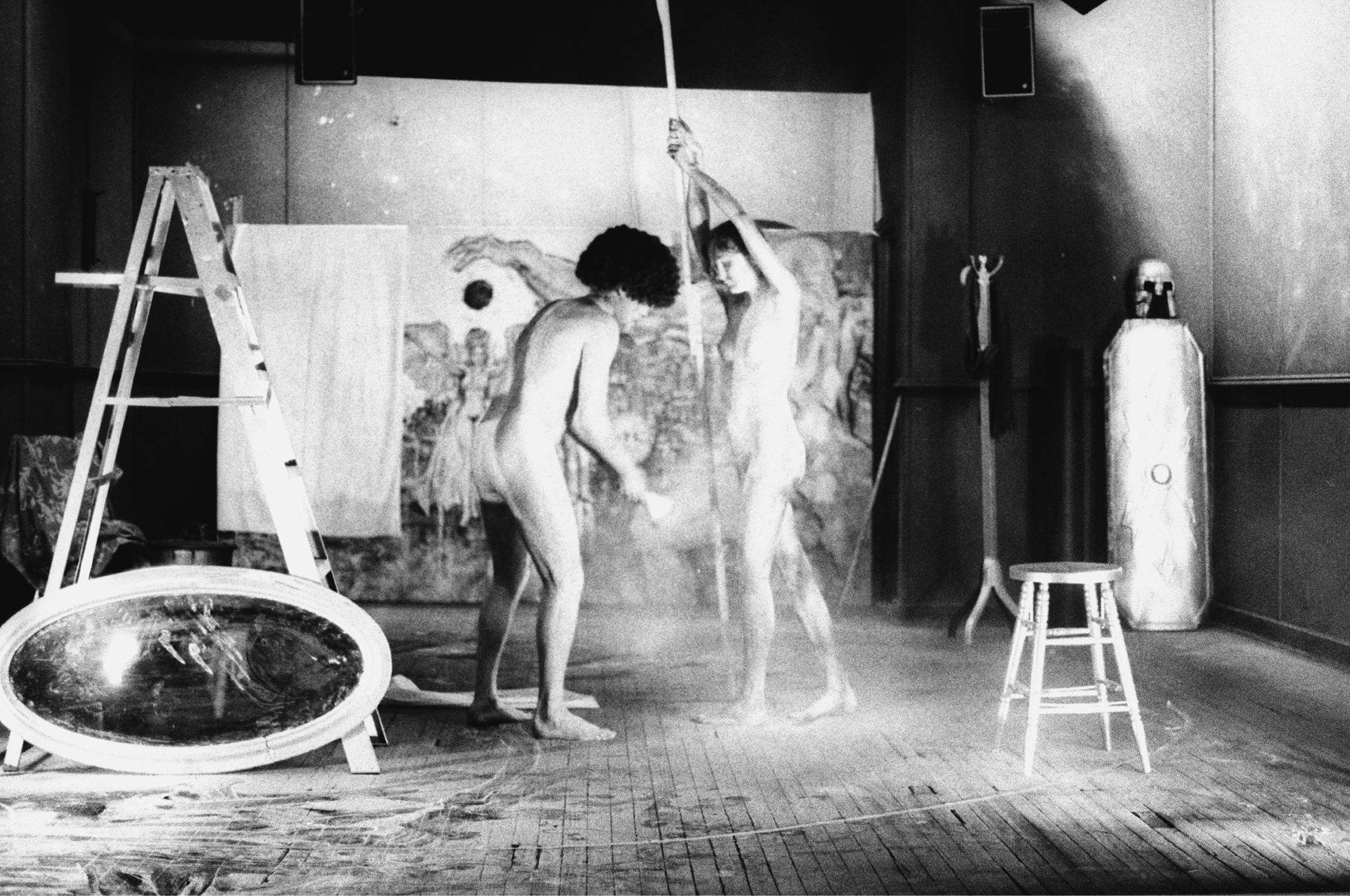
The motto of Fluxus written by Machunas was like this: “Clean the world from“ Europeanism ”!” - And on the debut performances of the movement in Germany in 1962, artists waned the piano to smithereens. Yoko was invited, but refused: she did not like to smash the piano. “I am not one of those people who want to burn Monu Lisa,” she said once. “This is the difference between me and some revolutionaries.” Однако у нее есть нечто общее с Мачюнасом. Оно идеалистка. И была бы счастлива, если бы весь мир мог быть флуксус-островом.
«Разрез-пьеса»
В 1962 году Йоко Оно вернулась в Японию, где обнаружила, что японский авангард еще более радикален, чем нью-йоркский. Возникло множество новых школ. Самая известная из них сегодня — зародившаяся в 1954 году в Осаке школа гутай. Подобно флуксусу, искусство гутай было перформативным, низкотехнологичным и использовало подручные материалы. Одна из самых ранних работ гутай — «Вызов грязи»: художник на полчаса окунался в лужу глины и грязи. Застывшая в результате глина представлялась как произведение искусства.
Тоси Итиянаги вернулся на родину раньше супруги — их брак распадался — и договорился для Йоко о концерте в Центре искусств согэцу в Токио. На выходе из зала художница организовала выставку под названием «Инструкции к картинам» — прикрепленные к стене 22 листа бумаги, каждый с указаниями на японском. Инструкции напоминали некоторые работы молодых художников в нью-йоркском кругу Кейджа — к примеру, «Голосовую пьесу для Ла Монте Янга» (1961), которая сводилась к «Спросите, есть ли среди зрителей Ла Монте Янг, а затем выйдите», и «Словесное событие» Брехта, которое заключалось в слове «выйдите».
В зале вместе с 30 артистами Оно исполнила несколько произведений. Неясно, как реагировала аудитория (хотя Дональд Брэкетт, автор самой свежей биографии художницы — «Йоко Оно: Искусная жизнь», говорит, что с энтузиазмом), но шоу получило скверный отзыв в японском журнале об искусстве от американского экспата Дональда Ричи, который высмеял Оно за «старомодность». «Все ее идеи заимствованы у людей из Нью-Йорка, в особенности у Джона Кейджа», — писал он. Это не было нападками со стороны недоумевающего традиционалиста. Это были нападки со стороны культурного левого фланга. Оно была травмирована. Она легла в психиатрическую лечебницу.
Однако, выйдя из больницы, Йоко начала с того места, где остановилась. Оно вышла замуж за Тони Кокса, американского арт-промоутера и контркультурного деятеля. В 1964 году вышла ее первая книга — «Грейпфрут», собрание сценариев перформансов («партитур событий») и инструкций:
Пьеса для солнца
- Смотри на солнце, пока оно не станет квадратным.
Пьеса полета
- Fly.
Пьеса сборки II
- Разломайте музей современного искусства на кусочки с использованием инструментов по своему выбору. Соберите кусочки и соедините их при помощи клея.
Как «Словесное событие» Брехта, но с одним важным отличием. «Словесное событие» предназначалось для исполнения, и художники находили различные изобретательные способы выполнять инструкцию «Выйдите». Пьесы Оно не могут быть исполнены. Это инструкции для воображаемых действий.
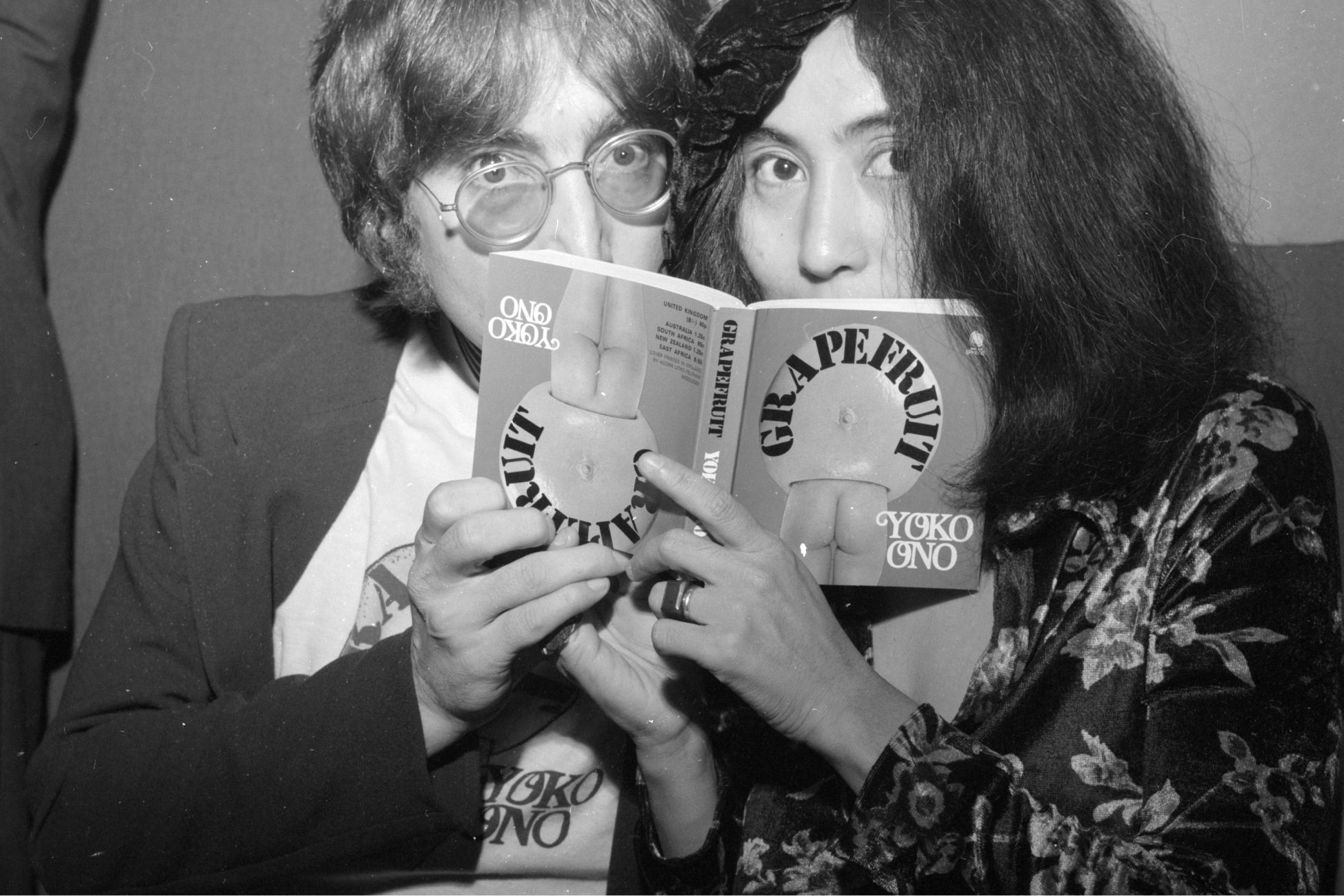
В эссе для японской газеты об искусстве Йоко Оно затронула концепцию «надуманной правды», имея в виду, что то, что мы придумываем в своей голове (что бы нам хотелось съесть на ужин), — такая же реальность, как стул, на котором мы сидим. «Я думаю, возможно воспринимать стул таким, какой он есть, — объясняет она. — Но когда вы сжигаете стул, вы вдруг осознаете, что стул в вашей голове не сгорел и не исчез».
Йоко занималась концептуальным искусством. Когда в конце шестидесятых концептуалисты стали крайне популярны, ее имя практически нигде не упоминалось. О ней нет ни слова в знаковом эссе Люси Липпард и Джона Чэндлера «Дематериализация искусства» 1968 года. А ведь она была одной из первых художниц-концептуалисток.
В 1965 году Оно вернулась в Нью-Йорк, и в марте у нее состоялась очередная выставка в Карнеги-холле, «Новые работы Йоко Оно». Это была нью-йоркская премьера ее лучшей работы, поистине великого произведения искусства Cut Piece («Пьеса разрезания», или «Разрез-пьеса»).
Исполнитель (в данном случае Оно) выходит полностью одетым и становится на колени в центре сцены. Рядом лежат большие ножницы. Зрителям предлагается по очереди подниматься на сцену и отрезать кусок одежды художницы (его можно оставить себе). Позднее в инструкциях Оно писала: «Исполнитель остается неподвижным в течение всей пьесы. Время окончания пьесы — на усмотрение исполнителя». Она говорила, что на этот перформанс всегда надевала свою лучшую одежду — даже когда у нее было мало денег и она не могла позволить себе ее портить.
Оно исполняла Cut Piece в Токио и Киото, есть фотографии этих перформансов. Нью-йоркский перформанс был заснят на пленку братьями-документалистами Дэвидом и Альбертом Мэйслес.
В большинстве хеппенингов или перформансов исполнители — сами художники или друзья того, кто писал партитуру. В Cut Piece художник не знаком с исполнителями. Они могут толковать инструкции непредсказуемым образом. Это словно раздать заряженные стволы целой комнате незнакомцев. Йоко Оно невысокая, всего 157 сантиметров, а ножницы большие и острые. Когда зрители начинают резать ткань вокруг ее груди или в паху, возникает реальное ощущение опасности и надругательства. Один из тех, кто резал на Оно одежду на выступлении в Японии, стоял за ее спиной и держал ножницы над ее головой, как будто собирался проткнуть ее. Партитура приписывала Оно оставаться бесстрастной, но в записи видно тревогу в ее глазах по мере того, как зрители продолжают подниматься на сцену и стоять над ней, орудуя ножницами и разыскивая место, где еще можно отрезать. Когда на ней разрезают бюстгальтер, Оно прикрывает грудь руками — почти единственное движение во время всего акта.
Cut Piece — это точное проигрывание акта раздевания, который (якобы) происходит в головах у мужчин, когда они видят привлекательную женщину. Перформанс превращает мужской взгляд в оружие. Женщины также участвуют в разрезании одежды — потому что они тоже являются частью общества, которое объективирует женщин. Таким образом, перформанс можно относить к феминистскому искусству (причем созданному во времена, когда почти никто не занимался феминистским искусством) — и это явно оно и есть.
Однако значение Cut Piece во многом зависит от аудитории, для которой он исполняется, и изначально задумкой Оно было кое-что еще. Когда художница исполняла пьесу в Японии, возможной была буддийская интерпретация. Это аллюзия к «дзен-традиции делать какую-то вещь, которая тебя смущает наиболее всего, и смотреть, что ты придумаешь и как ты будешь с этим справляться», — говорила она.
В другом месте Йоко заявляла, что перформанс проистекал из истории о том, как Будда отдавал людям все, о чем его просили, а в конечном итоге позволил себе быть съеденным тигром. Оно предлагала незнакомым людям все, что у нее было, — и именно поэтому надевала лучшие наряды. «Вместо того чтобы отдавать аудитории то, что художник хочет отдать, художник дает зрителю то, что зритель хочет взять», — поясняла Йоко.
В 1966 году Оно прилетела в Лондон для участия в симпозиуме «Разрушение в искусстве», где исполнила свой знаменитый перформанс дважды. На тех мероприятиях он считывался не как буддийский текст. Сарафанное радио после первого перформанса привело к тому, что на второй пришла толпа — мужчины яростно срезали всю ее одежду, даже нижнее белье. Это был свингующий Лондон; все решили, что работа была о сексе. После Лондона Оно не исполняла Cut Piece до 2003 года — тогда она повторила действо в Париже, сидя на стуле. В этот раз художница объяснила, что работа посвящена миру во всем мире и была реакцией на теракты 11 сентября 2001 года в США.
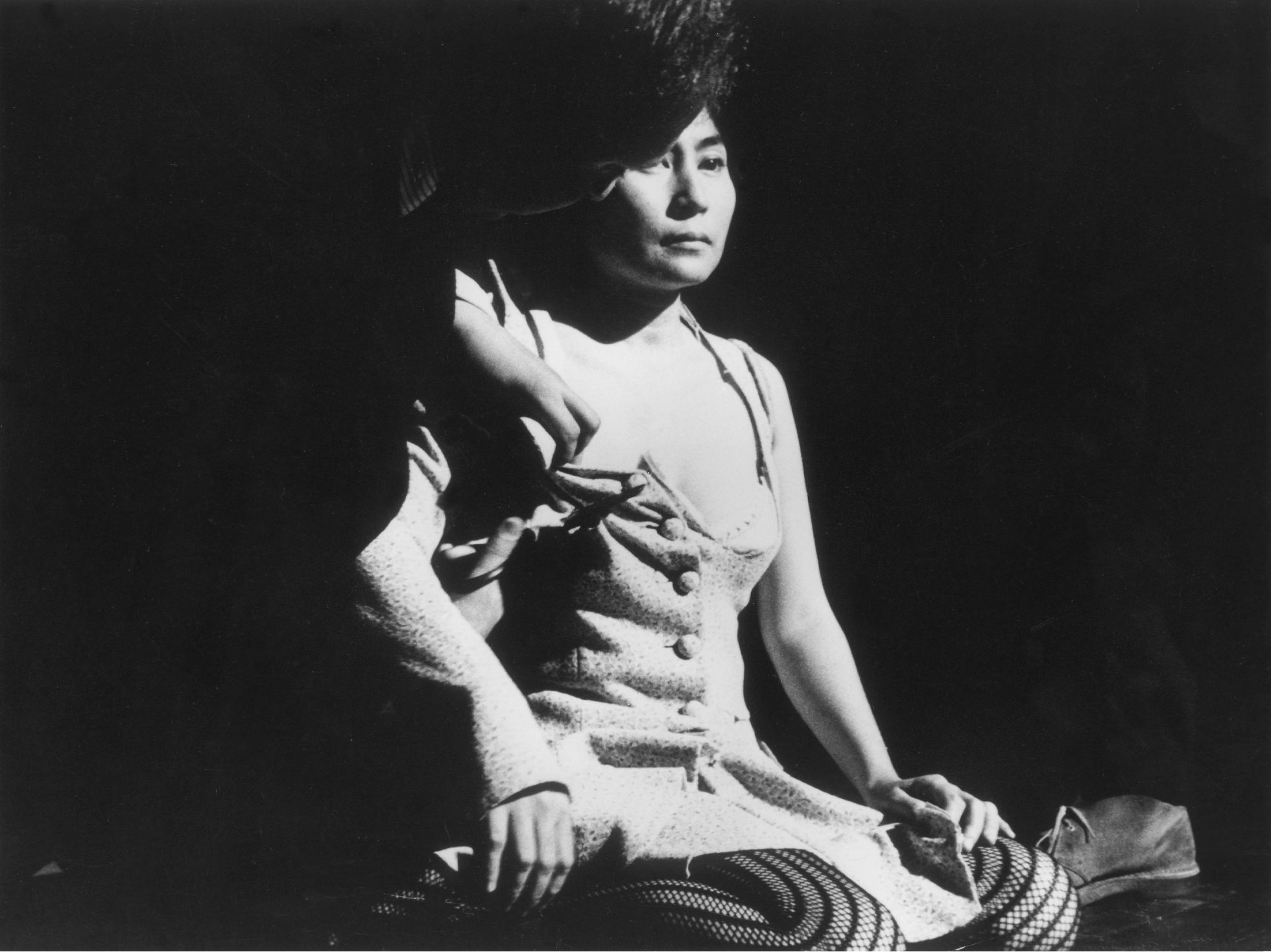
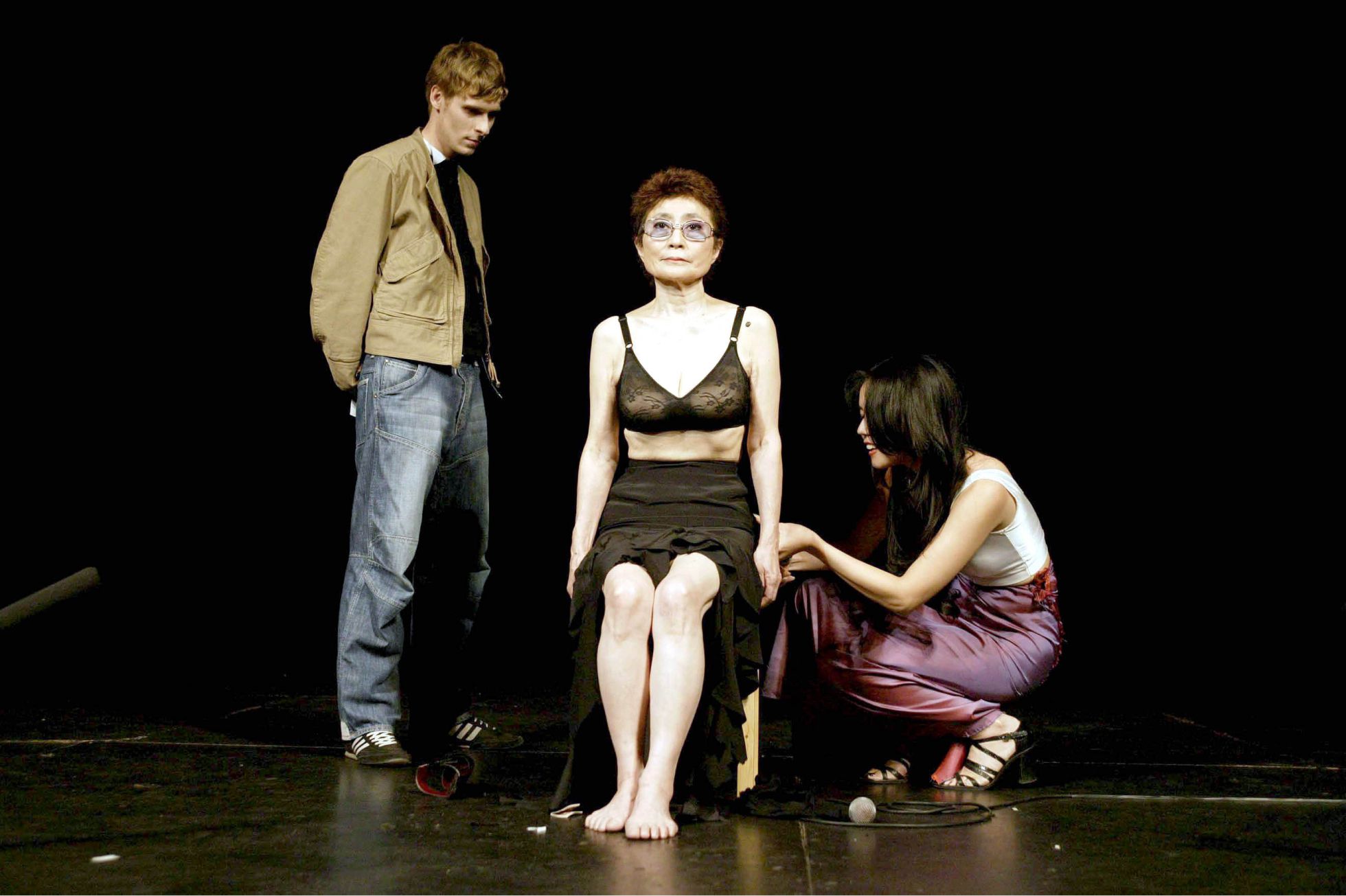
Вне зависимости от того, где перформанс исполняется и как толкуется, это определенно эксперимент по психологии групп. Людям предлагается публично сделать что-то, что обычно запрещено: жестко раздеть незнакомую женщину. Те, кто участвует в действе, могут обосновывать свой поступок, говоря себе, что это не раздевание пассивной женщины, а искусство. Но, разумеется, на самом деле они делают именно это — раздевают ее. А те, кто не идет на сцену, потому что находит зрелище отвратительным или недопустимым, могут говорить себе, что по крайней мере они в этом не участвуют. Ну и конечно, чем больше вокруг тех, кто режет, тем проще начать резать самому.
«Вообрази себе»
Йоко Оно планировала провести в Лондоне лишь несколько недель, однако обнаружила, что мир искусства этого города восприимчив к ее творчеству. Интерес вышел за пределы этого мира, когда она с мужем Тони Коксом выпустила фильм «No. 4», также известный как «Задницы» (Bottoms). Это, собственно, вы и увидите в этой ленте — снятые крупным планом задницы голых шагающих людей.
Оно и Кокс сняли шестиминутную версию фильма в Нью-Йорке на камеру для высокоскоростной съемки, которую им одолжил Мачюнас (а он, в свою очередь, взял ее взаймы у кого-то еще). В Лондоне многие известные представители мира искусства охотно согласились сняться в фильме, и в окончательной редакции лента длится 80 минут — это примерно 20 секунд экранного времени на один зад.
Но по виду сзади непонятно, что вы знаменитость. Так, фильм — это не просто прикол, там есть идея. Он высмеивает ощущение собственной значимости. Йоко Оно описывала эту работу как «бесцельную петицию, которую люди подписывали своим анусом». Фильм был незамедлительно запрещен Британским советом киноцензоров — пожалуй, лучшая реклама, на которую мог рассчитывать кинематографист в Лондоне шестидесятых. Из-за фильма Йоко Оно попала в желтую прессу. Однако к тому моменту она уже познакомилась с Джоном Ленноном.
Согласно их собственной версии (и ведь она может быть целиком правдивой, кто знает?), 9 ноября 1966 года — за день до выставки работ Оно в Indica Books and Gallery — в галерею заглянул Леннон. Indica была контркультурной арт-галереей (индика — вид конопли), среди покровителей которой был Пол Маккартни. Оно сопровождала Леннона, пока он ходил по галерее и изучал выставленные произведения. Позднее она заявляла, что не знала, кто он такой, что не очень правдоподобно, — правдоподобнее предположить, что ей было все равно, кто он. Одна из работ представляла собой яблоко на пьедестале. Леннон спросил Оно, сколько она стоит. «Двести фунтов», — ответила она. Он взял яблоко и откусил от него. Йоко сочла, что это было гадко.
Следующим экспонатом была стремянка. Человек взбирался по ней, наверху была подзорная труба, а в нее нужно было смотреть на клочок бумаги на потолке, где написано крошечное слово «да». «Каким облегчением было узнать, что, когда ты поднимаешься по лестнице и смотришь в трубу, там не написано „нет“ или „да пошел ты“», — говорил Леннон позднее.
Однако судьбоносная связь установилась между ними через экспонат «Картина, чтобы забить гвоздь (No. 9)». Посетителям предлагается забить гвоздь в висящую на стене доску. Леннон спросил Оно, можно ли ему забить гвоздь. Да, ответила художница, если заплатит пять шиллингов. «Хорошо, я дам вам воображаемые пять шиллингов и забью воображаемый гвоздь», — сказал Джон. «Тогда мы встретились глазами. И она все поняла, и я все понял — и, как говорят во всех наших интервью, остальное теперь уже достояние истории», — вспоминал Леннон.
Какое-то время они были «просто друзьями». Не стоит забывать, что это было самое начало карьеры The Beatles — менее трех лет прошло с тех пор, как группа впервые сыграла на шоу Эда Салливана. Они еще не записали «Сержанта Пеппера». Леннону только исполнилось 26. Впрочем, Йоко Оно было 33. Ее творчество достигло полной зрелости. Она дала Леннону экземпляр «Грейпфрута», который тот внимательно прочитал. Отношения начались только в мае 1968 года. В июне они предали их огласке, и в течение следующих 12 лет — пока Леннона не убили — пара жила под пристальным вниманием мировых средств массовой информации (еще один контекст для понимания Cut Piece).
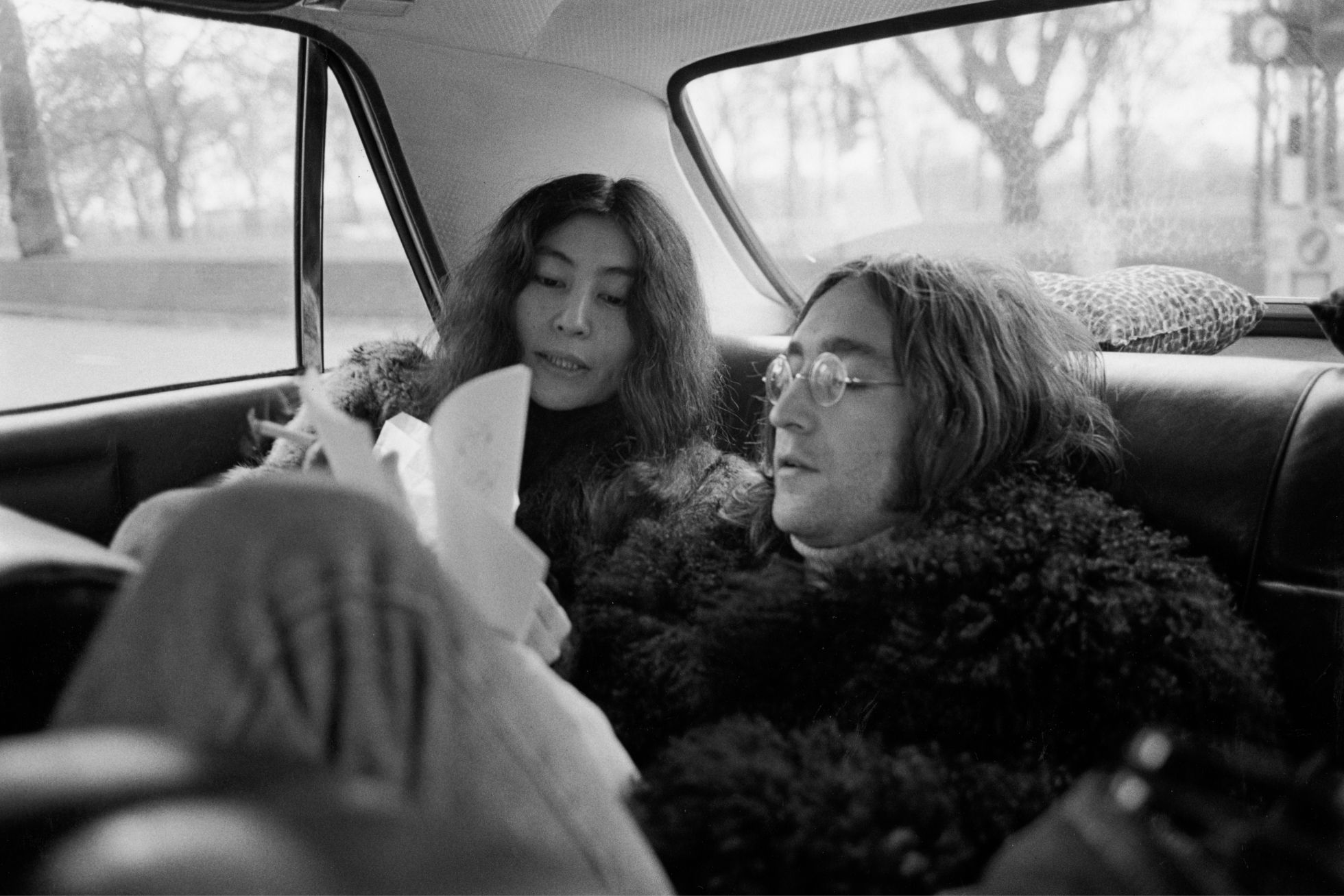
Джон Брэкетт, автор биографии художницы, утверждает, что это Леннон был навязчивым партнером, а не Оно. Он уговаривал ее сидеть рядом, пока битлы записывались в студии, — потому что опасался, что, если Йоко будет вне поля его зрения, она бросит его.
Музыкальный критик The Times Роберт Палмер считал, что «тот факт, что в нее влюбился Джон Леннон, было наихудшей возможной вещью, которая могла произойти с карьерой Йоко Оно как художницы». Сама Йоко признавала, что вместе с Ленноном они «вредили карьере и положению друг друга — просто будучи друг с другом и будучи самими собой». Насколько это утверждение правдиво?
После 1968 года в творчестве Оно происходит резкая смена курса. Начиная с акции «В постели за мир» (где они с Ленноном в пижамах сидели в гостиничной кровати и обсуждали политику с журналистами и разного рода контркультурными знаменитостями типа Тимоти Лири), множество работ художницы было посвящено вопросам международного мира. Кроме того, ее творчество стало откровенно феминистским. У Мачюнаса была политика, но по большей части искусство флуксуса — как и творчество Кейджа и Дюшана — аполитично. Это искусство об искусстве. После 1968 года творчество Оно стало про политику. Однако это можно сказать практически обо всех художниках — из-за войны во Вьетнаме искусство политизировалось и остается политизированным по сей день.
Представление Оно о своем зрителе также изменилось. Когда они с Ленноном женились, она была художницей для узкого круга лиц, а он был популярным развлекательным исполнителем — вероятно, самым известным в мире. Она исполняла для сотен — он исполнял для сотен миллионов. Йоко Оно решила, что снисходительность по отношению к популярному развлекательному жанру была высоколобым предрассудком. «Я пришла к выводу, что беспримесность авангарда была такой же душной, как постоянное повторение одного и того же рок-ритма». Поэтому Йоко Оно стала поп-звездой. Выпустила 22 альбома (включая совместные записи с Джоном Ленноном). И — увеличила свою аудиторию.
Разумеется, ее музыка никогда не продавалась так же хорошо, как музыка The Beatles. Тем не менее они с Ленноном произвели на свет по крайней мере одну ошеломительно успешную коллаборацию.
«Imagine» стала главным хитом постбитловской карьеры Леннона. Песня была записана в 1971 году и со временем стала своего рода мировым гимном. Ее перепело бессчетное число музыкантов; она звучала на церемонии открытия олимпиады и на Таймс-сквер в канун Нового года. Напеть эту мелодию может практически каждый.
Многие наслаждаются песней и ощущают ее настроение как идеализм детей-цветов. This is a delusion. «Imagine», конечно, утопична, но это также и концептуалистская работа. Instructions. «Вообрази себе», которое Йоко говорила своему младшему брату, отрикошетило через время и пространство, чтобы спустя 26 лет очутиться в словах песни, которую знают миллионы людей.
На задней стороне обложки пластинки была напечатана одна из инструкций из «Грейпфрута»: «Представьте, что с облаков капает вода. Выкопайте яму в своем саду, чтобы положить туда облака». Позднее Леннон говорил, что с его стороны было сексизмом не указать Йоко как соавтора — учитывая, что автором идеи и значительной части текстов была именно она. Но почему-то он так ничего в этой связи и не предпринял. Однако в 2017 году Национальная ассоциация музыкальных издателей объявила, что отныне Йоко Оно будет считаться соавтором «Imagine».
Rethered by Dina Mingalieva