
Translated material
The second beginning (in art and sociocultural history)
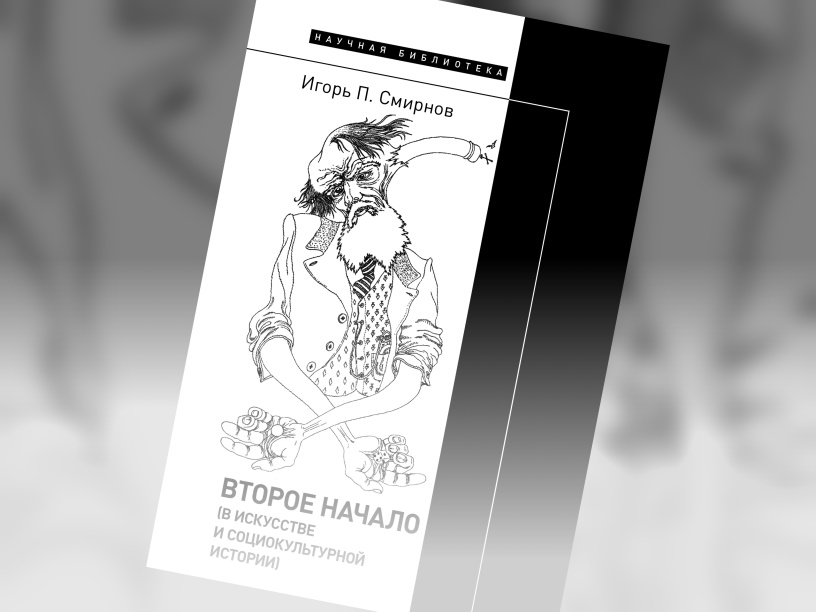
The publishing house "New Literary Review" represents the book of philosopher and culturalist Igor Smirnov "The second beginning (in art and sociocultural history)."
Unlike animals, a person experiences not only biological, but also spiritual birth. This transition from the first beginning to the second, he extends to all areas of his work. The little -studied problem of the second beginning in the history of socioculture is covered in the book of Professor I.P. Smirnov at different angles of vision. In the introductory part of the work, the second genesis is considered as one of the most important foundations of human activity. In the following sections, the author proceeds to the study of the second beginning on a particular historical and cinematic material, in particular, this includes the work of Dostoevsky and Nabokov, as well as the fate of the historical avant-garde. The book is completed by chapters in which the situation traumatic for Russian socioculture and attempts to withdraw from them, laying national traditions are traced.
We offer to read a fragment from the section of a book dedicated to cinema and dog handler.
"Spring" Grigory Alexandrov as Parodia Sacra
Already the beginning of the independent work of Grigory Alexandrov in the cinema was marked by a parody response to the work of his co -author and teacher Sergei Eisenstein. The Musical Comedy “Funny Guys”, filmed by the “Sticks” (1924) score, translates the Eisenstensky film Motive of universal death in a ridiculous plan.
In the "Stelka", Eisenstein blasphemously rethought the Christian doctrine of the resurrection of the dead: the lumpen-professing of the professional who participating in the provocations against the strikers rises from the "Kadushkin cemetery". Tanatos in "Stelka" is irresistible. The identification of labor with death is introduced in a “strike” in episodes with a hanging worker, unjustly accused of theft of a micrometer (ill. 1), and acquires a generalized value at the end of the film, which shows the area completely dotted with corpses (ill. 2). The reprisal against the striking, taught by the Cossacks is preceded by personnel in which a child is confused at the feet of the horses (ill. 3), then perishable. At the death in the apocalyptic film Eisenstein, a generic person does not dare to hope not only to apocatastasis, but also to continue life in the offspring.
The Eisenstein Apocalypse is exhibited in "Funny guys" in an oc noxure. Labor as death turns from Aleksandrov into a brawl that happened during a rehearsal, which is conducted by the “Musical Collective of Friendship” ”before the first exit to the public 1 . The musicians, exhausted by a fight with their bodies, are the floor of the room in which they rehearsed, and one of them hangs on the chandelier, making a comic pair with a worker who committed suicide in a “strike” (ill. 4). The child playing on the pipe with Eisenstein's face replaces the child with a child who was brutally killed in a “strike”. On the Cossack horses from the Eisenstein film, a toy horse hinted by a toy horse, which Alexandrov placed next to the baby (ill. 5). The orchestrants who were being rolled out of a rented apartment, as if by a widespread woman, continue to rehearse on the street, attaching to the burial drogs.
Il. 1. Samoban worker
Il. 2. "Remember, proletariat!": Landscape after the battle
Il. 3. Cossacks before attacking strikers
Il. 4. Imaginal corpses of "funny guys"
Il. 5. A horse and a child who prevented rehearsals
The uprising from the dead is turned into sacrilege in the "strike" and in "funny guys", but in the comedy of Alexandrov it is devoid of the sinister content that was endowed with Eisenstein. The dancing funeral procession in “Merry Guys” sends us to the Dadaist tape Rene Clear and Francis Picabia “Anthract”, shot, like “Stack”, in 1924 2 . It is possible that the addressing of Alexandrov to the sources separated from the “funny guys” in a ten -year period is not accidental, being a parody of the anniversary dedication of the “battleship“ Potemkin ”and“ October ”(the last film was staged by the decade of the Bolshevik revolution).
There is no doubt that the parody of the “strikes” in “funny guys”, which converted “death seriously” into imaginary and focusing on the values of life as a stream, as continuity, was due to the polemic, which the entertaining culture of the 1930s led with the early avant-garde, which thought of immediately and the end of aesthetic and any other creative searches.
The transformation of the shepherd into the star of the stage in "Funny guys" is exactly the opposite as the personal success of a gifted person from the lower class conflict depicted by Eisenstein. Giving about the formation of the new elite, Alexandrov answered ordering the post -revolutionary Stalinist society. But this is the function of a parody of “funny guys” is by no means exhausted. Aleksandrov not only disputes the “strike”, but also picks up the profanity of Armageddon from there, even if the battle is running out of the time in “funny guys” - a farce, and not a tragic event, like Eisenstein’s. Functionally of this type of parody (partly auto -parody, since Alexandrov assisted Eisenstein when staging “strikes”) is similar to archaic and medieval tits of sacred imagery, which showed that its provision could cause anything other than a ridiculous effect, and thereby protecting it from the audit, from drawing into its historical historical Metamorphoses 3 . Parodia Sacra encourages us not to laugh at the shrines themselves, but at those who unsuccessfully and inappropriately imitate a respectful attitude towards them (in “funny guys” these are the musicians who are neglected with death). Of course, Parodia Sacra in the film by Alexandrov has to protect not mytho-religious values, but just on the contrary-their fragmentation undertaken by Eisenstein (possibly in a polemic with “thoughts about violence” (1906), where Georges Sorel interpreted a universal strike as a revival of the myth).
Before us is Parodia Sacra, who recognized its defeat in the fight against history, submitted to the epoch -making dynamics with its denial of the nearest past (in this case, the early man -garde mentality), but nevertheless found the possibility of further existence in relation to the personal creative heritage of a great master, affirming his authority and certifying his right to belong to the states of the first discontinurators.
Purvation techniques, the development of which Alexandrov began in “funny guys”, will form the basis for building his “spring” (1946–1947), a film, which is entirely projected on the Eisenstein “Ivan the Terrible” (1943–1945) 4 . As the art director of Mosfilm Alexandrov, he was in the closest way to create the historical drama of Eisenstein and later enthusiastically responded about her aesthetic virtues in his memoirs, but he also noted the “unlawful shift of the meaning <...> of the movie trilogy to the internal tragedy of the King-Demot” 5 , giving tribute to the official criticism that the second series of the film was subjected to the second series (It is difficult to judge how sincere the memoirist was in this regard). The duality of the head of the Institute of the Sun Nikitina and the actress of the tent is woven in the “spring” into the theme of the film-in-film, filmed by the director, whose role is played by Nikolai Cherkasov, who had previously played the role of Ivan, also a kind of director in the interpretation of Eisenstein: the king leads the orgiastic dance of the oprichniki and arranges a mizan science with the possession of Vladimir Staritsky in the robe of the autocrat ending with the murder of a liar. Duplication in “Spring” is total, turned into Mise En Abyme: it captures the main characters of the picture, and its subject, which is the film production, and the choice of the actor, who was already a certain likeness of the director, for the role of the creator of the film-in-film (it is significant that Alexandrov gives his director a “meteorological” surname of Gromov, echoing with the title of Ivan IV formidable 6 ).
According to this total, Vesna's doubts have many points of parody contact with Eisenstein’s last film, and not one, like “Funny Guys” in relation to “Stoke”. I will list only some of them. The wedding of the kingdom, along which the archbishop of Pimen has a hat of Monomakh on the head of Ivan (she will then appear in the episodes of old -fashioned and mourning the Euphrosyne death of his son), traversely (with the substitution of the male sovereign accessory of the female) decreases and is searched in the “spring” by the economy Margarita Lviv, trying A hat sent from the house of models before going on a date with the administrator of the Scientific Institute Bubenstsov (ill. 6, 7). It will not be superfluous to say that the playing economy Faina Ranevskaya was intended for Eisenstein for the tragic role of Euphrosini Staritskaya, but was subsequently replaced by Seraphim Burman. Aleksandrov gave Ranevskaya the opportunity in the farce manner to compensate for the loss of role, making it the heroine with the same envious shadow of Nikitina, which was regarding Ivan Euphrosyne performed by Burman. It is clear that this gesture of Alexandrova could only be understandable. Eisenstein’s film tragedy parody of “spring” is not only explicated, but also has a hidden side, in its own way mysterious competing in this with a source-with a video argument about the secret of absolute power.
Il. 6. Wedding at the kingdom of Ivan IV
Il. 7. Monomakh cap from the House of Models
Aleksandrov parodies either repeated, or shock, disposable, but particularly significant motives of “Ivan the Terrible”. The latter belongs to a dangerous disease of the king. During the co -sob, Pimen reveals the Holy Scriptures over the head of Ivan (Il. 8), the profane analogue of which in “Spring” becomes an exaggerated volume volume of authoritative statements about love - they are read out by Nikitina Gromov, taking her as an actress and trying to heal her from the restraint of feelings (ill. 9). The technique of handling a film sprinkling in Spring is akin to a counterpoint in music (whose fruitfulness for cinema was emphasized in the Manifesto “Future Sound Films” (1928), compiled by Eisenstein and Vsevolod Pudovkin together with Alexandrov). The plot segments of the “Spring” resistance (into a breakdown) of the sequence of scenes in “Ivan the Terrible” are so that both paintings form a kind of polyphonic compositional whole.
Il. 8. The dying king-director
Il. 9. The director resurrects Nikitin to life
As one of the options for reducing the Eisenstein pathos, the shift of the details on the periphery “Spring”, which was made by Alexandrov, can be interpreted by Alexandrov. Such, among other things, a smoking cup in the hands of a secondary character - the prima donna, which will be replaced on the theatrical scrapes of the shater (ill. 10). The plot is dysfunctional and as if nothing more than decorative, the cup in the picture of Alexandrov inherits the bowl with poison, which Euphrosyne Staritskaya poisoned the “junis”, the wife of Ivan (ill. 11). The bowl moves from the first series of Eisenstein's film to the second, serving the poisoning of the poisoner, while the Cup in Spring does not carry any semantic load. The dark glasses with which Eisenstein supplied the Lithuanian ambassador to indicate the hemisphere of the foreigners, evaluating the ruler of the Russian land, lose the symbolic significance from Alexandrov, receiving instead of him only pragmatic: Nikitin puts them on, conducting an experiment with solar energy. The ambassadors from the West provoking Aisenstein Boyarsky conspiracy (Il. 12) in the “spring” in the “spring” in the category of fleeting, disappearing actors - they appear in the studio where work is underway on a cinema about an outstanding researcher (who should meet with them at a diplomatic reception), but immediately expelled from the Thunderer with the words: “You can smoke ”(ill. 13). As a film about how the movie is made, “Spring” did not bypass one of the central in the metaphy -second series of “Ivan the Terrible” situations - “Cave action”, the theater performance intended, according to Philip Kolychev, to turn the king from terror (ill. 14). The negative parallel to the miraculous salvation of the three Christian youths from the Fire Death is an episode with Bubensts (Il. 15): During the experiment carried out by Nikitina, he hides in fear of a disaster in the institute garden, having previously stole a tube with a solar substance, which explodes in his hands and burns his clothes (“As I eagerly,” he complains). A bush sparkling in this scene, reminiscent of the flame, from which the voice of God came to Moses, certifies that it is a mockery over the sacred source: directly - over the Old Testament, indirectly - over the “cave action”.
Il. 10. Chalice of the poisoner
Il. 11. Operational goblet
Il. 12. ambassadors at the reception of the autocrat
Il. 13. Ambassadors freed from film work
Il. 14. Cave action
Il. 15. "Everced" Bubentsov (Rostislav Plyatt) in front of the bush
It should not be thought that “Spring” betrays Eisenstein’s film only frivolously gaming revalorization. Aleksandrov’s comedy is antithetic “Ivan the Terrible” in essence. In its climax, the second series of the Eisenstein Chronicle rejects the idea of twinity: the Volynets, sent by Euphrosyne, slapped by a knife to kill Ivan by a knife of Vladimir. As in the “Golden Branch” (1890) described by James, the archaic ritual described by James, during which the ruler’s place is temporarily occupied by a slave, then condemned to death, the king of Eisenstein is irreplaceable 7 . Ivan is exceptional, he cannot have copies: in a tendency to directing the “cave action”, Metropolitan Philip, “in the church, the prince”, according to what was said in scenario 8 , loses power, as the perishable old - acting likeness of the king does not receive it. In the reverse order: the interchangeability of Nikitina and the tent (both performs Lyubov Orlova) perfect, as Natasha Drubek-Mayer 9 emphasized . Shatrova is not lost in the circle of scientists, encouraging them to sing in chorus (the interphylmic background of this scene is a robbery song of the oprichniki, turned by Alexandrov into a hymn of the resurrected nature). Nikitina, in his turn, joins the film studio under the mentoring of Gromov to acting (replacing each other, the heroines change outfits, thereby parody of the travesty in Ivan the Terrible). Aleksandrov continues in the “spring” a polemic with the vanguard of the first wave, begun in “funny guys”. The avant-garde idea of an ultimately unique creative personality embodied by Eisenstein in how historical, such an autobiographical film about the ruler of the director, “spring” contrasts the image of the world without another, where there is no threat emanating from rivalry. Of course, this reality reflects the totalitarian leveling of personal differences in the Stalinist society, but, in addition, the post -war period with its fatigue from the struggle is not for life, but for death. From the post -war hope to the universal harmony of duality in the “spring”, that accompanying his transmission in romantic literature and in early cinema is terrifying, which Sigmund Freud (1919) designated as “das unheimliche” 10 .
Aiming the “spring” following “funny guys” to refute the avant -garde, Alexandrov repeats in it an ambivalent parody of laughter and at the same time not allowing him to cross out from sociocultural memory. Let in a comic form, “Spring” presents the Motivik of the second series of “Ivan the Terrible”, prohibited by the decision of the Secretariat of the Central Committee of the All -Union Communist Party of Bolsheviks of March 5, 1946 “Due to its anti -historicality and anti -art” 11 . In some sense, Alexandrov provides Eisenstein, from whom he studied directing, the same service that he rendered to his mentor, Vsevolod Meyerhold, saving his archive. In accordance with the duality of the “spring” in her conjugation with “Ivan the Terrible”, the debate that she leads with the vanguard, half -hearted (as in “Funny guys”, where “Anthract” is quoted without abyss). The conquest of solar energy in Alexandrov gives the second life of the futuristic opera of Mikhail Matyushin “Victory over Salz” (1913), whose libretto wrote in collaboration with Velimir Khlebnikov. The comic alteration of “Ivan the Terrible” encourages the Eisenstein film from those destructive-seriously attacks on him, which went from the very top of the state-party power and subjected it to expanding it, pushed over the line of discussing to be discussed dulledly. To the extent that the “spring” confronts with the murderous-commissioned opinion of Eisenstein’s masterpiece, she was a phenomenon of regenerative laughter. The director at Aleksandrov makes a mistake, confusing Nikitin with the tent, but in the end understands the Quid Pro Quo, passes the doubles. Art in the "spring" overcomes totalitarian all equalization.
Parodia Sacra was reanimated in the conditions of the Stalin Conservative Revolution as her own. Being a protective coup of values, this kind of laughter is as paradoxical as she. However, Parodia Sacra not only positively correlates with her, but also undermines her, because it does not conceal its inner inconsistency, which is resolved in laughter, thereby casting doubt on the intention of the conservative revolution to marked the logic finally gained by history.
1. To the connection of comic and labor in “Funny guys” see: Kalinin I. Laughter as labor and laughter as a product // New Literary Review. 2013. No. 3 (131). S. 113 trace.
2. About the "Anthraquet" and "Funny guys", see more: Smirnov I.P. Video Rogi. Historical semantics of cinema. SPb., 2009. S. 188, 208.
3. Somewhat differently, Parodia Sacra was interpreted by Olga Freidenberg, who saw in it the kinship of the tragic and comic, which meets the oldest ideas about the dual -acadity of all that exists, the high and low (Freudenberg O. M. The Origin of the Parody [1925] // Proceedings on iconic systems. [T.] VI. Tartu, 1973. S. 490–497). The Bakhtinsky understanding of the “sacred parody”, tolerant by the inertia, which goes from the “reporting and pre -state social system” (Bakhtin M. Creativity Francois Rabelais and the folk culture of the Middle Ages and the Renaissance [1940]. M., 1965. M. 8, p.S. 8 traces), ascends to this article. According to the concept of Georgio Agamben, Parodia Sacra, it arises from the impossibility of any other except comic alteration, the way to supplement the indisputable mystery (cit. "Profanazioni" by German translation: AGAMBEN G. Profanierungen / übers. Von M. Schneider. a/m., 2005. S. 30–44). PARODIA SACRA does not have a defensive purpose in Agamben, which makes it indistinguishable from other types of parody.
4. Alexandrov Parodino processed the motives borrowed from Eisenstein’s films, and in his comedies, created in the interval between “funny guys” and “spring”. In the “circus” (1936), the rescued baby, transmitted by the audience of the entertainment representation from hand to hand, is correlated in contrast with the child, who dies in a stroller rolling along the Odessa staircase in the “battleship” Potemkin. ” The ranks of the amphitheater, in which the audience is located in Alexandrov, are clearly similar to the staircases. In the Volga-Volga (1938), the captain of the vessel, which was overboard, provokes in memory the scene of the reprisals of sailors against officers in the same "Babric" Potemkin ", which becomes a comic harmless to Alexandrov.
5. Alexandrov G.V. era and cinema. M., 1976. S. 235.
6. In the first appearance of Gromov in the film, it comes out from under the low vault, characteristic of various interiors in Ivan the Terrible (their architecture caused Molotov's indignation in the discussion of the second series of the film in the Kremlin). The manner of Acting Cherkasov in the role of a director in Spring holds from an extremely constructed Ivan's extremely ambiguous image only one line - authority. Cherkasov is not so much parody of himself as poses reduces his performing opportunities.
7. Eisenstein reproduction of this rite has long been analyzed in detail: Ivanov Vyach. Sun. From notes on the structure and function of the carnival image // Problems of poetics and history of literature / Ed. S. S. Konkina. Saransk, 1973. S. 37–53.
8. Eisenstein S.M. Ivan the Terrible. Filzenary. M., 1944. S. 107.
9. Drubek-reader N. Primate Der Doubles. Zwei Sojetische Filmkomödien: A. Medvedkins novaja moskva (1938) und G. Aleksandrovs Vesna (1947) // Mystifikation - Autorschaft - Original / Hersg. Von S. Frank Ua Tübingen, 2001. S. 243–245, 257–261.
10. Cf.: Kittler F. Romantik - Psychoanalyse - Film: Eine Doppelgänger Geschichte // Kittler F. Draculas Verächtnis. Technische Schrift en. Leipzig, 1993. S. 81–104.
11. Kremlin cinema. 1928–1953: Documents / comp. K. M. Anderson, L.V. Maksimenkov and others. M., 2005. S. 723.