
Translated material
Martyr Vladimir Pravdlyubov
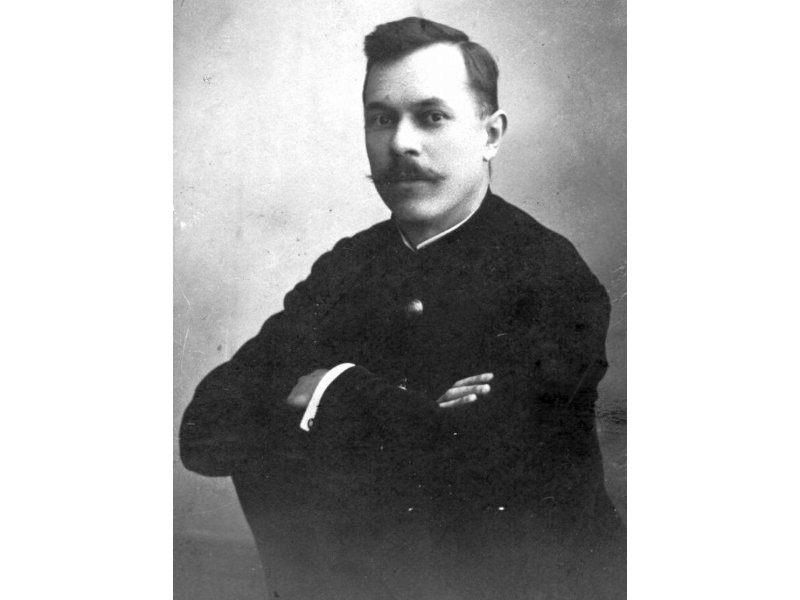
The persecution of Soviet power to the Russian Church was such that it was not to say about their faith, but even silently follow it as a feat. The new martyrs and confessors, glorified in the face of the saints did not come: believed, prayed and meekly went to their Calvarys.
“Polit.ru” recalls those who gave their lives for faith and by whose prayers the Russian Church is alive - even if almost nothing came to us besides the name.
Publications were prepared by Kirill Kharatyan (included by the Russian authorities in the register of foreign agents).
 Martyr Vladimir Pravdlyubov
Vladimir Pravdlyubov is the son of a priest from the city of Kasimov, Ryazan province. Brother of the Holy Martyr Priest Fr. Nikolai Pravdlyubov and confessor about. Sergius Pravdulubova. In 1898-1903 he studied at the Kasimov Theological School, then at the Ryazan Theological Seminary. In 1909, 21-year-old Vladimir Pravolubov graduated from the seminary in the first category and entered the Kyiv Theological Academy, which he graduated in 1913 with the degree of candidate of theology for the composition of "the creed, views on the ritual side of religion and the moral teaching of the book of the Prophet Jeremiah." According to Mikhail Pravolubov, the theme of the candidate work of Vladimir Pravolubov was "the inextricable connection of love for God and his neighbor in the life and morality of the Christian."
The path of church ministry was opened to Vladimir Pravdlyubov, but he was not married by that time, and he did not accept the monastic tonsure, not feeling calling for that. He began to engage in science, mainly psychology and pedagogy. Vladimir Pravolubov was invited to the Zhytomyr to teach Russian, literature, as well as logic and psychology in the teacher's seminary and the female gymnasium named after St. Anastasia. Already in August 1913, he began duties, at the same time gave lectures at the People's University. In 1914, he became the director of the Zhytomyr Teacher's Seminary, and in 1915 and 1918 he went to Galicia as a teacher for special pedagogical courses organized by the government for the training of teachers of public schools.
In 1917 he was first arrested, but soon released.
The power was constantly changing in Zhytomyr: the Soviet government was established, then the Petliurians came. The border of Ukraine with Russia was closed, so it was impossible to leave Zhytomyr, located in Ukraine. When the Petliurians came to power, pogroms began in the city. Vladimir Pravdlyubov spent several times from the pogroms of those who were in danger. In one case, several families took refuge in the attic of the teacher's seminary and safely waited the pogroms there. In another case, he, along with his friend, teacher of the seminary, covered a family of seven people in one small room. The dwelling of these people was completely defeated, but they themselves remained alive.
In 1922 he moved to Moscow, where he continued his pedagogical activity. At the same time, he began to engage in serious scientific work. In 1922-1929 he headed an orphanage in Moscow, taught Kraskomov at the United School named after The All -Russian Central Executive Committee in the Kremlin, was a scientific worker in the People's Commissariat of Education, wrote several works on child psychology.
In 1923 he became an assistant professor of the Second Moscow State University, a senior assistant to the psychotechnical laboratory, a researcher at the Institute of School Work. He gave lectures at the psychotechnical laboratory and the Institute of School Work. The field of his scientific research was pedagogy and psychology.
In those years, among scientists engaged in psychology, the idea of creating a new direction in this science - a special science about a child: his upbringing, education and formation as a person, arose. At the second Moscow University, a whole team of famous and talented scientists was formed, who actively developed this new direction in psychology. They published their work with separate publications, placed articles in the well -known journal “Psychology, Neurology and Psychiatry” at that time. Vladimir Pravonyubov worked with them, and the activity of him as a scientist and teacher successfully developed in these years. In less than seven years, from 1922 to 1929, he published three books: “The History of the Letter”, “The performance of students” and the work very important for pedagogy - “Cinema and our youth”. In the central newspaper Izvestia in 1928, two of his articles were printed - “On the Young Cinema” and “Students and Cinema”, and in 1926 articles on his work with students of students were published in the journal “On the Work for the New School”. Especially interesting is his book “The History of the Writing”, which went out of print with many illustrations.
Vladimir Pravdlyubov was invited as a specialist in various institutions. In the Military Academy, he took part in the work of its psychological laboratory, where a new testing method for that time was studied, which has now become widespread. In 1923, he was a member of the First All-Russian Congress on Neuroneurology, at which he read the report “On the issue of experimental and psychological study of stenographers”.
Vladimir Pravdlyubov did not hide his faith and veneration of Patriarch Tikhon. In 1924, at the request of Vladimir Pravdulubov, St. Tikhon accepted Archpriest Anatoly and Sergius of the Truth -Lubs and gave his photo with a gift inscription. After the publication in 1927, Metropolitan Sergius (Stragorodsky) and the temporary patriarchal Synod of the “Declaration”, Vladimir Trudolubov, did not join the non -remembering ones, but at one time did not approach the blessing of his father, who remembered the worship of Metropolitan Sergius. Later, the influence of the father and brother and firmness in the confession of the faith of many other supporters of Metropolitan Sergius led Vladimir Trudolov to the conviction that we must have communication with supporters and with opponents of the latter.
Only in 1925, when he was already 37 years old, did he get married. But this marriage cannot be called happy: they had no children, and in 1932, when Vladimir Trudolubov returned from conclusion and exile, his wife left him.
On June 4, 1929, he was arrested on charges of "malicious anti -Soviet agitation and propaganda, participation in the" Union of the Russian People "and a counter -revolutionary conspiracy." For more than two months he was under investigation. During this time, he was charged with a variety of accusations, which the prosecutors themselves could not prove. For example, in 1918, Vladimir Pravonyubov answered the accusation of an uprising in the city of Kasimov by the fact that from 1917 to 1922 he did not leave Zhytomyr due to the closure of the border between Ukraine and Russia. In 1918, he objected to accuse the participation in the city of Zhitomir in 1918, which, on the contrary, covered in those years so many who threatened these pogroms, which the participants in these events could confirm. On August 8, 1929, a special meeting at the College of the OGPU was sentenced to three years of a forced labor camp. He was serving a sentence in the Solovetsky special forces camp, a year later he was sent to exile in the city of Velsk of the Northern Territory, worked in the hospital as an assistant to a doctor, and taught in courses for medical staff.
After the end of the exile, he lived in Gorky, was engaged in literary work, and participated in the organization of the Gorky Psychotechnical Laboratory. From spring 1933 to August 1934 he lived in Kasimov, taught at an industrial technical school.
During this period, Vladimir Pravdolyubov compiled the biography of the Kasimov locality of the piety of the pious prince Jacob (XVII century) and Peter the Hermit (Ser. The XIX century). Together with his brother, priest Nicholas, he compiled a detailed biography of the blessed Matrona of Anemnyasevskaya, for which he traveled to her in the village of Anemnyasevo Belkovsky district of the Moscow region (now the Kasimov district of the Ryazan region).
Since August 1934, he worked as a teacher at a technical school and an exemplary school in Gorky. In the early summer of next year, he came to Moscow for treatment, after which he left for Kuibyshev, but could not get a job there. From September 1, 1935 he taught at a pedagogical college in the city of Sergache of the Gorky Territory.
On September 25, 1935 he was arrested, he first went through one case with the Kasimov clergymen and a blessed matron, then his case was allocated in a separate one. Vladimir Pravonyubov was accused of the fact that he “was an active participant in the counter-revolutionary church-monarchist grouping of churchmen for counter-revolutionary purposes to create authority and glorify“ Blessed Matreshi ”and“ Tsarevich ”Kasimovsky Jacob wrote a detailed biography organized a mass pilgrimage to his grave, where the group participants processed believers in the groups. Anti -Soviet spirit. "
On November 26, 1935, Vladimir Pravolubov was sentenced to five years old, on December 2, he was sent to the Karaganda ITL, where he worked as an assistant to the doctor.
In 1937 he was arrested in the camp on charges that together with the archim. Mauritius (Poletaev) "created a counter -revolutionary group, which under the leadership of Poletaev systematically gathered, conducted worship, distributed counter -revolutionary and religious sentiments among the camps." He did not admit his guilty of participating in the “counter -revolutionary group”, he said in interrogations that he had the Bible. On September 28, by the decision of the Troika UNKVD in the Karaganda region. Sentenced to the highest extent punishment.
Shot on October 4, 1937 along with the archim. Mauritius (Poletaev) and MCH. Vasily Kondratiev.