
Translated material
The man of the day: Pavel Nakhimov
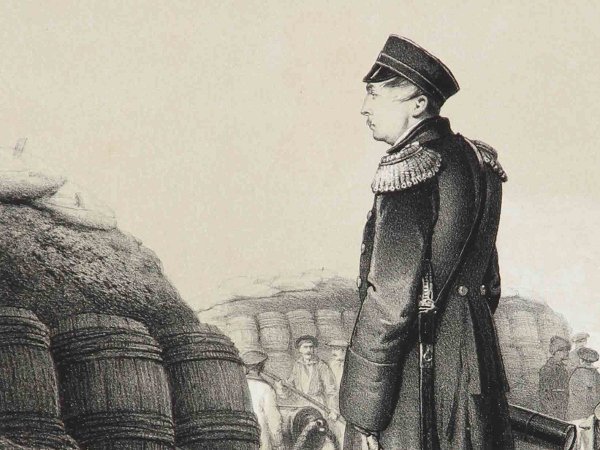
On July 5, 1802, the Navy was born, Admiral Pavel Nakhimov
Personal business
Pavel Stepanovich Nakhimov (1802 - 1855) was born in the village of Gorodok of the Vyazemsky district of the Smolensk province in the family of a poor landowner, who had only 136 serfs of serfs. Was the fourth of the five sons. In 1813, together with his brother Ivan, he was enrolled as a candidate for the Marine Cadet Corps. After the summer practice of 1815, while swimming at the Simeon and Anna training brig, the Nakhimov brothers were accepted in the cadets, and then to the midshipmen. At the age of fifteen, Pavel Nakhimov was enrolled in the crew of the Phoenix brig, who sailed along the Roconstadt -Rochensalm (Kotka) route - Sveaborg - Revel - Riga - Stockholm - Karlskron - Copenhagen - Kronstadt. At the beginning of 1818 he passed exams in the Marine Cadet Corps, was carried out in midshipmen and appointed to the second naval crew.
The end of 1818 and all 1819 Nakhimov served in St. Petersburg, in 1820 he sailed in the Baltic on the Yanus tender, and in 1821 he was sent to Arkhangelsk, to the team of the ship built there. From Arkhangelsk, however, he was soon called back to St. Petersburg and appointed to the “cruiser” frigate, intended along with the 20-cannon sloop “Ladoga” into around the world. The head of the expedition and the commander of the cruiser was the captain of the 2nd rank Mikhail Lazarev.
On August 17, 1822, the “cruiser” left Kronstadt and hit the road, visiting Copenhagen, Portsmut, Canary Islands, circling the cape of good hope. Further, through Tasmania and Tahiti, the expedition headed for Novo-Arkhangelsk, the capital of Russian America. There, the “cruiser” remained until October 1824, having made one swimming in San Francisco during this time to deliver food for Russian colonists. Then he circled Cape Horn, visited Brazil and arrived in Kronstadt on August 5, 1825. During the navigation, Nakhimov received the rank of lieutenant.
After the return of Pavel Nakhimov, they were going to take the guards naval crew, which meant a rejection of large swimming. But with the assistance of Lazarev, he achieved the appointment of Azov on the ship. Nakhimov participated in the completion of the ship and moved on it from Arkhangelsk to Kronstadt. In the summer of 1827, he went to the Mediterranean Sea and participated in the battle of Navarin. According to the results of the campaign, Pavel Nakhimov was made to the lieutenant captain and awarded the Order of St. George of the 4th degree. On August 15, 1828, Nakhimov accepted the command of the trophy Turkish corvette, renamed Navarin. On it, the sailor participated in the blockade of Dardanell and on March 13, 1829 with the squadron Lazarev returned to Kronstadt. On December 31, 1831, Nakhimov was appointed commander of the Pallas frigate.
In 1834, Admiral Lazarev began to command the Black Sea Fleet and invited officers to him, whom he knew well from long -distance voyages and battles. Among them was Nakhimov, who was appointed to command the Silistria battleship and transferred to the 41st crew of the Black Sea Fleet. In August of that year, he was a work in the captains of the 2nd rank, and in 1837-in the captains of the 1st rank. He participated in landing operations in Tuapse (1840), and assisted the Golovinsky fort in repelling the attack of the highlanders (1844). In 1845, Pavel Stepanovich became Rear Admiral with his appointment commander of the 1st Brigade of the 4th Naval Division. In 1852, he was appointed head of the 5th Naval Division with production in Vice Admiral.
With the beginning of the Crimean War, he commanded the first Black Sea squadron. On November 30, 1853, he attacked and destroyed twice the superior forces of the Turkish fleet in the Sinop Bay, without losing a single ship. In December, he was appointed commander of the squadron, which defended the Sevastopol raid. Since September 1854, he was one of the leaders of the defense of Sevastopol. Since March 1855 - the commander of the Sevastopol port and the temporary military governor of the city, was promoted to admirals.
On July 10, 1855, Pavel Nakhimov was mortally wounded by a bullet in the temple at the Kornilov Bastion Malakhov Kurgan. He died on July 12, without regaining consciousness.
What is famous
The greatest victory of Pavel Nakhimov was the Sinop battle - the last major battle of sailing fleets in history. Nakhimov discovered a detachment of Turkish ships in the Sinop Bay under the protection of coastal batteries. The forces of the Russian fleet were six battleships, two frigates and three steamers, Turkish - seven frigates, three corvettes, two steamers and two armed transports. The Russians had 720 guns, and the Turks - 510. On November 18, the Russian squadron in the ranks of two wake columns began rapprochement with the enemy. The Turks began artillery battle. Russian ships broke through the enemy’s barrage fire, anchored and opened a crushing return fire. As a result of the battle that lasted four hours, the entire Turkish fleet, with the exception of the TAIF boat, was destroyed. The Turks lost more than three thousand people killed and drowned, about 200 people were captured (including the Osman Pasha fleet commander). The Russians lost 37 people killed and 235 wounded. Thanks to the victory in the Sinop Bay, the Russian fleet received complete dominance in the Black Sea and tore off the plans for the landing of the Turks in the Caucasus.
What you need to know about
Since the landing in the Crimea of the Anglo-Franco-Turkish landing, Nakhimov has been engaged in the defense of the city. In September 1854, he was forced to agree to flood part of the sailing ships of the Black Sea Fleet in the Sevastopol Bay. From ship and coastal naval teams, battalions were formed that took up positions around Sevastopol. On September 23, 1854, Nakhimov was appointed head of defense of the south side, becoming the main assistant to Admiral Kornilov. Successfully reflected the first assault on the city on October 17. After the death of Kornilov, he headed the defense of Sevastopol along with Istoleben. Under his leadership, Sevastopol for nine months heroically repelled attacks. Nakhimov organized sorties, waged a counter -battery and mine war, erected new fortifications, mobilized the civilian population to protect the city and personally traveled through advanced positions, inspiring troops.
Direct speech
“It's time for us to stop considering ourselves landowners, and sailors by serfs. The sailor is the main engine on the warship, and we are only the springs that act on it. The sailor controls the sails, he also leads the gun to the enemy; The sailor will rush for boarding, if you need it; The sailor will do everything, if we bosses will not be egoists, if we do not look at the service, as a means to satisfy our ambition, but at subordinates, as at the steps for our own elevation. That's who we need to elevate, teach, excite courage in them, heroism, if we are not self -lovers, but real servants of the Fatherland. ”
Pavel Nakhimov
“Our vice-admiral, the head of the 5th naval division, Nakhimov. The extermination of the Turkish squadron at Sinop you decorated the chronicle of the Russian fleet with a new victory, which will forever remain memorable in the sea history. The status of the military order of the Holy Great Martyr and Victorious George indicates the award for your feat by fulfilling with the true joy the decree of the status, we complain to you by the gentleman of St. George the second degree of the Great Cross, abiding to you by the imperial mercy of our own,
Nicholas I
“With his mind and will, he was selflessly devoted to maritime affairs. A convinced bachelor, a man of Spartan habits, hating luxury, he had no personal interests, was alien to all egoism and ambition. Simple and always modest, N. avoided the ostentatious side both in service and in public life. But everyone who knew the admiral could not help but understand what the greatness of the soul, what a strong character he was lurking under his modest and simple -minded look. On the shore of Nakhimov, he was a senior friend of his subordinates, was a "dad" of sailors, their wives and children. Helped in word and deed, and often his means of officers; He delved into all the needs of the lower sea fraternity. In Sevastopol, on the count of Count, one could see the admiral almost daily, who was accompanied by his adjutant to the crowd of petitioners - retired sailors, wretched old people, women, children. These people turned not for one help of the material to the "sailor dad", sometimes they asked and only some advice on all kinds of affairs, they asked the arbitration court for quarrels and family troubles. At sea, on the ship, Nakhimov was, however, a demanding boss. His strictness and the exactingness for the slightest omission or lethargy in the service did not know the limits. His closest coastal friends and interlocutors did not have a minute of moral and physical peace at sea: N.'s demands increased in the degree of his attachment. His constancy and perseverance in this regard were truly striking. But in the minutes of rest from official classes, at the dinner table in the Admiral cabin, Nakhimov was again made a good -natured interlocutor. Service troubles were soon forgotten, and dissatisfaction with the boss was never long. However, Pavel Stepanovich’s reprimands and remarks were not painful: they always wore an imprint of good nature. ”
Timchenko-Ruban G.
10 facts about Pavel Nakhimov
- The noble family of the Nakhimovs comes from Timofei Nakhimov, who served in the 17th century in the Akhtyr Cossack regiment.
- In 1820, Nakhimov asked for admission to the expedition of Bellingshausen and Lazarev, who was to open Antarctica, but was not taken due to too young.
- In 1826, Nakhimov fell in love with the daughter of the commander of the Arkhangelsk port and got up to her. A poor and busy officer was refused, after which Nakhimov hated women until the end of his life.
- In the 1820s, Nakhimov was distrustful of the first steam ships, contemptuously calling them samovars. But at the end of his life he already admitted that the future behind the steam fleet.
- For the battle of Navarinsky, Nakhimov was awarded the English Order of the Bath and the Greek Order of the Savior.
- The Russian squadron arrived with the victory from Sinop was forced to spend three days in quarantine in Sevastopol, as there was a cholera in Turkey.
- The defeat of the Turkish fleet in Sinop was the reason for entering the war of England and France. Nakhimov said: “The British will see that we are really dangerous to the sea, and believe me, they will use every effort to destroy the Black Sea Fleet.”
- Nakhimov, bypassing the defensive positions in Sevastopol, refused to take off the epaulettes, although enemy arrows could easily identify and kill him on them. He answered the warnings like this: “They will kill me, this is nothing, but if they kill Totleben or Khrulev, it will be not good.”
- Nakhimov was buried in the sea cathedral of St. Vladimir in Sevastopol, where Admiral Lazarev, Kornilov and Istomin are also buried.
- The 1946 film “Admiral Nakhimov” was shown in Sevastopol on a sail of one of the ships, since in the city destroyed by the war there was not a single cinema.
Materials about Pavel Nakhimov
Article about Pavel Nakhimov on Russian Wikipedia
An article about Pavel Nakhimov in the encyclopedia "Around the World"
Pavel Nakhimov in the project "Chronos"
Nakhimov in the "Russian Biographical Dictionary"