
Translated material
Holy Martyr Valent Nikolsky
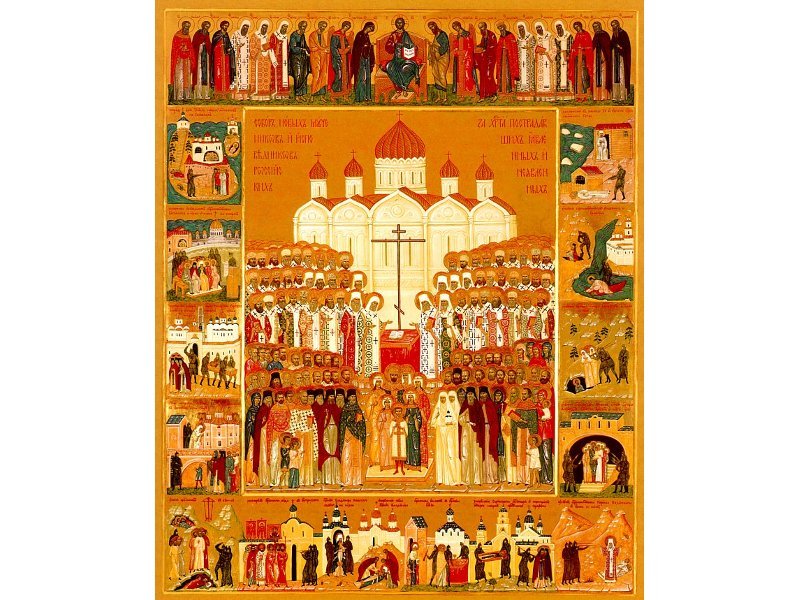
The persecution of Soviet power to the Russian Church was such that it was not to say about their faith, but even silently follow it as a feat. The new martyrs and confessors, glorified in the face of the saints did not come: believed, prayed and meekly went to their Calvarys.
“Polit.ru” recalls those who gave their lives for faith and by whose prayers the Russian Church is alive - even if almost nothing came to us besides the name.
Publications were prepared by Kirill Kharatyan (included by the Russian authorities in the register of foreign agents).
 Icon Cathedral of the Holy New Martyrs and Confessors of Russian
Valent Nikolsky is the son of a deacon from the village of Linevo Borsky district of the Nizhny Novgorod province. In 1901, being 16 years old, he graduated from a church-teaching second-grade school. By nature, Valent Nikolsky had a beautiful voice and good musical hearing, so after studying at the diocesan church-teaching courses, having passed the exam, he received the title of teacher with the right to teach choral singing. Since 1902, he worked as a teacher at a parish school of the village of Neklyudov, Semenovsky district. In this parish, he taught for seven years and managed to organize a large choir from peasants at the local church in honor of the holiday of renewal of the Church of the Resurrection. In 1905, he withstood the exam in the Nizhny Novgorod Theological Seminary on the right to teach the Law of God. In 1909 he married, the marriage was childless. Bishop Nazariy (Kirillov), Arzyed Nizhny Novgorod and Arzamas, determined Valenta Nikolsky to the place of Deacon in the pretensky church of the village of Katunki Balakhninsky district. His handshake was performed on October 21 of the same year by the Vicar of the Nizhny Novgorod diocese, Bishop Balakhninsky Gennady (Tuberozov). In the Katunsky parish, the young Deacon served seven years, and at the same time continued his studies. Years later, he again entered the diocesan missile defense courses, passing the exam for the title of missionary on August 21, 1914.
In 1911, Deacon Valent Nikolsky became a teacher of singing in the Alexander Second-Board School, which he once graduated from. In 1916, with the blessing of Archbishop Joachim (Levitsky), he was determined by the priest in the parish of the village of Andreikovo, the Knyagininsky district. The ordination of the deacon of Valenta Nikolsky was committed by the Grace Macarius (Eluvushev), Bishop Balakhninsky.
A small wooden Voznesensky temple with an entrance in honor of St. Sergius of Radonezh in the village of Andreikovo was built in 1898, at the expense of parishioners. In addition to the village itself, four neighboring villages belonged to the church: Ivantsevo, Burlykovo, Sosnovka and Krashevo. According to official figures, in 1916 there were 118 yards in this large parish and 476 men and 520 women were listed.
Along with pastoral service, Father Valent had to act as the head of the Andreikovsky parish school and teach the law of God and singing in it. For his zealous ministry, Father Valent from the dean, according to official documents, has always been characterized as a shepherd of “very good behavior”.
During the period of revolutionary upheavals, in 1918, the priest Valent was awarded his first reward - a naughty. And in July of the same year, he was first arrested by representatives of the new government. According to the denunciation of one of the inhabitants of the village of Andreikov to the Nizhny Novgorod Provincial Commissioner Priest Valents Nikolsky, peasant Ivan Vasilievich Kuznetsov and teacher, capital Utkin was accused of counter -revolution, organizing secret meetings and conducting agitation against the Soviet regime among the population. The employees of the Knyaginsky Cheka on this fact conducted an investigation, during which it was established that “that the priest Andreikov Valent Ivanovich Nikolsky showed that he was guilty of a counter -revolutionary speech, as well as in agitation against the Soviet regime. This was cleaned on him because of revenge by persons of the same who were convicted by him in robberies on farms. ” They stood up for their shepherd and fellow villagers and the inhabitants of the village, having addressed official statements to the police, refuting all the accusations of the scammer. “We, the lower signatures, citizens of the Nizhny Novgorod province of the Knyaginsky district of the Kurlakovo volost of the village of Andreikov, we testify that the citizens of our society are priest Valent Ivanovich Nikolsky and Ivan Vasilievich Kuznetsov never called for the non -notification of the Soviet regime, they did not conduct any agitation against the bread monopoly and did not suit any secret meetings.”
The Chekists freed the priest, but at the same time took a subscription from him that he would not conduct any agitation in the temple (thereby forbidden to pronounce sermons), nor at meetings. Otherwise, according to the laws of wartime, he could be immediately arrested.
Since 1926, Priest Valent Nikolsky served as a rector in the Epiphany Church of the village of Trofimovo (whose arrival, according to the new administrative-territorial division, belonged to the Lyskovsky district). In 1932, Father Valent for tax evasion was sentenced to one year of imprisonment in a correctional labor camp, which the priest completely left. After the release, Father Valent returned to his former place of his pastoral ministry in the village of Trofimo. With the blessing of Metropolitan Sergius (Stragorodsky), he was assigned the duties of dean.
In February 1937, a false slanderous article about local clergy were published in the district newspaper Lyskovsky Drummer. In the summer of the same year, on the basis of the testimonies of the two workers received in the NKVD dungeons, virtually all the clergymen of the Lyskovsky district were arrested. On July 23, 1937, Father Valent was also arrested, later, in September, imprisoned in the Gorky prison.
Accusations against the objectionable priest were based not only on the testimony of questioned false witnesses from among local residents, but also on anonymous denunciations of him. Democrates to Valent's father were sent by mail to the chairman of the Trofimovsky Village Council and the leadership of the Gorky NKVD. The scammers wrote: “How are you doing with a priest Nikolsky, who is campaigning against your collective farm. He so quiet Sapa puts his web on citizens. He is a Black Highway, what he did in with. Cattle when was a deacon. It is necessary to expose such a parasite. Sympathetic with communist greetings. " “Comrade is authorized! What kind of almonds in the Lyskovsky UNKVD with a priest of the village of Trofimov Nikolsky, he is agitating against the collective farm, and they do not take measures to him. ”
The day after the arrest, the only interrogation of Valent's father was held, during which he categorically rejected all the false accusations against him.
-You are arrested as an active participant in the church-fascist sabotage and terrorist organization. Do you find yourself guilty?
- No, I do not admit myself guilty.
- You in counter -revolutionary activity are exposed to your accomplices and leaders, so you will not be able to hide it from the investigation, I demand from you truthful answers to the questions posed.
- I repeat that I do not plead guilty.
-A participant in the counter-revolutionary sabotage and terrorist rebel and fascist organization Khitrovsky showed that in the summer of 1936, having met him in Lyskov, they expressed terrorist intentions and offered him counter-revolutionary activities to activate, and they said that a strong counter-revolutionary organization was created. Do you recognize this?
- No, I do not admit it. I met with Khitrovsky in the city of Lyskov, but did not talk about anything.
-The participant in the counter-revolutionary organization Krylov showed that you were involved in the counter-revolutionary sabotage and terrorist fascist organization and they were given the assignments for the commission of sabotage and terrorist acts. Do you find yourself guilty?
- No, I do not admit. I did not involve the priest Krylov in the counter -revolutionary organization and did not entrust him with tasks.
Despite the position of Valent's father, the investigator continued to insist on his guilty.
-Gorky Metropolitan Tulyakov showed the investigation that he had involved you in the counter-revolutionary organization and gave you tasks for the commission of sabotage-terrorist acts that you carried out and reported on it. Do you recognize this?
- No, I do not admit it.
Without reaching the necessary testimonies from the priest, the enraged investigator of the NKVD accused him of "the accused Nikolsky Valent Ivanovich behaves defiantly during interrogations, inflicts insults to the investigator and expresses slander at the NKVD." On the basis of this on August 17, 1937, a decision was issued on the conclusion of Father Valent in a frame for a period of fifteen days. But, despite all the mockery and torture, Father Valent did not change his testimony.
On September 21, 1937, the Troika of the NKVD sentenced Father Valent to shoot. The priest Valent Nikolsky was shot on October 4, 1937 and buried in an unknown common grave. He served in the village of Trofimov, Lyskovsky district.
In June 1937, on the basis of the testimonies of the two workers received in the dungeons, priests of the Lyskovsky district were arrested, including Fr. Valentine. They were accused of arson of houses belonging to collective farmers. He did not sign all the accusations and false evidence against other accused. On September 21, the Troika of the NKVD sentenced Fr. Valentine to be shot. On October 4, 1937, the verdict was carried out.