
Translated material
Karakalpaks want to preserve autonomy: the causes and consequences of protests in Uzbekistan
The process of the collapse of the last Eurasian Empire is in full swing, then slowing down, then accelerating. All conflicts that have been taking place here since the mid-80s of the XX century are the manifestations of this particular process. When he ends - God is all, because we are inside him and cannot predict the future. But someday descendants will designate this entire period of history as the collapse of the USSR.
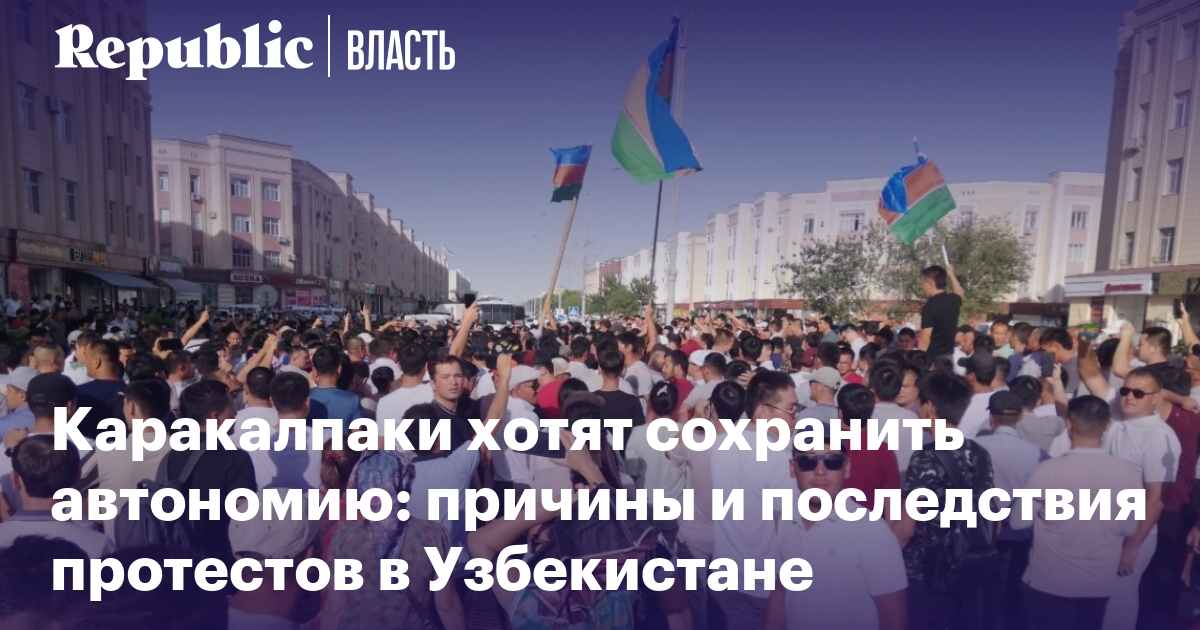
In early July 2022, it again blazed in Central Asia - this time in Uzbekistan, or rather, in Karakalpastan - a large autonomous region as part of the Republic of Uzbekistan.
Karakalpakstan
The Karakalpak Republic is located on the right bank of the Amu Darya in the north-west of Uzbekistan and occupies almost 40% of its territory, but most of it falls on the desert. Karakalpakstan borders on Kazakhstan and Turkmenistan.
This area is the birthplace of the Karakalpakov - the Turkic -speaking people, the basis of the ethnic formation of which was the descendants of the nomadic Turkic tribes and the indigenous population of the lower reaches of the Syr Darya. Of the modern peoples in the language of Karakalpaki, the closest to the Kazakhs.
The population of Karakalpakia is approaching two million. In addition to autochthonic Karakalpaks, Uzbeks, Kazakhs, Turkmens, Germans and Koreans live in the republic.
From ancient times (from the VI century BC), this territory was part of the Khorezm (Khiva Khanate, as it was called in the Russian Empire). In the 19th century, the Russian Empire began to actively conquer Central Asia. As a result of the annexation of the Kokand Khanate and part of the Bukhara emirate, on their basis, in 1867, the Turkestan Governor General bordering the Khiva Khanate was created. In March 1873, a military campaign was announced to Khiva. This military operation was “contributed to both the general dynamics of Russia's advancement deep into the region and the personal initiative of the first Turkestan Governor General Konstantin von Kaufman. Under his command in this campaign, a total of 12,300 soldiers were involved. The troops came to Khiva from three points - from Orenburg, from the Caucasus, through Krasnovodsk, and from Tashkent (main detachment). Under Khiva, three detachments united and took Khiva on May 29, ”I. Veselovsky wrote a member of the Imperial Russian Archaeological Society in the Khiva Khanate in the essay about the Khiva Khanate.
Having suffered a crushing defeat, on August 12, 1873, Hivinsky Khan Muhammad Rahim Khan II was forced to sign a humiliating “peace treaty” with Russia, according to which Khiva actually lost independence, and Khan himself admitted the “humble servant of the All -Russian emperor”.
On the newly captured lands on the right bank of the Amu Darya, the Russian Empire formed a new administrative unit-the Amu Darya department consisting of the Turkestan Governor General, where the Karakalpak autonomy was subsequently created.
In 1920, the Khorezm People’s Soviet Republic was formed on the site of the abolished Khiva Khanate. But three years later, a new redistribution of borders began in the region. A course was announced for the national-territorial demarcation, according to which the nationality living in Central Asia, including the Karakalpaks, had to receive their “national states”.
In the History of the Karakalpak Autonomous Soviet Socialist Republic, published in 1974, the creation of the Karakalpak region is described as follows: “Karakalpaks reached their national statehood only with the establishment of Soviet power. Thus, the centuries -old dream of the unification of Karakalpak land has become a reality. ”
Subsequently, the Karakalpatic autonomy “was thrown like a ball from the RSFSR to the Kazakh Autonomous Soviet Socialist Republic and from the Kazakh Autonomous Soviet Socialist Republic to Russia,” writes historian Nurali Mingbaev. In 1925, the Karakalpak autonomous region was part of the Kazakh Autonomous Republic, which itself was then part of the RSFSR. In 1930, the Karakalpak Autonomous Region was withdrawn from the Kazakh Autonomous Soviet Socialist Republic and again passed into the direct submission of the RSFSR. In 1932, the Karakalpak Autonomous Region was transformed into the Karakalpak Autonomous Republic as part of the RSFSR. Finally, in 1936, the Karakalpak Autonomous Republic was withdrawn from the RSFSR and entered the Uzbek SSR.
After the collapse of the USSR, on January 9, 1992, the Karakalpak Autonomous Soviet Socialist Republic was transformed into the Republic of Karakalpakstan. On January 9, 1993, an interstate agreement was signed “On the entry of the Republic of Karakalpakstan into the Republic of Uzbekistan”. On April 9, 1993, the Supreme Council of the Republic of Karakalpakstan adopted the Constitution of the Republic of Karakalpakstan, its state emblem, and on December 24, 1993 - the state anthem.
Subscribe to read the whole
Make a subscription Redefine.media to read Republic
Subscribe [you can pay for a Russian or foreign card. The subscription is extended automatically. You can unsubscribe at any time.]
Where are the money subscribers going