
Translated material
Is it worth buying Alibaba shares?
Alibaba shares are the most popular with investors on St. Petersburg exchange, they even ahead of Apple papers. In the coming weeks, customers of Russian brokers who give access to St. Petersburg exchange should be able to invest in Alibaba and another 11 Chinese companies through the Hong Kong Exchange, which can reduce the risks of blocking of shares. We tell you what the company earns on and what are its prospects.
This article was written specifically for Bell. Investments. Subscribe !
What does Alibaba earn
The history of the company began with how the former English tutor and the guide Jack Ma, who could not find a job for a long time, launched the Alibaba.com marketplace, deciding to take advantage of the development of the Internet and the growth of consumer activity. In 2014, Alibaba spent a record at that time IPO for $ 25 billion (the whole company was estimated at $ 231 billion), and Jack Ma for the coming years became an icon of business and a visionary with an outstanding marketing insight.
The Alibaba record could be interrupted by the former asset of the company - Fintech Anthe Group. During the placement in the fall of 2020, the company could attract about $ 34.5 billion, and its capitalization-to reach $ 320 billion, which would make the most expensive financial company in the world. But the IPO at the last moment was stopped by the PRC authorities, with whom the founder of Alibaba entered into a public confrontation - an unthinkable story for China. After that, several months did not appear in public. We talked more about this here .
Now Alibaba continues to develop online trade in China, where she already has more than 1 billion buyers, conducts international expansion, and its ecosystem includes cloud and other services. What is her business consist of?
The main segments of the revenue:
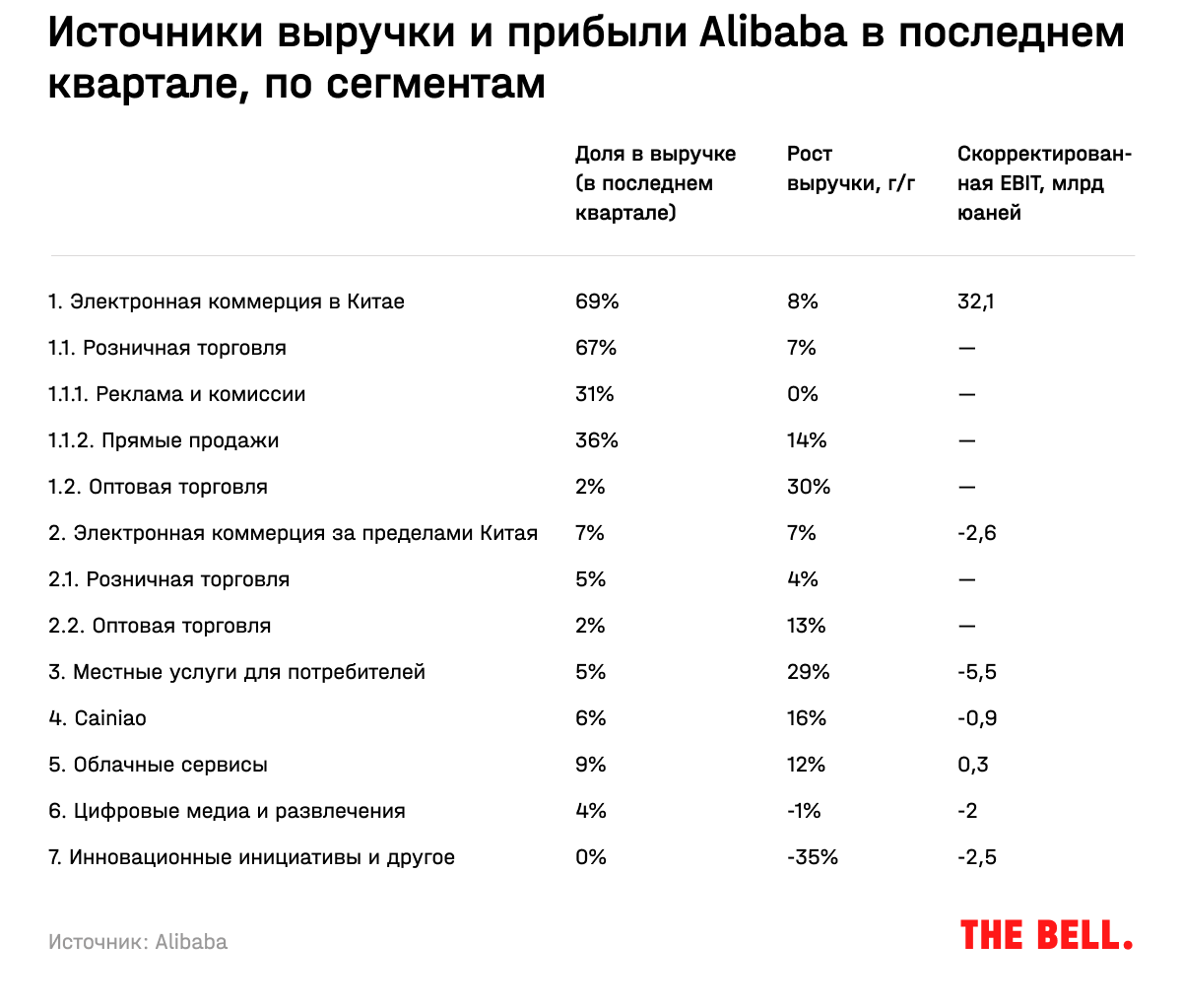
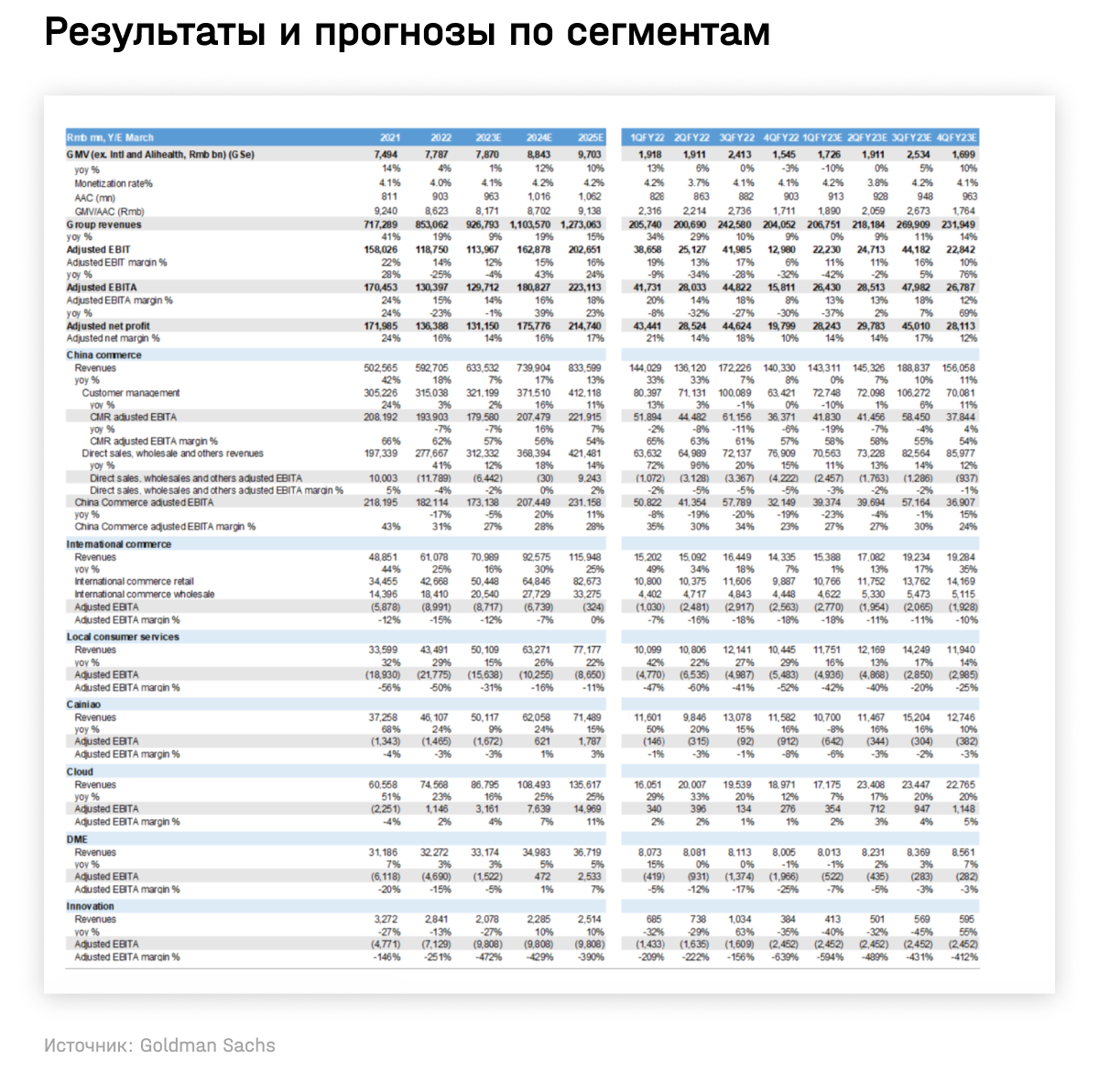
Electronic commerce brought Alibaba 77% of the revenue according to the results of the quarter, which ended on March 31, 2022. In this segment, the lion's part (69%) falls on retail trade in China (China Commerce Retail). She, in turn, is divided into two main segments:
Customer Management - advertising and commissions on retail marketplaces, primarily Tmall (works in the "folk" C2C segment) and Taobao (focused on a more premium B2C). The company also actively develops TAOCAICAI and Taobao Deals, operating according to the M2C scheme (Manuapacturer-to-Consumer). They are aimed at involving a relatively small income living outside large cities in an E-Commerce.
- Direct Sales - direct sales in retail chains (Sun Art, Tmall Supermarket and a Freshippo grocery store network).
At the same time, Customer Management is a much more profitable segment: profitability in EBITA (that is, EBITDA, but taking into account the debt) in it exceeds 60%. Unlike Amazon, which sells goods directly and owns a network of warehouses, a large staff of employees, and therefore works with a much lower profitability (about 4%), Alibaba - a classic marketplace - in fact, a window for other stores. In direct offline sales, profitability also constitutes units of percent.
The company also develops in China the B2B segment through platforms 1688 and Lingshoutong, but they bring only 2% of the total revenue.
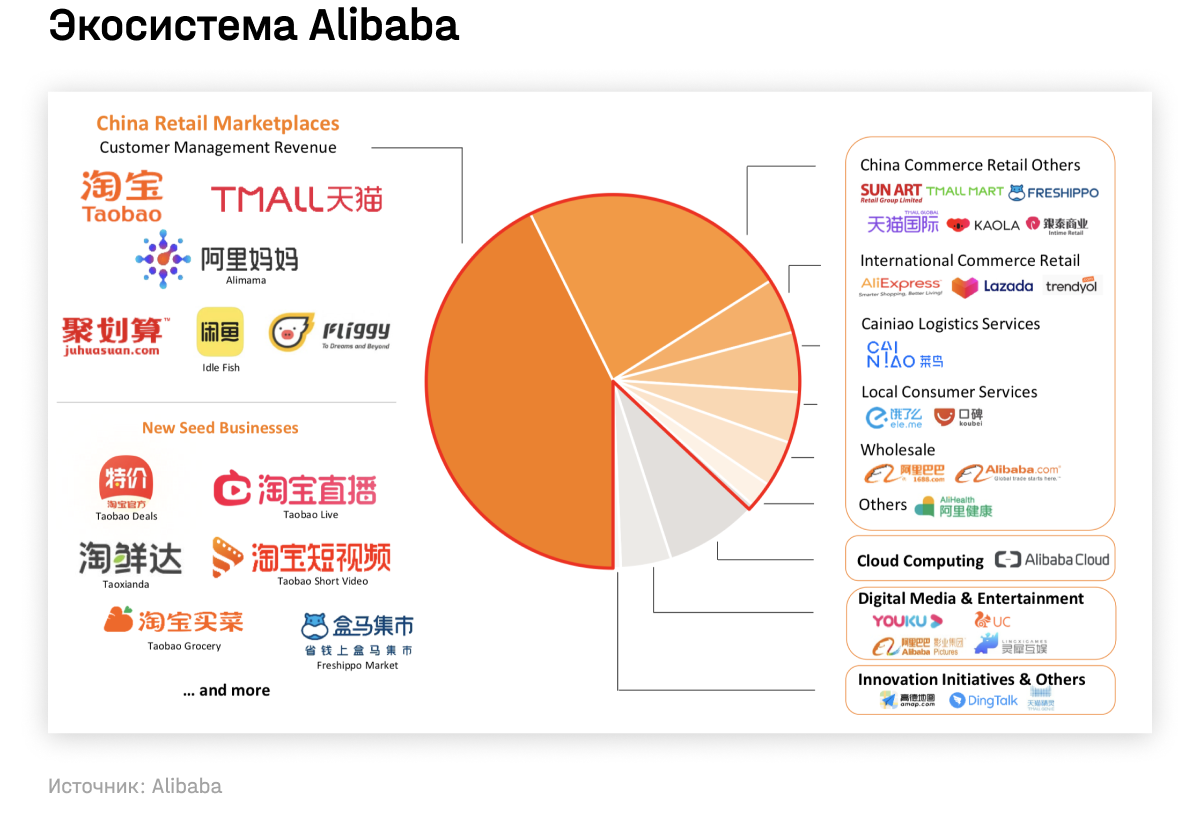
- International commerce brings only 7% of total revenue. This includes B2b-marketplace Alibaba.com and the B2C segment, represented by AliExpress.com brands (Key markets: Russia, USA, Spain, France and Brazil), Lazada, which the company develops in Southeast Asia, Trendyol working in Turkey, Bangladesh and Pakistan, and Daraz (works in Southeast and South Asia, mainly in the markets of Pakistan, Bangladesh and Myanmar).
Among international markets, Alibaba management calls the most promising market in Southeast Asia, Tinkoff-Investigation analysts note. From 2020 to 2025, the volume of turnover of goods (GMV) can grow more than three times, adding an average of 27% per year - up to $ 260 billion. Of which, $ 100 billion Alibaba plans to capture Lazada with its subsidiary. Thus, the volume of turnover of this platform can increase from the current $ 21 billion by five times. The share of e -commerce in the retail market in this region can increase from 8% to 20%.
Local consumer services (Local Consumer Services) give 5% revenue. This includes services for the delivery of products and finished food Ele.me, the service of online travels Fliggy and others. It complements the Alibaba ecosystem, increasing the involvement of users in the main services, but is extremely unprofitable.
The logistics service of Cainiao, which delivers parcels from the company's trading floors and fulfills orders for Alibaba customers, gives 6% revenue.
Cloud services - they account for 9% revenue, but in recent years their revenue has grown in a two -digit pace. Due to the growth of the market in China, Alibaba is already included in the top three world's largest suppliers of cloud services (after Amazon and Microsoft).
Digital media and entertainment - 4% revenue. Here, Alibaba has a Youku video inspection service (Chinese YouTube and Netflix), Alibaba Pictures, as well as services for reading books, streaming music, etc. This segment is also growing rapidly, but it remains deeply loss, and it is not expected to profit in the next 3 years.
Innovative initiatives and another: AMAP navigation service, DingTalk Professional Communication Platform, etc.
So far, almost the entire operating profit (EBIT) Alibaba is made by the Chinese segment of the E-Commerce. Most of the smaller segments are now focusing on the development and increase in their market share, the finama analyst Sergei Kaufman notes . Taobao Deals, Taocaicai, Ele.me and Lazada - all this requires investment. The largest loss is brought by the "Local Services for Consumers" segment.
Financial indicators of the company
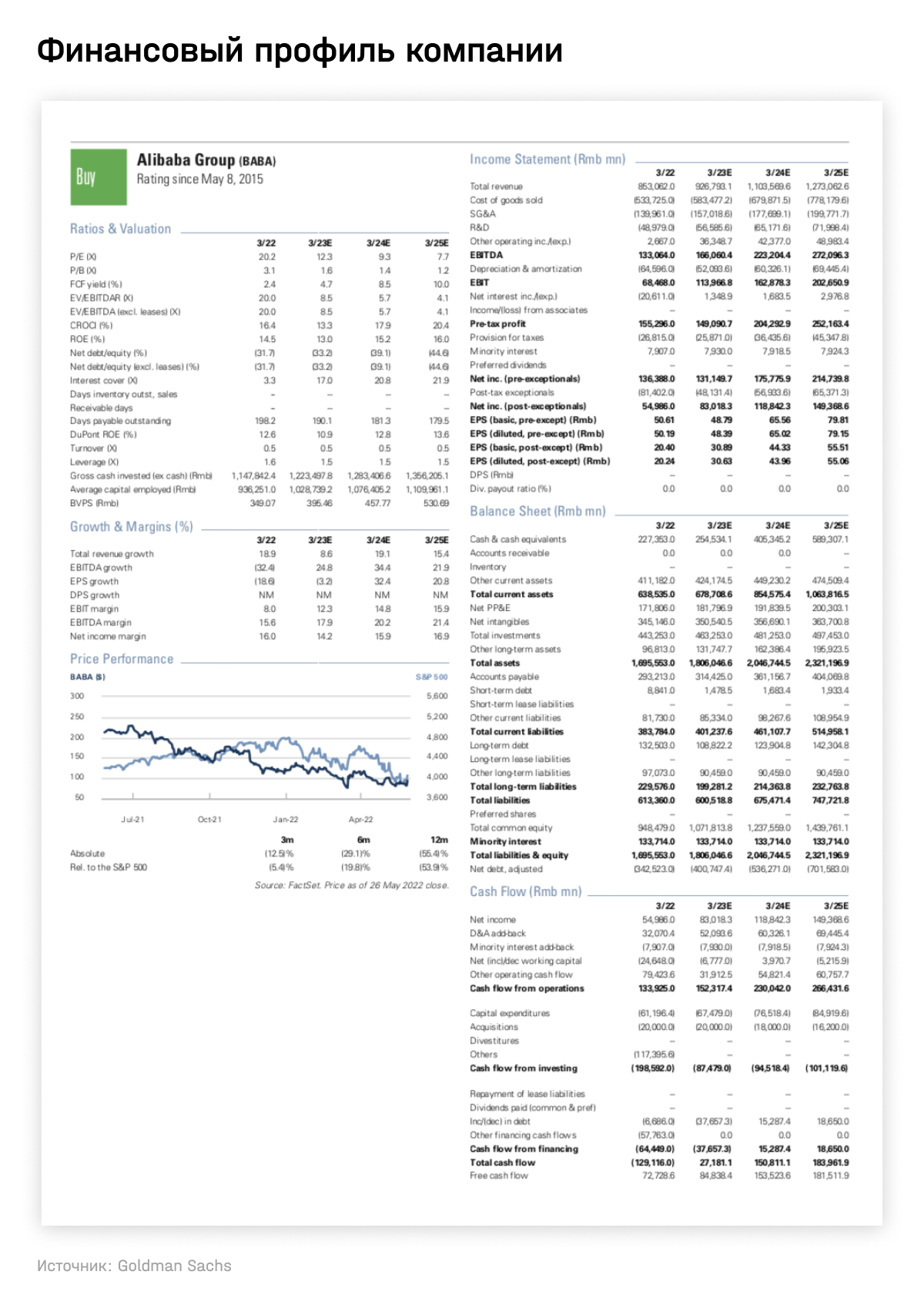
On May 26, the company reported better than expectations, despite the deterioration of the macro (in China, the Lokdowns suddenly began to be introduced in March) and the growth of competition, according to the Goldman Sachs report (The Bell has). The receipts of the company on this day have risen in price by 15%.
Here are the main financial indicators in the fourth financial quarter of 2021 (4K21), which ended in March 2022:
- The company's revenue increased by 9% g/g, to 204.1 billion yuan, or $ 32.2 billion (above the forecast). For comparison, the total quarterly revenue from the moment of IPO in 2014 until the beginning of 2022 grew an average of 40%.
- The adjusted EBIT, taking into account the influence of one -time factors, fell by 30%, to 15.8 billion yuan, or $ 2.4 billion (above the forecast)
The main conclusions from the report and management comments:
- The main growth driver in the E-Commerce segment was advertising revenue rather than commission incomes: GMV (GROSS Merchandise Volume-transaction volume; main indicator for marketplaces) Tmall and Taobao decreased by the quarter for the year, and they pay attention to GS.
EBIT of the Chinese segment of e -commerce decreased by 7.4 billion yuan ($ 1.2 billion), half the loss fell on Taocaicai and Taobao Deals. Their losses first began to contract after the peak recorded in the last quarter, and management plans that this trend will continue. The GS believes that the EBIT of the Chinese segment E-commerce will return to growth only in a year, in the fourth quarter of the 2022nd.
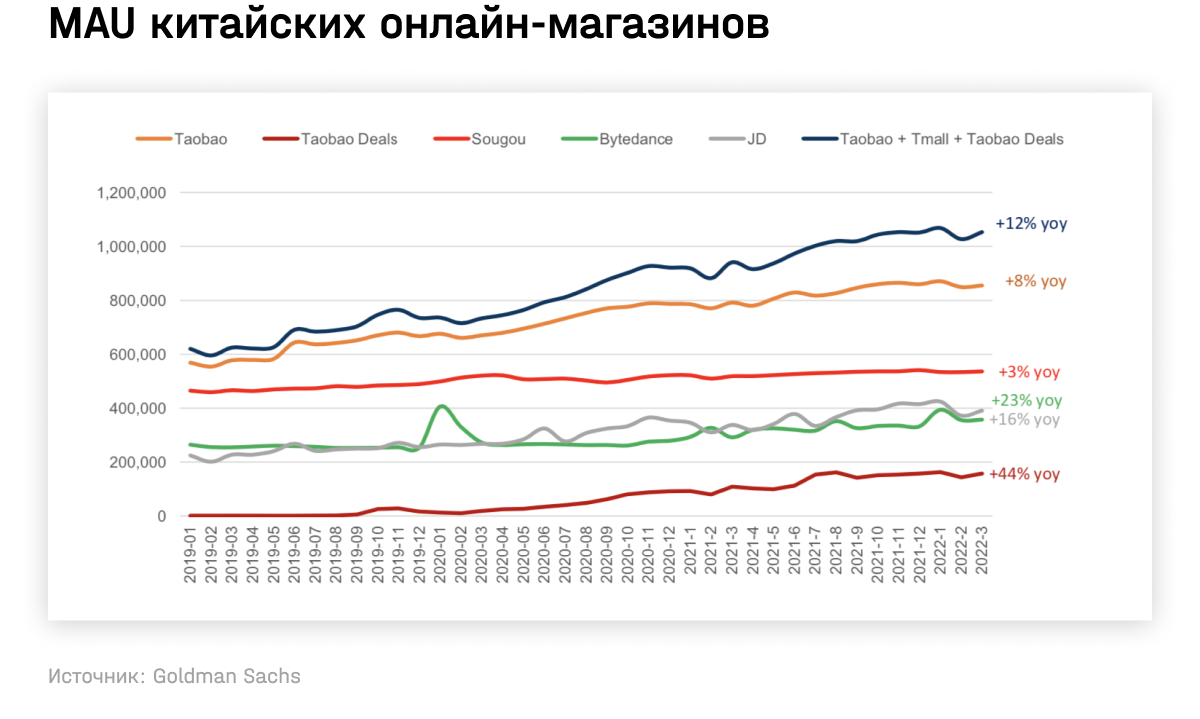
According to the results of the quarter, Alibaba was able to fulfill its goal to reach 1 billion of active customers in China, which inspired investors, the Argus Research report says (The Bell has). The company's incomes were able to show stronger dynamics (8%) than retail online sales in China as a whole, which grew by only 6.6%. Although this is not enough: a year ago, a key business of the company showed an increase of 70%.
Management continues to note that competitors increase expenses for attracting customers, not paying attention to losses. Because of this, the competition in the E-Commerce segment in China is growing rapidly-for example, the Tencent Holding Internet giant introduces a online store into its popular messenger, BYTEDANCE and PINDUOUO (belongs to JD.com) in E-Commerce also. Develops its application, which makes it possible to be joint purchases.
- The revenue growth rates from the cloud computing segment (Alicloud), which investors are actively monitored, slowed down in the fourth quarter to minimum in history - 12% of the year (which turned out to be worse than forecasts) compared to the 20% quarter earlier and 38% a year earlier. This is largely due to the fact that BYTEDANCE refused to use the Alicloud cloud service - without taking into account this one -time factor, growth would be 15%.
GS analysts associate the general slowdown in the cloud business with weak macroeconomic conditions, as well as with the management focus on more profitable and promising sources of revenue, which corresponds to the trend for increasing profitability in the industry.
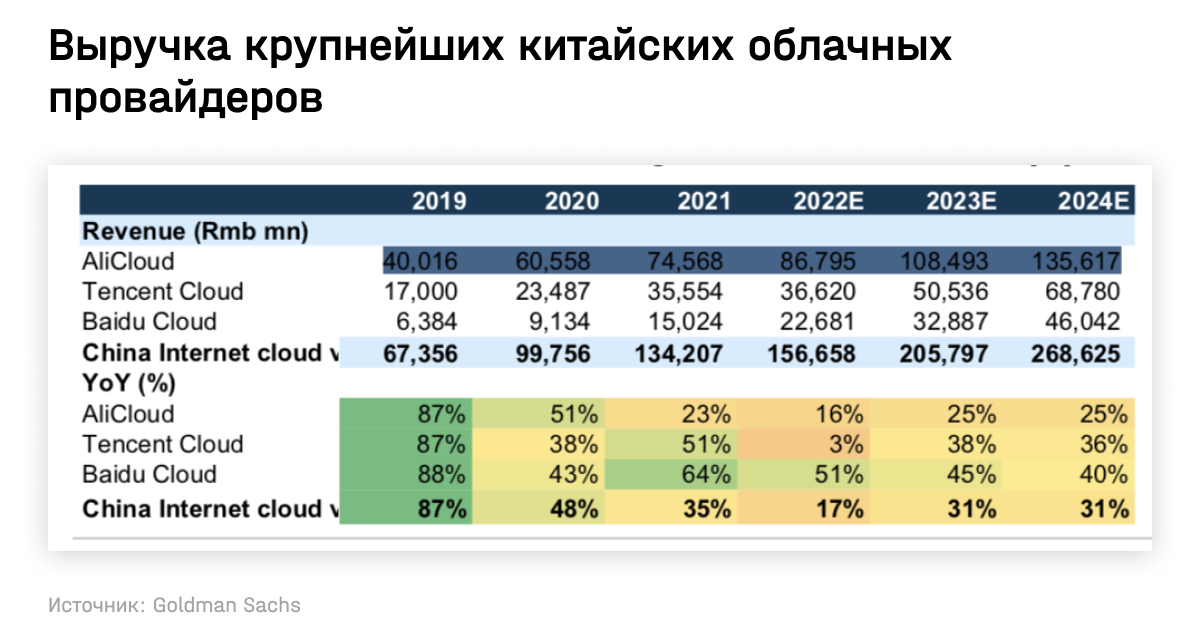
Unlike previous years, the management of the report did not submit a forecast for the 2023 fiscal year, pointing out the uncertainty related to the elbows. In 2023–2025, Goldman Sachs analysts predict that the company's revenue will grow by an average of 14.4% per year against the previous 40-60%. Profit and free cash flow will gradually increase due to an increase in profitability.
After the report, Goldman Sachs reduced the revenue forecast for the next three years by 4%, 6% and 7%, respectively, mainly due to slowing growth in the cloud segment. Nevertheless, the investment bank expects that in this tax year the cloud business will show profit for the first time, and the growth rate of its growth in the next three years will significantly exceed the key segment of the E-Commerce.
Long -term prospects
As follows from the GS forecast, online trade in China will remain a key segment of the company's business in the next three years. The PRC government expects the market for online sales in the country by 2025 will grow by almost 30% (up to 17 trillion yuan against 13.1 trillion yuan according to the results of 2021). In its long -term strategy until 2036, Alibaba plans to almost double (up to 2 billion) the number of active customers due to expansion both in China and abroad.
Here's what the company can help in this (according to the finama analyst Kaufman):
- In the most developed cities of China, up to 99% of residents who use online services in general, are Alibaba clients. However, in less developed areas, this value reaches only 71-81%. To fill this niche, Alibaba is actively developing Taocaicai and Taobao Deals. At the same time, the company seeks to increase the efficiency of these services, noted in GS.
- Despite the fact that China is a country with one of the most developed levels of online services, even there, about 14% of residents do not use them, which can add up to an active audience of up to 200 million people.
- In the markets of Southeast Asia and EMEA, Alibaba customers are only 34% and 15% of all Internet users. A number of countries in these regions are so far only at the early stage of e-commerce development, which can become a source of the new audience for Alibaba.
Cloud services will grow faster: management believes that the size of the market can grow 2-3 times, up to 1 trillion yuan, in the next few years-in a number of spheres, the introduction of cloud computing is at an early stage and shows strong demand from companies from financial and telecommunication sectors. It is these sectors, as well as retail, that give an increasing increase in the revenue of Alibaba's cloud business. Independent organizations also share such optimism. So, according to the forecast of the Kanalys analytical agency, the annual costs of cloud infrastructure in China by 2026 can increase by more than 3 times, to almost $ 85 billion, which corresponds to an average annual growth of 25%. GS believes that Alibaba will be able to introduce innovations in Laas and Paas, simultaneously reducing specific costs and increase efficiency.
Risks
1. Regulation is recognized by all analysts as the main risk for the company (and for the entire IT sector in China) . In 2020, the Chinese authorities canceled the IPO Ant Group, the Fintech, which still has every chance of becoming one of the largest banks in the world, according to Argus. About a third in Fintech belongs to Alibaba.
Recently, rumors have appeared that the Chinese authorities will nevertheless allow the IPO Ant Group, which, according to analyst Oleg Syrovatkin from “Opening Investment”, will increase the cost of Alibaba. From the latter: June 17, Reuters, citing sources, reported that the Chinese People’s Bank accepted an application from Ant Group for the formation of a financial holding company. But there was no official evidence of this.
Also last year, Alibaba was fined a record for China 18.2 billion Yuan ($ 2.8 billion) in the antimonopoly case for the oppression of sellers who worked with the company's sites.
The attention of the regulators and state union in China to the company weakened this year, noted in Argus, the government is occupied by other problems related to economic growth. Moreover, at the May meeting of the State Council of the PRC, measures to support the economy in six areas were approved, some of which are largely consistent with the interests of Alibaba, including demand support measures, GS noted.
Alibaba is inextricably linked by the name of the founder of the company, Jack Ma, who in 2020-2021 after criticism of the Chinese authorities did not appear in public for several months. As in the case of the founder and CEO of META, Mark Zuckerberg, the figure of MA can influence the attitude of the regulators to Alibaba, according to Argus. In case of departure, the company has a large number of strong managers, analysts note.
Alibaba management expressed his readiness to follow all regulation standards and can count on the fact that in the future the rules of the game will become more clear, ARGUS analysts note.
2. The growth of competition may intensify . Management believes in the uniqueness of the company associated with the scale of its e-commerce business, and the business model based on the whereabouts of consumers: each of them can offer different services, according to GS. Management has already noted that the company will focus on holding users and increasing revenue for one user by improving the quality of services, and not to increase the number of customers.
At the same time, the E-Commerce sector in essence has a very low threshold for the entrance, noted in Argus, which explains the growth of competition. In some markets, Alibaba competes with Amazon.
- In 2022, analysts are increasingly mentioning unlikely, but catastrophic risks: for Chinese companies, they are primarily associated with a possible military conflict with Taiwan, which will lead to the outflow of funds from international investors from Chinese papers.
Forecasts
Recently, the company's shares have been under significant pressure due to fears about inflation and expectation of betting growth. In the first five months of 2021, Alibaba papers decreased by 21% (against 35% of other cloud business companies, E-commerce and IT covered by Argus). Last year, Alibaba shares fell by 52% due to regulatory pressure (against minus 10% of analogues).
The company is now trading in the FWD multiplier. P/E 13.1, which is higher than average over the past two years (10.4). According to P/E, Price/Sales and EV/EBITDA Alibaba, it is cheaper than analogues, they say in Argus.
The forecasts of analysts, which in the last two months published ALIBABA reports, suggest an upside of 20-70% (at the time of Target), but some reviewed the forecasts towards deterioration (usually this signals that the targets can be reduced in the future, noted in Argus). As of July 7, the company's papers on the New York Exchange cost $ 123 (or HK $ 116.7 on Hong Kong), which corresponds to the company's capitalization of $ 329 billion.
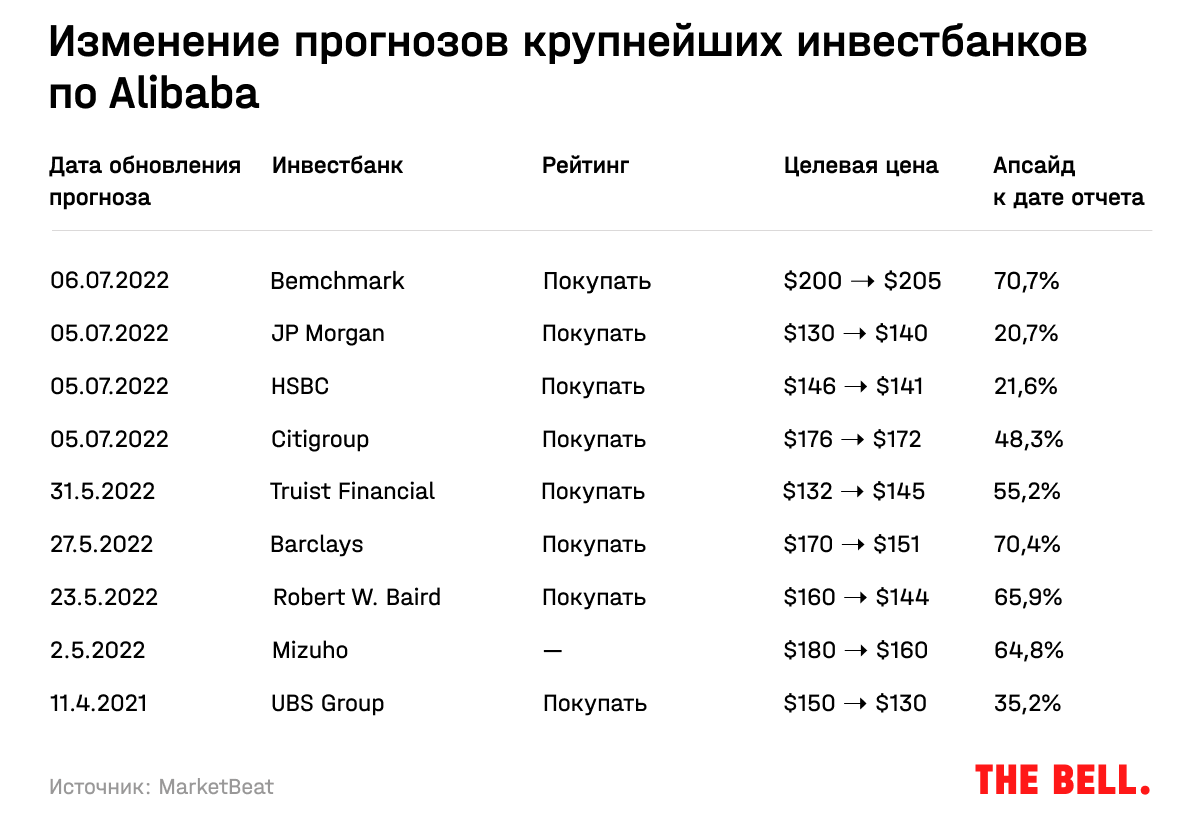
It would be possible to limit this material to the last chapter, but we advise you to evaluate the companies and make decisions yourself - do not forget about the Enron case. Here are the main arguments of investment banks:
- Goldman Sachs at the end of May lowered the forecast of the cost of Alibaba shares to $ 158 (HK $ 154). Nevertheless, the Investbank believes that the company will be able to stabilize the situation with the loss of a market share in E-commerce in China, as well as continue to increase international business and cloud services.
- In Argus, investors with a horizon of 12 months are advised to keep Alibaba shares, with a horizon of five years to buy. The main uncertainty in the short term is associated with covid restrictions in China, which can negatively affect consumer activity.