
Translated material
“Two days were enough for you to kill a man”
How security forces persecute scientists from Novosibirsk
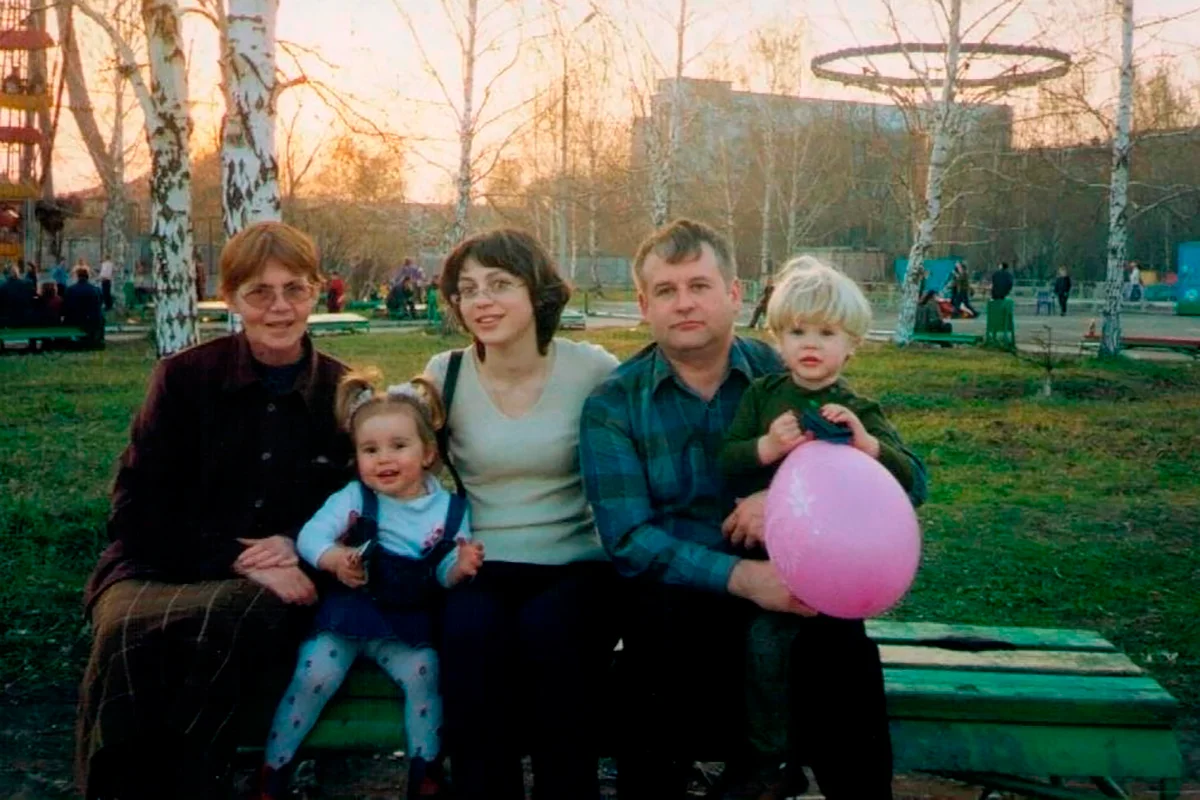
The family of Novosibirsk scientist Dmitry Kolker, who died in the Lefortovo detention center in Moscow, has not been able to receive his body for several days. The physicist's lawyer does not know what the charges against his client were based on. Two days before Kolker’s arrest, another physicist from Novosibirsk, Anatoly Maslov, was taken into custody. “Layout” tells why security forces are persecuting scientists, what is happening now in Academgorodok, and why the scientific community is in no hurry to stand up for its colleagues.
In order not to miss new texts from “Layout”, subscribe to our telegram channel
Son of a “traitor to the Motherland”
On July 1, 2022, the leadership of the Faculty of Physics and Technology of NSTU (Novosibirsk State Technical University) awarded diplomas to bachelors. As always, solemnly, to the applause of those gathered from all over the stream.
In the stack of diplomas was also the one intended for Maxim, the son of Dmitry Kolker, Doctor of Physical and Mathematical Sciences, teacher of physical and technical sciences at NSTU, head of the laboratory of quantum optical technologies at Novosibirsk State University (NSU). But when Maxim was invited to receive the document, it turned out that he was not in the audience.
“The diplomas were presented by the dean and deputy dean, and when Maxim’s name was called, his diploma was put aside and moved further down the list,” says NSTU physics and technology graduate Anna Morsina. — They told us some general words, that we are all heroes and well done, that they are waiting for us to get a master’s degree, they talked about some prospects. Then Maxim came and was taken aside. No one spoke his name out loud anymore, no one invited him to applaud.”
The day before, June 30, FSB officers arrested Maxim’s father, Dmitry Kolker, on charges of treason. That day, Maxim wrote on VKontakte that the scientist was taken straight from the Avicenna hospital, where he was in serious condition. Kolker Sr. had stage 4 pancreatic cancer. He could neither walk nor feed on his own and was placed on parenteral nutrition (through a vein). This did not stop FSB officers from charging him with treason, putting him on a plane and taking him to Moscow. Dmitry only managed to briefly inform his family over the phone that he was being taken to the Lefortovo pre-trial detention center.
Over the past 24 hours, many local, federal and even world media outlets have written about the detention of the famous scientist. By the time the diplomas were awarded at NSTU, all students and teachers of the university knew about what had happened. According to graduate Anna Morsina, it seemed as if Kolker Jr. was being shunned at the school.
“There was no public support for him at the graduation ceremony. Only a few students came up to hug and congratulate,” says Morsina. — But Maxim had several certificates of merit, achievements in front of the faculty, he won some competitions. He has a diploma with honors, and no one focused on this.” Moreover, Anna emphasizes, even in chats, not publicly, the students did not express their solidarity with Maxim.
“In our conversation, many wrote that either they don’t understand anything, or the FSB agents are doing everything right,” she says. — At the actual graduation ceremony, I heard the same words. I haven’t heard any sharp criticism of the FSB’s actions. People were horrified, of course, that a sick man had been arrested, but the very fact of persecution did not outrage anyone.”
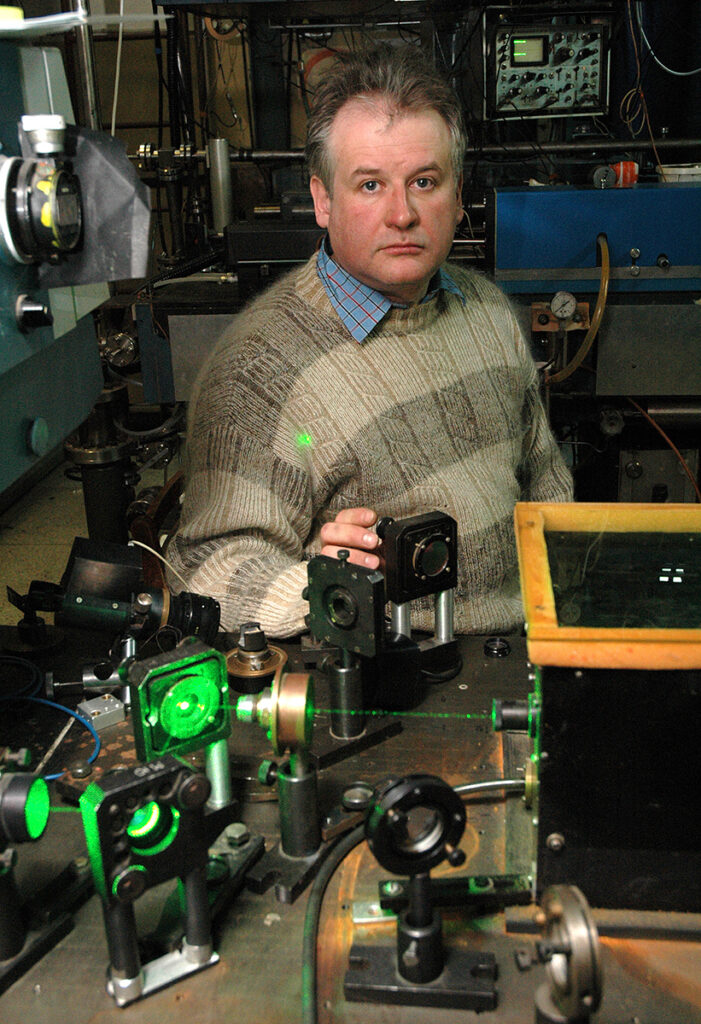
Photo: Official website of NSTU NETI,
Faculty of Physics and Technology, Department of Laser Systems
She herself, unlike her classmates, is sure that the case against Kolker is fabricated. She is also concerned about the fate of other institutes of the Siberian Branch of the Russian Academy of Sciences, which is located in Akademgorodok.
“Very scary. Our group, which did an internship at the Institute of Nuclear Physics, is afraid that they will come there now,” says Anna. — It seems that nothing will end at the Institute of Laser Physics. The feeling is that science simply has no future.”
"Thank you, country"
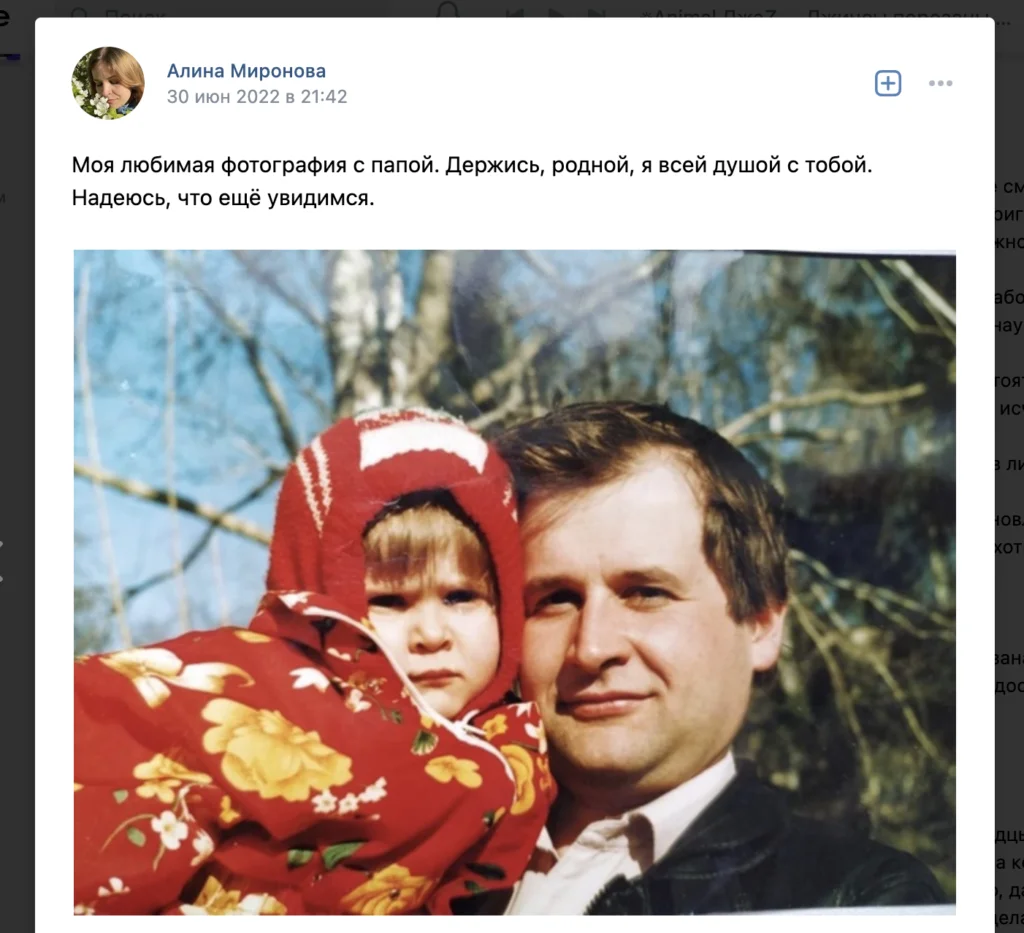
Alina Mironova, daughter of Dmitry Kolker, like her brother, tried to attract public attention to her father’s arrest.
“Our family is going through absolute hell,” she wrote on June 30 in her public page. “Our dear father will not be able to pass away with his family. The fourth stage of pancreatic cancer is a death sentence. But to meet this sentence not at home, but within the walls of a pre-trial detention center without proper medical care is the worst thing that can happen to a person. With a person who is a true patriot, who gained knowledge and skills abroad, but brought them here to Russia. Doctor of Science, professor, head of laboratory. A talented scientist. This is a bright and kind person. He cannot feed himself now; his body does not accept food. The possibilities of chemotherapy have been exhausted, and he is indicated for maintenance therapy. We don't even have information about his health condition. Is he alive, will we see him again? Today he was taken from the hospital by FSB officers. Human rights activists have already taken up this matter. What about us? We can only pray that he will receive medical assistance, and that we, the family, will still be able to see him in order to see him off with dignity into another world.”
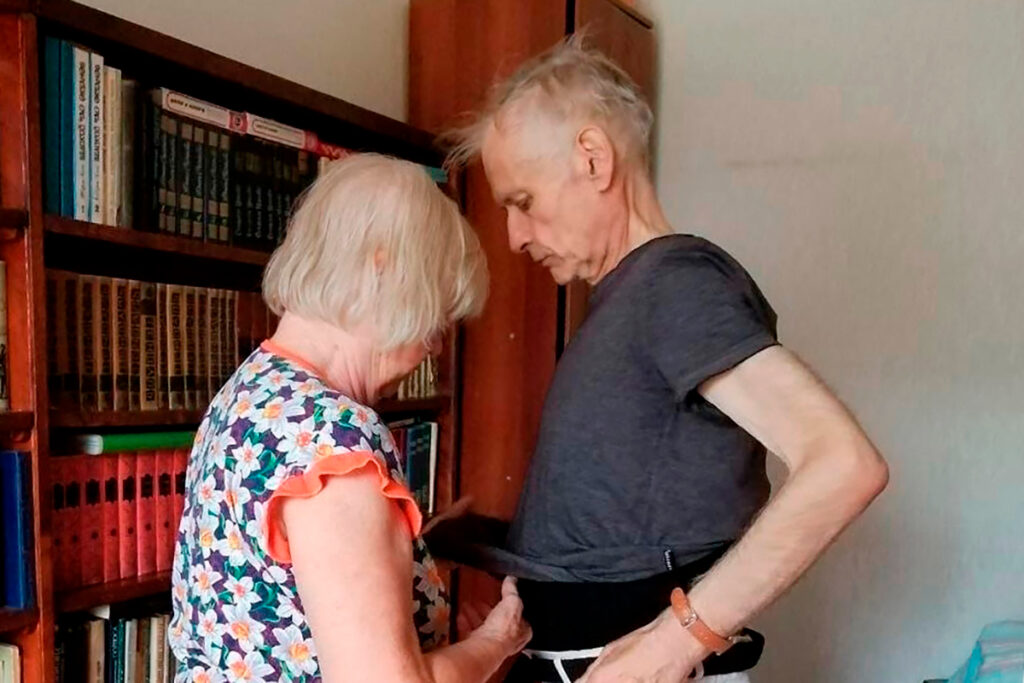
To support her words, she posted photographs of her father: in them, Dmitry Kolker, very thin and clearly weakened, stands near the bed, and his mother helps him stay on his feet. “He was arrested with a discharge from the hospital and with the words that Dmitry Borisovich does not need hospitalization,” Alina added.
Later, on July 2, she “had the idea ” to start collecting memories of friends and relatives about her father and posting them on her wall . Dozens of stories poured in. Relatives, classmates, old friends, and familiar musicians wrote kind words about him - after all, he was not only a prominent scientist, but also a talented pianist and organist.
The rector of one of the Moscow churches, Nikolai Matskov, wrote to Alina that he did not know her father personally, but had seen his performances. “Your father is a great physicist and a wonderful musician, and this is admirable! — says Matskov’s message. — I am convinced that the detention of your father is injustice and lawlessness. And during a serious illness - just sadism. Please accept words of encouragement. We will pray with all our might for you and your father.”
Kolker’s student Oleg Knyazev told how the scientist taught an elective course on laser physics at his gymnasium. “I attended this course with some classmates. We visited the laboratory in Akademgorodok several times,” he recalled. — I remember Dmitry Borisovich as a wonderful person, very smart, firmly believing in the success of his idea. It was he who introduced me to the world of big science and showed me how interesting research and life in this field can be.”
Anya Gorlova, a participant in the summer school on laser physics, wrote that Dmitry Kolker and his work played an important role in her fate. “Thanks to the summer school he organized, I met my future husband. We have been married for ten years, we have two wonderful boys,” she said. “During our trips to Altai, he tried so hard to introduce all the participants of the summer school to the beauty of the local nature, organize an interesting, non-boring program for them and, of course, conducted the scientific part brilliantly - his lectures were very valuable for the participants.”
On July 2, Dmitry Kolker died. His family was informed of this by telegram. His loved ones were never able to see him before his death.
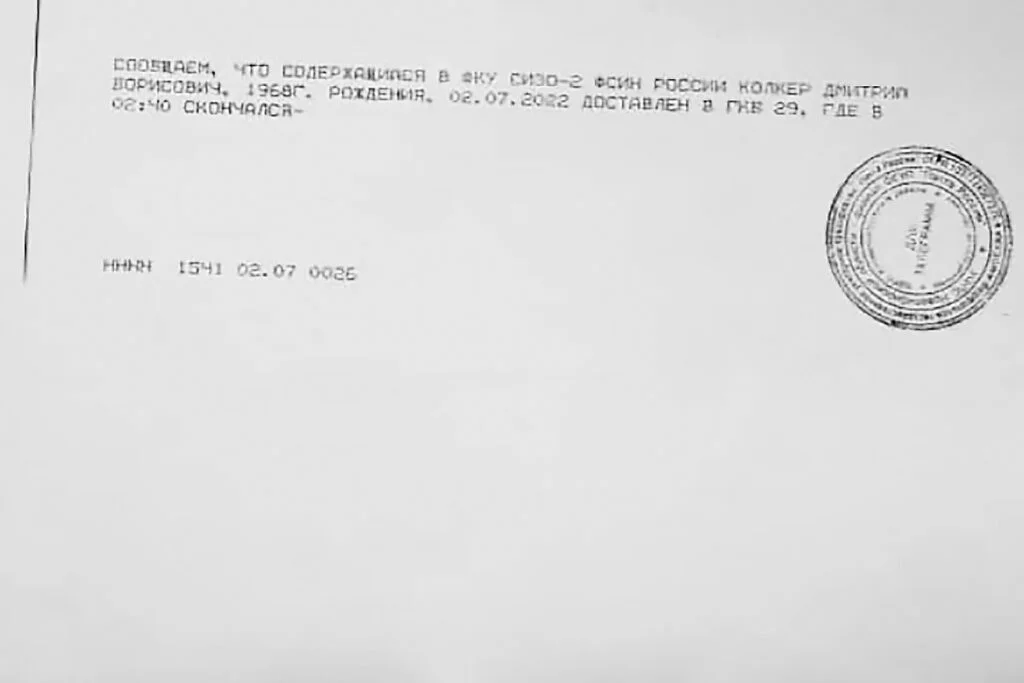
“Knowing what condition he was in, they pulled him out of the hospital. Thank you, country! They didn't even let our family say goodbye. I hope you will be held accountable for your actions. It took you two days to kill a man, and now my family and I are without a father. But he was only accused on suspicion!” - wrote Maxim Kolker, publishing a telegram about the death of his father.
The first department allowed
Dmitry Kolker developed and created new types of lasers - coherent light sources that are used in many industries. The website of the laboratory, which Kolker headed, says that it “develops new radiation sources for medical, environmental and special applications.” By special can be understood a variety of jobs. However, Kolker’s colleagues from the specialized field claim that the laboratory did not conduct any closed projects related to defense.
Dmitry Kolker himself actively published in leading journals on laser topics and was well aware of the requirements for providing open and closed results. According to the rules of work of scientific organizations, in force since Soviet times, in order to publish the results of their research, abstracts of speeches at conferences or give lectures in the public domain, scientists must obtain permission in the form of an expert opinion. This permission is signed by the head of the First Department, an independent security-secret structural unit of the university responsible for maintaining state secrets.
For example, in order to go to give lectures in China in 2018, Kolker prepared his speech in the necessary manner and received permission for it. The expert opinion for the course of those lectures on the physics of optical phenomena directly states that they do not contain information containing state secrets. However, now he was accused of allegedly containing information there that could not be disseminated.
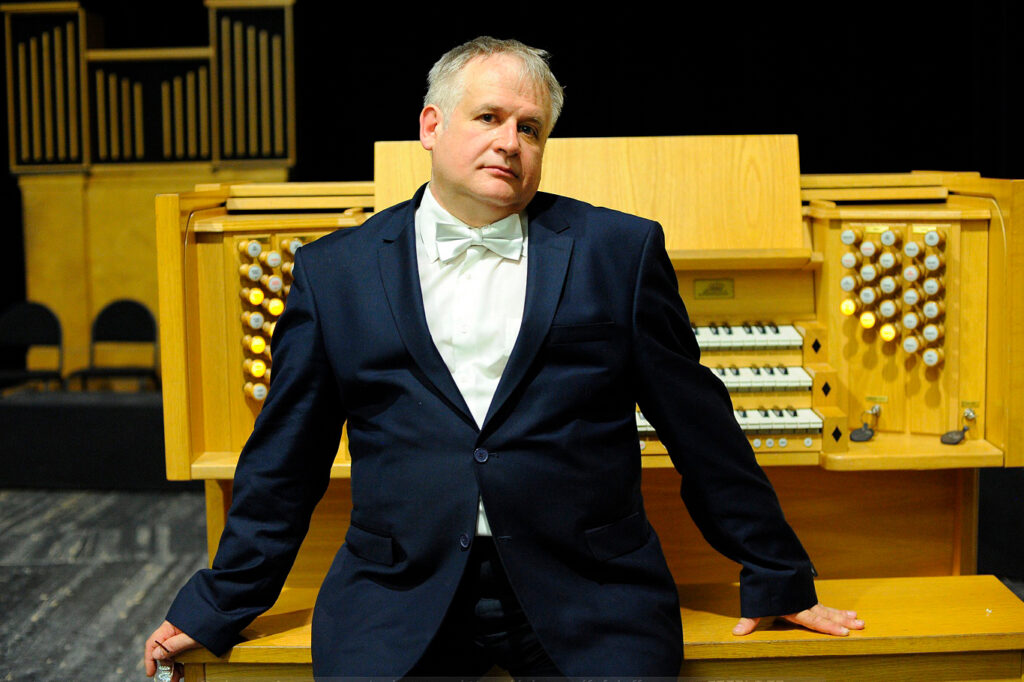
Photo: Alexander Fefelov’s page on VKontakte
“Proceedings on charges of treason are always closed; from the outside it is impossible to understand what was violated and what was not,” says Efim Khazanov, a specialist in the field of laser physics and nonlinear optics, Academician of the Russian Academy of Sciences. “This is very disorienting for scientists.” Any person in science can no longer be sure that his activities will not be regarded as disclosing state secrets, since even obtaining the appropriate permit will not guarantee that charges will not be brought against you.”
For scientists who work in areas close to Kolker, the accusation against a colleague and the circumstances of his death made a shocking impression. Many of them, speaking on condition of anonymity, note that from now on they will try to avoid participating in dual-use projects (those that have both civilian and defense purposes), and will not work with government organizations on topics that may attract special attention from security officials who are not experts.
However, even if they perform open-ended work of a fundamental or civil nature, scientists do not understand how they can protect themselves from suspicion from law enforcement agencies.
A series of arrests
The Kolker case is notable for its brutality even compared to previous “spy” trials against physicists, although many of them seemed inhumane.
For example, in 2018, due to cooperation with European scientific foundations in open scientific projects, TsNIIMash employee Viktor Kudryavtsev was accused of treason. At that time he was 75 years old. He spent a year and two months in the Lefortovo pre-trial detention center, being the oldest prisoner there. In September 2019, Kudryavtsev was released on his own recognizance due to the fact that he had developed a serious cancer disease. The investigation into his case was suspended, and a year and a half after his release from the pre-trial detention center, the scientist died.
Now another physicist from Novosibirsk is in Lefortovo - chief researcher at the Institute of Theoretical and Applied Mechanics of the Siberian Branch of the Russian Academy of Sciences, Anatoly Maslov. He is also charged with spying for China.
His colleague Evgeny Bondar, deputy director for scientific work at the Institute, told the NHS website that eight doctoral and eleven candidate dissertations were defended under the leadership of Anatoly Maslov; he was awarded various prizes more than once. “He worked for a long time as deputy director of our institute. Now he is the chief researcher,” Bondar explained. “This is a huge shock for the ITPM team. We all know him as a decent person and a brilliant researcher. No one believes that he could be guilty of what he is accused of.”
Maslov was detained two days before Kolker’s arrest. At the same time, according to colleagues, the two scientists did not know each other and did not have common projects. Both physicists also did not have serious administrative weight or influential enemies. It is not known exactly how many years they were in development by the intelligence services. The university and academic institutions did not receive any requests or documents from them.
According to colleagues, these criminal cases have no basis in reality and arose on the initiative of the regional department of the FSB, which opened them to improve reporting.
In order not to miss new texts from “Layout”, subscribe to our telegram channel
"China Initiative"
Over the past twenty years, dozens of Russian scientists have been accused of treason and disclosure of state secrets. A large number of cases are related to China: it is to this country that the defendants allegedly transfer secret information.
Similar processes have developed in recent years in the United States. In November 2018, the US Department of Justice launched a national security program called the China Initiative, aimed at preventing economic espionage and theft of trade secrets by Chinese government agents.
“The program, launched in 2018, quickly became notorious for questionable investigations and improper prosecutions,” writes Michael Herman, a researcher at the Brennan Center at New York University. “As former U.S. Attorney Carol Lam argued, the China Initiative created “perverse incentives” where agents and prosecutors, “pressured to meet higher prosecution expectations,” could “embellish the facts and jump to conclusions.”
And yet, as Alexander Kabanov, a professor at the American University of North Carolina, explains, despite the external similarities, there is a noticeable difference between events in the United States and what is now happening in Russia.
“It’s interesting that a lot of these ‘spy’ cases have been initiated in Siberia in recent years: Novosibirsk, Krasnoyarsk, Tomsk,” says Kabanov. — They are all similar to each other in that scientists are accused of some one-time actions. These cases are closed, it is impossible to find out anything, but, as a rule, we are talking about one specific disclosure of information that the scientists themselves consider open and publicly available. And this differs in nature from similar processes against scientists collaborating with China in the United States.”
He explains that the US FBI in such cases usually focuses on finding cases of direct espionage, deception, conflicts of interest, participation in long-term projects or working for another country without notifying US authorities. That is, we are talking about identifying systematic and purposeful activities.
“But in Russian affairs there are completely different, innocent plots,” says Kabanov. “The scientist went to give a lecture, published an article, and suddenly it turned out that this should not have been done.”
The second difference, according to the scientist, is that the FBI is not trying to discover a criminal spy ring and does not require one scientist to testify against another. They investigate the individual activities of a particular person. “In Russia, the special services have different, long-standing traditions: they seem to be looking for a conspiracy,” notes Kabanov.
In the US, the China Initiative ultimately failed. “Special services began to deal with scientists, not understanding how exactly scientific cooperation works,” says the professor. — Almost one and a half hundred scientists were accused. But a wave of opposition to this arose in the American scientific community. Famous scientists began to defend their colleagues. Universities protested, having to change rules on the fly. And it seems to me that security service workers began to think about the negative effect of their actions. The courts began - open trials with competitive justice. The accused remained free, they were not placed in pre-trial detention centers, they were not pulled out of hospitals, and the public could hear the arguments of both sides. Most of the charges had nothing to do with economic espionage. Many of the scientists were of Chinese origin, which not unreasonably led to accusations of racism in the campaign itself.”
At the end of February 2022, the American government announced the cancellation of the “China Initiative”, considering that it harms science and society. In closing the program, US Assistant Attorney General Matthew Olsen said : “Protecting the integrity and transparency of research institutions is a matter of national security. But it is also important that we continue to attract the best and brightest researchers and scientists from around the world to our country.”
In Russia, its own “China Initiative”, apparently, is only gaining momentum. At the same time, according to Kabanov, in the United States the fight against scientific espionage in favor of China had certain grounds: the intelligence services tried to stop the real and systemic theft of new technologies. In Russia, the situation is completely different: scientific ideas and knowledge are mostly open, and Russian scientists do not have many strong developments, so there is almost nothing to steal.
“The very scale of the problem is clearly far-fetched,” Kabanov is sure. “At the same time, the modern judicial system of closed trials in Russia does not allow either the scientist himself to defend himself or his colleagues to defend him.”
“You can’t help Kolker, but his case can help others.”
On the day when Dmitry Kolker was detained and taken from the hospital, his wife contacted the Agora law organization in search of a lawyer. Lawyer Alexander Fedulov undertook to defend the scientist.
According to him, on July 1, he spent the whole day trying to find his client in Moscow and join the case. But in the Main Investigation Department of the FSB, and in the Lefortovo pre-trial detention center, and in the Lefortovo court, they told him that they did not have such a case, there was no investigator, and there was no investigator-arrested Kolker either. The lawyer filed complaints against the denial of access to his client and against the decision of the judge of the Soviet Court of Novosibirsk, Irina Aliyeva, who made the decision to arrest.
Dmitry Kolker’s daughter also flew to Moscow after his arrest. She bought medicine, special food and things to give to her father. But, according to her, the investigator did not answer calls.
On July 2, it became known that Kolker was hospitalized at City Clinical Hospital No. 29 of Moscow, 800 meters from the Lefortovo pre-trial detention center. On July 3, the relatives received a telegram stating that the scientist had died the day before.
“What happened between these events is unknown,” says Agora head Pavel Chikov. Also, lawyers do not have enough data to draw any conclusions about the reasons for accusing the scientist and make predictions about the further course of the case.
“I understand that everyone wants quick and tough alarmist conclusions,” says Chikov. “And maybe everything is exactly as it seems at first glance.” But to confirm this, we need to obtain additional data. It is obvious that information about the acts that Kolker is charged with was known long before 2022, because we are talking about what happened in 2018. Judging by the case materials, a year ago an examination was carried out, which established that the materials of the lectures that Kolker gave in China contained some information related to state secrets. But why were they arrested not a year ago, but now? This is still an open question, like many others.”
Lawyer, specialist in state security cases Ivan Pavlov, who defended physicist Kudryavtsev, says that for the FSB, participation in such cases is an opportunity for career growth. For investigations related to “state treason”, awards and bonuses are awarded and promotions are given.
“That is, what happened to Kolker is pure cynicism,” he argues. “The development took several years, which means that by the time of the arrest all the documents, including medical ones, had been collected. The FSB knew about the disease and its severity. But an investigator from the FSB Investigation Department received an order to carry out urgent investigative actions (searches, detentions) and take the person to Moscow, where a preliminary investigation into the case will take place. He carried out this order like a military man.”
As for the persecution of Russian scientists in general, as lawyer Ivan Pavlov explains, they have become more frequent due to recent events in Russia.
“Who is at risk? The one who operates with sensitive information for the state,” he says. - And the sensitivity is different at different times. Now, in wartime, it is not the same as before. More and more information is falling into the sensitive category. And the second factor is communication with foreigners. Therefore, many scientists who participate in international projects or travel abroad to give lectures and speak at conferences take risks.”
Both Chikov and Pavlov believe that after Kolker’s death it would be fair to launch a public campaign demanding an investigation into the circumstances of his death.
“I have no doubt that the authorities will try to hide the true causes of his death and the events of the last days of his life,” says Chikov. “Whether he received any medical assistance, what was demanded of him, whether unauthorized investigative methods were used—we most likely will not know all this.” It is not even very clear yet who performed the autopsy and what medical documents the family will ultimately receive. So far, the public reaction has been limited to accusations, perhaps quite unfounded, against FSB officers. It would be better if it was aimed at demanding some kind of investigation. But at the same time, we understand perfectly well that in the current Russian realities, unfortunately, no investigation can be expected.”
Pavlov notes that Kolker’s colleagues are unlikely to come up with such an initiative. “There is no scientific community, it doesn’t exist. Forget it, it died,” says the lawyer. — Academic freedoms are strangled. Вся надежда на просто людей разных профессий, которые ещё шевелятся, у которых ещё какой-то гуманизм и ценности остались в приоритетах. Хотя их тоже и убивают, и сажают».
При этом он считает, что история Колкера могла бы спасти других учёных, которые сейчас находятся в Лефортово.
«У нас сейчас учёный Валерий Голубкин. У него тоже рак, он немолодой, и он в Лефортово по обвинению в госизмене, — рассказывает Павлов. — Мы проводим параллели и говорим: „Имейте совесть“. Мы не говорим: „Освободите его“. Мы просим отпустить его, чтобы он лечился, не доводить до рецидива. Колкеру уже не поможешь, но его кейс может помочь другим. У нас были случаи, когда подзащитные освобождались из-под стражи. Никто никуда не убегал, никто не скрывался от суда, все защищали своё честное имя».
Тайна в переписке
Как рассказал «Вёрстке» адвокат Александр Федулов, защищающий интересы Колкера, ему было предъявлено обвинение по статье 275 УК РФ (Государственная измена) за распространение сведений, которые содержат государственную тайну, и передачу их китайской стороне.
This information, according to the prosecution, was contained in the materials of lectures that Dmitry Kolker gave in China in 2018. Материалы лекций учёный направил китайским коллегам по электронной почте. According to investigators, it is the content of this email correspondence from Kolker that can be qualified as treason.
What exactly the FSB officers regarded as a state secret is unknown, since the materials that were presented to the lawyer do not contain any expert opinions or justifications from the investigation.
Коллеги Колкера и Маслова считают, что учёных могли арестовать в срочном порядке, чтобы обосновать принятие поправок к 275 и 283 статьям Уголовного Кодекса РФ о государственной измене, шпионаже и разглашении государственной тайны. Шестого июля Госдума как раз одобрила их в третьем чтении.
Теперь в первой части статьи 275 УК РФ, по которой обвинили Колкера, устанавливается ответственность за сотрудничество на конфиденциальной основе с иностранным государством, международной или иностранной организацией. Получается, что преступлением может стать любой «тайный» контакт россиянина с любой международной или иностранной организацией. А это значит, что основной рутинный инструмент работы современных ученых — электронная переписка с зарубежными коллегами — буквально криминализируется. После принятия поправок обвинить в госизмене можно будет любого, кто пользуется электронной почтой и общается с сотрудниками иностранных организаций.
«Почти никто не высказался»
На официальных сайтах Новосибирского госуниверситета иИнститута лазерной физики висят некрологи о Дмитрии Колкере. В них нет ни слова о преследованиях учёного со стороны ФСБ и обстоятельствах последних дней его жизни.
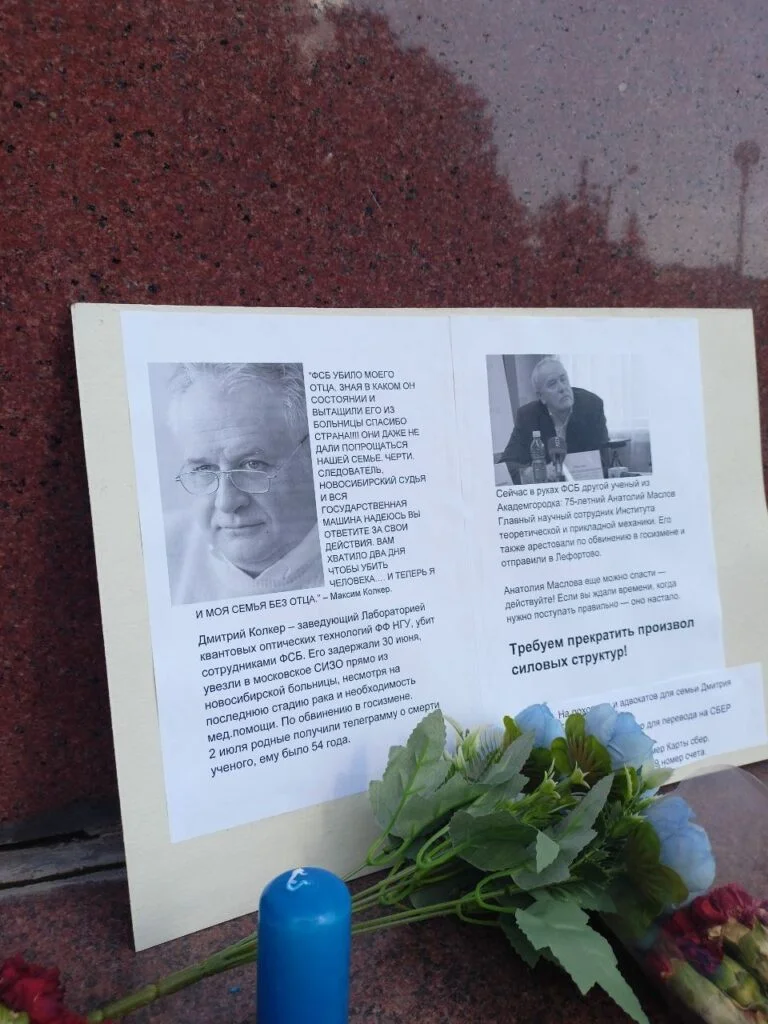
Третьего июля — в день, когда о смерти Дмитрия Колкера стало известно — в новосибирском Академгородке возле памятника академику Валентину Коптюгу появился стихийный мемориал: кто-то установил самодельные таблички с фотографиями учёных Колкера и Маслова и требованием прекратить уголовное преследование. Вскоре там появились и цветы. Однако уже через два часа к мемориалу приехали полицейские и увезли таблички.
Ещё один похожий мемориал на следующий день появился у памятника академику Михаилу Лаврентьеву. Сюда полиция прибыла уже через полчаса.
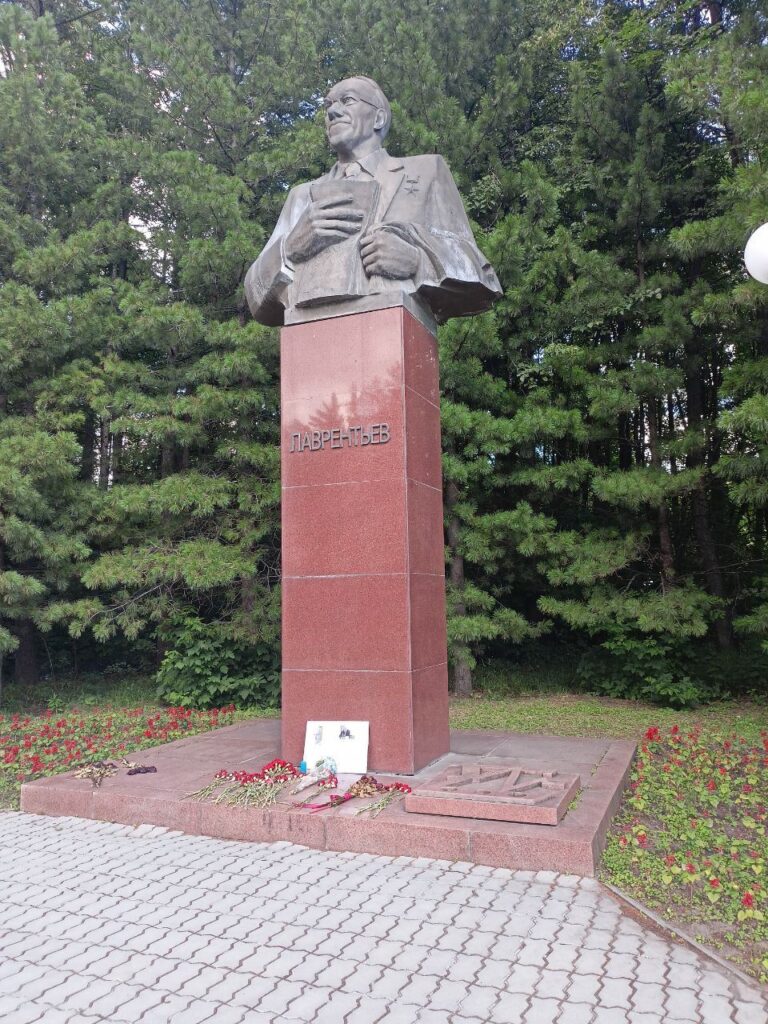
Автор мемориалов — выпускник НГУ, попросивший «Вёрстку» об анонимности, рассказал, что соорудил их, чтобы «как-то среагировать на произвол эфэсбэшников»:
«Потому что все парализованы. Никто не высказался. НГУ не высказался. Пармон (председатель СО РАН академик Валентин Пармон. — Прим. ред.) не высказался, — говорит он. — Но чувствовалось, что людям нужно что-то такое. Стихийный мемориал кажется чем-то очень естественным, когда происходит трагедия, а именно она случилась с Колкером и Масловым. Я подумал, что если мемориала ещё нет, то его нужно сделать».
Автор мемориала говорит, что участники местных телеграм-чатов одобрили его идею и направились к памятникам, чтобы возложить цветы: «Люди хотели, чтобы был мемориал. Не хотела его только полиция».
«Колкера уже нет, а Маслов жив, и ему семьдесят пять. И никакое академическое сообщество, парализованное страхом, не будет ничего делать, — рассуждает он. — Никакие официальные структуры не будут ничего делать. Постановление об аресте вынес Советский районный суд, и на него можно было бы повлиять, если бы люди вышли. Но последние митинги крупные у нас были в 2013 году, когда проходила реформа Российской академии наук».
Те учёные, с которыми он обсуждал дела Колкера и Маслова, боятся, что ни на что повлиять уже невозможно. Мол, ещё год назад можно было изменить ситуацию, а теперь наступили «самые тёмные времена». Именно поэтому они не высказываются публично.
«Поэтому так важны сейчас мемориалы, — говорит выпускник НГУ. — Это заявления о том, что общество против и академическое сообщество тоже».
Громких голосов коллег Колкера и Маслова в Новосибирске действительно почти не слышно. Но пятого июля с «Заявлением о Дмитрии Борисовиче Колкере» в поддержку учёного публично выступили члены неформального сообщества академиков и членов-корреспондентов Российской академии наук «Клуб 1 июля»:
«Мы возмущены тем, что тяжелобольной человек был помещен под стражу (онкология IV стадии входит в состав Постановления Правительства № 3 о медосвидетельствовании подозреваемых и перечне тяжелых заболеваний, препятствующих содержанию под стражей от 14.01.2011), и считаем, что порядок расследования дел о государственной измене создает неприемлемо высокие риски для проведения научных работ российскими учёными в первую очередь по наиболее важным для России научным направлениям. Как выясняется, несмотря на экспертные заключения, подтверждающие отсутствие сведений ограниченного доступа в материалах, публикуемых в научных журналах и представляемых на конференциях и семинарах, а также в лекциях для студентов, по неизвестным причинам решения экспертных комиссий могут быть в дальнейшем проигнорированы, а исследователи обвинены в разглашении государственной тайны и даже в государственной измене. Мы требуем привлечь к ответственности виновных в смерти нашего коллеги».
На сайте СО РАН ни одного заявления о Колкере с 30 июня по 7 июля, даже некролога, нет.
Дети Дмитрия Колкера объявили сбор средств на похороны: привозить тело отца из Москвы им придется за свой счёт.
Фото на обложке: страница Максима Колкера во «Вконтакте»
Editorial "Layout"