
Translated material
"Alexey Gorinov should be justified"
An open letter of lawyers explaining why Article 207.3 of the Criminal Code of the Russian Federation is unconstitutional and should be canceled
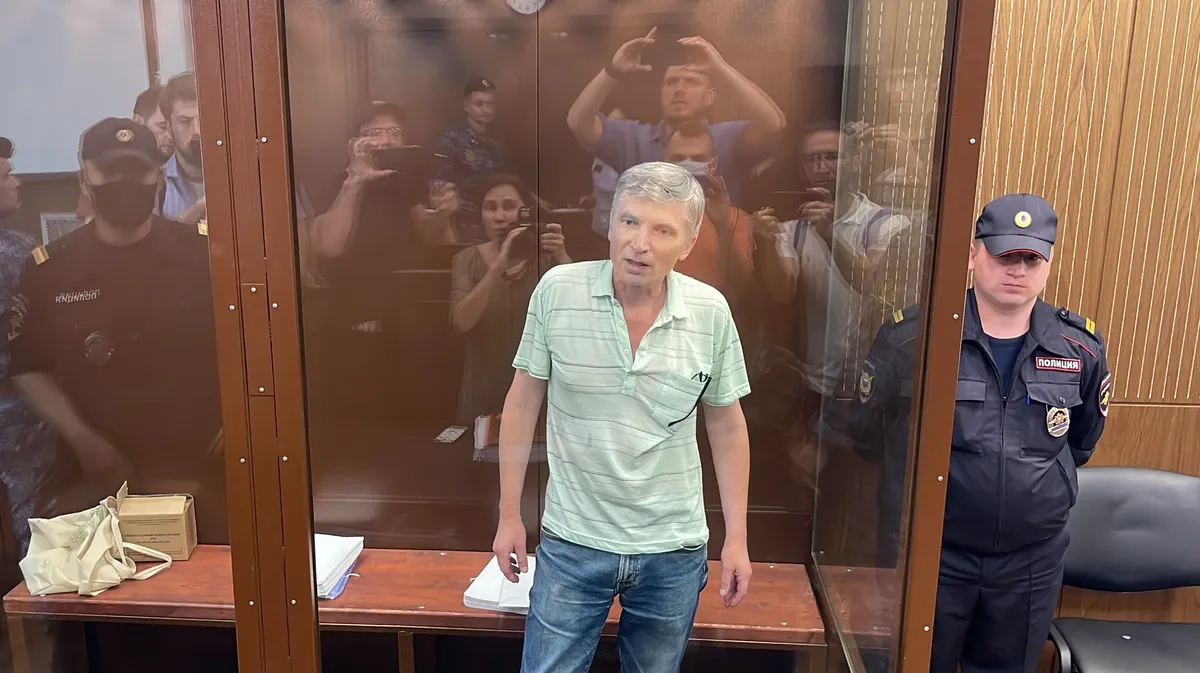
On July 8, 2022, the municipal deputy of the Krasnoselsky district of the city of Moscow Alexei Gorinov was convicted by the Meshchansky district court of the city of Moscow to seven years in prison in a general regime colony under article 207.3 of the Criminal Code of the Russian Federation.
According to the court, Alexei Gorinov is guilty of the fact that at a meeting of the Council of Municipal Deputies, he voted against the competition of children's drawing and pointed out that it was inappropriate at a time when in Ukraine every day children die or become orphans. The fact that Alexei Gorinov is a municipal deputy allowed the prosecution to qualify his actions at once on several paragraphs of part 2 of this article: “A” (committing a crime using an official position), “B” (a group of persons by prior conspiracy ”) and“ D ”(according to the motive of political hatred).
To date, the country is investigating 68 criminal cases under Article 207.3 of the Criminal Code, part of the cases is already considered in the courts. Alexei Gorinov is the first person who received the real term of imprisonment under the article on the "slander of the army."
We argue that this sentence is unlawful - first of all, because its formal basis was the provisions of the Criminal Code that contradicts the Constitution of the Russian Federation.
Article 207.3 of the Criminal Code is completely not consistent with the norms of the Constitution - in particular, its Articles 13 (recognition of the ideological and political diversity by the basis of the constitutional system of Russia), 28 (freedom to choose, have and spread their beliefs and act in accordance with them), 29 (freedom of thought and word; prohibition of censorship; prohibition of censorship), 54 (prohibition of arbitrary arbitrary criminal prosecution).
From these constitutional provisions it follows that in the Russian Federation everyone has the right to think freely, collect information from any sources, and also freely express their opinion and disseminate any information, without fear of persecution from someone else's side, primarily from the state.
The Constitution of the Russian Federation in accordance with part 1 of its Article 15 has the highest legal force and direct action; Laws and other legal acts should not contradict the Constitution.
The Constitutional Court of Russia has repeatedly indicated that the rights guaranteed by Article 29 of the Constitution provide citizens with a real opportunity to influence the activities of public authorities by maintaining a civilized peaceful dialogue between civil society and the state; This does not exclude the protest nature of statements, which can be expressed in criticism of both certain actions and decisions of state authorities, and the policy they pursue; Accordingly, it is assumed that the response from public authorities to the relevant statements should be neutral (decisions of June 4, 2020 No. 27-P, dated May 17, 2021 No. 19-P and others).
However, Article 207.3 of the Criminal Code, as well as Article 280.3 of the Criminal Code of the Russian Federation, as well as Article 20.3.3 of the Code of Administrative Offenses of the Russian Federation, prohibiting “public actions aimed at discrediting the use of the Armed Forces”, are directly aimed and used to suppress the criticism and free competition of opinions on the use of the Armed Forces of the Russian Federation and the policy pursued by the state. In fact, they are a reincarnation of the worst creatures of the Soviet repressive apparatus: criminal articles for anti -Soviet agitation and propaganda, as well as the spread of knowingly false fabrications that defeat the Soviet state and social systems.
Provided for in Article 207.3 of the Criminal Code of the Russian Federation, liability in a crushing way affects the readiness of citizens to analyze and disseminate information different from the officially approved
And approved by authorized bodies, practically excludes discussions on acute and exciting society, and also reduces public control over the actions of public power, which undermines the democratic character of the Russian state as the basis of the constitutional system.
If the state intends to protect its citizens from misinformation, the only means available to it from the point of view of the Constitution is to ensure the multiplicity and diversity of sources of information, the timeliness of information transmission and conducting an open dialogue with society.
Finally, in the case of Alexei Gorinov there is another important aspect. He is a municipal deputy and must have a deputy indeminite. This deputy privilege means the ban on bringing the deputy to legal liability for opinions expressed during political discussions on socially significant issues, because, in fact, the freedom of opinion of the deputy and its public expression is the main form of implementation of his mandate received from the population. This privilege follows from the content of part 1 of Article 40 of the Federal Law of October 6, 2003 No. 131-ФЗ “On the General Principles of the Organization of Local Self-Government in the Russian Federation”, which guarantees the municipal deputy “Unhindered exercise”. In the system of existing legal regulation, this norm should be interpreted as the municipal deputy for political statements involving the exclusion of legal liability.
We believe that article 207.3 of the Criminal Code should be canceled, and Alexei Gorinov should be justified.
Alabastrova Irina, Doctor of N.N., Professor of a Free UniversityBuzin Andrey, Ph.D.
Vipan Grigory, Ph.D.
Lukyanova Elena, Doctor of Yu.N., Professor of a Free University
Mishina Ekaterina, Ph.D., Professor of a Free University
Olga Podolova, constitutionalist, head of the Law Department of the Rus Sitting Foundation (entered into the register of NPOs performing the functions of a foreign agent)
Shablinsky Ilya, Doctor of Superior, Member of the Moscow Helsinki Group
Many respected colleagues have already begun to join the letter, we give them a list below. Alexey Gorinov - lawyer, deputy and human rights activist. Therefore, we invite all those who wish lawyers, human rights activists and deputies to leave their signature under this appeal in the form . The full list of the signator "Novy" will be published later.
Astrakantseva Svetlana, lawyer, executive director of the Moscow Helsinki Group
Bobrinsky Nikolai Alekseevich, master of jurisprudence
Valery Vetoshkina, lawyer of the first department of the first department (entered into the register of foreign media performing the functions of a foreign agent)
Gannushkina Svetlana, chairman of the Civil Promotion Committee, member of the Council of the Center for Human Rights Protection "Memorial"
Garina Anastasia, Executive Director of the Human Rights Protection Center "Memorial", lawyer
Glushkova Tatyana, member of the Council of the Center for Human Rights Protection "Memorial", lawyer
Davidis Sergey, head of the independent human rights project “Support for political prisoners. Memorial ", lawyer
Kaplin Natalia, lawyer, deputy of the Council of Deputies of the municipal district of Ramenka
MOREV Andrey, head of the municipal district of Yakimanka, deputy chairman of the Moscow branch of the Yabloko party
Moskalenko Karinna, lawyer
Olenichev Maxim, lawyer for human rights (according to the Ministry of Justice of Russia - a foreign media that performs the functions of a foreign agent),
Orlov Oleg, co -chair of the Center for Protection of Human Rights "Memorial"
Secretarova Natalia, member of the Council of the Center for Human Rights Protection "Memorial", lawyer
Cherkasov Alexander, member of the Council of the Center for Protection of Human Rights "Memorial" '
Sedov Denis, lawyer of the human rights media project “OTD-Info” (entered into the register of unregistered public associations performing the functions of a foreign agent), member of the Council of the Center for Protection of Human Rights “Memorial”