
Translated material
Russian music was banned in Ukraine
"Medusa" asked the participants of the Russian music market about what it will lead to
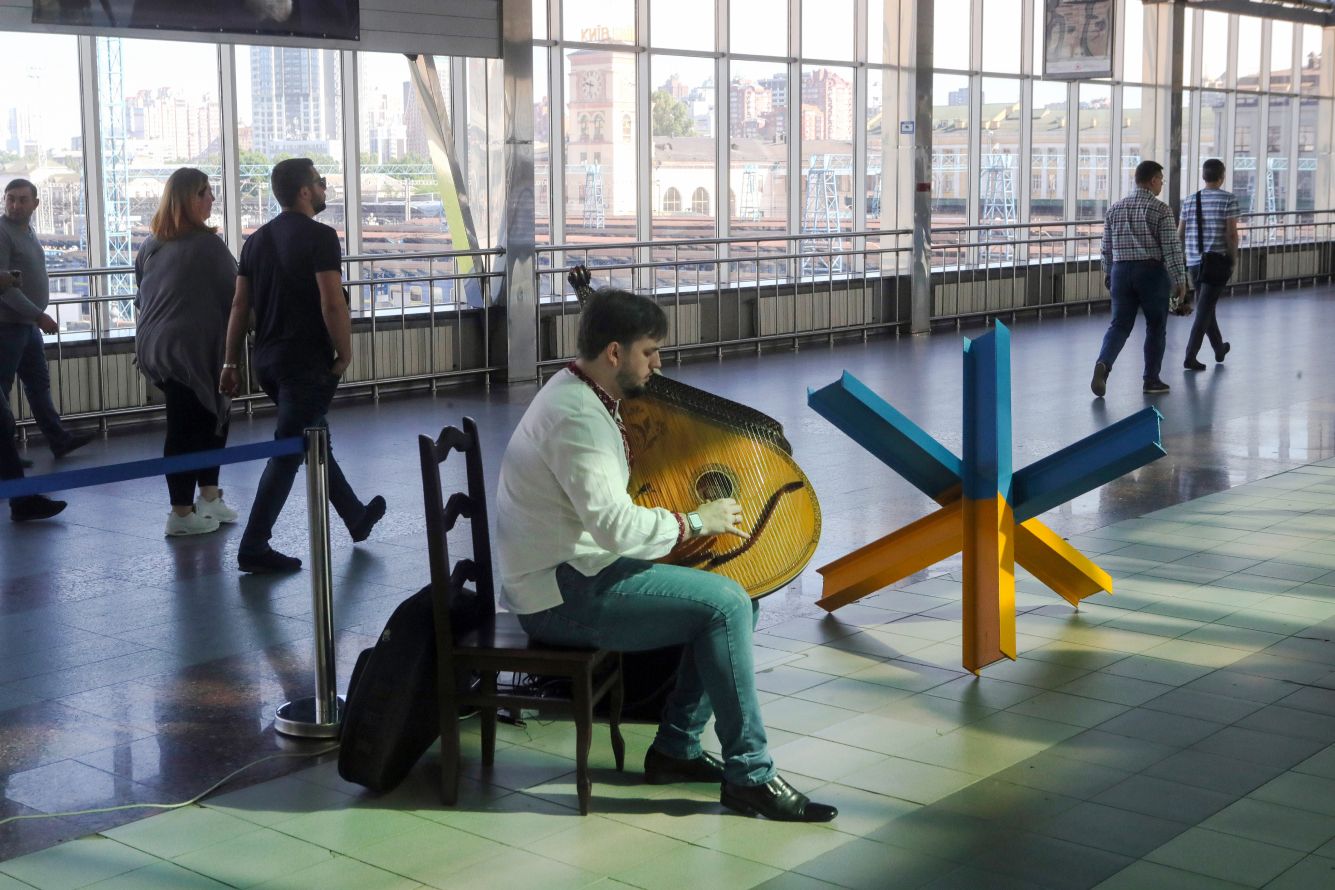
On June 19, the Verkhovna Rada of Ukraine adopted a law prohibiting the reproduce of Russian music in media and public places. Now in the country it is impossible to publicly execute and show “phonograms, video grams and music clips”, if this is a work of a citizen of the “aggressor country”. Medusa talked with participants in the Russian musical market about what it could threaten him.
The law “on amendments to some laws of Ukraine on the support of the national musical product and the restriction of the public use of the musical product of the aggressor state” prohibits the public execution of Russian music on the Verkhovna Rada. Now “phonograms, video grams and music clips” of artists from Russia cannot be broadcast in public places. This restriction applies to the performers who had Russian citizenship since 1991.
According to the materials of the Rada site, 303 deputies voted for the adoption of the law. According to the Russian BBC Service, restrictions will act "until the completely liberation of all the occupied territories of Ukraine and the cessation of aggression from the aggressor country."
It is possible to reproduce the songs of Russian performers in Ukraine, according to the new law, only if the artist with citizenship of the Russian Federation openly spoke out against the war. Such a musician needs to submit an application to the Security Service of Ukraine and thereby recognize the sovereignty and integrity of the country. Nevertheless, the SBU may reject the application without revealing the "grounds that caused the refusal." Whether one of the Russian artists entered this list is not yet known.
What do participants in the music market say
For this, the Medusa material asked to comment on the new law of about two dozen Russian and Ukrainian promoters, representatives of music labels, musicians, and critics. Most of them did not answer.
And to whom did we contact?
Representatives of the largest music labels Universal Music and Warner Music refused to comment, as the companies left Russia . Masterskaya label Ivan Dorn, as well as Gazgolder, also refused to comment. For various reasons, they did not respond to the request of Medusa or refused to comment on eight Ukrainian and Russian critics and seven promoters. The “Medusa” calls were not answered by the producer Natella Krapivina, producer Yuri Bardash, singer Luna. Representatives of Valery Meladze also did not answer Medusa.
In support of the ban on Russian music, People's Artist of Ukraine Tina Karol publicly spoke out . The performer congratulated Ukrainian musicians on the adoption of a new law. According to her, this is another step towards the independence of Ukraine, with the help of which the country develops the "identity of the nation":
We temper a new history of Ukraine in such a difficult, painful way. Let us write this latest story without Russia.
The singer also opposed charitable concerts in support of Ukrainian refugees, where Ukrainian artists perform songs in Russian: “I believe that these concerts, if Russian songs are performed, should be called commercial. They cannot represent Ukraine ... The community abroad [arises] the question: do we not understand - are you fighting or singing in Russian? ”
According to the leader of the Ukrainian group of “friend Rika” Valery Kharchishin , the Ukrainians themselves made themselves part of the Russian information space and therefore such a law had to be adopted much earlier: “Thanks to culture, in particular musical, we were made part of Russia. We sang and performed songs in Russian, became part of the Russian -speaking space. For Russians, all the Russian -speaking information space is Russia. ” According to the musician, the lack of cultural ties with Russia would help to avoid war. At the same time, he draws attention to the fact that Russian music can still be found on the Internet.
Andrei Danilko, who spoke under the pseudonym Verka Serdyuchka, also supported the new law in an interview :
I think this is right now. After all, now a heighten perception of people was also with the German language. People who were then under occupation could not hear German.
The famous Ukrainian producer and TV presenter Igor Kondratyuk believes that while war is in Ukraine, all Russian -speaking artists should be prohibited. The petition addressed to the President of Ukraine Vladimir Zelensky with a request to prohibit Russian -speaking artists to act in Ukraine Kondratyuk filed before the start of the war. 25 thousand people signed under it:
This is the same defense of Ukraine as the one that the armed forces in the places of collision with the aggressor. Russian artists should be Persons Non Grata in Ukraine until relations with Russia will have a friendly foundation. Since 2014, Russian artists have become just an advanced detachment of the Russian army.
In a conversation with Medusa, the musician and leader of the Russian SBPC group Kirill Ivanov noted that the ban on Russian -speaking music and artists who supported or did not condemn the war, “the obvious consequence of the fact that Russia had started the war.” Before the war, the SBPCh often performed in Ukraine: “It has always been touching and piercing concerts. Now the lack and impossibility of this is doubly felt, all this is destroyed, ”says Ivanov. He calls the decision to abandon Russian music "" quite obvious and purely personal affairs of Ukrainians. "
The music publisher and producer of the Pussy Riot group Alexander Cheparukhin adheres to a different point of view:
Regarding the boycott of the whole Russian - the mantra is now popular: "Their [Ukrainians] can be understood, they are doused with blood." I hate the Putin regime, and I understood everything about Putin back in the late 1990s. I perceive the war as a monstrous crime, as a severe personal tragedy, it causes me unbearable pain. But I cannot understand those who are trying to divide the entire Russian people, to introduce Russians who do not deserve life with cruel animals.
The Ukrainians who I met from the war - refugees and those who heroically save people, doctors, volunteers - have never shown any hatred of the Russians. They value solidarity in the resistance to evil.
But some of my Ukrainian acquaintances, prominent cultural figures, are actively striving to ban all Russian - wherever possible. Honestly, I do not quite understand by what criteria they determine what relates to the notorious “Russian culture”. Language? But among the most ardent prohibitions there are those who still communicate exclusively in Russian. Russian - including the language of Ukraine, millions of Ukrainians. Why should Ukraine give Russia a monopoly into Russian?
Russian passport? But citizenship is not chosen, it is not easy to change it, and it is no better to discriminate against people on the basis of citizenship than to do this on a racial basis.
“Demonization” and “disconnection” of Russians only contribute to even more inciting hatred and deepening the crisis, the producer believes: “Instead of concentrating on the international struggle with the regime that unleashed the war, the center of gravity is transferred to the fight against all the“ Russians ”. I think this helps Putin and his propaganda. ”
However, the number of live performances of Russian artists was significantly reduced long before the war - after 2014, said the founder of the Russian label “Labble” (works with musicians Mirèle, Kirill, Myrtlle) Ilya Fomenko. The musical marketer Yevgeny Anisimova told Medusa that for a performance in Ukraine before the war it was necessary to get a tour and coordinate the set list with the local authorities: “This is the same ridiculous situation as in Belarus. These are elements of total censorship. ”
Will the music business suffer in Russia to suffer
The ban on Russian -speaking music in Ukraine “held the final watershed between the two markets, it is not so much about the geographical border as about the ideological,” said Andrei Morozov, organizer of the Moscow Fields Musical Fields festival. Despite this, he emphasizes that Russian business is unlikely to feel some strong, sharp consequences from this, since the “cancellation of” large Russian artists did not begin today.
According to Ilya Fomenko from Libra, "the Ukrainian market was always important for Russian artists." According to his observations, the charts of the main musical platforms in Russia and Ukraine were almost identical. But the current ban on the Ukrainian authorities, he said, is only a “drop in the sea of general problems in the industry” of Russia.
After the outbreak of the war, labels and artists who collaborated with foreign distributors suffered most, says Fomenko. Over the past two years, the market for streaming platforms has increased significantly, and the royalties for listening have become the main income for musicians - but after the start of the war, part of foreign distributors and streaming platforms suspended work with Russian labels and artists. The methods and terms of payments have also changed, marketing budgets were frozen, which hit the Russian music business greatly.
According to Anisimova, another problem of artists in Russia today is a ban on performances due to the open condemnation of the war. One of the last examples-on the “excellent Fest” in St. Petersburg, four headliners were removed for this: Anacondaz, “Kis-Kis”, Alena Shvets and Doru.
Morozov also confirms that many artists have already received an unspoken ban on performances in Russia from power. In turn, some independent artists themselves refuse performances in Russia during the war:
That is, it turns out that the white list of Russian artists who will form in the Armed Forces of Ukraine, and the black list of “traitors of the Motherland” with us are almost equivalent concepts.
At the same time, artists who want to “sit on two chairs at the same time”, according to Morozov, are no longer left: those who wanted to have already announced their solidarity with Ukraine (for example, they did Noize MC and a coin, who held a series ofcharitable concerts in support of Ukrainian refugees) - and they will hardly return to the Russian stage in the near future. Thus, in Russia only performances of “silent” artists will remain - or those who publicly supported the “special operation”.
At the same time, it is clear that not all musicians have resources to speak out and leave. Most independent artists simply cannot afford it, Morozov believes. And now they are experiencing a “severe dissonance” from what is happening: “You are forced to be silent in order to maintain your freedom and be able to take care of your loved ones”:
First of all, it is [the ban on Russian music in Ukraine] a gigantic cultural and human tragedy for all sane and sensitive artists from Russia. I am sure that most of them never spent some clear line between fans from one country and another.
Most of these musicians had adhered to opposition views before the war: many of them went to rallies in support of Navalny and against Putin, donated funds to human rights funds, expressed disagreement with the annexation of Crimea. In the current situation, when a military censorship machine turned on, not all of them have the ability to express their opinion openly.
Alexey Slavin