
Translated material
"Acceleration" and "Perestroika". 1986-1988. The initiative from above
"Acceleration" and "Perestroika". 1986-1988. Initiative from above July 12, 2022, Natalia Eliseeva 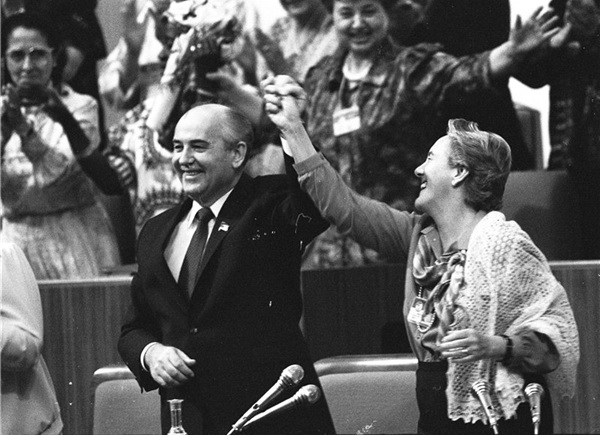
In order for a peaceful transition to the market, private property, political pluralism in our country, the initiative was needed from above. Such an initiative was manifested. The collapse of the socialist system, based on fear of repression, occurred thanks to the publicity of publicity and democratization begun by M. S. Gorbachev. In the process of Gorbachev’s “perestroika”, many Russians felt a taste for freedom, they have a hope that you can live no worse than in Europe on their land. The Cold War ended. At the site of the USSR, 15 independent states arose. The idea of building a communist society on the territory of the USSR and in the countries of Eastern Europe suffered Fiasco. Let's hope forever.
M. S. Gorbachev was elected General Secretary of the CPSU Central Committee on March 11, 1985. At that moment, the Politburo was 80% of L. I. Brezhnev. Each second member of the highest echelon of power began his party career under I.V. Stalin. It is not surprising that already in the first months after the election of Gorbachev he began personnel permutations, introducing his supporters into the power structures of his supporters.
The reformist wing in the Politburo was represented by A. N. Yakovlev, who is tuned to a change in the political system of the USSR in the spirit of Western Social Democracy. It was under his influence that M. S. Gorbachev decided on the policy of publicity in the press, which became a catalyst for not only reforms, but also abandoning the dogmas of socialism. Gorbachev’s “Brain Headquarters” included assistants to the Secretary General V.I. Boldin, N. B. Bikkenin, V. A. Medvedev, A. I. Lukyanov, philosopher I. T. Frolov, historians G. Kh. Shakhnazarov and A. S. Chernyaev, economists L.I. Abalkin, A. G. Agganbeyan, S. S. Shatalin, N. Ya. Petrakov and others. These were people with different ideological attitudes and intellectual baggage.
At the first stage, M. S. Gorbachev and his supporters could draw any decisions thanks to the monopoly on the power that the Politburo of the CPSU Central Committee possessed in the USSR. Party discipline ensured the implementation of decisions at all levels - from the Central Committee to the party organization of the enterprise. The question of broad social support before Gorbachev and his like -minded people did not stand then.
Publicity
In 1985-1986, M. S. Gorbachev and his supporters in the Politburo and the apparatus of the Central Committee thought exclusively about the improvement of socialism, the task of building which was not questioned. They wanted to combine the incompatible - totalitarian socialist system and elements of democracy and market.
But they did the main thing - they allowed people to tell the truth. In a country where every printed line, every phrase of the dictator was censored, unheard of - the authorities allowed to publish articles about egregious cases of mismanagement. Journal and newspaper pages were filled with revealing materials: about the shortage of goods and food, about lines, about forced labor and mass alcoholism. Rramed publications appeared on a decrease in the real growth rate of the USSR economy, huge material and energy intensity of the national economy, low compared to foreign countries of labor productivity.
Professor V. D. Patrushev [1] wrote that the population spends 65 billion human hours for purchasing purchases, which does not include the time to search for the necessary goods. This corresponds to the annual fund of working hours 35 million people employed in the national economy. Doctor of Economics O. R. Latsis noted that in lines in the USSR there are as many people as in the entire industry - 37.6 million [2]. According to the estimates of Professor Z.V. Korobkina, “the total losses of potatoes during the growing season, cleaning, storage, transportation and implementation were 50–70% of the biological crop of this culture” [3].
The authors of the magazines “New World”, “October”, “Friendship of Peoples”, “The Banner” reassessed the results of the economic development of the USSR over the past decades. This period was called "stagnation." They even spoke about the crisis of the planned system of farm. Instead of the State Public Directive Tasks, they proposed to introduce free contractual relations between enterprises, to establish a wholesale trade in production facilities.
Another topic of the official press of that time is forced labor. Here is an excerpt from a letter published in Komsomolskaya Pravda: “In our Turkmenistan, cotton is the main culture ... both schools and secondary special educational institutions, and universities stop the educational process from the first decade of September to the beginning of December and the program calculated for 9 months is held in 6 months” [4]. They wrote about a sharp increase in alcohol consumption. “From 1940 to 1980, the country's population increased by 35%, and the production of alcoholic beverages increased several times! So, the demand has increased by about the same time! ”[5]
Economic journalism played an important role in the formation of anti -and -bureaucratic, antinomennomenclature moods in the population. In the Soviet period, the highest “class” in the company was the so -called nomenclature - a fairly narrow circle of leaders who were appointed to their posts with the consent of the relevant party committees. The nomenclature was the highest upper layer in relation to other professional groups [6]. Previously, the vague sense of the contradiction of the interests of the general population and the party-economic nomenclature was articulated.
The career growth of party workers in those years took place according to a well -known scheme: the chairman of the trade union committee - instructor of the KPSS district committee - director of the enterprise - secretary of the regional committee - deputy minister. Formally, these people were ordinary members of society, and really occupied a privileged position. The party and economic elite was provided at public expense with personal transport, vouchers in elite sanatoriums. She received “material assistance” in envelopes, at “funny” prices in special distributors acquired scarce goods.
But the main thing is that, in conditions of socialism, the interests of the party -holding were strikingly different from the aspirations of the people. In the speeches of party functionaries there were many phrases who showed the party’s care about the needs of workers and collective farmers. But in practice, party officials and director of enterprises overwhelmingly were guided only by considerations of their career. The main concern was reduced to the preservation of the leading chair, and for this it was necessary to report on the completed task in any way (postscripts, fiction) so as not to look behind the authorities in the eyes of the authorities. It is precisely to report, and not achieve real success.
Journalism gave a clear idea of the abyss between the word party and its affairs. There was an understanding of the inefficiency of the existing administrative-commanding system of economic management. People thought about the reasons for the rejection of the achievements of scientific and technological progress, the absence of incentives for work, alienation of the working class and peasantry from the means of production, and the causes of a low standard of living. In the public consciousness, the idea was formed: "You can’t live like that!"
The production system that has developed even under Stalin, which supposedly was supposed to operate on the principle of “plan is the law”, by the mid-1980s expanded into the administrative trading system. The assignments lowered from the State Planning plan as they are “expanded” by republics, regions, ministries and enterprises were adjusted depending on the authority and personal connections of managers, their ability to “knock out” resources or, conversely, “fight off” from increasing the plan. By the end of the year, tens of thousands of “Decembrists” - heads of enterprises came to Moscow. Their goal was to adjust the planned tasks that were not completed “for objective” reasons. The vast majority achieved the goal and even received at the end of the year a bonus for fulfilling the adjusted plan.
Mandatory planned tasks gave rise to absurd motivation among the heads of enterprises and ministries. The causal chain was such. The volume of products released by the enterprise was calculated in fixed directive prices. These prices were approved by the Goskomen based on the planned costs calculated on the basis of labor and material cost standards. The draft standards were developed by the enterprises themselves, and the ministry approved. It was physically impossible to check the standards painted for millions of technological operations in specific conditions in specific conditions in specific conditions. Therefore, enterprises submitted for approval projects of standards with a large “margin”. Along the way, “planned profit” was more than laid in directive prices.
In such conditions, a decrease in the cost of production of products contradicted the interests of managers. After all, they were responsible for their seats, primarily for the implementation of the plan for the “gross output”, that is, at the total cost of products. The more costs, the higher the planned cost of products, which means it is easier to fulfill the “shaft” plan. Why fight for increasing labor productivity, if it is easier and more reliable to overestimate the projects of standards and appeal to whom in the ministry ...
The more resources are at the disposal of the director of the enterprise, the higher the probability of fulfilling the directive plan. The director, overstating the standards, handing gifts and giving bribes to ministerial officials, he tried to get additional limits on the number of staff, outfits for equipment and raw materials. Hence the high material consumption and complexity of the products of Soviet enterprises in comparison with foreign.
When in the country everyone pulls resources “for themselves”, the general need for them is growing rapidly, and less and less products are produced. The deficit dominated not only in stores, but also in factories and construction sites. There were machines, metal, forest, building materials.
The plan for Valu was easier to fulfill if enterprises produced long -mastered and often outdated products. Therefore, antediluvian machines, primitive household appliances, low -quality shoes and clothes were produced. There were many talented engineers, scientists, inventors in the country, but their talent came across an impenetrable wall of disinteresting, inertness, bureaucratic consultations and indifference. Anti -stimulars for innovation blocked the mass production of products similar in characteristics with Western analogues. The difference was clearly visible as domestic and imported TVs, radios, and cars. An indicative example: the sectoral institutions of the Ministry of Defense for twenty years have developed a new model of the Moskvich car. Nevertheless, its quality was so low that even vassal Czechoslovakia refused to buy it.
Instead of the market under socialism, a system of stock distribution of products led by the State Nable was created. This huge influential department was intended to coordinate the production and consumption of products. However, an extremely ineffective bureaucratic procedure for coordination led to the accumulation of huge volumes of unclaimed products. The author is a professor at the Russian State University, the head of the educational and scientific center "New Russia. History of post -Soviet Russia". The original text is published on the website "History of the New Russia".
______________________
Source: © 2010 www.ru-90.ru [1] Izvestia. October 5, 1984. [2] Izvestia. November 12, 1984. [3] Literary newspaper. November 21, 1984. [4] Komsomolskaya Pravda. November 27, 1984. [5] Izvestia. May 17, 1984.
Photo tvc.ru
In order for a peaceful transition to the market, private property, political pluralism in our country, the initiative was needed from above. Such an initiative was manifested. The collapse of the socialist system, based on fear of repression, occurred thanks to the publicity of publicity and democratization begun by M. S. Gorbachev. In the process of Gorbachev’s “perestroika”, many Russians felt a taste for freedom, they have a hope that you can live no worse than in Europe on their land. The Cold War ended. At the site of the USSR, 15 independent states arose. The idea of building a communist society on the territory of the USSR and in the countries of Eastern Europe suffered Fiasco. Let's hope forever.
M. S. Gorbachev was elected General Secretary of the CPSU Central Committee on March 11, 1985. At that moment, the Politburo was 80% of L. I. Brezhnev. Each second member of the highest echelon of power began his party career under I.V. Stalin. It is not surprising that already in the first months after the election of Gorbachev he began personnel permutations, introducing his supporters into the power structures of his supporters.
The reformist wing in the Politburo was represented by A. N. Yakovlev, who is tuned to a change in the political system of the USSR in the spirit of Western Social Democracy. It was under his influence that M. S. Gorbachev decided on the policy of publicity in the press, which became a catalyst for not only reforms, but also abandoning the dogmas of socialism. Gorbachev’s “Brain Headquarters” included assistants to the Secretary General V.I. Boldin, N. B. Bikkenin, V. A. Medvedev, A. I. Lukyanov, philosopher I. T. Frolov, historians G. Kh. Shakhnazarov and A. S. Chernyaev, economists L.I. Abalkin, A. G. Agganbeyan, S. S. Shatalin, N. Ya. Petrakov and others. These were people with different ideological attitudes and intellectual baggage.
At the first stage, M. S. Gorbachev and his supporters could draw any decisions thanks to the monopoly on the power that the Politburo of the CPSU Central Committee possessed in the USSR. Party discipline ensured the implementation of decisions at all levels - from the Central Committee to the party organization of the enterprise. The question of broad social support before Gorbachev and his like -minded people did not stand then.
Publicity
In 1985-1986, M. S. Gorbachev and his supporters in the Politburo and the apparatus of the Central Committee thought exclusively about the improvement of socialism, the task of building which was not questioned. They wanted to combine the incompatible - totalitarian socialist system and elements of democracy and market.
But they did the main thing - they allowed people to tell the truth. In a country where every printed line, every phrase of the dictator was censored, unheard of - the authorities allowed to publish articles about egregious cases of mismanagement. Journal and newspaper pages were filled with revealing materials: about the shortage of goods and food, about lines, about forced labor and mass alcoholism. Rramed publications appeared on a decrease in the real growth rate of the USSR economy, huge material and energy intensity of the national economy, low compared to foreign countries of labor productivity.
Professor V. D. Patrushev [1] wrote that the population spends 65 billion human hours for purchasing purchases, which does not include the time to search for the necessary goods. This corresponds to the annual fund of working hours 35 million people employed in the national economy. Doctor of Economics O. R. Latsis noted that in lines in the USSR there are as many people as in the entire industry - 37.6 million [2]. According to the estimates of Professor Z.V. Korobkina, “the total losses of potatoes during the growing season, cleaning, storage, transportation and implementation were 50–70% of the biological crop of this culture” [3].
The authors of the magazines “New World”, “October”, “Friendship of Peoples”, “The Banner” reassessed the results of the economic development of the USSR over the past decades. This period was called "stagnation." They even spoke about the crisis of the planned system of farm. Instead of the State Public Directive Tasks, they proposed to introduce free contractual relations between enterprises, to establish a wholesale trade in production facilities.
Another topic of the official press of that time is forced labor. Here is an excerpt from a letter published in Komsomolskaya Pravda: “In our Turkmenistan, cotton is the main culture ... both schools and secondary special educational institutions, and universities stop the educational process from the first decade of September to the beginning of December and the program calculated for 9 months is held in 6 months” [4]. They wrote about a sharp increase in alcohol consumption. “From 1940 to 1980, the country's population increased by 35%, and the production of alcoholic beverages increased several times! So, the demand has increased by about the same time! ”[5]
Economic journalism played an important role in the formation of anti -and -bureaucratic, antinomennomenclature moods in the population. In the Soviet period, the highest “class” in the company was the so -called nomenclature - a fairly narrow circle of leaders who were appointed to their posts with the consent of the relevant party committees. The nomenclature was the highest upper layer in relation to other professional groups [6]. Previously, the vague sense of the contradiction of the interests of the general population and the party-economic nomenclature was articulated.
The career growth of party workers in those years took place according to a well -known scheme: the chairman of the trade union committee - instructor of the KPSS district committee - director of the enterprise - secretary of the regional committee - deputy minister. Formally, these people were ordinary members of society, and really occupied a privileged position. The party and economic elite was provided at public expense with personal transport, vouchers in elite sanatoriums. She received “material assistance” in envelopes, at “funny” prices in special distributors acquired scarce goods.
But the main thing is that, in conditions of socialism, the interests of the party -holding were strikingly different from the aspirations of the people. In the speeches of party functionaries there were many phrases who showed the party’s care about the needs of workers and collective farmers. But in practice, party officials and director of enterprises overwhelmingly were guided only by considerations of their career. The main concern was reduced to the preservation of the leading chair, and for this it was necessary to report on the completed task in any way (postscripts, fiction) so as not to look behind the authorities in the eyes of the authorities. It is precisely to report, and not achieve real success.
Journalism gave a clear idea of the abyss between the word party and its affairs. There was an understanding of the inefficiency of the existing administrative-commanding system of economic management. People thought about the reasons for the rejection of the achievements of scientific and technological progress, the absence of incentives for work, alienation of the working class and peasantry from the means of production, and the causes of a low standard of living. In the public consciousness, the idea was formed: "You can’t live like that!"
The production system that has developed even under Stalin, which supposedly was supposed to operate on the principle of “plan is the law”, by the mid-1980s expanded into the administrative trading system. The assignments lowered from the State Planning plan as they are “expanded” by republics, regions, ministries and enterprises were adjusted depending on the authority and personal connections of managers, their ability to “knock out” resources or, conversely, “fight off” from increasing the plan. By the end of the year, tens of thousands of “Decembrists” - heads of enterprises came to Moscow. Their goal was to adjust the planned tasks that were not completed “for objective” reasons. The vast majority achieved the goal and even received at the end of the year a bonus for fulfilling the adjusted plan.
Mandatory planned tasks gave rise to absurd motivation among the heads of enterprises and ministries. The causal chain was such. The volume of products released by the enterprise was calculated in fixed directive prices. These prices were approved by the Goskomen based on the planned costs calculated on the basis of labor and material cost standards. The draft standards were developed by the enterprises themselves, and the ministry approved. It was physically impossible to check the standards painted for millions of technological operations in specific conditions in specific conditions in specific conditions. Therefore, enterprises submitted for approval projects of standards with a large “margin”. Along the way, “planned profit” was more than laid in directive prices.
In such conditions, a decrease in the cost of production of products contradicted the interests of managers. After all, they were responsible for their seats, primarily for the implementation of the plan for the “gross output”, that is, at the total cost of products. The more costs, the higher the planned cost of products, which means it is easier to fulfill the “shaft” plan. Why fight for increasing labor productivity, if it is easier and more reliable to overestimate the projects of standards and appeal to whom in the ministry ...
The more resources are at the disposal of the director of the enterprise, the higher the probability of fulfilling the directive plan. The director, overstating the standards, handing gifts and giving bribes to ministerial officials, he tried to get additional limits on the number of staff, outfits for equipment and raw materials. Hence the high material consumption and complexity of the products of Soviet enterprises in comparison with foreign.
When in the country everyone pulls resources “for themselves”, the general need for them is growing rapidly, and less and less products are produced. The deficit dominated not only in stores, but also in factories and construction sites. There were machines, metal, forest, building materials.
The plan for Valu was easier to fulfill if enterprises produced long -mastered and often outdated products. Therefore, antediluvian machines, primitive household appliances, low -quality shoes and clothes were produced. There were many talented engineers, scientists, inventors in the country, but their talent came across an impenetrable wall of disinteresting, inertness, bureaucratic consultations and indifference. Anti -stimulars for innovation blocked the mass production of products similar in characteristics with Western analogues. The difference was clearly visible as domestic and imported TVs, radios, and cars. An indicative example: the sectoral institutions of the Ministry of Defense for twenty years have developed a new model of the Moskvich car. Nevertheless, its quality was so low that even vassal Czechoslovakia refused to buy it.
Instead of the market under socialism, a system of stock distribution of products led by the State Nable was created. This huge influential department was intended to coordinate the production and consumption of products. However, an extremely ineffective bureaucratic procedure for coordination led to the accumulation of huge volumes of unclaimed products. The author is a professor at the Russian State University, the head of the educational and scientific center "New Russia. History of post -Soviet Russia". The original text is published on the website "History of the New Russia".
______________________
Source: © 2010 www.ru-90.ru [1] Izvestia. October 5, 1984. [2] Izvestia. November 12, 1984. [3] Literary newspaper. November 21, 1984. [4] Komsomolskaya Pravda. November 27, 1984. [5] Izvestia. May 17, 1984.
Photo tvc.ru
| Print version |
-
Leonid Gozman: No matter how circumstances develop, no one will want to go to real risks for the principles of justice and deposition. Although someone may well believe in the opposite.
