
Translated material
Premier race: Who will take the place of Boris Johnson?
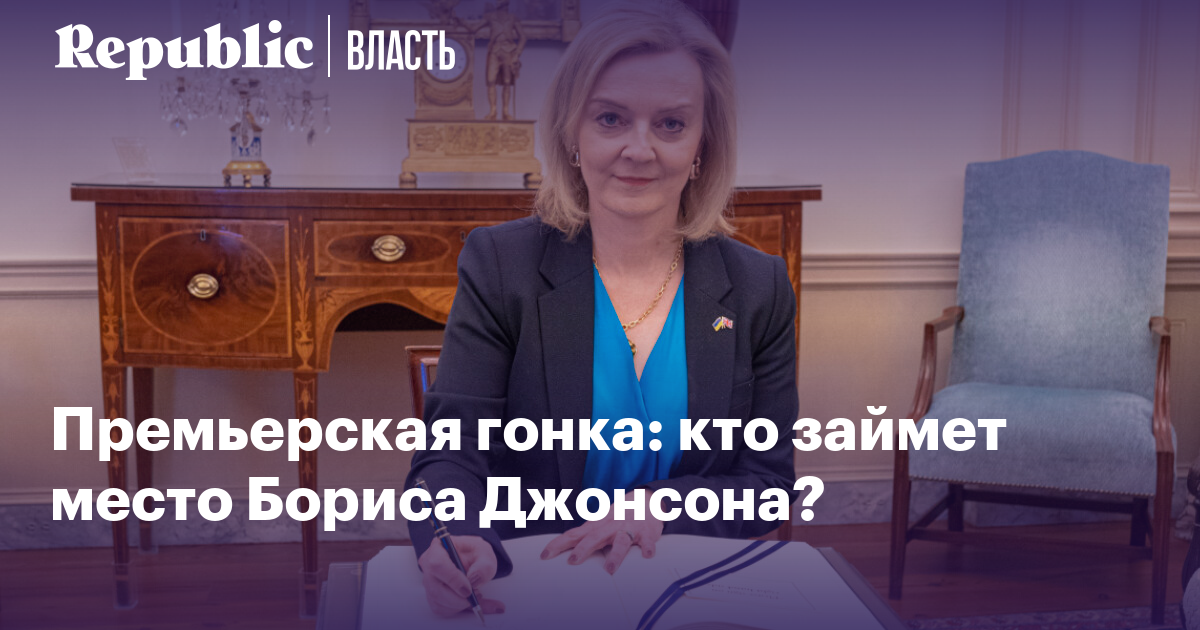
On July 7, 2022, Boris Johnson announced his resignation from the post of Prime Minister of Great Britain. This launched the mechanism of the new elections of the leader of the ruling conservative party, which will take the vacant place of the head of the cabinet on Dauning Street. "Power" with interest monitors the elective process in the oldest democracy in Europe.
How are the premiere elections in the United Kingdom
It is believed that in Britain, a bipartisan system has been established since the 19th century. In fact, this is not entirely true. Currently, in the United Kingdom of Great Britain and Northern Ireland there are 408 registered political parties, and all of them have the right to participate in the parliamentary elections. But they dominate the country's political system, indeed, only two parties-until the 1920s it was a conservative and liberal parties, or, if we recall their historical names, still used in everyday life, Tori and Vigi. In the 20s of the last century, the popularity of the Liberal Party (Vigi) decreased, and to replace it as the main opposition of Tori, the Labor Party arose as an alliance, trade unions and various socialist movements. Since then, for 100 years now, the conservative and Labor Parties dominate British politics and alternately form the current and shadow governments.
Usually every 5 years, deputies of the House of Commons are elected in the general election, and the party leader, which gained more votes in parliament, automatically becomes the country's prime minister. Although formally he is still appointed by the queen.
But after Brexit, this order began to fail. The last three Prime Ministers-both David Cameron, Teresa May, and Boris Johnson-left ahead of schedule, or independently making such a decision as Cameron, or under pressure from circumstances, like May and Johnson. Therefore, they lost the right to take part in the new elections, and voting for a new head of government for the second time in a row is not held in the general parliamentary elections, but inside the conservative party, which has a majority in the House of Commons. It passes into several rounds, the rules of which are determined by the governing body of the party; In the Conservative Party of Great Britain, it is called the 1922 Committee.
On July 12, the head of the “Committee of 1922”, Sir Graham Brady, said that eight candidates will compete for the position of new prime minister of the country and in the evening they will get the opportunity to speak with a 12-minute speech; On July 13, the first round will be held, in which candidates will be eliminated who will receive less than 30 votes; After that, several more rounds will take place, as a result of which only two applicants for the position of leader should remain. If only members of the Tori parliamentary faction take part in preliminary votes, then all members of the conservative party will vote in the final elections.
In fact, at first the prime minister was claimed by 11 members of the conservative party. But even before the first round of elections, the Minister of Defense Ben Wallace, the former Minister of Health Sajid Javid and the Minister of the Interior, Pritish Patel, refused to participate in the premier race. And there were eight applicants (they involuntarily recall the English count of ten blacks).
Only one will remain
So, on July 12, the following politicians from Tori entered the battle for the post of head of the Great Britain (by the way, exactly 50 to 50, the ratio, is not yet conceivable in Russia): on the gender basis):
Kemi Badenok . The deputy of the parliament since 2017, for about two years was the Minister in the government of Boris Johnson on local governments, religion, women's affairs and equal opportunities.
Kami Badenok
Chris mcandrew / wikipedia.org
Suella Brahverman . Minister of Justice of England since 2020. In the previous government, Teresa May was engaged in Brexit, but resigned due to the final agreement proposed by the prime minister.
Liz tracks . Foreign Minister in the Johnson government.
Penny Mordont . In 2019, it became the first woman in history as Minister of Defense of Britain. Prior to this, the Mordont, the Royal Fleet reservist, served as Deputy Minister for Armed Forces in the Cameron government.
Penny Mordont
Tejas Sandhu / Keystone Press Agency / Global Look Press
Jeremy Hunt . A member of the lower house of parliament since 2005, in 2010 entered the government of David Cameron as a Minister of Culture. Also in the government of Cameron Hunt held the posts of the Minister of Health and Foreign Affairs. In 2019, Hunt reached the final of the leader of Tory, but in the end lost to Boris Johnson.
Rishi Sunak . He became a deputy of the British Parliament in 2015, and already in 2019 he was appointed Minister of Finance. He remained in this post until July 5 of this year, when he announced his resignation after his colleague, Minister of Health Sajid Javid. Both in sharp expressions declared disagreement with Boris Johnson.
Nadim Zakhavi . Born in Iraq, and his family came to Britain shortly after Saddam Hussein came to power. Zakhavi created the Merchendiz trade company under the Telepuziki brand, after founding the sociological service of YouGov, and in 2010 he elected to the parliament from Stratford-Oon-Evona. He was the deputy minister for vaccination in the Johnson government, also worked as a minister of education. After Sunak left the post of Minister of Finance Zakhavi, this, the second most important in the government, post.
Tom Tigendhat . The former military man who served in Iraq and in Afghanistan, who has long been visited by the leaders of the party of conservatives. Since 2020, he heads the Committee on International Relations of the House of Commons.
Subscribe to read the whole
Make a subscription Redefine.media to read Republic
Subscribe [you can pay for a Russian or foreign card. The subscription is extended automatically. You can unsubscribe at any time.]
Where are the money subscribers going