
Translated material
Operation "Air Corridor"
The New York Times told how Ukrainian intelligence delivered weapons to the factory in the midst of the siege of Azovstal and evacuated the wounded military
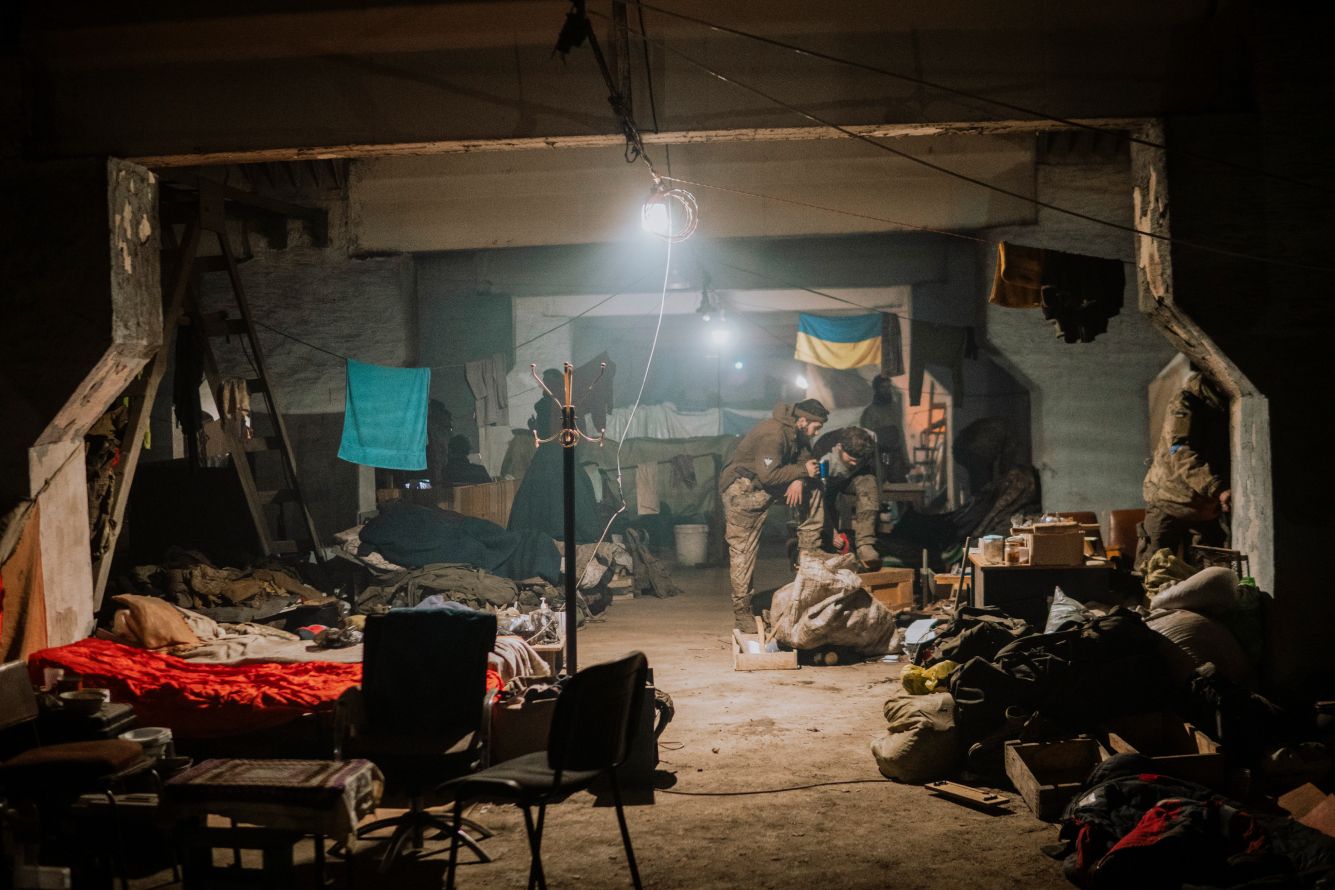
The New York Times published a large report on the siege of Mariupol and the operation “Air corridor” organized by Ukrainian intelligence to help the defenders of Azovstali. At this metallurgical plant, since the Cold War, an equipped network of 36 underground bomb shelters, for almost three months, the Ukrainian military, including fighters of the Azov regiment, resisted the Russian troops.
In early March, when Mariupol was in the Russian siege, the general director of Azovstal, Enver Tskitishvili decided to stop the work of the enterprise - for the first time since the Second World War. The leadership hoped that the fighting would not continue for a long time, and invited the factory’s employees with their families to hide in bomb shelters in the plant, where there were reserves of everything necessary to feed thousands of people for several weeks.
But the Ukrainian military began to arrive at the plant, and Azov fighters arranged a command post there. In total, about three thousand troops turned out to be at Azovstal. “The military never told us, and we never assumed that they would be deployed with us. We planned asylum only for civilians. We did not consider ourselves participants in the war, ”says Tskitishvili in an interview with the newspaper. As a result, Azovstal became a trap for both. Because of the soldiers, civilians were in a fierce siege without food and water, and because of civilians, soldiers could not fully defend themselves.
The operation "Air Corridor" began in the early morning of March 21. Then, on the territory of the besieged Azovstal, two Mi-8 helicopters with the Ukrainian special forces on board landed. They managed to get into the Russian radars not noticed at the hottest point on the warfare map, moving at an altitude of only six meters above the ground.
The helicopters did not turn off the engines and the blades continued to rotate, while the military quickly unloaded ammunition boxes, Stinger and Javelin missile systems, as well as Starlink satellite Internet systems. Freed from the cargo, they took on board on a stretcher of several wounded fighters from Azovstal and flew back to central Ukraine. On the territory of the plant, helicopters spent no more than 20 minutes.
Over the next two weeks, the helicopters managed to penetrate seven more times into the Azovstal - deliver the necessary weapons and evacuate seriously wounded soldiers. According to the publication, an intelligence officer with the call sign Flint, who directly participated in the operation, thus managed to save 85 fighters. “There was just a sense of happiness, emotional satisfaction from the fact that we were able to pull out these guys,” says the military. He also shared a video on which the first helicopter mission is captured. The faces of the participants in the operation on these frames are blurred so that it is impossible to identify them.
In addition to cargoes, helicopters also delivered volunteers to Azovstal, who wanted to join the defense of the plant. Among them was a private from the Azov regiment Nikita Zherdev, whose father recently died at an artillery shelling in Mariupol. The colleagues were shocked when they saw him. "Why do you want to die here, with us?" One of them asked.
Zherdev told Nyt that the losses among the military were heavy. His commander died on the second day. A week later, Zherdev himself was injured by fragments of the reactive grenade, one of them stuck in his back of his head. They decided to send him back on the next rescue helicopter. When he took off, a Russian rocket hit him in the fuselage. Somehow, he remained in the air and managed to reach the destination on one engine. The second helicopter with the wounded soldiers was shot down.
Another fighter of Azov, who managed to safely evacuate, was the 20-year-old younger sergeant Bogdan Tsymbal. In 2014, the Azovites liberated his village from the separatist troops, so Bogdan and his brother Anton decided to immediately enter the regiment after school. The Tsymbal unit once managed to break through the siege of Azovstal, but the military fell under a squall fire. The sergeant lay for an hour and a half, bleeding, in ruins next to the factory, after which he was saved and operated on in the bunker. His brother later died as a result of mortar shelling at the factory.
On April 7, another helicopter of the Armed Forces of the Armed Forces, returning from Azovstali, was shot down by the Russian military just a few kilometers from the territory controlled by Ukraine. A second helicopter flew out in search of the survivors of the second helicopter. The crew and four special forces were killed on board.
After that, the operation “Air Corridor” was decided to stop, said its leader, head of the Main Directorate of Intelligence of the Ministry of Defense of Ukraine, General Kirill Budanov. The military initially understood that this mission could be doomed, but it helped the defenders of the Azovstal to hold out for another month. “We brought them everything we could, but, as you know, not as much as necessary,” said Budanov.
“It was so important for guys who were in complete environment that we did not abandon them, that we would fly to them, risking their lives in order to take the wounded and deliver ammunition and medicines. This was our main goal, ”Flint added.
Thanks to Starlink, the Ukrainian military cut off from the outside world began to actively publish information about what was happening on Azovstali on the Internet. Among those who regularly shared with the press photo and video from the plant, was the deputy commander of the Azov regiment, captain Svyatoslav Palamar.
According to the publication, at first the military messages were full of soldier's bravado, they stated that they were ready to die with weapons in their hands. But over time, many began to say that they hoped for the cessation of siege through negotiations. “We are ready to leave the city, because there is nothing more to protect,” Palamar said at the end of April. - We believe that we fulfilled our mission. But we will continue to defend it until there is an order to retreat from our military leadership. ”
On April 26, the UN Secretary General Antoniu Gutherrish personally arrived in Moscow and asked President of the Russian Federation Vladimir Putin to organize a humanitarian corridor to evacuate civilians from Azovstali. Four days later, people who were underground were finally allowed to go outside, put him on the bus and took them out of the plant, where they were met by representatives of the UN and the Red Cross.
Immediately after that, Russian troops resumed the shelling of Azovstal. Two weeks later, the remaining two and a half thousand military ordered their command and surrendered to the Russians. The military began to leave the plant on May 16. On May 20, the Ministry of Defense of the Russian Federation announced that the entire Mariupol was taken under the full control of the Russian military. According to the agency, a total of 2439 people from among the participants of the Azov regiment and the military personnel of the Armed Forces of Ukraine surrendered. Now they are in a prisoner of war camp on the territory of the self -proclaimed "republics" of Donbass.
Azov commanders, including Palamara, were taken to Russia and are held in the Moscow pre -trial detention center Lefortovo. The DPR promised to organize a military tribunal over the defenders of Azovstal. The Russian authorities also stated that the captives of Azov should be judged. On June 29, 144 Ukrainian military, including 95 defenders of Azovstal, were exchanged for Russian prisoners.