
Translated material
The collapse of the imperial opposition
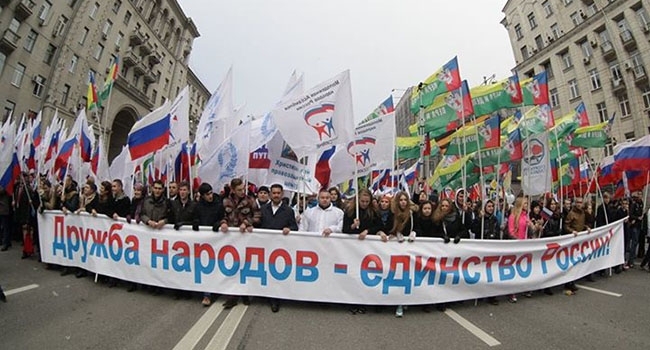
Frankly the imperial war of Russia against Ukraine increasingly raises the question of the future of the aggressor itself. This scares not only the Kremlin power, but also the anti -Putins. Many of them guess that the replacement of the "bad" king on the "good" is unlikely to get rid of. It will be necessary to solve a more fundamental problem - why, after all historical “liberation” (February 1917, August 1991), Russia inevitably turned into the same imperial track? And even if in the Kremlin after this war a liberal “pigeon” approaches, are there any guarantees that after some time he does not evolve in a new great-power “hawk”?
The Moscow opposition, which calls itself "Russian", thinks the same imperial categories as the Kremlin. The empire is not necessarily external aggression, first of all, it is the internal division of the country into "metropolis" and "provinces", which is due to obviously subordinate, and sometimes directly colonial status. It is clear that in such conditions no really federalist thinking, as in the USA or Germany, is impossible.
This is especially evident in the history of the Vilnius Forums of Free Russia, which have been held on the initiative of Harry Kasparov for several years. The leading main panels there, as a rule, are the "stars" of the Moscow opposition, which habitually broadcast "for the whole of Russia", and federalists from different regions are given only one "optional" discussion, which sometimes even forget to include in the general broadcast. And they turn out to be " dissidents among dissidents ."
However, the frank misunderstanding of the principles of federalism demonstrates almost all the course of the Russian opposition. For example, the head of Navalny’s headquarters Leonid Volkov claims : residents of different Russian regions cannot even imagine that Moscow is not Moscow. And all the "federalism" comes down to the fact that Moscow should not completely rob the "province", you need to leave something to itself. The Federation as an agreement of equal entities for Volkov is the same taboo as for the Kremlin.
The opposition guru Vladimir Pastukhov, as if calling for federalism, begins for health, but finishes for the repose, proclaiming the “state integrity of Russia” with the highest value. Which, again, does not provide for any agreement: Russia should consist of "20-30 regions", the boundaries of which will be "well thought out" and probably appointed by someone "from above". How this "federal" model differs from unitary - decisively incomprehensible.
In the end, representatives of more than 30 regions of the Russian Federation, which are in political emigration, were tired that some Moscow politicians and theorists are trying to determine their future. In May of this year, in Warsaw, they held the first forum of free peoples, and in July in Prague - the second, at which they adopted a declaration of decolonization of Russia . That is, they no longer spoke about federalism, but raised the question more radically - about the formation of new independent countries. It is clear that the Kremlin propagandists caused a rage . But panic among many figures of the Russian opposition is also indicative. They are used to making statements on behalf of the "Russian people", and then suddenly there are many peoples, and the soil leaves under the feet ...
Thus, the famous blogger Anatoly Nesmiyan, known under the nickname El Murid, despite all his “opposition”, fell upon the forum participants with typically proceeded crazy accusations of “collaboration” of the Second World War. Moscow political scientist Alexander Kynev was very frightened by the word "decay" , although it practically did not sound at the forum - its participants talked about post -heems reconstruction based on the interests of residents of different regions. But, apparently, this is a characteristic feature of the thinking of “Moscow political scientists”: if instead of one Kremlin subject there are several in the Russian space and they conduct direct negotiations with each other, such a situation from the standpoint of the Imperial Center, claiming a political monopoly, certainly looks like a “collapse”.
Kynev’s reproaches were especially funny that the Prague Forum seemed to "discredit the Russian opposition." In fact, this Moscow -centric opposition has long discredited itself with its many years of denial of equal federalism. For Kynev, the forum participants “do not represent anyone” - in reality, they just represent the public of their regions, but who are the “all -Russian” opposition at their conferences?
Further, Kynev reproduces typically the Kremlin horror stories: as if decentralization of Russia will lead to dozens of dictators who fight among themselves instead of one. Although the forum participants in their speeches constantly emphasized their desire for peaceful, contractual and equal relations. The Moscow metropolis causes general criticism, which economically robs the regions, unites their cultures and does not allow them to freely elect their power.
By the way, about the regional government. For some reason, Kynev defends the current local "elites", although these appointments "vertical" do not deserve such a name. Real regional elites will be elected only in free parliamentary elections in all regions, and what federation or other arrangement of this space they will agree among themselves - this is their own business. But the Moscow political scientist, in principle, does not allow such agreements to be concluded directly by the regions themselves. What then will the "federal elite" do?
Another characteristic template: Kynev is confident in the Russian "united engineering", because the majority of the population of the empire are Russians. And the Russians, in his conviction, born the Great Power, and this again brings him closer to the Kremlin opponents who are confident in the same. In this regard, I would like to remind Kynev the story of his native Republic of Komi, which in 1990, along with other autonomies of the then RSFSR, adopted a declaration of its state sovereignty. And this was not at all prevented by the fact that most of the republican deputies who voted for this document were ethnic Russians.
In a word, the current Russian opposition in its unitaristic views is a strange mirror reflection of the Kremlin power. It is fundamentally unable to perceive the gigantic Russian spaces from the Baltic to the Pacific Ocean as a territory of multipolarity , as a free contract of equal regions. Therefore, the participants of the Prague Forum were already talking about building history . Yes, while this term sounds unusual, but in 1991 the word "post -Soviet" was just as unusual. The story continues - and the imperial opposition will probably disappear with the empire.