
Translated material
"End androgin in Russian culture was Christ"
Conversation with Veronika Zuseva -Ozzan, editor of the collection "Woman Modern"
At the end of July, the publishing house “New Literary Review” was published by the collective monograph “Woman Modern. Gender in Russian culture of 1890-1930. " At the request of Gorky, Maria Bashmakova spoke with the editor of the collection Veronika Zuseva-Ozan about the image of a woman and the female beginning in the philosophy and literature of the Silver Age.Starting from February 24, 2022, we were all in the face of the advancing barbarism, violence and lies. In this situation, it is extremely important to preserve at least the remnants of culture and support the values of humanism - including for the sake of the future of Russia. Therefore, the editorial office of Gorky will continue to talk about books, reminding our readers that the world remains in the world and fiction.
Modern woman. Gender in Russian culture of 1890-1930. M.: New Literary Review, 2022. Edited by Veronika Zuseva-Ozan. Content
 - Why did the philosophy of the Silver Age think about the search for courageous and feminine?
- One of the reasons was that life itself became more complicated. By the end of the 19th century, the de facto situation of women had changed significantly-and somehow it was necessary to reflect it. Moreover, there was a rise in the female movement, more and more women tried to lead an independent, independent of her husband, father, brother life. The philosopher Vladimir Soloviev considered it necessary to speak out on the topic of female emancipation, writing in 1897 the article “Female Question” - after him he saw a serious “change in society”.
In addition, the more sophisticated, sophisticated, the forms of social and cultural life became more sophisticated, the more the normative ideas about femininity and masculinity were subjected to erosion - this also forced Russian philosophy to think about where the border between the sexes passes. All the trends from the West were also imposed on this, where at that time a surge in interest in the floor problem was also noted. Say, the book of Otto Weinger “Paul and Character” was very popular in Russia, which withstood many reprints. In addition, there were rather specific reasons regarding the proper Russian philosophy. This is mainly the doctrine of Sofia of the wisdom of God. First of all, it is precisely in connection with sophiology that the male and female principles of Russian philosophers of the Silver Age are discussed.
- What philosophical, sociological aspects influenced the formation of a new understanding of male and female and what was new to the Silver Age?
-In my opinion, in the silver century, the main “innovation” in the understanding of the male and female was the departure from the idea of masculinity and femininity as fixed natural features, although, of course, this was not formulated. The same Weininger - extremely widely discussed in Russian society - introduces categories M and f, not fully coinciding with their real, physical carriers. He agrees with him in this - although the individual provisions of his theory criticize - Zinaida Gippius. And if we look at Taffy's work, then this is generally a model of social constructing Gender: in her stage miniature “female question”, for example, all the absurdity of women coercive to certain social roles is shown due to their supposedly special physiology, “incomplete” compared to the male. And there was a lot of this in the literature and cinema of the era - philosophy as such was somewhat more conservative.
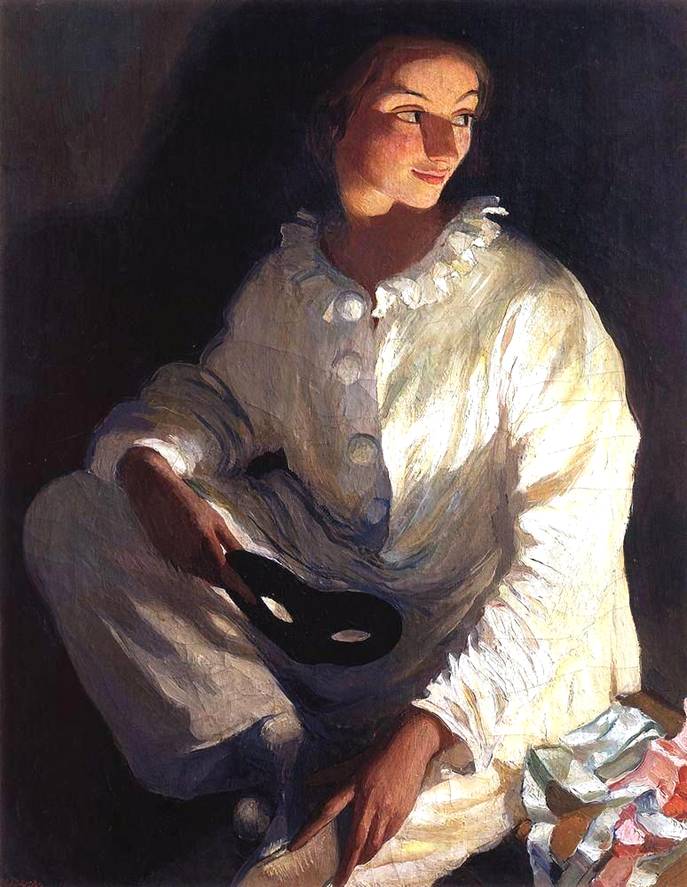 Self -portrait in Pierrot's costume. Zinaida Serebryakova, 1911
The Russian philosophy of the Silver Age is mainly religious philosophy, although it went far beyond the canonical church framework. Nevertheless, if we talk about the philosophical aspects that influenced the formation of a new understanding of male and female, then, firstly, to be called a high assessment of the femininity of the thinkers of the Silver Age, who in general opposed the femininity and the theory of emancipation did not complain, considering them to be belittled by femininity. They recognized the position of a woman as a second -rate creature unfair, but the equality of male and female principles, as they emphasized, does not mean identity. Moreover, in historiosophical calculations, the idea is often expressed that it was androcentrism, underestimation of the feminine, caused the crisis of modern civilization. As Dmitry Merezhkovsky wrote, the world is dying because his mother forgot. Hence the important idea of the closest connection of the private sphere with the public: if the family and the house were traditionally considered the female sphere, while the man belonged to the sphere of public (“citizenship”, creativity, etc.), then the Russian philosophy of the Silver Age, as it were, restores women's right to participate in “processing civilization”.
Secondly, the philosophy of this era breeds the concepts of gender and sexuality, which previously not thought separately at all. Thirdly, the idea of a transcendental, connecting a person with a deity, the nature of the floor was expressed.
As for sociological aspects, which also influenced the literature of the Silver Age, this is primarily the problem of female emancipation, attempts by women to live separately from the family, with their own expense. The circle of female professions expanded, although some innovations in this area were perceived as “incident”, for example, when a woman became a doctor (not a midwife, namely a doctor) or a military. Yes, in fact, the task of becoming a recognized writer, to prove his right to be not a muse, but the Creator, was also not from trivial: women were “attributed” to a massive, specifically “female”, amateurish literature, to enter the “Big Canon” incredibly difficult.
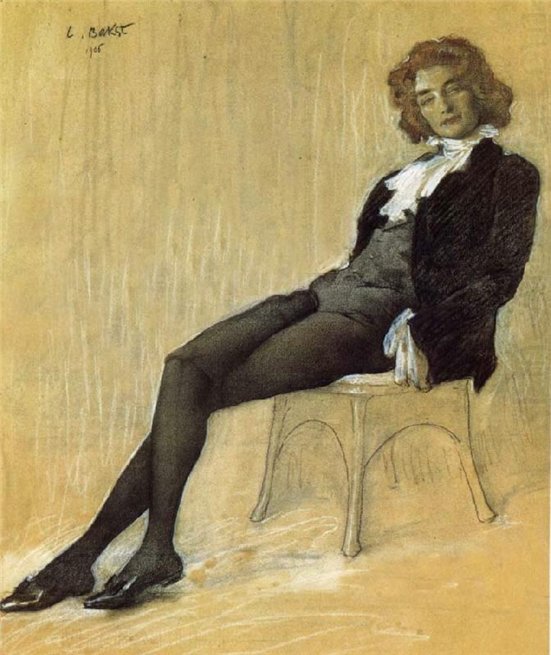 Portrait of Zinaida Hippius. Leo Bakst, 1906
- “Madonna” and “harlot” - these polar images wander in the texts of the Silver Age. Where did these interpretations come from?
- In the Androcentric World, a woman is generally depicted either as a divine being (unattainable, higher), or as animal (material and natural). Actually, these poles are reflected in the article by Hippius "Beastbog" - even in its very heading. Madonna and harlot are another version of this polarity, semantically equivalent: Madonna is also unattainable and higher, the harlot is also a material and natural creature.
In addition, the images of the Madonna and the harlot flow from the key for the silver age of philosophers, which, in turn, go back to the biblical prototypes (the silver age is generally known for the constant appeal to the “eternal images” of world culture). Personifying the sinful Babylon, a blonde sitting on the beast is a vivid image of the revelation of John the Theologian, or the Apocalypse - the key text of the culture of the FIN de Siècle , essentially eschatological. The image of the "Babylonian harlot" in the Russian literature of the Silver Age could represent not only a sinful woman, but also a church that fell away from God, and a corrupted city. Since apocalyptic expectations in the silver century were combined with an acute reaction to the position of a woman in society, the harlots were often depicted as public women against the backdrop of a depraved city.
Madonna, or the Virgin, is the opposite side of femininity, and her polarity with the harlot was recorded, including Dostoevsky in the formula for the existence of the “ideal of Sodom” and “ideal of the Madonna”. Madonna is one of the images of eternal femininity and a beautiful lady: Vladimir Soloviev found a connection between the courteous cult of Madonna, the beautiful lady and the cult of Sofia. Vasily Rozanov believed that the cult of Madonna was created by men - and this once again emphasizes the "male" look at this image. He believed that in the West the cult of Madonna merges with an erotic attitude to a beautiful lady (while in Russian traditional culture the Virgin embodies divine motherhood and cannot attract an erotic look) - but the situation was also in the Russian literature of the Silver Age.
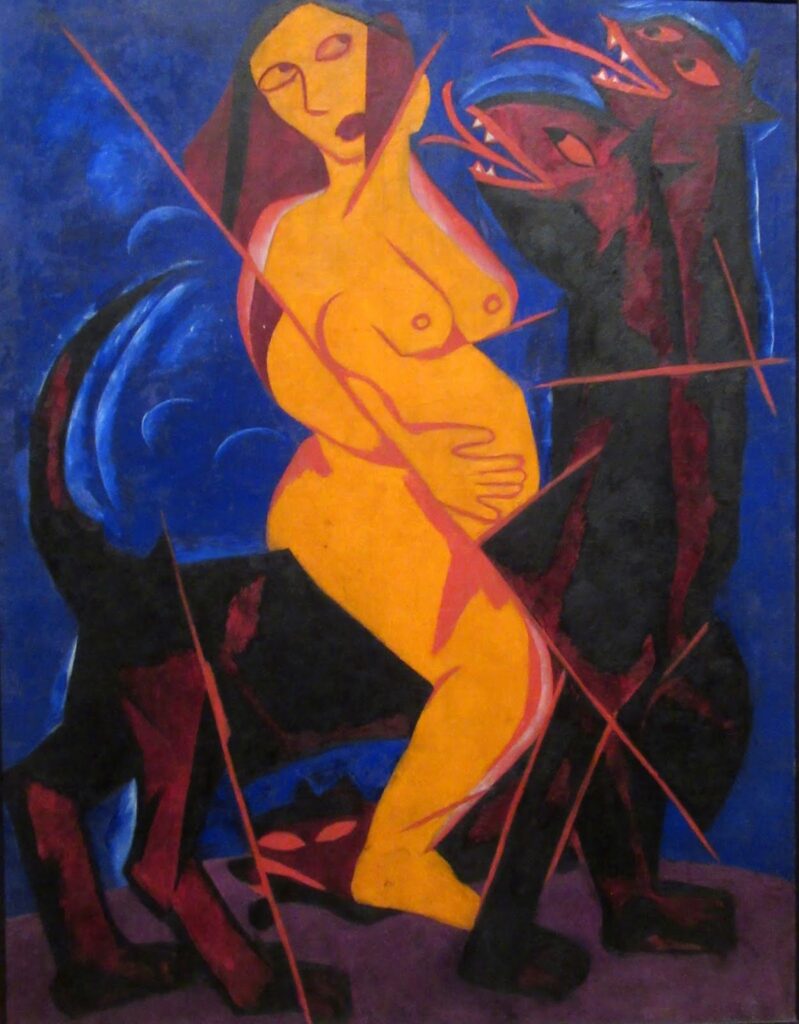 Virgin on the beast. Natalia Goncharova, 1911
- How was the understanding of new femininity associated with new religiosity?
- The new religious consciousness as a whole was based on a high assessment of femininity. According to Rozanov, there are, as it were, “two gods are the male side, and the side is female. This last one is that “eternal femininity”, world feminine, which they have now begun to talk about everywhere. ” In addition, the ideas of female messianism were widespread. In particular, according to Solovyov, “the women were the first to rose to meet the Risen Christ. The meaning of the current female movement <...> to prepare new wives of the myrrh for the upcoming resurrection of all Christianity. " Vyacheslav Ivanov agreed: “... we find a woman in the initial stages of a new elevation,” humanity awaits her words, which “cannot but be religious and prophetic.” But at the same time, Russian religious philosophers to the emancipated woman as such were unpleasant, seeing in emancipation the profanity of femininity.
- One of the central points of the woman’s accusation of Christianity was the statement about Eve’s special fault of the fall. How did the original sin have responded to the gender throwing of the broken centuries?
- The image of Eve, as one of the “eternal images” of world culture, of course, was very in demand in the culture of the turn of the century. At the same time, he was evaluated, one might say, polarly. On the one hand, since in the Christian picture of the world the emergence of Paul's problem was indeed associated with Eve, the woman was considered the main carrier of “sexual poems” and, accordingly, the bearer of sin. On the other hand, about. Sergiy Bulgakov in the "light of an unbockery", arguing about why the division of two gender needs, quite unexpectedly indicates that it was through Eve Adam that the corporal, the living flesh of the world, in relation to which he had previously felt alien. Moreover, Bulgakov connects Eve with Sofia, believing that in the Mirror of the Beauty of Eve Adam, he saw the sophia beauty of the creation itself, that is, intermediary functions are attributed to Eve (as it was in relation to Sofia itself as a mediator between God and the world). The “Neva Light” is generally directed against misogy. According to Bulgakov, “Eve is what distinguishes a person from an angel”, and those who see the beginning of sin in Eve deny the fundamental difference between a person and an angel, see only an “failed” angel in a person. The philosopher believes that Adam is as guilty of original sin as Eve, not to mention the fact that “sin of Eve” is not an evil will, but “children's seduction”. And perhaps the most interesting: after the fall in Eve, “two fighting principles appeared, and the Providence of God <...> will lead to their final separation of the birth of the Mother of God.” That is, as Christ overcame and redeemed the “Old Adam”, so Maria redeemed Eve; She, in fact, is the new Eve.
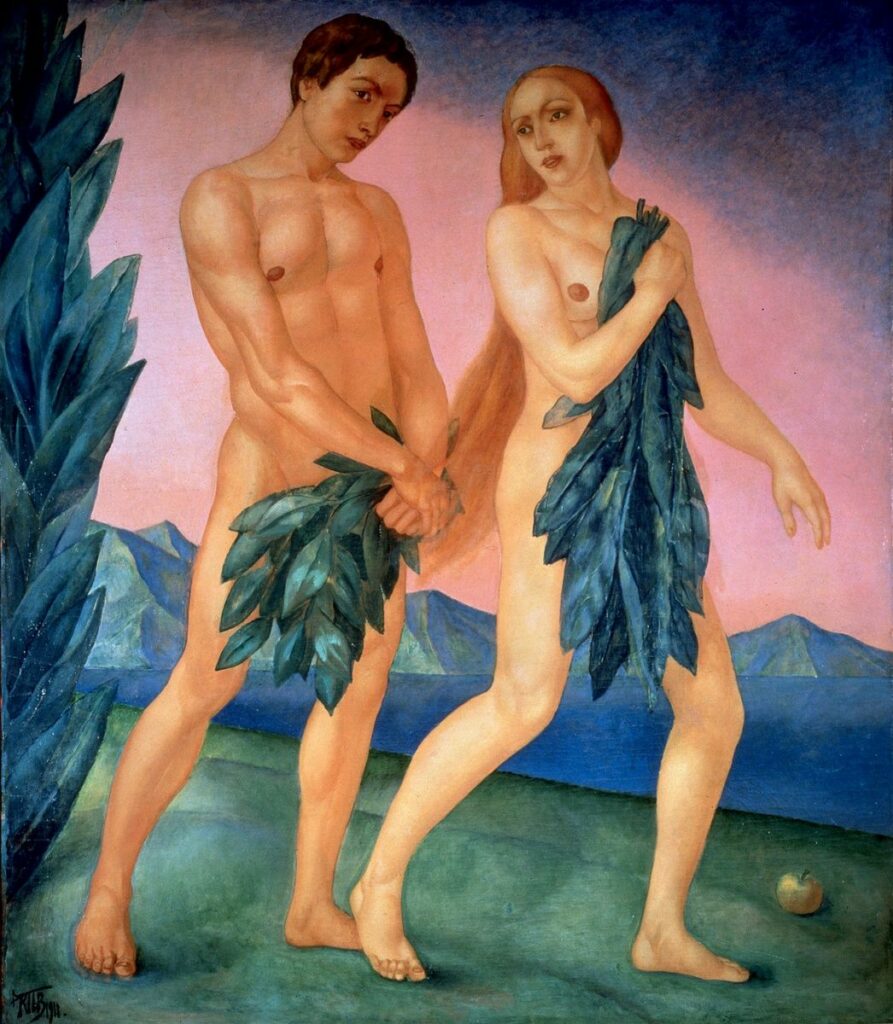 Exile from paradise. Kuzma Petrov -Vodkin, 1911
- How did the image of Eve rethink the fiction of the Silver Age?
-For example, in creativity there is little known now, but, in my opinion, the brilliant poetess of the love of the capital, this heroine appears repeatedly. In the cycle “on a different earth” it turns out that God first created not Adam, but to Eve. Thus, the traditional theological thesis about the dominance of men over women and a higher male nature is inverted, the priority of women in front of men is affirmed. The lyrical heroine of the poem of the capital “poetess” is brought closer to the Evoa heroine - a seer endowed with a mystical force who allows her to “say her word for men”. In the poem “Matriarchy”, which, as the capital believed in accordance with the then widespread beliefs, existed at the dawn of mankind, the era of matriarchy is shown as the kingdom of a woman, “the great Varvarka of Eve”. In the culture of the Silver Age, the comparison of Eve and Lilith (as the first, demonic wife of Adam) becomes popular, and in this comparison the attribute of sinfulness - but also precipitation - is mainly transferred to Lilith.
- The constant idea of the philosophy of this time is the complementarity of the female and masculine principles. And how is the idea of Androggin rhymes with this thought and how is this concept forming?
“Surprisingly, Christ’s exemplary Androgin was Christ in Russian culture - the Byzantine mysticism“ loved to describe Christ as the whole not only of courageous, but also the feminine perfection of human nature, as the overcoming of the split of the Old Adam to male and female. ” The constant complementarity of the male and feminine principles manifested itself in the fact that the female corbel was required to clearly the male father of the god, as which the Virgin or Sofia was perceived.
The word “Androgin” itself existed in the Russian language and until the Silver Age, but, so to speak, “actualized” this concept for contemporaries Vladimir Soloviev, which constantly reflected on the unity of male and female principles. In the work of “meaning of love”, he says that a “true person” “cannot be only a man or only a woman, but should be the highest unity of both”, which is the “closest task of love”, and it is “chaste love” potentially leading to the restoration of “integrity”. That is, in Solovyov androgyness is attributed not to the past, but to the future, and to the future eschatological. Solovyov referred to the words of the book of Genesis about the creation of man (“And God created a man in his image, in the image of God created him; the man and the woman created them”; 1:27), believing that “the image and likeness of God” is subject to restoration, and this does not belong “to half, not to the human floor, but to a positive union of male and female principles. True androginism - without external confusion of forms - that there is ugliness ... ". Solovyov refers exclusively to the spiritual area.
The loss of a god in the act of the creation of androgynia was associated with original sin. At the same time, the thinkers of the Silver Age believed that in an eschatological dimension, a "restoration of heavenly Androggin" would occur. In their works there are two ways to restore - one, following Solovyov, through love (which gave rise to many disputes) and the second through creativity. The idea of androginism also passed into historiosophical concepts, interpreting not in relation to individuality or, conversely, to humanity as a whole, but in relation to the path of Russia.