
Translated material
From the zone to the army. Military observer Alexander Golts - about the practice of sending prisoners to war
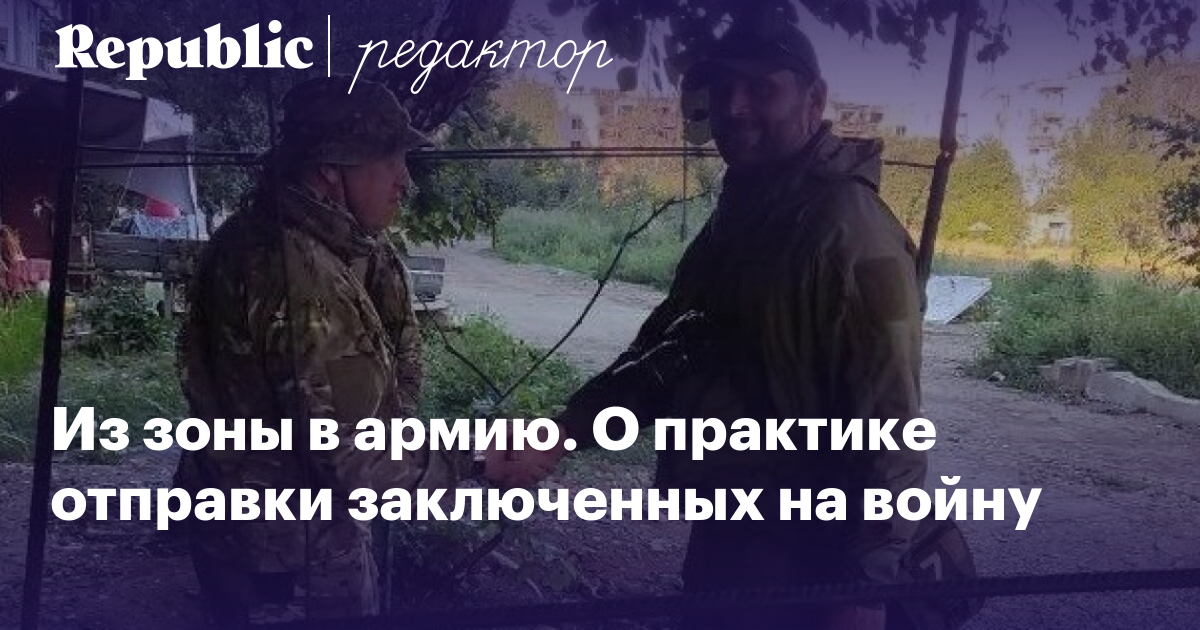
Recently, in his program on Russian television, Nikita Mikhalkov spoke about the feat of a certain Konstantin Tulinov, who, being wounded in battle, blew himself up with a grenade of himself and the Ukrainian military. The director, not without pathos, told about the complex path of the hero, who conducted most of his short life in prison. And, most importantly, he got into the army directly from the imprisonment, before the expiration of the sentence. The story of Mikhalkov, who sounded on the state television channel, confirmed the media reports that prisoners are recruited to participate in the hostilities in Ukraine.
Service in hell
At first glance, such a practice should have a lot of examples in world history. It would seem that it is simpler - it is here that the interests of a person who had stopped the law and the state coincide. The prisoner dreams of freedom, and his country needs soldiers. However, it turns out that the examples of replenishment of military ranks at the expense of criminals (here I do not consider all kinds of penal and disciplinary units created to punish those who were already a military man at the time of the crime). It is known, for example, in France in the 17th century, criminals and tramps were recruited into the army and formed special units from them - Bataillons de Salades. The same thing happened in Prussia. In 1713, King Frederick-Wilhelm I legitimized the forced recruitment of persons with "bad morality" (Schlimme Subjekten) and criminals. In Russia, from the moment of the creation of the regular army Peter I to the Milyutinsky reform of the 1870s, the sending “to soldiers” was one of the common punishments for criminal and political crimes.
In modern times, the beginning of the recruitment of criminals in the army laid the decree of the French king Louis Filipp I of June 13, 1832 on the creation of two battalions of the "light African infantry." A year later, another battalion was created. They were located in Tatavin (Tunisia), one of the most arid and hostile colonial regions of France. The creation of these units was to resolve the contradictions between civil and military legislation. In France, by that time there was a universal military duty. In the battalions, soldiers who were sentenced to disciplinary companies were to “serve” their term, if the sentence was shorter than the total service life in the army. The convicted “civilian” criminals were sent there, who, at the end of the imprisonment, had to fulfill their duties on compulsory military service. Thus, royal decrees restored a certain justice. Indeed, before the adoption of decrees, a person who committed a petty crime “on a civilian” could safely avoid the army, the service life of which was then seven years.
Subscribe to read the whole
Make a subscription Redefine.media to read Republic
Subscribe [you can pay for a Russian or foreign card. The subscription is extended automatically. You can unsubscribe at any time.]
Where are the money subscribers going