Date
Author
Лусине Григорян, Владимир Понизовский
Source

Preserved copy
Translated material
I'm not to blame!
It is difficult for people who are important for their group affiliation. That psychologists and philosophers know about collective responsibility

Recently, even in everyday conversations of citizens, the concepts of collective guilt and personal responsibility have firmly included. In some, they, especially guilt, are associated with terrible pages of history, with crimes, the responsibility for which applies to everyone and everyone, up to the whole nation. Others agree to be involved in the glory of Tolstoy, victory in the war, the feats of the heroes, but they rebel against their involvement in the tragedy of the Gulag, the arbitrariness of the authorities, and the prosperity of corruption. Why do people want to feel always good and never - guilty, is it fair to blame large groups of people of crimes of specific personalities when the concept of collective guilt was formulated? We deal with social psychologists explaining these complex emotions from a scientific point of view.
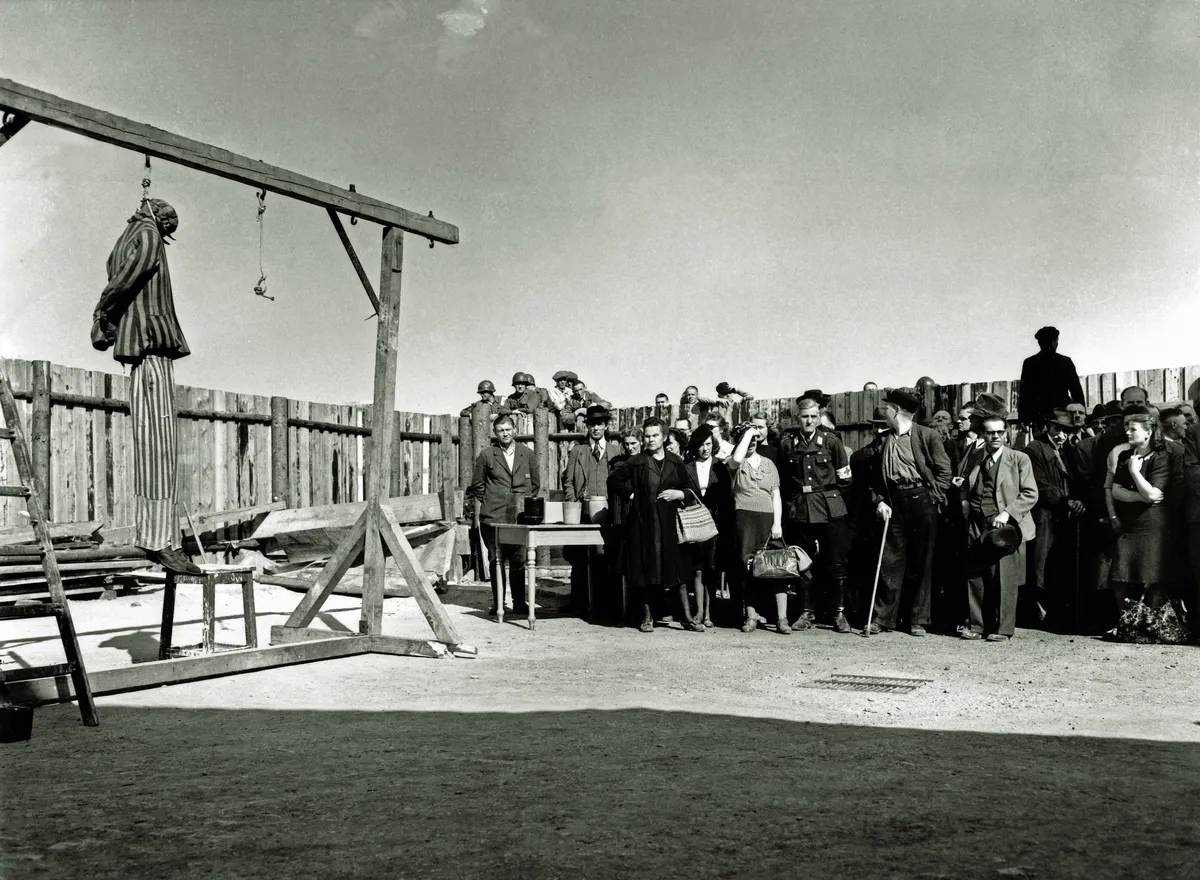
In the material there are photographs of war crimes: 18+
The question of collective guilt and responsibility, like many other issues in the field of intergroup relations, acutely stood after the world found out about the atrocities of the Nazi regime in 1945. Within the framework of the German denacing the Anti -Hitler coalition in many cities of Germany, posters appeared with the inscription "You are to blame." On the poster, a finger indicating the viewer was depicted, and a photograph of Buchenwald. Such accusations caused indignation in German society. How can you blame ordinary Germans of terrible crimes of the Nazi regime when they knew nothing and even if they knew, they couldn’t do anything about it?
After February 24, 2022, the question of collective fault and responsibility also arose for the inhabitants of Russia: some feel guilty, others do not accept the opportunity to answer what others do.
Many are angry with Western sanctions, from which ordinary Russians suffer, and Ukrainians who accuse all Russians in a skew. Let's try to understand the phenomenon of collective guilt and responsibility with a small excursion into philosophy and with the main emphasis on psychology.
Arenid against Jaspers
The starting point of a scientific discussion about collective fault can be considered the famous discussion between Karl Yaspers and Hannah Arendt about the collective fault of the Germans. Yaspers believed that only through the awareness of their own guilt can we come to the “repentance and renewal” of society (Jaspers, 1961), while the position of Arendt is capaciously described by its famous quote “When everyone is to blame, no one is to blame” (Arendt, 1977). Although it seems that these two positions are mutually exclusive, with a closer consideration it turns out that in the positions of the Jaspers and the Arendt there is more in common than different.
Jaspers shares legal, political, moral and metaphysical guilt. Legal and political are assigned and removed by others, while a moral and metaphysical person can only take upon himself. In this sense, the moral and metaphysical wine in the expert is purely personal experiences. However, despite this division of personal and public, Jaspers says that
There can be no unambiguous separation of moral and political guilt, since a sense of moral guilt causes "an internal rise that is directed to the implementation of political freedom."
Anadian resisted attempts to call all the Germans guilty of the crimes of Nazism. She insisted on the separation of collective guilt and collective responsibility.

According to Lessee, if you call the whole group guilty, this removes the need for everyone to be responsible for their own actions.
At the same time, the collective responsibility lies with all citizens of the country and is an involuntary in nature, since citizens of the country bear this responsibility automatically, on the basis of their belonging to a group, which they usually did not choose.
In the positions of the Jaspers and Redt, there are two important intersection points.
Firstly, both believe that collective responsibility is undeniable. Yaspers cited a number of reasons why a citizen is responsible for his state, regardless of his own political views. If only one citizenship is enough to divide the benefits of the country (education, medicine, natural resources), then one citizenship should be enough to share both obligations and sanctions. Making decisions in the state is delegated from citizens to politicians, and the positive and negative consequences of political decisions rightly affect all citizens. Finally, even in authoritarian regimes, in which decision-making becomes completely independent of citizens, citizens will create an atmosphere of depression, which serves as the basis of such power.
Secondly, both believe that society can only be changed through the adoption of political responsibility (and moral guilt, according to the Jaspers) for what is happening in society. Jaspers describes this as a splash of personal experience of guilt in political activity. Arendt in a similar way speaks of the necessary ligament between personal and public life:
When people are limited only to their personal sphere and refuse to participate in political life, they “alienate from the world”, leaving a void in which they prevail the upper with ideology that does not allow dissent.
Thus, both Jaspers and the rent agree in the main thing: state citizens are political responsibility for the actions of this state, taking this responsibility and participation in political life - a necessary condition for the existence of a healthy and free society.
Collective emotions: wine and shame
The psychological approach to collective fault is consistent with the understanding of the guilt of the expert as a purely individual, subjective experience. To understand what psychologists mean by collective emotions, you can recall your experiences when the team for which you are undergoing a competition. You personally, most likely, did nothing for her winning. It’s not you who took the players to the team, trained, financed these training: it seems that you have absolutely nothing to be proud of if emotions can arise only on the basis of our personal actions. But this is not so.
People are social animals characterized by “mandatory interdependence” (Brewer & Caporal, 2006), which means that other people need us for survival.
All our psychological functioning is adjusted to successful coexistence with other groups in groups. Social identity (a sense of belonging to a group and related experiences) is the “glue” that holds social groups together and makes us experience both positive and negative emotions based on our group affiliation.
No one has doubts that you can be proud of your country. However, when it comes to emotions of guilt and shame, we often encounter resistance and denial: “I am not ashamed. We repeat: everyone can only take on moral guilt. To explain why this feeling can arise at all, we give the following example: have you been ashamed or embarrassed for the behavior of a loved one in the circle of other people? For example,
Your child began a fight on the playground. Most likely, many of you have experienced in this case a feeling of shame or guilt. Why, if you personally did nothing bad? Because this is your child, and his behavior says something about you as a person.
Collective emotions work in the same way: when the behavior of members of the groups to which we belong is diverge with our understanding of morality or permissible norms, we can also experience shame or guilt - the actions of the group affect both our views and how others perceive us. But what is the function of these emotions?

Turn to yourself
Negative emotions work as a signal warning us that something is going wrong.
When the members of our group achieve success and gain recognition, we feel pride. And when they behave in a morally unacceptable way, the emotions of guilt and shame signal us that something is wrong, and give an incentive to action. For example,
If it seems to us that other people will think badly about us because of our group affiliation, there may be a desire to distance themselves from the group. In the case of the country, this may be a departure, a change in citizenship or strengthening ethnic identity.
If it seems to us that the actions of the group members jeopardize the moral foundations of coexistence in it, then this is motivation for activity - the search for like -minded people and an attempt to bring group moral standards in agreement with their own ideas about morality.
Wine and shame are the so-called Self-Conscious Emotions, which can be roughly translated as "emotions converted to yourself." These emotions are available only to people, as they are based on reflection. These emotions are evolutionarily important for the regulation of social behavior. Social norms exist in order for people to know what to expect from each other, what contributes to trust and cooperation in the groups so necessary for our survival. Emotions of guilt and shame exist so that we do not violate these norms.
Refusing the feelings of collective guilt and shame, we lose the most important incentive to change: a person, devoid of fear, destroys himself.
Only in the case of the fault we risk not with our physical safety, but “mandatory interdependence”.
Refusing collective emotions, we lose the opportunity to correct the maladaptive behavior of our symbols. If most citizens do not feel responsibility for the decisions of their government, only those who take such responsibility will affect the government decisions.
Collective emotions and collective action

Guilt and shame motivate people to support actions that restore relations between their group and others: reparations, economic support programs, and official apologies. For example, feelings of collective guilt for the actions of their governments among the Dutch (Zebel et al., 2008) and Serbs (Brown & Cehajic, 2008) were associated with the greater support of reparations for Bosnian Muslims, and the collective fault of the white inhabitants of Australia, New Zealand, South Africa - with supporting economic policy, protecting the interests of their indigenous people peoples.
However, wine is not the only strong emotion motivating a person. This function can sometimes and better perform moral shame, anger aimed at their own group, and sympathy for the injured group.
At the same time, feelings of guilt and shame can have negative consequences - for example, a deterioration in mental health. By the way, it is interesting that people are literally sharing collective guilt - it is easier to carry it together.
But if a person feels guilty, while others from his environment are not, then he feels more intensively. This effect was observed among Jews and Arabs, as well as white and African Americans - people consider themselves responsible to be guilty of “on behalf of the group”.
We see this effect in the Russian context today.
Are there enough emotions for collective action?
No. For example, one of the popular socio-psychological models of collective action (Van Zomeren et al., 2008) suggests that three elements are needed for collective action:
awareness of injustice,
Social identity (sensation of yourself part of the group)
self-efficiency (the feeling that you can influence something)
Collective emotions usually serve as one of the indicators of conscious injustice, but little to us tell us about the power of social identity or about perceived self -efficiency. Moreover, negative collective emotions are usually weaker than those who are very identical to their group: for whom their group affiliation is extremely important, difficult to experience emotions such as wine and shame, and they usually find ways to maintain a positive image of the group, no matter what happens in it.
In Russia, self -efficiency is low, and this is partly explained by objective reasons - the state, instead of encouraging and creating conditions for the political participation of citizens, is trying by all means to remove citizens from politics.
At the same time, low self -efficiency is not only a reflection of the political situation in Russia, but also a “self -retentioning prophecy”. The feeling that the system is unchanged and can never be changed, gives us a sense of stability and soil under the feet. But as we know from the history of the world (and even specifically Russia), the collective action is often successful, and authoritarian systems regularly fall apart. The idea that the collective action is useless, deprives motivation for action and allows authoritarian regimes to exist. In Russia, such an attitude is characterized not only by the “deep people”, which the propagandists like to talk about, but also to those who are in a healthy society a catalyst for public changes, is an elite, both anti- and Prooputinskaya. This attitude gives a sense of stability, but at the same time it is the foundation of authoritarianism.

In order to find self -efficiency, two components are needed: awareness of the need for action and setting realistic goals. The base point is to honestly admit that
Being in the system, you are responsible for what the system does in the outside world.
Then you can ask how your actions help or interfere with this system. Work on a propaganda television channel is worse than working in a local newspaper. Giving part of the salary for organizations that fight the regime is better than not giving. To encourage others to abandon public and political life, to extinguish the political actions of others is worse than giving people to self -organize and help in this.
It is possible, based on the degree of sense of responsibility and your own capabilities, to decide how far you are ready to go. Between sacrifice to society and complete isolation from public life is a large range.
No one is obliged to give all their resources for public good; Both two percent and half a percent are permissible values.
Not alienating from the world
The collective political responsibility for the actions of the state lies with all its citizens, regardless of whether we recognize this responsibility or not. However
Collective wine is a subjective, individual experience, to which another one cannot force.
Collective emotions of guilt and shame signal the violation of moral standards in the group and motivate us to actions aimed at correcting errors. However, guilt is not the only way to action: this function can also be performed, for example, anger aimed at their own group, or sympathy for the injured group. And of course, although emotions are important, emotions alone are not enough for collective actions and changes in the situation. Without the feeling of community with the group (identity) and the feeling that you can affect the situation (self -efficiency), such negative emotions can be useless or even harmful. To avoid such negative consequences, it is important to find like -minded people and have realistic expectations from yourself, which will allow you to act in accordance with their own moral standards, "without alienating from the world."