
Translated material
New alarms in August
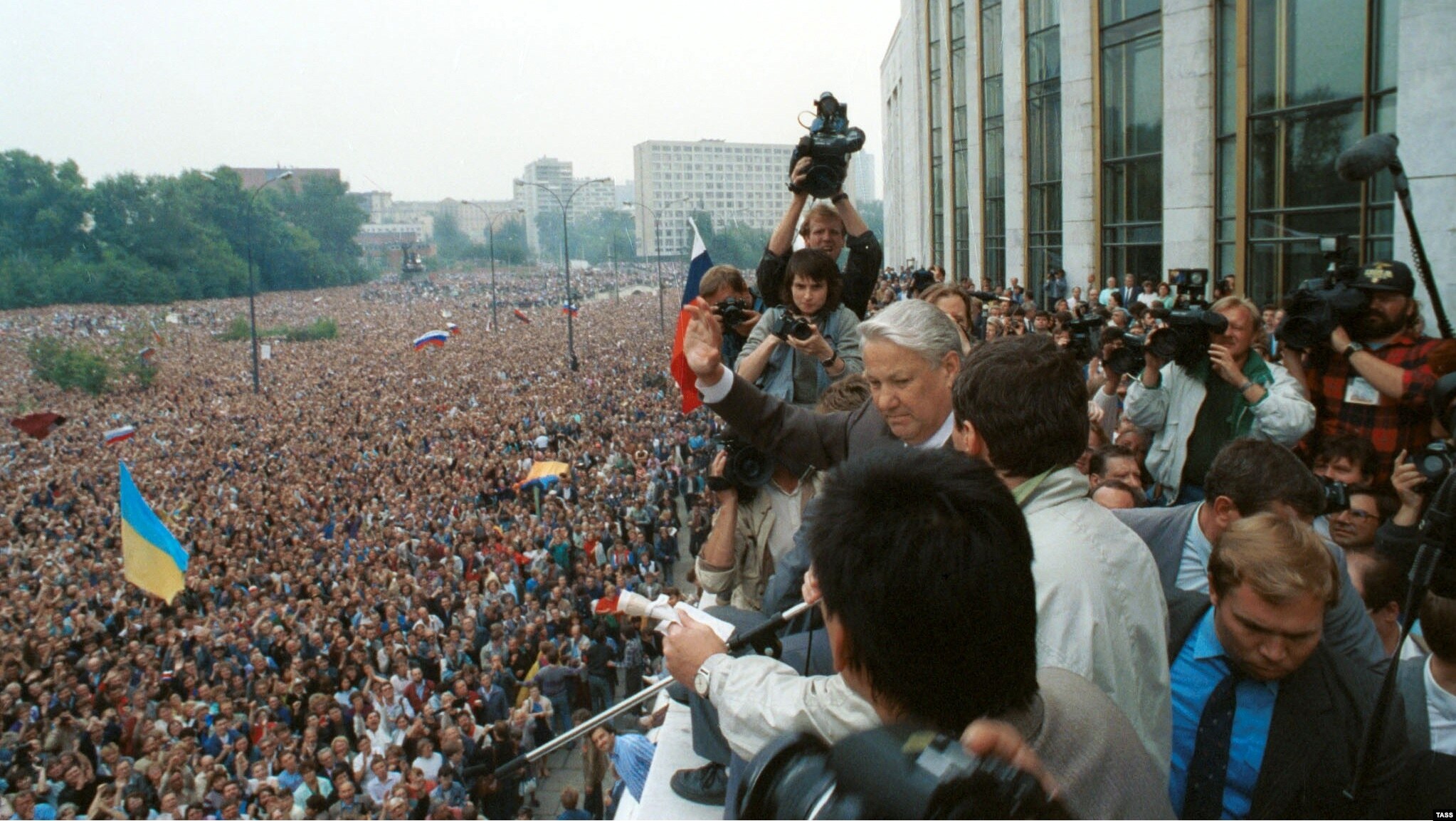
The tragic path: from 1991-in the 2022th. How and why, 31 years after August 1991, the ideological heirs of putschists from the State Emergency Committee completely mastered the authorities in Russia?
On the air, the historian, deputy chairman of the Party of People's Freedom Andrei Zubov.
Video version of the program
Mikhail Sokolov: Today, the historian and religious scholar Andrei Zubov are on the air. We are talking with you on the next day of endless bloodshed in Ukraine, and in the field of attention there are several dates: today is 25 years of default of 1998, and we are on the eve of the next anniversary of the Civil Code of the GKChP in August 1991. What happened 31 years ago, your explanation as a historian, what was done before the coup, as perestroika has advanced far far from?
Andrei Zubov: This topic is still one of the main topics of Russian history, until we have the end of the totalitarian past that caused, in particular, the war in Ukraine, and before that caused a lot of other things. Perestroika began with an attempt to improve the socialist system. “Back to Lenin,” Gorbachev called. In fact, until the very end, until December 1991 and continued to call for something like that. I remember very well when, after the failure of the putsch, Gorbachev signed the presidential decree on the prohibition of the CPSU, he did it without any jokes, he did it painfully, I saw a torment on his face, because it was really for him to refuse himself, the career, the person that he built in himself, but he found little courage, he had little left as an alternative at that time. What was it?
The putty itself was an attempt not to end the reforms, but an attempt to return Russia, the Soviet Union to the state before the reforms. They did not offer any alternative. It was a typical purely conservative action, the task of which was not the former, so that there was no publicity, no perestroika, and even more so the collapse of the Soviet Union. We remember that by this time the almost Baltic states left the USSR that the East European block collapsed, that not only the Berlin wall was already destroyed-this was in 1989, but in 1992 Germany united. That is, everything collapsed. The attempt of these people, rallying around Yanaev and Kryuchkov, was an unpromising to return everything back. Nothing happened.
After that, as you know, Russia quickly declared itself independent, dropped its communist formally formally, soon a new constitution was adopted, the name of the Russian Socialist Federal Republic was canceled, the Russian Federation appeared instead of it. It would seem that everything is going well. At that time I was terribly inspired, although I would not hide that I was also sorry for the destroyed state, I believed that it could be preserved by reformatting the Federation equal in the literal sense of the word of subjects, not republics, of course, but much smaller subjects. Be that as it may, it did not work out, everything collapsed. Both Russia and other parts of the former USSR began the way to the world, it would seem light, simple, from bad to good. The return is always simple, I repeated, but it turned out that it was not easy.
Mikhail Sokolov: members of the State Emergency Committee, a paradox, wanted to save the USSR from reforms, from the confederation, but accelerated the death of the Union, which you already said, on August 24, Ukraine announced independence. In general, they set some goals, but it came out completely different. Suppose they could win what would happen then?
Andrey Zubov: This is the case when the historian should not get carried away. It is unlikely that they could win. You remember that they tried to use violence, they tried to do something, did not dare to do anything. Most of the people of our generation remembers perfectly how the streets were filled with the people, what a protest was, how, according to the call of supporters of Yeltsin’s defense, people gathered for the White House, I was among them. It seems to me that the attempt was from the very beginning impossible.
Mikhail Sokolov: There is an opinion that the late Gorbachev perestroika and several months after August was the most free period in the history of Russia. After 1992, he went into a rollback, there were fewer freedoms, there were no longer such acts as the Law “On the Rehabilitation of Victims of Political Repressions”, where the USSR was recognized as a totalitarian state responsible for the mass persecution of its people. Does it not turn out that the impulse to European development in Russia depends only on the personality of the leader? Here is Gorbachev, here is the early Yeltsin, they wanted something good, and then everything broke.
Andrey Zubov: Yes, and no. Of great importance is society. In fact, the society of the era of perestroika and the beginning of independent Russia - it was a society, of course, completely Soviet. People dreamed of freedom of entry and departure, at the same time it was madly sorry for the fact that the country had broken up, although it broke up almost bloodlessly. Before their eyes in Yugoslavia, horrors were happening during the collapse, they had to thank God, but did not thank. This Soviet enchantment of the empire also prevented the perspective to see normal people. The second is that always, when this type of event takes place, people should receive something real, tangible. The Bolsheviks promised the Earth, the world, of course, they did not give anything, but they promised and believed them, they took the land, and then they selected this land in the brutal way during collectivization. There was no peace either, there was a civil war. Here, ordinary people received almost nothing. There was a certain illusion of stability in the late Soviet system. They lived badly, went for sausage to Moscow, but they knew when to get up, which train to sit, how many sausages could be brought. It was heavy, bad, but life. They were in a state of life also heavy and absolutely unpredictable.
The former professor could go some guard because they paid a penny at the institutes. The former officer, some Afghan hero was forced to go to some private enterprise for the protection of some oligarch. And on the other hand, rich people appeared, who did not understand how the rich became rich, then we realized how they became rich, but this was not at one moment. This is a feeling of injustice that the reform did not give anything, she still gave professors, even if they were poor, but they were free, they could write, they could go abroad if they were sponsored, of course, and most people did not receive anything. And this was the main mistake of this system that it was not designed for some positive contribution to the life of an ordinary average person.
The Soviet man remained Soviet. If he received the property of his ancestors, he would quickly change if he had a psychology of the owner, as in central Europe with the restoration of property. There was none of this here, and people remained evil, Soviet people living on a salary. It was a painful situation. And the rich, rich people were afraid that there would be democracy, the populist parties would come and take away wealth. From here, somewhere since 1996, non-homocratic forms of management began to be introduced even by the state, even parliament, therefore, Yeltsin just transfers when he leaves his post, the authorities of the KGB Putin officer, so that he retains the status quo primarily for his relatives, for his family, for his environment. This status quo could only be preserved by reducing democracy and its actual elimination, because otherwise the left-wing parties will come, which will say: let's change all, because most people will support them, at the same time will call for the restoration of the Soviet Union. This led to the fact that democracy and freedom was less, and the authoritarian system was more tougher. What this led to, we all see now.
Mikhail Sokolov: I wanted to ask you about how relations with Ukraine were built, as with an independent state? In principle, there were agreements in Yalta, the friendship agreement is large, everything was somehow decent, but not very stable. Then, under Putin, there is already a change in the course in relation to Ukraine, interference in its affairs repeated, desperate struggle with European projects and everything else. Why got worse and worse in this matter? The imperial past under any leader would not give Russia peace or is there a great personal contribution of Vladimir Putin to the destabilization of Ukraine?
Andrei Zubov: Again, we should not forget about a very simple thing here: in Russia, before the very end of the Yeltsin regime, in the late 1990s in the survey, which was conducted by the Levada Center, three quarters of the respondents dreamed of restoring the Soviet Union in one form or another, that is, completely, partially. Only 25% of people did not want the expansion of the Russian Federation, believed that it was possible to live in Russia completely. Imagine that democratic elections will be held, a party will come to power, which calls, as Hitler called on in 1932 in the elections to revenge, to restore the lost territories.
Yeltsin never sought to restore the Soviet Union, he sought to create a certain space so that all these countries were more or less democratic. But democracy still could not be allowed, if there was a parliamentary democracy, it would conventionally speaking, not the Yeltsin party, but the party that advocates the restoration of the USSR, and it would be the same thing that happened can be more peaceful, it may not be more peaceful - I don’t know this anymore. Putin under the mask of the not very talented successor Yeltsin, as the family of Boris Nikolaevich saw him, he turned out to be a man fanatically belonging to this imperial majority. Therefore, when he did not want any redistribution of property in favor of the people, but he wanted to restore the empire.
I do not know that Yeltsin says: do not treat Ukrainians as a not -so -full state. In my opinion, he did not say so to any of his advisers, but Putin spoke repeatedly, starting from the very first years. That is, from the very beginning, he did not recognize the law of the state for Ukraine, of course, Belarus, too, for Kazakhstan, also dreamed of some kind of revenge, like most Russian people. In this sense, he is an exponent of the will of the majority. That is why Krymnash turned out to be popular, and even this war, although it, of course, caused not such a clearly positive reaction, but quite a few people to one degree or another even support this terrible war. Instead of fighting the post -colonial, imperial syndrome, how they fought and continue to fight in the UK, in France very consistently, they indulge this here. If we take into account that this was still superimposed on a poor society that was not given property, it was irritated by this, it was a completely perfect substrate for creating a new populist, I would even say a totalitarian regime that, glory to you, has not yet created, but can be created, there is internal prerequisites for it. But the war in Ukraine can lead to the fact that this regime will collapse and, thank God, will not turn into a totalitarian one.
Mikhail Sokolov: There are two dates - August 17, 1998 and 1999. August default, was he such a passing event or key, because he undermined confidence in the liberal course in power, to those who personified him, then a counterweight to Primakov was, from here was Putin, who was approved by the prime minister just on August 17, 1999? After all, there were other candidates. Again, the role of the personality here was lost another scenario of the development of events?
Andrey Zubov: I don't know. Of course, some of these personalities are well acquainted with me, I am very sympathetic to them. Someone, such as Aksenenko, died, but at the same time there was a person in many respects interesting, worthy. But I outlined another picture that there was an objective need for power or to change my course, that is, to conduct real decommunization, restoration of property, lustration and so on, and then most of society, like Czechs or Slovaks, would support power in principle, then power would become democratic. And if you do not carry out all these things, if the property is transferred to the chosen circle of loved ones or those who managed to grab it, then the dictatorship is inevitable. Because with democracy, political forces will appear that will say: we want the property to be redistributed in a democratic way in one way or another.
Most people who are dissatisfied will vote for these parties, actually take away from the same oligarchs, from rich people. They will never go for this of their own free will. You can call it as much as you like a revolution, repatriation, but it would have happened with real democracy. And when the ownership of restitution was transferred to millions of people, as in the same Czech Republic or Slovakia, Hungary, no one will call for the redistribution of property - this means to go against the whole people, it is hopelessly politically. So the wrong steps of Yeltsin were made in the beginning, instead of correcting them, but I do not know the person who would understand this and could fix this in 2000, neither Kasyanov did not understand then, nor Aksenenko did not understand then, it is clear that Putin did not understand then.
Everyone one way or another thought about maintaining the status quo with a certain democratic decor, democracy actually controlled by the authorities, as the presidential elections in 1996 were under control. In this sense, no matter how, of course, another development would go a little, Russia would become a pro-European authoritarian country, retaining property for those who have taken possession of it in the 1990s, but without imperial ambitions and with a limited democracy, as about current Türkiye. This option was possible. But a completely democratic country, as the current Czech Republic, say, or Estonia, Russia could never be and cannot, by the way, be in the future without systemic decommunization - this must also be borne in mind.
Mikhail Sokolov: It turned out that at a historical distance at the age of 30 he won the State Emergency Committee, but in a more aggressive form than it was in 1991. And this despite several waves of protest, on the activities of Navalny, we see the process of destructive archaic counter -revolution?
Andrey Zubov: Not quite. The GKChP simply wanted to return Russia to the Brezhnev era, that is, no perestroika, no publicity, as we lived under the road Leonid Ilyich, and we will live on, a little bit, maybe small property will be allowed, but not more than that. The current regime is, of course, a regime built on the principle of limited, but private property, no one talks about the full socialization of property. The first does not speak about this Putin.
All, the property is owned by trusted people. This terribly resembles a fascist regime, but this is by no means what the State Technical Service wanted to do - this is a new system. This is a system that in the economy focuses on a private, but state controlled property. You remember that Nazism was just that, and fascism was just that.
In politics, it focuses on the authoritarian regime, to the high level of aggression, on the constant feeling of the offended, which must be compensated by the restoration of "historical justice", that is, the force of those lands that were once part of the empire. So Hitler thought, so Mussolini thought, so Molotov thought with Stalin, and Putin thinks so.
That is, this is not the victory of the GKChP - this is the creation of a new system. This is not socialism-this is just such a fascist, and not the National Socialist regime without any offensive connotations, in which power promises rich people to preserve their means in exchange for loyalty. Those who are loyal, have everything and have even more, and those who are unlimited, lose everything, is transferred to this property loyal. This is a new system.
Next, watch the video