
Translated material
The strange creature living 535 million years ago was excluded from among the secondary
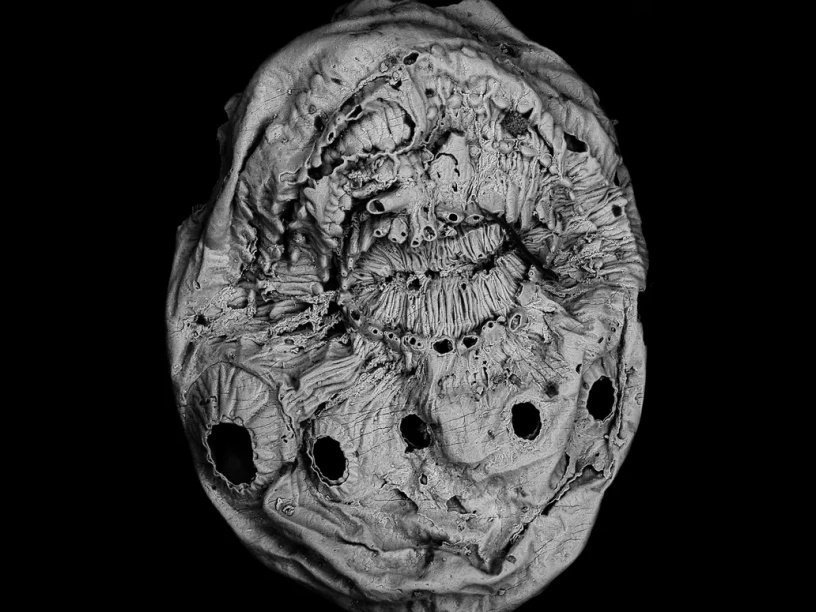
The authors of the new study came to the conclusion that the unusual Saccorhytus coronarius animal, which lived on Earth 535 million years ago, does not belong to the group of secondary -born, uniting a large number of animals, including echinodists and all vertebrates. Earlier, Saccorhytus Cornarius was considered the oldest representative of the secondary, that is, the closest to the common ancestor of this group of animals. The secondary name is due to the fact that the distant ancestor of all these animals in the place of the rotary hole arose anal, and a new rotary hole appeared at the opposite end of the body.
The fossil remains of Saccorhytus Cornarius were found in the south of China, their description was published in early 2017. The size of the animal was small - only about a millimeter. Its appearance describes the Latin name Saccorhytus well, which can be translated as a “wrinkled bag”. The adjective Coronarius describes a large mouth -like mouth that occupied about half the body. The mouth was surrounded by several rows of hillocks. There was no anal hole in the animal at all, but there were several conical holes on the sides, which, according to the researchers, served as the separation organs. It is noteworthy that the number of these holes in different individuals differed and was from one to four. The animal also had bristles that performed a protective function. It is assumed that Saccorhytus Coronarius lived in bottom sediments. In 2017, researchers suggested that the animal closely by Vetulicoli - a group of animals that existed 518–507 million years ago, which is also considered primitive secondary ones. The main argument in favor of the secondary strength was conical holes that scientists interpreted as primitive gills from which gills arose at later secondary ones.
Now the team of paleontologists from China, Great Britain, Switzerland, Germany and the United States, having studied the new Saccorhytus coronarius samples , which have been preserved much better, claims that the hypothesis of the relationship of this animal with secondary ones will have to be rejected. They collected hundreds of additional samples that used to create digital 3D models of the creature in order to detect microscopic features of the structure in detail.
As a result, the researchers came to the conclusion that the spikes and holes around the Saccorhytus Coronarius mouth were not respiratory organs, as the authors of the 2017 work mistakenly suggested. “The previous conclusion was based mainly on the fact that the fossils of Saccorhytus have a number of holes around the mouth, which researchers interpreted as primitive gills, a feature of secondary ones. But now we know that these holes are where the teeth have broken down, ”says Professor Philip Donohee from the University of Bristol. “Our analysis shows that Saccorhytus is actually a member of an animal group, which includes arthropods and their relatives, called mudding, although we cannot say exactly what kind of group they belong to.” The sinking ( E CDYSOZOA) include a large number of animals, the life cycle of which is characterized by the periodic discharge of the upper chitin cover. These include arthropods, round worms and a number of other groups.
Thus, the conical holes were not the organs of the living Saccorhytus coronarius , but arose after the death of the body due to damage during the formation of fossils, that is, they represent, according to the authors of the work, “taphonomic artifact”.
The study is published in the journal Nature.