
Translated material
Chemists created a map of hydrocarbons stability
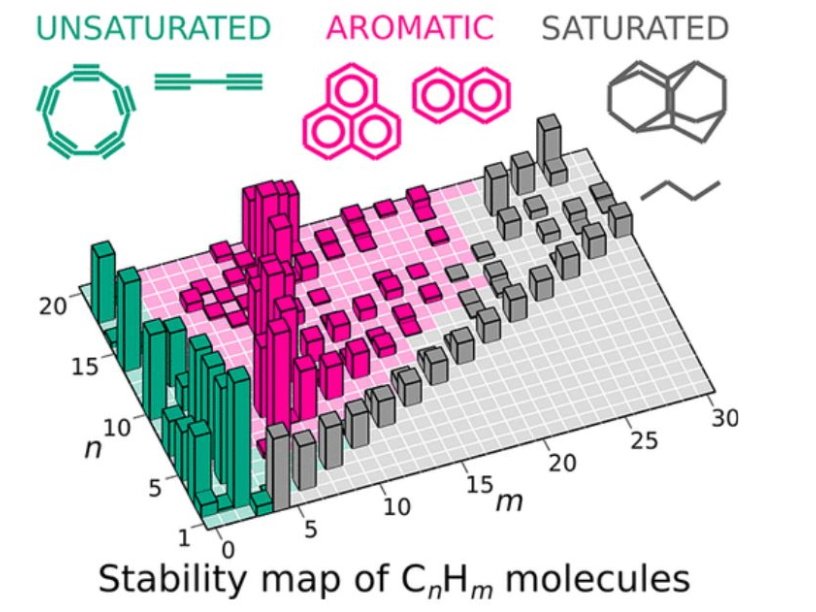
A group of researchers from Skoltech, led by Professor Artyom Oganov, found out why some hydrocarbons can be found in nature in large quantities and easily synthesized, while others could not. For this, scientists took advantage of the criterion for the “magicism” of molecules - their stability in relation to the closest compounds in composition. This approach made it possible to create a map of stability, which is consistent with experimental observations and predicts new potentially synthesized molecules. Skoltha press service spoke about the study.
Hydrocarbons are called carbon and hydrogen compounds, which can be described by the total formula C N H M , where n is the amount of carbon atoms, and M is the number of hydrogen atoms in the composition. This is one of the main classes of organic molecules, which there are a huge number. At the same time, some of them are more common and easily synthesized in the experiment, others are almost impossible to get without resorting to special tricks. The scientists still did not have a single theoretical substantiation of hydrocarbons.
“It seems to me that the textbook of organic chemistry makes an equally frightening impression on everyone: a huge number of molecules without a clear system have been listed. Some molecules can exist, but some are not, and no one knows for sure why this is happening. Much can be understood for each specific molecule, if you draw its chemical structure - the "sticks" help in this, which symbolize the connections between atoms, but in reality many concepts still cause disputes and do not answer the question "why?" But “sticks” are nothing more than a convenient abstraction for humans, and the strict criterion for the stability of compounds is energy, ”explains Sergey Lepeshkin, the first author of a new job.
Scientists examined the chemistry of hydrocarbons from a theoretical point of view, based on the values of energies for various compounds. At the same time, for stability, it is not the absolute energy of the molecule is of greater importance, but by the energy of its transformation into neighboring compounds, which differ in the formula for one carbon atom or 1–2 of the hydrogen atom. To determine the most stable compounds, the authors of the article used the concept of “magicism” of molecules previously proposed for nanoparticles. “Magic” is called such a molecule that is more stable than the ensemble of neighboring molecules.
Scientists conducted a test of “magic” using calculations for a wide range of compounds: up to 20 carbon atoms and up to 42 hydrogen atoms in the molecule. The calculations were made using the USPEX (Universal Structure Predictor: Evolutionary Xtallography) designed in the laboratory, which simultaneously predicts minimal energy structures for each composition, “forcing” different molecules to compete and exchange information with each other. Having received energy for all compositions, the program automatically found “magic” molecules. As a result, the researchers received a stability card for all hydrocarbons in a given range.
“In fact, we received all the chemistry of hydrocarbons in one scheme. It is remarkable that on it in the form of "stability ridges" familiar to us from school are homological ranks - a series of compounds with a natural change in the composition, structure and properties. Our map shows which molecules are easily synthesized, which can form spontaneously, accumulate and be present in large quantities. For example, with the help of this map, it becomes clear why certain connections are present in planetary atmospheres and interstellar space. Finally, she predicts what connections we have yet to find. Compounds that do not meet the criterion of "magicism" are very interesting, but exist. The most striking examples are cyclopropan, the instability of which chemists explain with tense connections with non -optimal angles; Butadien, whose increased activity and tendency to polymerization are well known and are used in industrial synthesis of rubber; Cyclobutadien, which took about 30 years on the synthesis, ”concludes Artyom Oganov.
Thus, scientists have shown that there is a single energy criterion that allows us to judge the stability and instability of the molecules. And at the same time they presented a look at the huge variety of hydrocarbons and organic chemistry in general. Since the method is universal, in the future it can be used for a similar analysis of the stability of molecules of any other classes.
An article with the results of the study is published in The Journal of Physical Chemistry Letters .