
Translated material
Intensive therapy
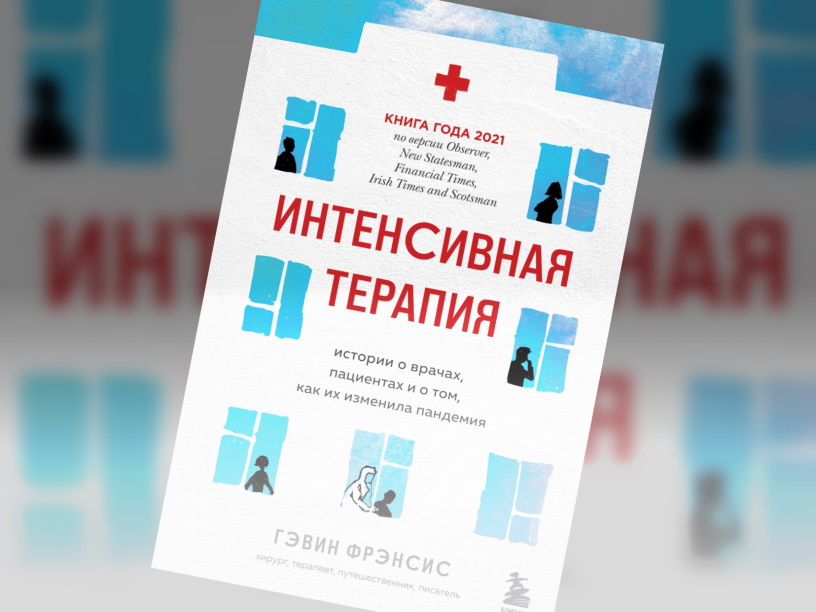
The Exmo Publishing House represents the book of the Scottish doctor Gavin Francis “Intensive Therapy. Stories about doctors, patients and how their pandemic has changed. ”
Gavin Francis worked as a surgeon on four continents, was a doctor in the Antarctic Directorate of Great Britain, an ambulance, as well as a general practitioner. His book “The Journal of the Human Belief” became a bestseller and “Book of the Year” according to the British Medical Association. He devoted his new book to the Wirus, which in 2020 changed the global and local economies, the organization of healthcare, moving from one country to another and all the usual life in 2020. In it, he describes the evolution of the pandemic from the moment the first messages about the sick, before the invention of the vaccine appeared. Gavin Francis collided with coronavirus as a general practitioner. He worked a lot with a variety of people: his patients in the hospital, elderly people in the nursing home, homeless people in public organizations. I saw how the virus manifested itself in one or another person, how isolation influenced people, how his colleagues reacted to constantly changing conditions. “Intensive therapy” is a story by Dr. Francis about the most difficult and unpredictable months in his career and his reflections on the consequences of the pandemic that fell on society and the healthcare system.
We offer to read a fragment of the book.
In the first week of March, at the Center for the provision of UET-Lotian emergency assistance, it became clear how many people arrive from Italy to the UK every week. Fans of skiing returned home, many had a cough and temperature. The incidence grew rapidly. We have reached the development phase of an infectious disease, when the viral particles multiply inside the body, causing noticeable symptoms. Among the patients I contacted by phone, there was a man who arrived a day earlier from the south of France. He was bothered by a headache, a feeling of severe weakness and heat. According to the recommendations, I should not have considered him as a potential coronavirus patient, so he told him that there was no official need for quarantine. However, from this advice I felt uneasy, so I asked the patient to stay at home and not go to work for at least a week.
Among my patients was a family who had just returned from vacation in the Alps. Of the symptoms, they had severe weakness and heat. Judging by the location of the place of their rest, they were at risk, so I wrote to them the direction for the test. I directed the official uniform to the public healthcare authorities, but general practitioners did not report to whom the test was positive, and who had a negative 1 .
In the computer system, where doctors see all the information about the patient, make records of each consultation and write directions to narrow specialists, in early March new coronavirus codes were added. The idea was to mark all the patients with coronavirus with a special code, which would monitor the rate of the spread of the disease, as well as determine the working coronavirus load of general practitioners. At that time, the “Recommendations for 2019-NCOV” were given the only one that I could often use.
According to official figures, we were still in the phase of containing the spread of infection. This was stated in the media and ballots for general practitioners sent by public health authorities. This meant that we could not independently take from patients a smear on the Covid-19 and the authorities ourselves “checked and tracked” all suspicious people who arrived from places with an unfavorable epidemiological situation, and isolated them from society. However, the number of new cases grew so rapidly that for further deterrent of incidence it would be necessary for hundreds of experts who could decide by phone, whom to leave at rest, whom to be isolated and whom to send for a test. In addition, we needed several hundred employees who could track everyone who contacted the sick. Testing of people who arrived from places with an unfavorable epidemiological situation was organized in Edinburgh by the regional department of infectious diseases.
However, now fear was not without reason among the population, and the situation became extremely serious. One of my patients, a taxi driver named Eddie, worked under a zero contract: he paid a large amount for renting a car and drove passengers all day.
“ I can’t afford not to work for two weeks,” he said. - If I do not work for two weeks, I will become bankrupt. And also homeless, because I will have nothing to pay for housing.
As a doctor, I was used to reassuring and encouraging my patients, but in a situation of developing pandemia could not console anyone.
One elderly lady asked me to write a letter to her insurance company so that she was returned home from the trip, but I replied that until the government changes the recommendations, the letter would not matter. She was upset. My other patient, a scientist who worked in a laboratory with colleagues from around the world, came to the clinic with complaints of severe headache (he said that he seemed to hit his forehead with a hammer), a temperature above 39 degrees and a cough. He was not in Italy, but his wife recently returned from Bologna, and some colleagues recently flew from China. I was forced to tell him that, according to the current rules, I have no reason to direct him to the test, since he himself was not in countries with an unfavorable epidemiological situation.
After listening to his chest with a stethoscope, I realized that he seemed to develop severe pneumonia, so I directed it to fluorography. In a local hospital, they began to ask patients with a cough and temperature, sitting in line for fluorography, putting on a mask. “But the radiograph was not in a mask,” my patient later told me. He was isolated for two weeks in the same house with his wife, but she did not have any symptoms. Looking back, I am almost sure that he had a Covid-19, but this was my first meeting with this dangerous and capricious virus that impressed people differently and kept everyone in uncertainty.
More and more patients addressed me with suspicion of Covid-19. Although they had classic symptoms, not one corresponded to strict national testing criteria. It was clear to me that the virus circulates freely among the population: a plumber with a cough and temperature, a woman with vomiting and heat, returning from a pilgrimage in Saudi Arabia, etc. We continued to say that only those who flew from Italy and East Asia. The news argued that the spread of the virus manages to restrain, but, knowing about the poor access to the diagnostic tests and complaints of many people to cough and high temperature, I understood that the situation was much worse than we were inspired.
Watching the news, I was surprised at the unusual, but necessary measures that Italy took: the organization of field coronavirus hospitals, dragon restrictions and normalizing access to the intensive care unit. Once I studied with military doctors to get a diploma in disaster medicine. We were told how to build impromptu hospitals, to allocate clean and dirty areas in hospitals, plan emergency mass vaccination, as well as organize the supply of medical equipment. It seemed to me incredible that all these measures are now taken so close to my house, in a country where the medical system is no worse (if not better) ours.
The first death from coronavirus in the UK was recorded on March 5. An elderly woman who infected Covid-19 within the country died. People began to realize the seriousness of the crisis, but even I, a doctor who read all the ballots of the public healthcare organs, did not understand the real scale of the disaster in the country. On Saturday, March 7, when the number of sick in the UK exceeded 200, I met friends. Many of them were doctors, and we joked that we were tired of in contact with the elbows, instead of shake hands. I stood in the corner of a crowded pub: many people came to see the register of England - Wales. After that, we went to the concert at Asher-Hall-a concert hall with a capacity of 2200 people. Crowds of people sang and hugged, trying to forget about the Covid-19 for at least one evening.
My colleagues and I knew that the virus was nearby, because we saw many patients with suspicion of it, but felt normal. We hoped that the press exaggerates its danger and we may have immunity, since we regularly encounter various coronaviruses at work. I knew that the virus was real and spreads, but all my patients were treated with suspicion of it at home. A thin voice in my head said with hope that the media may be exaggerated.
The next day, March 8, in the entire north of Italy they introduced the self -isolation regime, but the British continued to return home from there, and they were not put in quarantine. We were told terrible stories that in hospitals in pawnshops there are not enough apparatus of artificial ventilation of the lungs (IVL) and that the operations are urgently converted into intensive care units. This is especially scared, because there are many hospitals in Lombardy, and the number of IVL devices per capita is higher than in the UK.
My wife’s brother wanted to return home to the pawnshop from the south of Spain and loaded all his things into his van, intending to go by car for two to three days. However, he realized that due to the deterioration of the situation with the virus, he might not go across the border by car, so he had to get by public transport. He spent March 8, placing his things in the attic of his lessor (he was going to pick them up when everything subsides), and then got on a train from Cordoba to Barcelona. According to him, there are still a lot of people on the streets. They kissed and held hands when he walked among them in a mask and gloves. He expected a train from Barcelona to Marseille in the very corner of the station, trying to stay from other people at the maximum distance.
In Nice, he saw other Italians in masks and gloves. They sought to return home as soon as possible, and many needed to take care of other family members. Local children laughed at their masks and gloves, calling the Chinese.
The border with Italy was closed (this was shocked after so many years of open borders inside the Schengen zone), but it was enough for my Shurin to present an Italian passport and indicate in the declaration that he had a family in Italy to miss him.
He had to drive on two trains to get from the border to Genoa, where the police were unexpectedly friendly and attentive. According to him, the atmosphere of partnership and perseverance before the onslaught of the crisis reigned everywhere. From Genoa, he got on an empty train to his village. He spent two weeks in the basement of his parental house, completely avoiding contact with relatives, until he was convinced that he was healthy.
By March 9, some sections of the north of Italy were classified as category 1 - this meant that anyone who recently visited there is obliged to be in a quarantine for 14 days even in the absence of symptoms. The American journalist who worked at Lombardia flew to John Kennedy International Airport in New York and wrote on social networks that, to her surprise, she was calmly missed and no one even asked where she had arrived and whether she had heat. British newspapers wrote nonsense about the alleged hard quarantine in Italy, although people could calmly leave the country.
The epidemiologist Max Roser began to publish on the Internet graphs showing the benefits of measures to contain the spread of the virus, although it was clear that in the end he would inevitably reach everyone. He showed two curves: the first, similar to the Himalayas, showed how the virus would spread without restrictions, and the second, reminiscent of the hill of Saut-Daars 2 , illustrated how the virus would behave, subject to extreme social distance measures. On both schedules, the number of patients was the same, but on the second rise to the top and the descent were much more smooth, and this meant that the healthcare system would not be overloaded at the peak of the pandemic.
The next day, the whole territory of Italy was classified as 1. In prisons, riots began due to a ban on visiting. The prisoners were afraid that the thinning prison staff would leave them to die. Among people, stories about the Italian houses of the elderly, abandoned by employees from behind the virus, began to spread. They said that the military came there and found their inhabitants dead in beds.
We, Edinburgh, general practitioners, received an email from the regional department of infectious diseases in which its employees asked us not to contact them for advice. The number of calls from general practice doctors who were worried about their patients who came to places with an unfavorable epidemiological situation or returned from them.
We received another letter with orders about how to do with the patients of the Covid-19, located in the mountains and on the islands, and explanations on how to transport patients from the islands to the Aberdin or Inverness Hospital, ensuring their isolation. All this seemed to me something unreal and impossible. It was interesting how many people who made this protocol really encountered the transportation of people from the islands. Forced proximity to patients during the many hours of ferry or helicopter, logistics difficulties associated with the weather, the overload of island medical institutions ... Six or seven people had to work together to prepare a platform for planting a helicopter or aircraft. Meanwhile, in Italy, patients with coronavirus lay in hospital corridors.
Waking up on March 10, I saw a message from a colleague in WhatsApp. Although we have already met with many suspicious cases in our practice, the first few Covid-19 cases in Edinburgh were officially confirmed. All these patients returned from Italy. They had a fever, a headache in the forehead and dry cough. We all expected this news, but it still became a slap for us. Everything in our work was supposed to change.
Aircraft still flew from Italy and France. On sites, worried people were advised to call their doctor, and we, general practitioners, looked through emails every morning to find out what changed.
Protective costumes had to be left to the staff of hospitals and ambulances working with sick coronavirus. I began to wake up at night more often and scroll through my head recommendations that I gave patients during the day.
Did I act correctly by telling someone to stay at home? How will our clinic cope with such a stream of patients if the staff has already begun to get tired?
In the clinic, we decided to reduce the number of full -time consultations by half and take the released time telephone. We entered a new code for keeping medical records: “Telephone consultation in connection with restrictions on Covid-19”. Nevertheless, my colleague and I made five visits a day to the weak older people who could not leave the house. These are one of the most lonely people in our community. They are all over 85 years old, and they all asked about the virus with anxiously, trying to measure our level of anxiety with their questions.
On that day, many of my patients joked about the approaching Koronageddon, but only one person turned to us with complaints of dry cough, increased sweating and temperature above 39 ° C. He lived alone and did not go abroad for several months. I told him to stay at least for a week and ask friends to buy his products and leave them on the threshold. I promised to call him back in a week and asked to contact me immediately if he would breathe hard. Then the pubs were still open, and in the evening my colleagues and I gathered in one of them. It seemed to us that we were at a drunken military council. We shared stories about coronavirus patients in hospitals and ideas on how to protect our traditional practice. I remembered the meetings about the pork flu in 2009, but they were completely different, and the threat seemed far from so real.
1. So it was until August, while the new system related to national clinical data has not begun to inform general practitioners about the results of tests on coronavirus of their patients. - approx. aut.
2. One of the four regions of the deposits of the chalk in Southern England. It extends from the east of Gampshire, through Sussex and reaches the greatest height in the rocks of Beach-head. This is the latest National Park of England, formed on March 31, 2010.