
Translated material
It is impossible to read Russia
Modern Russian literature must be invented again, otherwise we will completely remain without it. Bookstores in Yerevan through the eyes of an emigrant
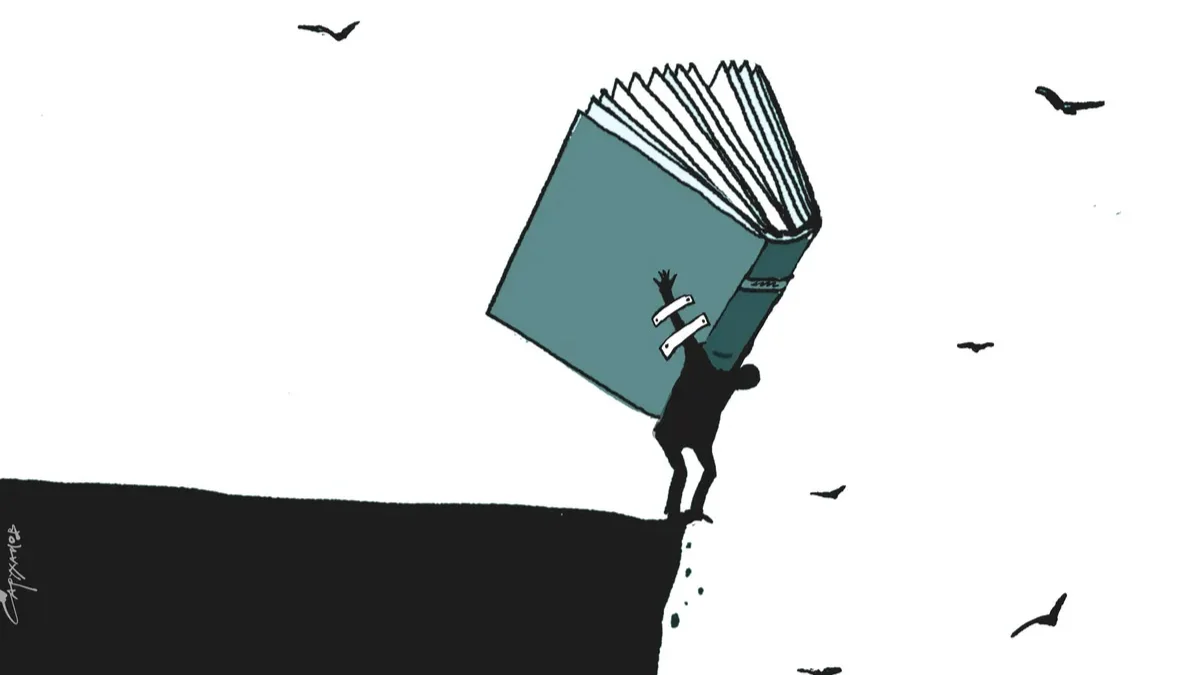
The home library is the main thing that is missing in exile, you can somehow come to terms with the rest. A few months ago, the media wrote about hipsters who returned to Russia, because in Yerevan there is no on sale of their beloved yogurt. I personally touched a couple of times to take a return ticket: I wanted to remove from the regiments of the rarity Dovlatov, bought back in the early 90s at the book collapse, and the same “Treasure Island” that I read in childhood. This is probably the homeland.
Leaving Moscow, I randomly put one of two thousand books in my backpack. Already on the plane it turned out that these are “seventeen moments of spring” and other novels about Stirlitz. The choice with meaning: the hero whom everyone is considered by the Nazis, but in fact he is not a Nazi, he is exactly the opposite. By the way, the mechanism of coming to the power of the Nazis and zombies of the population there is described very realistic.
The first taxi driver I asked if there were bookstores in Yerevan. He was offended by: "Brother Dzhan, Yerevan is a cultural city, what are you?" And he took me to the house of the Russian book on Vardananz Street. Already from the threshold, from the tricolor at the entrance, from the portrait of the Patriarch in the hallway, it became clear that this is a house not so much lovers of Russian literature as lovers of Russian power. And again I felt like a Stirlitz.
Yes, there were Dumas and Jules Verne, but the main assortment is approximately like this: “masters of espionage”, “the failure of the blitzkrig”, “military elite of Russia”, “Soviet military missions and intelligence”, “Way to death”, “Blood payment” ... In short, the library of the Russian samurai. Because of which it seems that Jules Verne and Dumas are also, in essence, about the path to death. War, death and nothing but.
But this is probably a propaganda project. Its goal is to create an attractive image of Russia in Armenians. I don’t know how attractive all this is, I doubt.
The beautiful poet Leo Losev has such a line: "Good - only war." And this Losev did not praise his homeland, he wrote about her tragedy.
To die and kill, kill and die. I would like to ask: what else do you know?
Once I worked as a book journalist, wrote reviews and understand a little in this business. Having removed the book from the shelf, I immediately opened the weekend - the Publishing House "Veche". He took off the second, third, fourth - the same. And I know this publisher. In 1993, I even accidentally ended up in his warehouse near the Kievskaya metro station, my acquaintances were played there. They thought it was just a big room where you could play. They played, drank. And around were books with names such as “the 17th century caftan and the mentality of the Russian nobleman”. Someone asked: "Where are we?" -"In the warehouse of the Publishing House" Veche "-" A-ah ... "
This “ah ...” meant: well, you never know the crazy people. Then all this Slavophilism was perceived as pure marginalia. Something like Hatha Yoga or a game of Indians. Here the country is new, the life is new, everything is new, we fly along the highway forward so that it takes your breath, and they ...
But a little less than 30 years have passed, and the Publishing House of the “Veche” from the marginal turned into a mainstream. In 2019, they presented their books in the DPR.
They released the volume dedicated to the outstanding people of Donbass in the series “100 Great”. In 2021, Putin's personal gratitude were awarded. And now they are almost monopoly representing Russian book publishing in Yerevan.
In general, everything is clear with the house of the Russian book. There is also Zangak on Abovyan Street, Russian books are also sold there. A small cozy hipster shop, something like the Moscow Book Chain "Republic". A store for rich and idle. For those who consider the book a toy or a sign of prestige. The stylish interior, very high prices, and the assortment is approximately like this: “Madly rich Chinese girl”, “The last letter of your beloved”, “Where happiness”, “A meter from each other” and Murakami in large quantities. Money, love, exotic. And the feeling of some incredible emptiness inside, which I want to fill right now.
There is a large book collapse on the vernisage, in the very center of the Armenian capital. It is open every weekend, and sometimes even on weekdays. And to be honest, makes a sad impression.
The books are wonderful, but you understand that people have grown up, have impoverished, and the library that the family was built around was built, the children grew up, suddenly turned out to be depressed and unnecessary. Now it is sold on the street for a penny.
There are a lot of Russian classics. The scattered volumes of Turgenev, Pushkin, Krylov, but the most incredible books also come across: “Little pressing of dentist prostheses from plastics”, “Oncological aspects in dentistry”. Apparently, the owner of the library is a dentist. Or a neglected patient of a dentist.
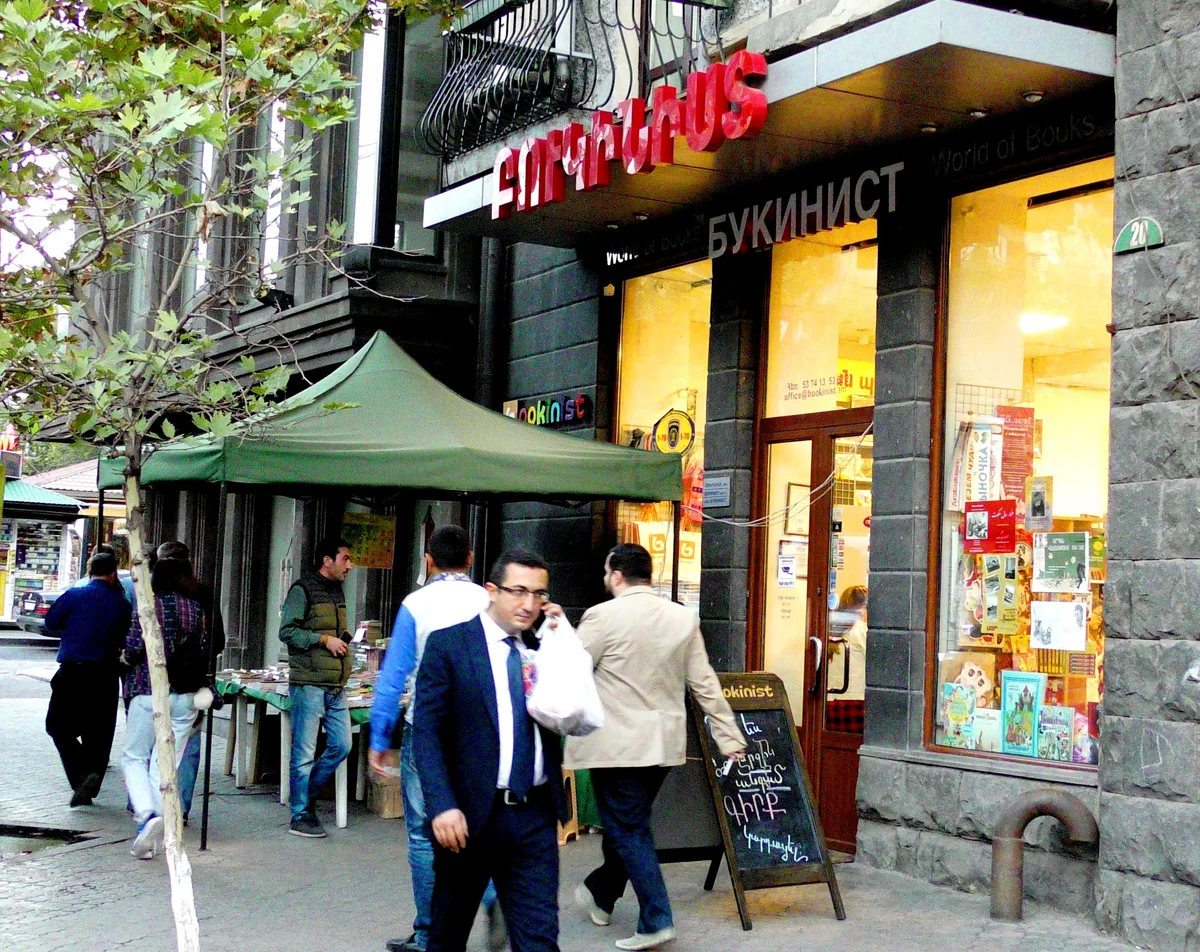
And there is a book network "Bukinist", quite pretty. On Amiryan Street, a little poorer, on Mashtots Avenue - more diverse. In fact, this is something like the Russian network “Read Gorod”. Feast of consumption, squeezing from world culture. As if someone had come and said: "Give me the best, time-tested." It is not clear about today whether they are good or not, and everything is already known about the last century.
These are books that they take with them on a train, on a plane, to a desert island and yes to emigration. All interspersed: Julius Caesar, Chapek, Nietzsche, Orwell, Dracula, Ivengo. And nearby - “in bed with bacteria”, “British spy network in Soviet Russia”, Agatha Christie, Marinina, Osho. I can hardly imagine the reader Nietzsche and Marinina, but, probably, there are such.
You look at this and think: modern culture does not exist. In Russian for sure. She canceled herself, turned it into a museum.
And a bookstore is also a museum in essence. But Yerevan is a cultural city, closely associated with Russian literature. What then talk about Madrid or Antwerp?
Mark Grigoryan and I, director of the Yerevan Museum of Architecture, in the Italian cafe at the Nzhda monument, are talking about books. I ask:
-And what good comes out in Yerevan in Russian?
- Yes, almost nothing.
He began to recall and said:
- The fingers of the hand is enough.
There is a feeling that we will not see good honest new Russian books in exile for a long time. They, perhaps (for sure!) They are now written in Russia, but it is unlikely that this literature will be published and even more exported. But there are many of us outside the Russian Federation - according to approximate estimates, about three million. And to read in Russian something more relevant than novels about the Stirlitz, these millions are now physically nowhere. Only telegram and facebook*.
The language does not turn to call it a humanitarian disaster when you see what is happening in Ukraine. But there is something catastrophic here.
And if we do not immediately invent modern Russian literature and not publish it here, in exile, in Armenia, in Georgia, in Latvia, in Germany - there will be no Russian literature.
And there will be nothing to take the next generations of the townsfolk with them to an uninhabited island.
Take care of yourself. The countries that have accepted us are definitely not obliged to do this. And Russia ... in Russia now only the "path to death."
* Belongs to META, which is recognized as extremist and prohibited in the Russian Federation.
Offline
This text will be released in the next, fourth, number "New Story Gazeta"