
Translated material
"A refrigerator against the TV - does not work in modern Russia." Alexey Levinson - about how Russian society has changed in six months of war
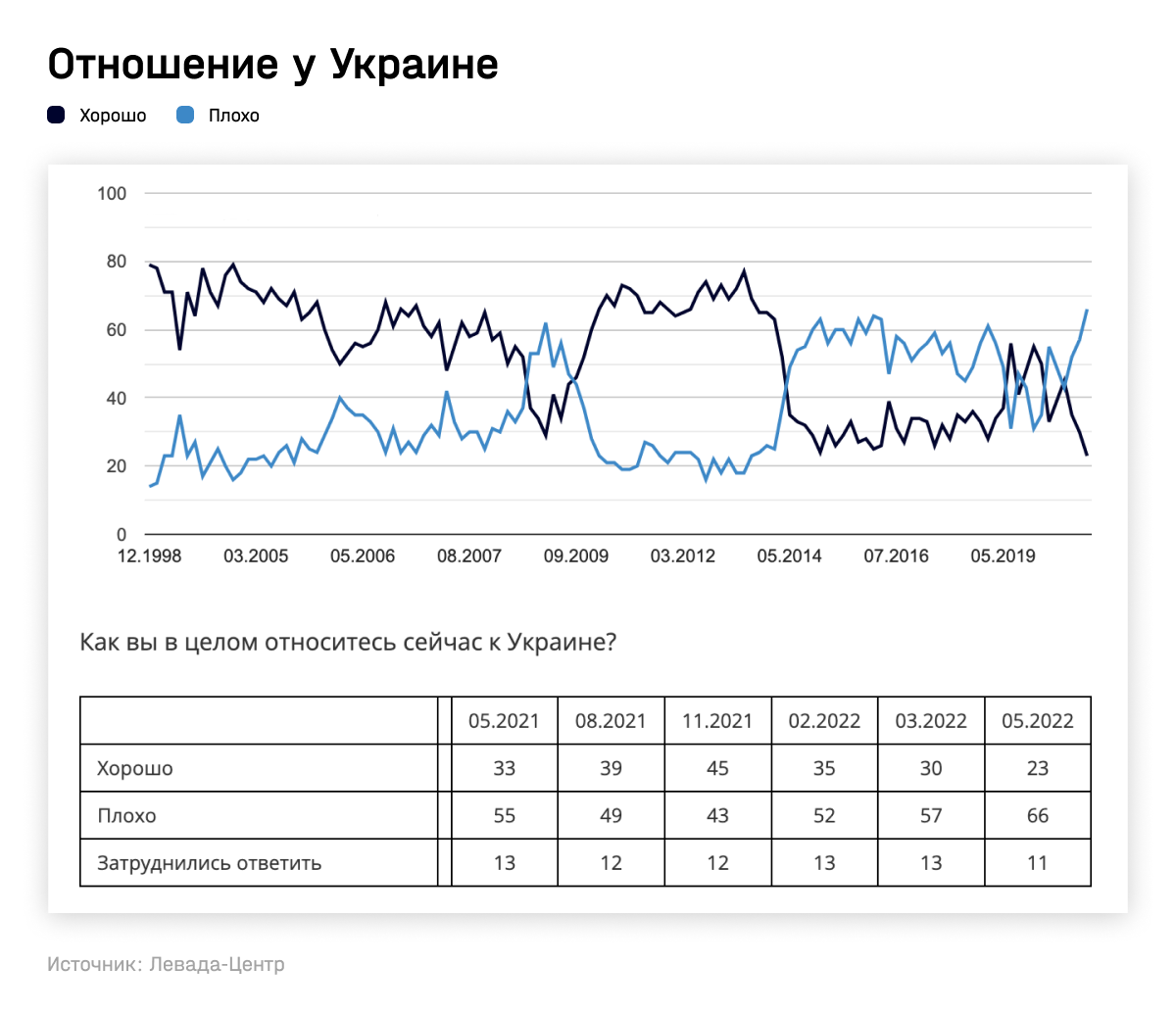
From the very beginning of the war, the sociologists of the “Levada Center” (recognized in Russia by the ino-agent) record 70%support by the Society of the Russian Army. Tighting the conflict did not cause much irritation - six months after its beginning to sociologists it became obvious that people simply try to distance themselves from this topic, pushing it to the background. We talked about what attitudes reign in Russian society, what attitudes in it turned on and what the contribution of propaganda was, we talked with the head of the department of socio-cultural research “Levada-Center” Alexei Levinson.
"There is no feeling that we are like a people - we are fighting"
How did the Russians react to the beginning of the war in Ukraine? And how did the attitude change in six months?
On the very eve of the start of a special operation, in February, when military preparations were visible, 45% of respondents were expected , and 49% thought that it would cost. But along with this, throughout the year, we recorded the highest level of fears about the world war. In February, there were a lot of afraid that she will grow into the world war, almost 60%.
In March, not yet recovering from the shock [from the beginning of the special operation], people reported about fear, horror, and shame, that is, about negative feelings, but also about pride in Russia, because we did something similar to the accession of Crimea because we showed our will. These emotions were approximately manifested. Something great and something terrible happened - such a reaction.
Now, on the one hand, Russians prefer to consider a special operation a limited event. Therefore, even in household conversations, she is not appropriated by the name of the war. A real war is in its popular sense - this is when bombs are pouring on our territory.
On the other hand, this is interpreted as a confrontation with the West, America, NATO. Ukraine, like Georgia in 2008, is represented as a country that executing the will of the main enemy.
It turns out such a design in which, on the one hand, in general, nothing terrible happened. And on the other hand, what is happening has a historical, geopolitical meaning. This is a design convenient for consciousness, which, in general, allows self -esteem that Russians are very important. “We are not fighting with a country that is obviously weaker, but with a world evil.” [But this is not a real war, so there is no danger.]
Power prepared society for this war? And it seems to you whether it was possible to mobilize it or was there such a task?
I think that such a task did not stand. On the contrary, it would be difficult for the authorities with a heated society. And we see that the public in Russian cities (not counting the border) lives an ordinary summer carefree life. Mobilization if there is, then on TV. And in people - when they look at him.
There is no feeling that we are like a people - we are fighting. The company knows that contractors are fighting, not soldiers on a call. Contractors are perceived as people who themselves made such a decision receive money for this, this is their work. If they die, then these are the costs of the profession. That is, for society it is a regular, not an extraordinary event.
Let me remind you that many observers said that how coffins go to Russia, the level of discontent would begin to grow. I don’t know how many people put their heads on the battlefields, but certainly that there are a lot. And where is this effect? I don't see him.
In this sense, this special operation is different from, say, Afghan and Chechen wars, where "our guys, our boys" died. Now no one says so. In particular, because of this, the authorities are not decided on general mobilization.
And in relation to Ukraine, some narratives were built consciously to prepare for war?
No, unlike, say, 2008, when an anti -Georgian campaign was held, there was no serious anti -Ukrainian campaign. Of course, between Russian and Ukrainian ethnic groups, as between any ethnic groups, there were and are mutual claims and prejudices. But I cannot say that they were activated [before or after the start of a special operation]. In contrast, anti -American, anti -Nate moods are very strong - everything is built on them.
In general, Ukraine in the eyes of Russians is devoid of subjectivity, is not perceived as a country, this area; Ukrainians as a people, as a nation are not seen, because they are not considered enemies. Instead of Ukrainians, there are some Nazis there, fascists. People are invited not to think about what this means, and they prefer not to think. It’s just that some are very bad and completely alien to ours.
Data "Levada Center" show that in the region of 70% they approve of the actions of the Russian army. A fairly common opinion was that such a high support figure was largely related to people's refusal to answer direct questions. Is that so?
No. So say those who really do not want to admit that the Russian people supported the actions of the authorities with a huge majority. But if you consider positive answers to the questions of the interviewers “You support or do not support ...” support (and not words about support), then the share of these answers is really as follows. The checks showed that there are no differences in the behavior of respondents in these polls. The share of failures and other technical indicators are the same as always. And approximately the same as in many other countries.
The share of those who generally refuse to participate in research is high. It has long been high in our country and in others. There is a very large share of people who have no opinion on issues that sociologists usually ask about. And they do not want them to molest them with these issues.
Of course, it was wrong before. Our team began to work in the late 80s, and at that time, as well as in the early 90s, in Russia there was a completely different attitude to surveys. People vied with a vocational to the authorities, others, what they think. Now it is a long time ago in the past. People do not think that public opinion polls is a conversation between society with themselves, that there is a real function of these polls.
But we must accept the fact that the vast majority expressed support for the actions of the authorities. No need to amuse yourself with the hope that somewhere there is a majority that does not support the special operation, it is simply not covered by surveys.
Another thing is that behind these answers, some firm beliefs are hidden, and other moods that can change to others, including opposite ones.
Another opinion
There is an opinion that making unambiguous conclusions from the results of sociological studies in the current situation is not worth it. Sociologist Grigory Yudin, in a conversation with The Bell in mid -July, argued this:
“The Russians generally believe that the state is conducting surveys, and therefore meet accordingly. The huge majority does not fall into polls - and VTsIOM (as well as other Pollesters) does not speak about this, does not report the level of the non -meaning.
As for those who agree to answer, in the conditions of war, of course, the pressure is even stronger. People feel the atmosphere perfectly - direct questions about “support” are perceived as a requirement to show loyalty. VTsIOM is also aware of this and therefore also asks indirect questions - for example, questions about which script respondents would consider more favorable now. Such questions create less pressure, give more problematic answers, and therefore does not publish VTsIOM.
Plicitic issues are perceived by respondents as a requirement of support. The answers to [such questions] reflect how strong the dominance of the monarch is from the point of view of those responsible. When this dominance is staggering, answers to such questions will change. But not vice versa. "
That is, this is not due to the fact that the interviewer is perceived as a representative of the authorities?
They perceive, but not as a police agent who can convey [as many people think], but rather as a channel of communication with the tops: sometimes to convey indignation for him: “Is that they are there? Do not see that our prices are rising? ”, Sometimes, to convey assurances in loyalty:“ Tell us what we support. ”
The influence of propaganda is significantly statistically?
This is a very difficult question, I will not say yes or no. But I will note that in such, of course, extraordinary conditions, when people understand that we are talking about something vital, the only thing that can do is verbally, visually design what people want to hear and see.
If they want to tell themselves - and they want! - That we do not do anything bad, we fight for the good, and those who are against us are bad, then propaganda shows everything that way. This is an order not only of the authorities, but also to society. In this sense, I am sure that propaganda is one of the institutions of society, such as our conversation with you, our work.
So the authorities mainly do what the Russians would like. Perhaps one of the few exceptions is an increase in retirement age in 2018. They did not want this.
But it is important that in the place of Putin there could be another leader who would lead a completely different policy, and this policy would also express the desires of the Russians and supported. For example, if a person appears who will offer something like peaceful coexistence, friendship with all peoples, which has happened more than once in our history, as, for example, under Khrushchev and Gorbachev, this will also be approved, and propaganda will talk about peace again.
Yes, the Russian mass political culture contains the potential of militarism, radicalism. This is what the current elite is operating, but this is not the main or only axial feature of Russian society. The same culture contains quite serious grounds for tolerance, for friendship, and inclusion. This is now pushed, declared forbidden. But it is possible that time will pass and the same Russians will support another political line.
Maybe we will see this with our own eyes. Maybe I will not see, but you will see.
"It was decided, which means that it is necessary to fulfill, and that's it"
Are there any installations exclusive for Russian society?
Among the main exclusive, I think there is no. Russians are the same people like everyone else. And they have as much tendency to evil and good as everyone. The question is which of the universal features here and now are especially relevant.
So, the modern structure of Russian society is such that for him now the image of the enemy is extremely important for the internal excess of the nation, for mobilization. There are societies in which this image of the enemy is also present, but it does not affect how public life is organized.
In our country, society is very poorly differentiated horizontally. The rule is “like everyone else”. This is due to the fact that already in the first decades of the Soviet power by this power to be more convenient to rule, a mass society was created from the people. This was done by the propaganda system, mass art, unified living and labor conditions, a single education system, and so on. This is a society where people react uniformly to the same events, signals, calls, mobilization.
So our society is still arranged - it has a command system. It was decided, it means that it is necessary to fulfill, and that’s it.
And the negative identity, when you oppose someone, is a strong way of unification, which was exploited in Stalin's times, partly in Brezhnev and, in general, is exploited now. We tried to live without it during the time of Gorbachev and Early Yeltsin. There were some encouraging signs that this was possible, but we can now state that this attempt failed.
But once again: it's not in the people themselves. The point is in those elites who have not allowed further movement along this path. These elites manage us now, and they exploit this mass and this negative identity - unification against the enemy, and successfully.
Is there any special attitude in the mass consciousness to the topic of the use of nuclear weapons or a nuclear disaster, which is now being discussed in the context of the Zaporizhzhya nuclear power plant?
The fear of the second Chernobyl, of course, is. It is clear that our mass media has guilty on the Ukrainian side, and our audience is more likely to accept this version. [This fits into a narrative] that these Nazis-nazili are such that they and a nuclear disaster can arrange.
The use of nuclear weapons by the Russian side is a very difficult question. People really do not want their loyalty to Putin to be subjected to some tests. They believe that nuclear weapons cannot be used. To ask a question whether Putin can give such an order is to make people think that they are almost excessive from the point of view of their emotional experiences. You can’t trust Putin at the same time and think that he will do something that will kill us all.
Therefore, people get away from thinking about it or think that maybe there is nothing wrong with this. I have met people who argue that tactical nuclear weapons are like just a very strong bomb. They say that there is no need to exaggerate this danger: yes, for some time it will not be necessary to go there, but nothing special.
How much moods about nuclear weapons in society can influence the decisions of the authorities on this matter?
People's opinion on the actions of the authorities as a restraining factor influence the country extremely weak in the country with such a social and political structure as ours. There is no mechanism for influence on power, say, through the elections. And the rating, which is shown by agencies such as ours, is, of course, also the voice of the people, but they can not be listened to.
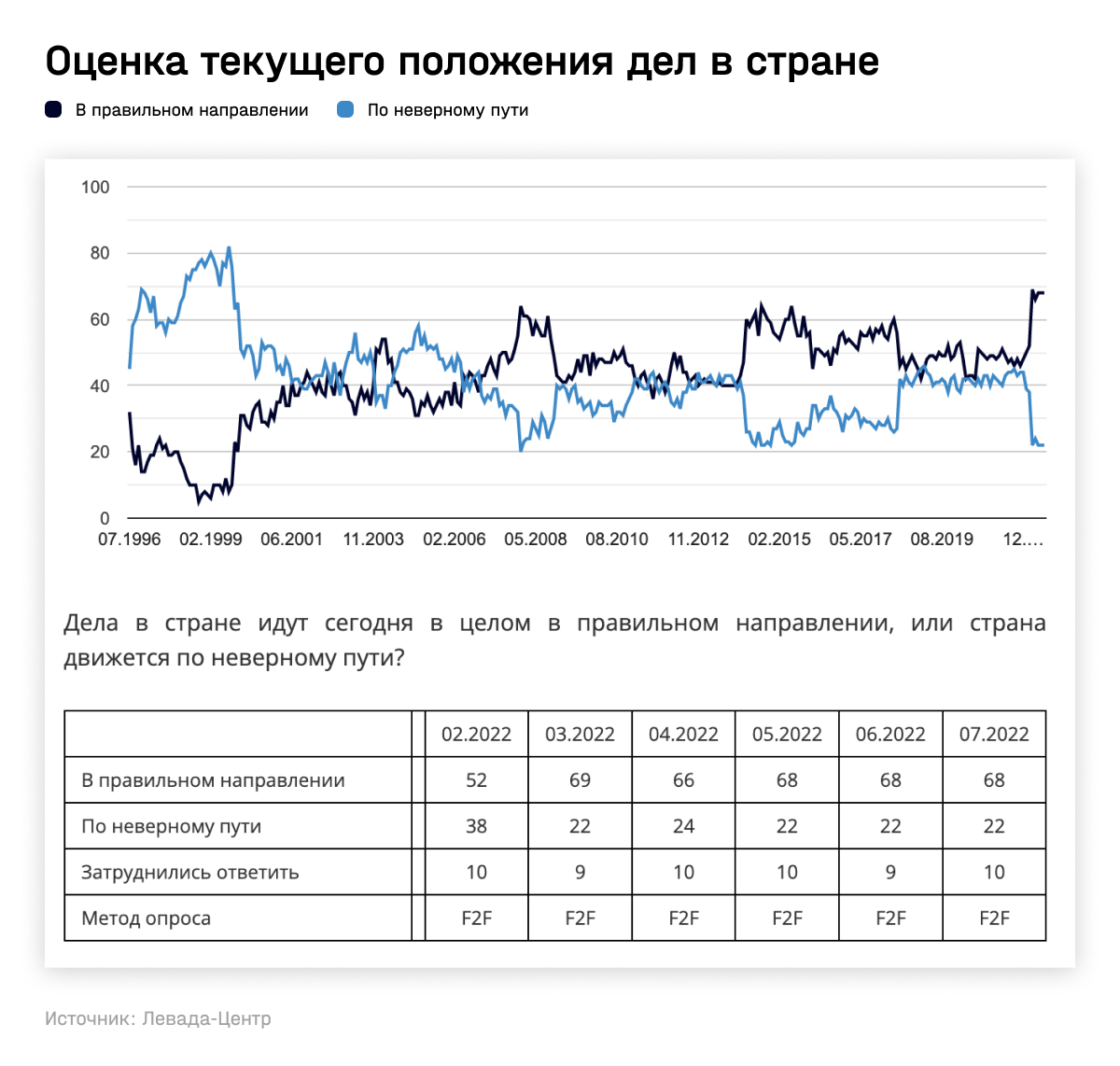
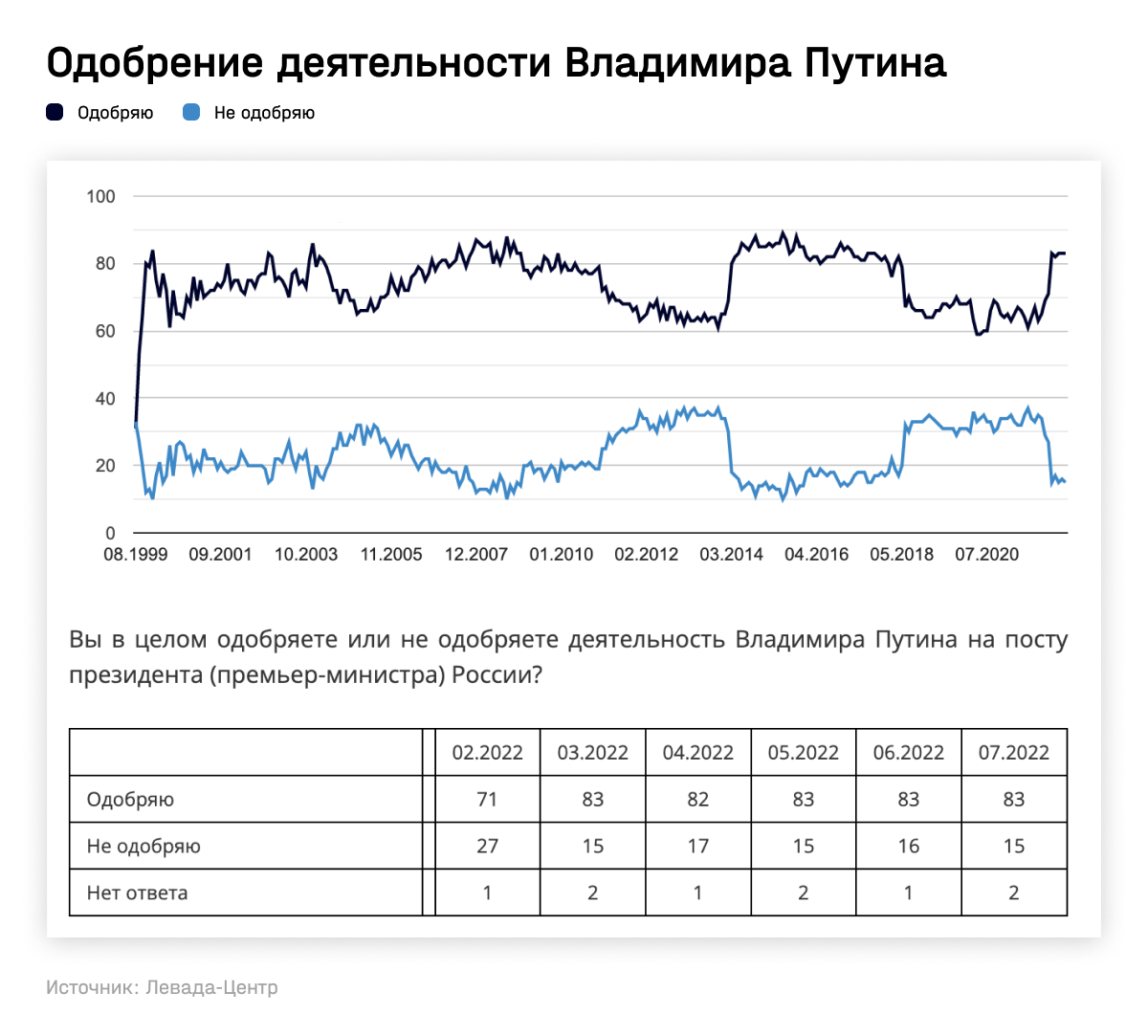
Yes, for Putin popular support is apparently an important resource. And they try to support him at the height. It is difficult not to suspect that Putin or his advisers believed that a small victorious war would positively affect the ranking. Military operations in Georgia and the accession of Crimea raised Putin’s rating to marginal values of 88% in 2008 and 2014. And now his rating jumped from 65% in December 2020 to 83% already in March (in July this figure also amounted to 83%. - The Bell).
But Yeltsin, for example, ruled the country without having such ratings at the end of his reign. And he waged war, by the way, in the territory of his country and contrary to the will of public opinion. But he was replaced not by the popular will, but by the decisions of some tops.
Six months of the war
The war has been going on for six months - and it has its own price. The Bell talked with experts in different areas about how she affected various areas of our life and in society itself, and how much more could last. Read all the interviews of this cycle here .
"N inhabitant image - a refrigerator against the TV - does not work in modern Russia "
Your colleague Lev Gudkov in an interview with Medusanoted that since May the Russians began to fall interest in what was happening in Ukraine. Especially among young people who less support the war. Why is this happening? Are people tired of the war?
If you understand fatigue from special operation as dissatisfaction, when people begin to demand that military operations stop, there is no such thing. Or not yet.
People just turn away from her. Such quite elementary mechanisms of rationing, routinization are triggered-so far this is just news from somewhere, and not the events of personal life or close people.
This is my explanation of what is happening with the mood of the young. In such an absenteeism, escapism, you can see the desire to open with reality. There are many grounds for this position. Among other things, this eliminates a person from a sense of responsibility or shame, from severe experiences that his country is doing something that he considers unacceptable, morally reprehensible and so on.
As I said, many are amazed to note that while the special operation is going on, in Moscow, and in other cities everything as if nothing special was happening.
It was also expected that if the sanctions begin to be introduced, this may affect the support level.
If this was expected by those who introduced them, then this is their big mistake, because the majority - we measured this in cases of sanctions after Crimea and the downed Boeing - reply that in response to the sanctions we should not change our policy.
- Firstly, sanctions do not affect the economy sharply. For example, in recent years [the slowdown of growth] it was so smooth that it allowed the psychological and economic adaptation of the bulk of people.
- Secondly, moods are born as a reaction, they say that we do not care, or even to benefit, we will live on everything. Talking about the fact that import substitution has now begun or began, the people are supported with approval.
In addition, a simple calculation is that with a deterioration in the economic situation, the support of the authorities will decrease, it is incorrect. Such a connection is not required. Here is the famous image - a refrigerator against TV - does not work in modern Russia. The economic situation of people has become worse, they themselves report this themselves, but they do not reduce their support for the special operation, the approval of Putin.
People do not know how they will live in Autarkia mode in the isolation of [Russian economy], but they think that everything will be fine. People do not say: let's [do so] that the sanctions are lifted, then everything will be fine. No, on the contrary, they are ready to live in some new world in isolation-but let Russia be great, one with which all the great powers are considered, etc.
On the other hand, you record in surveys that the basic needs of people are to make life better, so that social problems are solved. And people sincerely do not want to pay for the war. How does all this combine in installations?
This is generally a simple matter. Both in public opinion and in the individual consciousness two ideals may well coexist, and one compensates for the other. So the mass consciousness works in general - both historically in Russia and in other countries.
It seems that, at least in public opinion, Putin's legitimacy is largely built on contrasting with the “hungry” 1990s. Can a decline in living standing a decrease in the support of the regime support?
My opinion and opinion of my colleagues is Putin’s authority, his significance as a leader for Russians is completely connected with this. He is not about welfare. He in the eyes of the population is not at all responsible for internal economic processes, but is responsible for the glory of Russia in the international arena. For the growth of economic indicators in the zero, no one said thanks to him. А за присоединение Крыма кто только Путина не хвалил в самых разных формах.
В массовое сознание очень глубоко внедрили мысль, что в 1990-е после развала СССР Россия была унижена. Оскорбительно было даже то, что нам оказывали помощь. А потом мы стали «вставать с колен», активизировались во внешней политике, нас боятся и, значит, уважают — вот это связывают с деятельностью Путина.
Вообще, рейтинг одобрения Путина на уровне не ниже 60% сохраняется больше 20 лет. [Такой высокий рейтинг у лидера страны на протяжении столь длительного времени] — это то, чего не видела мировая социология в странах с недеспотическим режимом (а он не был деспотическим в РФ).
В какой вообще плоскости лежат события, которые могут лишить действующую власть поддержки?
Мне кажется, что руководители более всего опасаются, что на поддержке режима очень резко скажется военное поражение. Может быть, они правы. Но россияне обо всем узнают из телевизора. Представить, что кто-то в телевизоре появится и скажет, что мы потерпели поражение, не приходится.
Вы много говорите о том, что российское общество следует за элитами. Но в сравнительно недалеком прошлом, в 1991 году, этот же народ вышел в защиту демократии. Что произошло с этим народом?
Самое главное: то, что люди ожидали, не состоялось. Идея демократии оказалась скомпрометированной. И ликвидацию большинства ее институтов, возведенных в 90-е, люди допустили спокойно. Только самые грубые нарушения вроде массовой фальсификации результатов голосования вызвали относительно массовые протесты.
И, как известно, власти ответили на эти протесты радикальным усилением репрессивной системы. Все сделано для того, чтобы протест был не делом масс, а делом героических одиночек. Но все, в том числе и те, кто планирует и осуществляет репрессии, знают, что есть предел, за которым они перестают гасить протест, а напротив, начинают его разжигать. Фокус в том, что где лежит этот предел, никто не знает.
Но, опять же, моя главная мысль: в российской политической массовой культуре — не элитарной — имеются основания для поддержки демократии, пусть и не в той ее форме, в какой ее ждали в прошлом веке. Я не сторонник идеи, что русские — это народ, который никого, кроме царя, не признает, что ему всегда необходима сильная рука и так далее. Not always.
Есть еще чиновники-технократы, значительная часть которых, как кажется, не поддерживает войну, считает, что она обесценивает годы их работы, но тем не менее остается на своих местах в силу тех или иных причин (в том числе объясняя это соображениями общественного блага). Может ли на что-то повлиять скрытое недовольство в этой части общества?
Я не берусь оценивать в количественных параметрах: при всей очень большой важности этой части населения она статистически не очень многочисленная. Поэтому в наших больших опросах вес ее мнений не очень велик.
Качественные методы (интервью и фокус-группы) показывают, что в этой среде, которая включает профессионалов в широком смысле (в области IT, финансов и т.д.), произошел основной раскол. В ней все-таки гораздо более проработанные профессиональные взгляды, есть люди, которые действительно думают, что прахом пошло очень многое.
Но при этом есть достаточно сильная имперская, скажем так, партия. Все более распространенной становилась оценка, что Россия, оказывается, безнадежно отстает от мира в развитии. Для российского сознания это нестерпимо — Россия должна быть великой. И в том, чтобы [попытаться резко поменять ход истории] люди видели больше шансов [для страны] — может быть, нерационально, но эмоционально.
Я не знаю, как распределились мнения в этой группе, но они имеют явно сравнимый вес.
А к чему такой раскол может привести?
Часть тех, кто не согласен, уедет. Но я не знаю, каким образом будет развиваться страна в ближайшие годы. Если будет сценарий чрезвычайного положения, военной экономики, это будет способствовать утечке мозгов и тому подобным феноменам. Может, возникнут обстоятельства, при которых таких людей насильственно куда-то увезут. Но логика репрессий такова, что они раскручиваются, постепенно захватывая все более широкие слои, включая и тех, кто все это начал. Потом это остановится, но общество потерпит гигантский урон.
Согласны ли вы с вашим коллегой, Львом Гудковым, что процессы деградации России как страны и общества идут с очень большим ускорением?
В редких случаях война, если она не освободительная, очищает, облагораживает нацию и так далее. Она тяжело сказывается на моральном состоянии общества, не говоря о том, что она калечит души людей, которые на ней побывали.
То, что произошло, будет исключительно трудно лечить, потому что здесь, так сказать, в глубоком тылу, где никто ни с кем вроде бы не воюет, люди мобилизуют в себе те чувства, которые они бы сами в другой ситуации благородными не назвали.
Путин заявлял о «самоочищении общества» от «пятой колонны». Насколько люди захвачены идеей поиска внутренних врагов?
Пока еще не очень. Но дело в том, что иногда в ситуациях, когда общество очень сильно чем-то обеспокоено, напугано и так далее, начинается поиск чужих, виноватых, кого-то, кого в этот момент сочтут именно внутренним врагом. Это может начаться спонтанно, но гораздо более вероятно, что это будет запущено властью на локальном или федеральном уровне.
Пока что власти к этому инструменту [на массовом уровне] не прибегают, потому что когда этот процесс начинается, то он, как я сказал, может уже входить в режим самопожирания, и те, кто репрессировал, окажутся репрессируемыми. Это показала, к примеру, наша история 1930-х годов.
Есть ли какой-то значимый конфликт на уровне поколений? Верно ли говорить, что уровень поддержки войны растет по мере старения респондентов?
Если мы говорим о результатах опросов, то это, бесспорно, так. Самая высокая поддержка спецоперации — среди самых пожилых, 65 лет и старше. Но надо понимать, что это всего-навсего ответы на вопрос интервьюера. Это не есть никакое реальное социальное действие: они не идут ни приветствовать, ни, напротив, протестовать. Многие живут в основном в мире слов, которые они сначала слышат или видят в телевизоре и т.д. А какова будет поддержка, если сказать: теперь выходите [на улицы] или давайте деньги — все будет совсем по-другому.
Что касается молодых людей, то среди них уровень поддержки ниже. Но лишь в некоторых не очень многочисленных группах неподдерживающие — в большинстве.
То есть я правильно понимаю, что социология не может спрогнозировать, что произойдет дальше? Опять же, в начале 1990-х защищать Белый дом тоже выходили десятки тысяч человек.
Yes. Мировая социология не смогла предсказать самые главные события XX века. Именно с предсказательной точки зрения наши возможности слабы.
Вот я в этом цехе так или иначе состою с 1960-х. Я несколько раз предсказывал, к примеру, какое-то ультрастабильное будущее. Потом в течение нескольких месяцев вдруг система рушилась. Оказывается, что подспудно существовало какое-то внутреннее несогласие, которое я не увидел и которое теперь вырвалось наружу.
Так уже было
Быстрое и почти бескровное падение коммунистических режимов в Восточной Европе в конце 1980-х, изменившее ход мировой истории, стало неожиданным практически для всех, отмечал профессор Университета Дьюка Тимур Куран, изучающий, в том числе, социальные изменения.
Куран объясняет это через феномен фальсификации предпочтений — смещение публичных предпочтений в сторону социально одобряемых.
Неожиданная смена власти чаще всего происходит в странах с репрессивными режимами, которые держатся на всеобщем страхе, поскольку их подлинная легитимность невелика, отмечал Куран. Масштабы фальсификации предпочтений в таких странах можно определить с помощью специальных методик, а возможности соцопросов ограниченны.
Конкретно сейчас на протяжении пяти месяцев, с марта по июль, основные показатели общественного состояния — отношение к властям, к военной операции и т.д. — замерли. Казалось бы, сколько всего произошло, сколько людей погибло. Почему российское общественное мнение замерло? Это шок, ужас от происходящего, оцепенение или это все-таки надежда на триумф, с ожидания которого власть начинала эту историю? Я не берусь поставить такой диагноз.
Последний вопрос: у вас есть какие-нибудь хорошие новости для нас?
[Долгая пауза]. Если искать, чему порадоваться, можно отметить: мы не видим взлета шовинизма, антиукраинских настроений в России. Благо, в общем, пропаганда настраивает все-таки не против украинцев, а против «нацистов/фашистов». И в этом смысле на русском народе именно этого греха нет пока.