
Translated material
There are no liberal empires
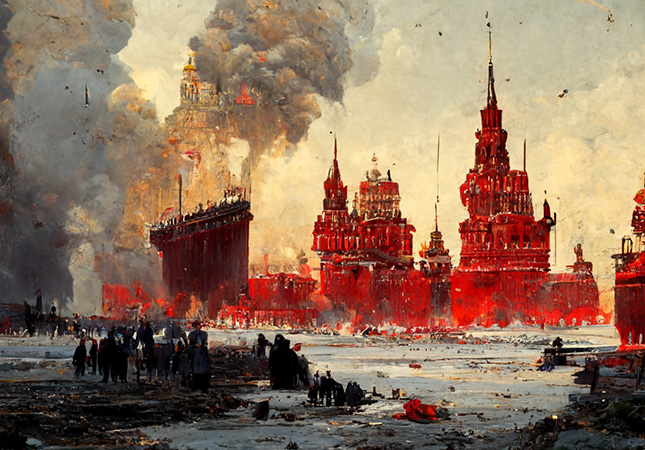
The expression "liberal empire" into the Russian political vocabulary, as you know, was introduced by Anatoly Chubais back in 2003. He was then a prominent representative of the Russian establishment - the chairman of the board of the RAO UES of Russia and the co -chair of the Union of Right Forces. Probably, Chubais felt the inconsistency sentiments of the new President Putin and decided to synthesize them with liberalism in his own understanding.
The Doctrine of the Liberal Empire, designed for 30-50 years, was waved to create a single economic space of Russia, Ukraine, Belarus and Kazakhstan. At the same time, Moscow considered itself the leader of the "liberalization" of post -Soviet countries - in other words, she wanted to maintain the status of imperial metropolis, only in a different ideological appearance.
However, over the incomplete 20 years of the existence of this doctrine, its imperial component completely defeated the liberal. About the same thing happened in the communist era, and Chubais can even be likened to Trotsky, who became superfluous in the "New Russia" built by him, which turned simply into a totalitarian empire, where all sorts of ideological adjectives are secondary.
Chubais left a month after the start of the "special operation" - like Trotsky, first to Turkey. But then in Italy it overtook it with an ice ax, but a fairly rare paralyzing giyen -barre syndrome - fortunately, not lethal. Well, the liquidation means of high -ranking fugitives in the empire were clearly modernized.
On August 31, numerous exiles will gather in Vilnius for the Congress of Free Russia - the event is much larger than the forums of free Russia performed before. After February 24, many of those whom the situation had completely satisfied left Russia. It can be assumed that they will sharply criticize the Kremlin’s imperial policy, but the paradox is that the main speakers of the Vilnius forums are offered to solve this problem by replacing the “bad” king in the “good” in the same Kremlin. That is, they actually want to preserve the imperial model, only in a more "liberal" form.
It is strange that the organizers did not invite Anatoly Chubais to their Congress, although some of them were also government officials and even his one -partyists. They probably consider his figure too toxic for Russians, and themselves - "popular opposition". Alas, they will have to disappoint them - in reality for residents of different regions of Russia, they are on one person, since all their political thinking is based on Moscow centralism , which does not imply any equal interregional agreements.
If Chubais proposed to include several countries of the post -Soviet space in the "liberal empire", then participants in the Vilnius meetings are limited to Russia. Indeed, talking about Ukraine as part of the empire today would somehow not be comme il faut. However, with geographically more modest ambitions, the basic imperial worldview does not change - the Moscow political emigration still continues to look at events from the standpoint of the Metropolis, believing that the "provinces" should obey it unquestioningly, and they will not survive without it at all.
In this regard, the figure of Dmitry Nekrasov, a former employee of the President of Medvedev, then an oppositionist who moved to Cyprus, is quite characteristic. He is a regular participant in the forums of free Russia. In a long Facebook post and comments on it, Nekrasov formulates the doctrine of the Liberal Empire most frankly: “In most of the regions, nothing is useful and never will be. It will never be to blame for this, but the background of the regions and their unnecessary to the world economy. They are doomed to degradation and handouts.”
In a word, only we, "qualified" (as he defines himself) Moscow officials, can be controlled with this wild space, otherwise it will come to complete desolation. What is the difference between this "opposition" point of view from the Kremlin is absolutely incomprehensible. However, these figures for some reason are sure that their return to power will change something.
Nekrasov believes most of the regions "hopelessly subsidized", although this subsidiary is often completely artificial. For example, why does Karelia contrast sharply in terms of living standards with Finland, although there is also no oil and gas in a neighboring country? Yes, because all the large Karelian enterprises (including the Kostomukoksh GOK built by the Finns back in the 1970s) today belong to the "federal holdings", which are exporting raw materials from the republic, without paying a penny of taxes to its budget. A typical colonial situation characteristic of many Russian regions. But for figures from the Metropolis, this is in order of things. After all, if the regions begin to dispose of their resources themselves, they, what good, will require political freedoms, and then goodbye, empire!
Participants in the Vilnius Congress consider the main current task to end the war in Ukraine. But how many of them understand that while the empire exists, it will inevitably wage war - both against its "provinces", and against the neighbors, which she also wants to turn into "provinces". And if we talk about the projects of the "Europeanization" of Russia, then first of all we must recall that in Europe no empires for a long time, the EU is an agreement of equal states.
Therefore, it would be logical if the European guests of the Congress (and among them are the ex-president of Estonia and the current Euro-deputies) would raise the question not only about liberalization, but also about the decentralization of Russian policy, its new, contractual format. Federalist or confederalist - this will already decide the new, freely elected authorities of the regions themselves. Otherwise, even if liberals come to the post -Putin Kremlin, but its centralism will remain, the imperial track will simply reach a new historical circle.