
Translated material
What to vote here
All problems of electronic voting in Russia
The head of the CEC Ella Pamfilova recently asked members of the election commission: “I call you all: please continue my dear colleagues, to conduct an educational program among Dag-nigiists.” As a member of various election commission with the right of advisory vote (PSG) over the past ten years, I cannot but follow this exhortation of Ella Aleksandrovna: on the eve of a single voting day, I explain what happened with remote electronic voting (DEG).
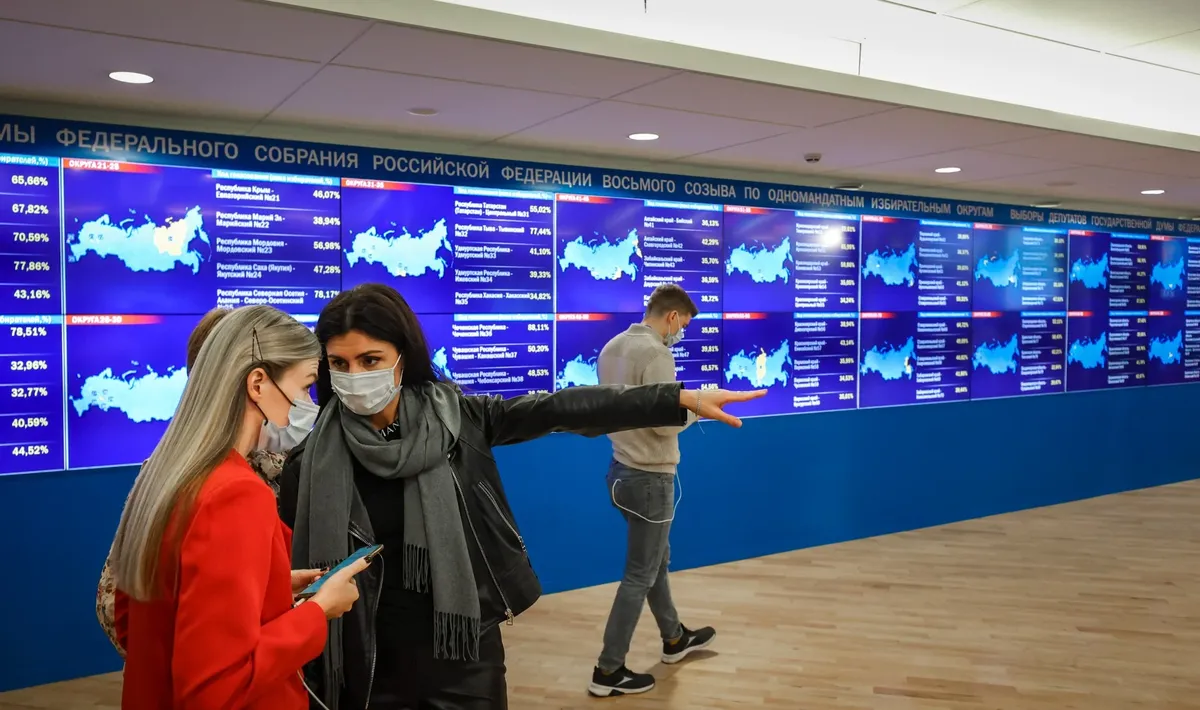
Some believe that against the backdrop of what is happening, all our passions in the elections , from which there are not even horns and hooves, but horns and hooves, all sophisticated electoral analysis and elegant mathematical fishing of digital scammers by the hand - meaningless self -love of expert competencies. That in a burning house they do not paint the ceiling.
This is wrong. Continuing the metaphor, the house so quickly and powerfully caught fire, including from the fact that the ceiling was painted with something wrong. We saw that even two and a half deputy in the late State Duma of the VI convocation, who opposed the violation of the international legal obligations of Russia in 2014, created hellish headache for the Kremlin and did not allow the approval of Russian aggression unanimous. That a dozen municipal deputies this year caused Batthart of such a level that the system snapped a stars for Alexei Gorinov . What candidates for municipal deputies are cut off during the current campaign with falsified cases of “discrediting” and other no less crazy reasons for distant approaches, preventing even the election of the election of the election.
Based on the results of the voting in the elections, at least eight opposition candidates won the current State Duma (calculations can be viewed in an expert report for the “liberal mission” ), which lost votes exclusively at the expense of DEG. Of these, at least four are occupied by an anti -war position. Therefore, if not for theft for DEG, the current Duma would be no less opposition than the VI Duma.
Therefore, even in the current hell it is important to “collect receipts” and carefully record all the successful and failed attempts to deceive, as well as attempts to justify the fraud.
What awaits us
Why can we say now that electronic voting in this September retains the vulnerability of last year's DEG and, possibly, is enriched with new ones?
Firstly, due to the adopted so-called “Vyatkina-Lamykin law”, to which the basic rules for the implementation of DEG were enshrined at the level of the FZ-67 Law “On Basic Guarantees of Electoral Rights and the Right to Participate in a Referendum”. We analyzed in detail the review of the bill published on the “liberal mission”, those holes that were left by this law in online voting. Last year, the violations that the Russian “New Gazeta” wrote about was a ban on access to the DEG servers for observers, the presence of a “secret blockchain”, the contents of which we had to take on faith from the words of the City Hall, the lack of publication of the full code of DEGs, the difference between the launched DEG code that was published, with great bless, can be published, with a lot of goodness, it If we take the role of the devil’s lawyer, it would be considered a “bugs”, the mistakes of the performer.
What changes have occurred in response to large -scale last year's DEG exposure?
The normative regulation of DEG is delegated, that is, it remains the subject of the discretion of the CEC or the election of the subject of the Federation. At the same time, the partition is prohibited (FZ-67, Article 64.1, part 18) is perhaps the only one of the short stories related to the potential reduction in the room for possible falsifications. The legislatively does not provide mechanisms for control over the equipment and launched DEG software.
The law also does not provide for control by observers for identifying voters and for the correctness of the recording of their will in the database.
“Not provided” is a very powerful tool in Russian public law regulation.
These controls are in relation to the usual “paper” vote. The observer is still entitled (part 9 of Article 30 of the FZ-67), for example, observe the issuance of ballots and get acquainted with the voter lists, that is, it can check the legitimacy of issuing the ballot. And in DEG he actually cannot do this. Now the DEG is “as it were equipped” (in fact-no) at the level of the federal law. Therefore, a meticulous observer for DEG may require (at least on the basis of analogy of the law) to grant him the same rights as a “paper” observer. However, due to the absence of the same “regulation objects” in the DEG (a physical voting box made on paper of voters), the law enforcer will easily refuse (as it was in 2021), since the law “does not provide” the same rights of the observer in relation to electromagnetic waves, electrons in wires and magnetic domains on hard drives.
Another important novel is the complete liquidation of the Institute of members of the precinct election commissions with an advisory vote (PSG). It exposes ordinary areas and DEG sections. Only observers remain, for many years significantly limited in rights in terms of access to the documents of the election commission. Therefore, if theoretically PSG could demand the source code and the full log of the programs, then for observers such a right cannot be seen in the current FZ-67, even interpreting it very liberally.
... in the old way
Secondly, there is every reason not to trust DEG due to a specific reaction of the electoral authorities to expert assessments and attempts by specialists to understand this situation. New Gazeta wrote about mockery unsubscribes that the Moscow editorial office received in response to requests with proposals to reveal the details of the system. Since November last year, the so -called “Group of Public Audit DAG”, led by the chairman of the Voice Movement, Grigory Melkonets, functioned.

It included, in particular, the authors of investigations of falsifications in the 2021 elections published in Novaya Gazeta, and other IT and electoral specialists. This group directed requests, we give only one example:
“According to the DEG source code published on the GITHUB website, the following subsystems were used for elections, the source code of which was not published on the site:
“Register of voting participants”, also referred to in the source code as MDM. This system is responsible for the issuance of identifiers of the postponed voter decision (Groupid), therefore it is significant for the election.
“Army of the Chairman”, in the course of voting, providing information to members of the election commission on personal data of voters registered for DEG, in particular, information on the number of appeals to the ballot, according to the “Expanded Solution” mechanism.
Service of interaction with blockchain. The component of the interaction service with the blockchain records transactions in the blockchain. In the published source code of the transaction for the record in the blockchain, the Rabbit MQ messages are recorded, the code of which directly records data to the Dit-Blockchain-Source and Dit-Blockchain-Private-Source components.
The service that mixes and group transactions with voters with votes for recording in the blockchain.
Service for summing up the results. Counting votes and messaging between blockchains and encryption service ENCRYPTEDGROUPID.
Observation portal. The site Observer.mos.ru during the elections showed information about the turnout, and also provided unloading the SQL database of blockchain transactions.
We ask you to publish the data code of the DEG system components.
Publish a description of the authorization service of voters for access to the DEG portal. Publish a description of the methods of REST API of this service.
In the previously published source code there are no examples of services configurations, which greatly complicates the analysis of the system and the reproduction of its work. We ask you to publish configuration files of these systems, namely the contents of Config folders and ENV php files Form (Ballot, Form, Encryptor).
We ask you to publish changes in the software code of the DEG system, which were made after a test vote on July 30, 2021.
We ask you to explain in what way the members of the PEC DEG and the observers on the PEC DEG may make sure that the published source code corresponded to the executable.
Please provide the composition of the Moscow DEG system system and documentation for it. ”
Despite all these requests, the source code was never presented for analysis in its entirety.
On the same occasion, the following remark of the candidate of technical sciences, an employee of the MVTU named after Bauman Viktor Tolstoguzov:
“It should not be hoped that the publication of the code itself will finally make the system of the verified. But we don’t even know what the system consists of. This was also a question in Dit and MGIK, but there was no answer.
The source code is one of the small components of a huge system. But there is also a functioning environment, which is a certain omnipotent patron for the source code and which is much larger (can be evaluated by bytes), and it has its own inputs and exits. The functioning environment and its administrators can, for example, can quietly launch another code, even for one nanosecond. They can connect another wire, another screen, another keyboard.
The functioning of the source code externally looks like an opaque silicon pebble with invisible electrons and holes inside. And no one has yet proposed an objective method of verification that the code that has declared in the pebble works in the pebble. ”
Recall that in the codes of the 2021 elections, work with voter lists was brought into a separate system. Roughly speaking, this system also checked that a person does not vote several times. And in particular, there are no source codes in public access.
We also recall that there is no history of changes in the code of 2021 - what edits of whom were made; If you want to deal with last year's falsifications, such a story, as it were, helped.
In addition, the system of the system would be very helped for a full analysis (remembering, however, that their very presence does not yet prove the correctness of the system, since the composition of the system is unknown to us). So, we must recall that in the previous elections, the site Observer.mos.ru was first disconnected, then the results appeared with a strong delay.
It is still unknown which operations had to do the operators to turn off the so -called Observer Observation Portal, after which the votes could be launched. All this remained behind the closed doors of the Department of Information Technology (DIT) of the Moscow City Hall.
And any traces that would help restore the picture of the events of that night were not provided. At one of the meetings of the expert group, Artem Kostyko carefully said that the logic system is not the documentation of the commission, and accordingly, they are not required to store them. Apparently, hinting that they gently rubbed all this.
Member of the Group of Public Audit DEG, author of investigations in Novaya Gazeta, programmer Peter Zhivin also notes:
“I checked on my own“ stand ”, which I can experimentally fake the election. I asked on the portal to launch my utilities that would allow:
Figure out how the system works.
Deanonymize voters.
Falling the voting results.
The request to launch my own code was denied. It was argued precisely by the fact that the “closed circuit” was certified by authorized bodies, and therefore amendments to the “closed contour” - crime. ”
The “closed circuit”, by the way, is that “legalized” amendments to the FZ-67; In legal language it sounds like this: “...
The implementation of the requirements for the protection of the information contained in state information systems established by the federal executive body in the field of security and the federal executive body authorized in the field of countering technical intelligence and technical protection of information ”(part 19 of Article 64.1 of the Federal Law-67).
Therefore, apparently, all that remains for us is the traffic light system , advertised Kostruk: a green light is burning - DEG works normally. And you do not need to know the details.
In the order of anecdot, we note that Russian citizens who are abroad will not be able to vote: as follows from the message in the TG channel Oleg Artamonov, according to the Ministry of Construction, access from foreign IP addresses will be blocked. The naive advice is to buy VPN in advance with the Russian IP address. However, experience suggests that Russian state-owned services such as public services, even with such VPN, often do not open from abroad. Therefore, a more realistic advice is to agree with his relative or friend in Russia to vote for you, and then change the password.
Mathematician and Goliath
Recently, a teacher at Moscow State University Mathematician Mikhail Lobanov is one of the candidates who would now be a deputy of the State Duma, if not for DEG, filed a complaint with the ECHR. The complaint was submitted to the Russian authorities of Article 3 of Protocol No. 1 to the Convention on the Protection of Human Rights and Fundamental Freedoms, which reads: “... the parties undertake to hold free elections with reasonable frequency by secret vote in such conditions that would ensure free will of the people when choosing the legislative branches”. Lobanov went through all the stages of domestic appeal until the supervisory appeal to the Presidium of the Supreme Court of Russia and was expected everywhere, was refused everywhere. Lobanov also filed a complaint with the Constitutional Court. From the point of view of Lobanov, the “experimental” nature of the legal norms of the DEG does not correspond to the principle of legal certainty; Lobanov sees arbitrariness from the CEC in the regulation of DEG, which violates the principle of the rule of law; The withdrawal of voting from accessible without the application of special knowledge of public control deprives the election of their public law and does not allow legitiming the national parliament, which does not correspond to the republican nature of the board in Russia; The creation of “megaucities” with hundreds of thousands of voters contradicts the principle of accountability and transparency; in voting without visual identification of the voter by members of the commission, Lobanov sees the possibility of disclosing the secrets of voting; The counting of votes by employees of the Moscow City Hall is incompatible with the prohibition of executive intervention in the election. However, the complaint in the Constitutional Court is not considered an effective way to protect the right from the point of view of the ECHR, and therefore Lobanov did not wait for a decision on it. The basis of the complaint in the ECHR is that the Russian authorities did nothing for the effective proceeding of violations in the DEG, which he complained about.
And this is exactly the same thing that a group of experts led by Melkonian fired about for several months.
What the CEC did not say about
Thirdly, neither in the new federal law, nor in the CEC acts, there is not a word about those “as if so-technical” innovations that will actually be more important than the discussed legislative novels.
As it gradually becomes clear from the public statements of one of the officials responsible for DEG - Artem Kostyko (here in this program ), at least in Moscow there will be a radical innovation with voter lists. If earlier the paper lists of voters on the weekends were available in the form of books, the control of which was an essential part of the routine of each observer, and those who vote electronically were excluded from them, now, from the words of Artem Kostyko, there will be a single electronic list, which will include everyone. There will be an opportunity to choose an obvious manner: vote online or offline. Members of the PEC will have computers where they will put a mark that the person has already voted if he came to the voting room. If you have already voted online, then the system will not allow you to put a mark. At the same time, it remains unclear whether the unified electronic list will have priority, for example, when the data is discharged with its paper copy. What will be the legal regime of paper copies of voter lists, will they synchronize (and if so - how?) With an electronic list, will they be available to observers is unknown. It is also not clear to us how this innovation with the letter of the Law FZ-67 is also not clear.
And this, apparently, is the most significant from the technical point of view, what happened to DEG.
Visual control of the lists, verification that they are stitched, numbered, glued, sealed that they do not make unacceptable dropouts and records, and all records provided for by law are made - one of the key elements in the observer’s work. If manipulations are possible with the list, then you can not deal with urns and carousels. Now imagine: the list does not exist in the form of a physical object visible with its own eyes. His condition is not controlled by a HIK member sitting in front of you. Question: Who will you catch the hand?
But worse than that: most likely you will not let you see this list.
Последние годы на участках и обычного перелистывания «из чужих рук» бывало сложно добиться. Что же говорить о такой «персонализированной» вещи, как чужой рабочий компьютер.
Еще хуже: мы в принципе не сможем знать, как эти списки составляются, модифицируются, кем и куда информация направляется. Если раньше мы могли хотя бы в теории проследить, откуда в ТИК была направлена информация о несуществующих избирателях, кем и когда она включена в список, то теперь такой возможности не будет в принципе. Мы не будем знать, как гарантировать, что туда не будут включены лишние люди. Также еще сложнее будет фиксировать случаи несанкционированного электронного голосования от имени избирателя.
Наблюдателей — в урну!
Какое место на обычном избирательном участке самое неудачное для наблюдения за выборами?
Очевидно, внутри ящика для голосования. Сидя внутри него, вы никогда не поймете, правомерно ли выдан бюллетень, который падает на вас.
Но можно придумать и более неудачное место для наблюдения. Это кусочек кремния в компьютере, в котором бюллетени представляют собой невидимые электромагнитные волны, двигающиеся со скоростью света, и невидимые же электроны, реагирующие на изменение электромагнитного поля.
Так вот, в сентябре на ДЭГе положение наблюдателей будет хуже, чем если бы они сидели в урне или в компьютерном чипе. Если им что-то и будет доступно, то, видимо, это будет только некая «нода наблюдателя» — экран со статистическими данными о голосовании, поступающими из непрозрачного ящика, без возможности контроля достоверности данных. Достоверность данных нельзя проверить изнутри непрозрачного ящика. Тем более этого нельзя сделать, глядя на непрозрачный ящик снаружи с экрана монитора, анализируя разрешенные, а может быть, и заранее подготовленные администраторами для публикации данные, вывод которых можно легко отключить.
Те же, кто оправдывали прошлогодние фальсификации, сулят нам стопятьсот разных изводов этой «ноды», пока что все в форме «существующих технологических возможностей», без публикации принципов действия, полного исходного кода и без проведения стендовых испытаний. Однако даже при реализации амбициозных планов, даже если наблюдение было бы устроено так, что каждая новая строчка базы данных поступала бы на компьютер наблюдателя синхронно с ее внесением в базу на сервере Департамента информационных технологий, не следует забывать о том, что все эти ухищрения не меняют вашей фундаментальной позиции: вы сидите в ящике. Для вас не существуют индивидуальные избиратели, но существуют электроны — полностью неотличимые друг от друга.
Россия — не Москва
В России за исключением Москвы всё будет еще хуже. Федеральная система ДЭГ не обеспечивает расшифровку каждого отдельного голоса. Федеральная система построена на так называемом гомоморфном шифровании. Суть гомоморфного шифрования в том, что оно допускает арифметические действия (сложение или умножение) над зашифрованными величинами без их промежуточной расшифровки. Поэтому анализ, аналогичный прошлогодней серии публикаций в «Новой», на федеральном уровне как был, так и останется невозможным.
Практический вывод
Игры кремлевцев и их шестерок с дистанционным электронным голосованием никуда не делись. Наученные горьким опытом публичного осмеяния, организаторы этой вакханалии больше не продвигают повторное голосование. При этом контроль за выдачей электронных бюллетеней так и не появился. Контроль за программно-техническим комплексом тоже не появился. Немногочисленные элементы контроля, которые обеспечивались членами УИК ДЭГ с ПСГ, теперь тоже похерены в связи с тем, что похерены все ПСГ УИК, не только электронные. Видимо, мы, члены избиркомов с правом совещательного голоса, были все эти годы слишком эффективны даже со связанными руками.
Недобитым кандидатам и избирателям остается мобилизовывать себя на участие в выборах оффлайн, чтобы, во-первых, сделать привод административно мобилизованных онлайн и оффлайн слишком дорогостоящими, а во-вторых, сделать запись информации в блокчейн от несуществующих избирателей слишком заметной по повышению явки по сравнению с теми округами, где ДЭГ не применяется. Видимо, аномалия явки будет наиболее перспективным инструментом для выявления фальсификаций на сентябрьских выборах.