
Translated material
Liberation
Six and a half years of the reign of Mikhail Gorbachev became an amazing example of consistent liberalization of the totalitarian regime, when sometimes in a matter of months Soviet people gained and mastered more and more civil and human rights. The freedoms that we found under Gorbachev and lost in the 2000s,-recalled The New Times
The first thing Gorbachev did was the first person of the state was tried to restore the connection with the country.
Freedom of speech
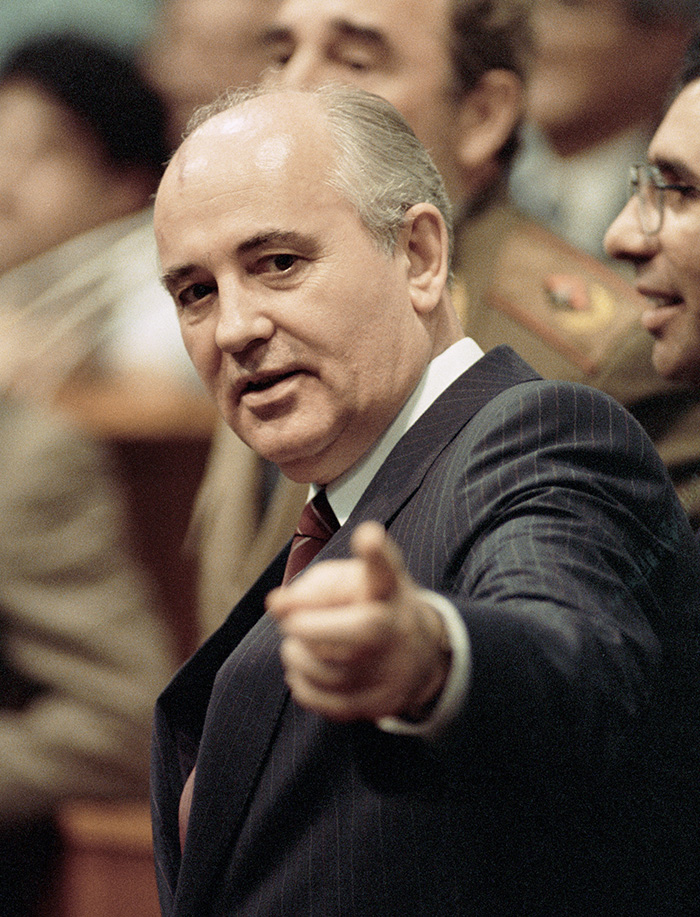
Perestroika began with publicity . This was not the freedom of speech in the meaning in which it exists in democratic societies. But in conditions of Soviet reality, publicity implied the opportunity to openly and publicly speak and write the truth. It was about the mismanagement, the arbitrariness of officials, crime or the musical underground and informal art - the conversation ultimately became political.
Rodionov, STF
At the same time, Gorbachev was the first to allow him to speak himself freely. Meetings with the people, normal coherent speech “without a piece of paper”, the rejection of the health of the health and attention to the shortcomings-it all began immediately after his election by the Secretary General in March 1985. This was a violation of the established hardware rule, when all public speeches of the responsible workers were drawn up and agreed in advance, any surprises were excluded. Now a new installation was set from the very top: the one who speaks according to the written is probably lying and cannot be taken seriously. According to the historian Giuseppe Boff, the flow of letters to Gorbachev from ordinary citizens increased sharply, and the letters themselves became more frank*.
The next step is the release of the media . In the spring and summer of 1986, the chief editors of the magazines "Spark", "New World" and "Banner" were replaced, the romance of Genghisa Aitmatov "Plah" was published. Then, on the “First Channel”, KVN was restored, associated in those years with the civil satire of the 1960s. In 1987, on TV on the air appeared the program of Vladimir Molchanov “before and after midnight”, and then the famous “look”. The rating of the Perestroika Pet of Perestroika, which was published immediately after the “Time” program, was 64%after 1987. Soon on the Leningrad Canal, the slaughter “600 seconds” started, where, together with Alexander Nevzorov (then a democrat), the future star of the liberal Russian television Svetlana Sorokina debuted.
On June 12, 1990, the Union Law “On Press and other media” was adopted, the first article of which proclaimed the freedom of print and the ban on censorship (on the fact of the abolition of political censorship, spontaneously began earlier, in 1988-1989). The first independent publications and publishers appeared.
In 1990, the newspaper Arguments and Facts fell into the Guinness Book of Records for the largest circulation in history-33.5 million copies with an audience of about 100 million readers. The circulation of one of the New World numbers amounted to more than 2.6 million on Pushkinskaya Square in Moscow, where the editorial office of the Moscow News newspaper was located, people came to read a fresh room at the stand and immediately discuss it. The publicity reached its climax when the direct broadcasts of the meetings of the congresses of people's deputies began.
Civil rights
The first signal of future political changes - the fact that Gorbachev does not just change the old Brezhnev personnel to younger functionaries, but that he is ready to listen to society and take into account his opinion, was the Decree of the Central Committee of August 14, 1986 on the termination of work on the transfer of Siberian rivers . For the first time, a wide public protest achieved the goal - this is how hope arose for the peaceful evolution of the political regime towards democracy.
At the end of the same year , academician Sakharov returned from the Gorky link to Moscow . This was the beginning of the release of political prisoners and the abolition of criminal prosecution for dissent .
The XIX party conference officially proclaimed the beginning of political reform , the purpose of which was the gradual transfer of all power to the Soviets. The main tool for democratic reform is free elections on an alternative basis . And if in 1987, in the elections to local councils, two or more candidates were nominated only in 4% of the districts, then in the election of people's deputies of the USSR, on March 26, 1989, the elections were unknoted in 399 districts of one and a half thousand. At the 1st Congress of People's Deputies , the first opposition parliamentary interregional deputy group in the USSR appeared in the USSR .
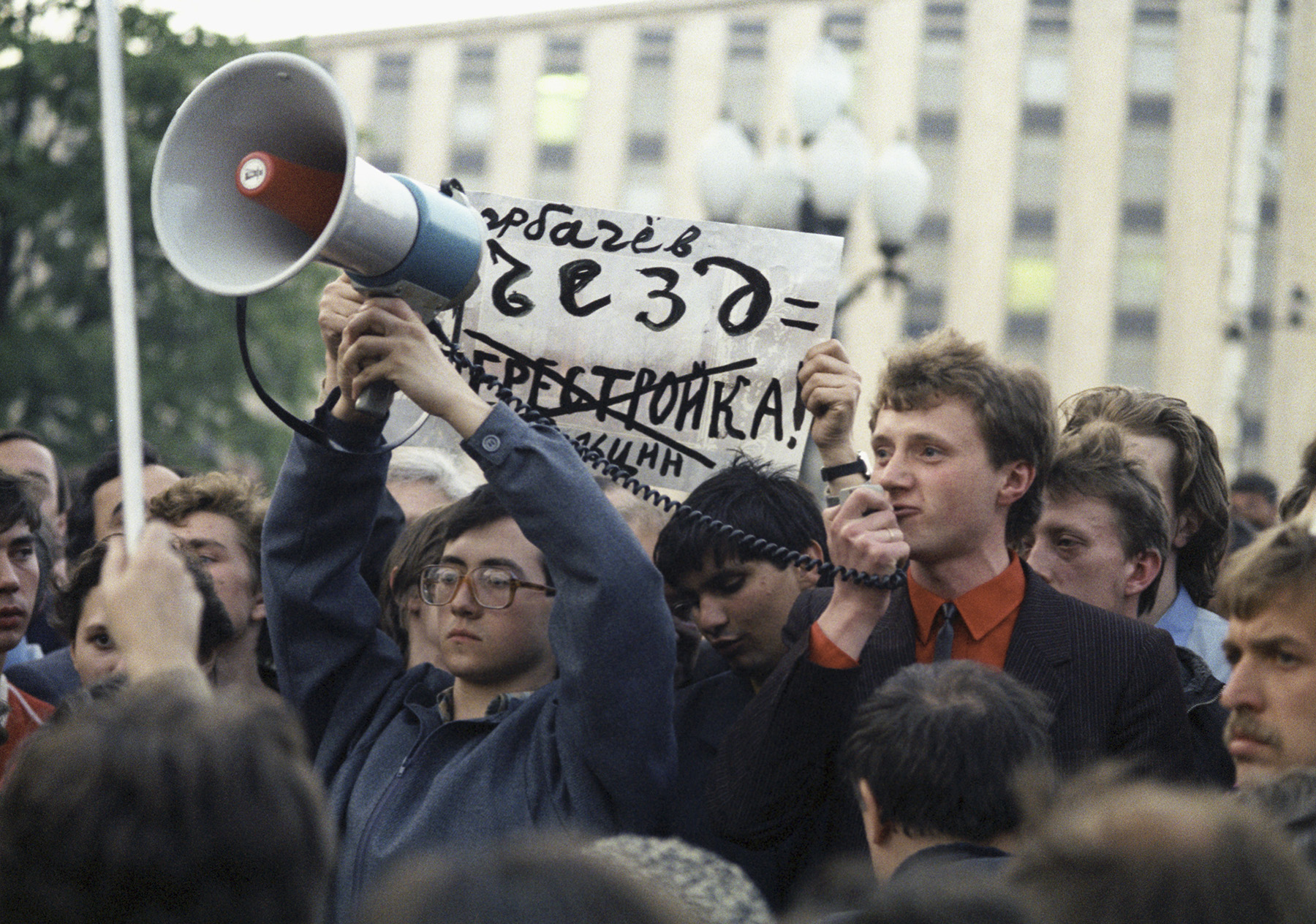
A rally on the first day of the congress of people's deputies of the USSR. The rallies law will be adopted later,
Moscow, May 25, 1989 Photo: RIA Novosti / Alexander Lyskin
III (extraordinary) Congress of People's Deputies of the USSR in March 1990 canceled the 6th article of the Constitution on the leading and guiding role of the CPSU .
The first steps to the multi -party system were taken two years before. In May 1988, the first congress of the non-parliamentary opposition party “Democratic Union” took place. In February 1988, the organization of independent trade unions began, and in July 1989, mining strikes were held throughout the country for the first time. At first, the authorities dispersed the unauthorized street shares of the informals (as they called the disagreements then), but in July 1988 the Supreme Council adopted the Law on rallies and demonstrations - in August in Sverdlovsk one of the first permitted rallies was held. There will still be a tragedy with the bloody suppression of the demonstration in Tbilisi (April 1989), but very soon the opposition rallies with dozens and hundreds of thousands of participants will become part of perestroika everyday life. The most massive democratic rally took place on February 4, 1990, when up to half a million people came to Manezhnaya Square.
In October 1990, the Law on Public Associations was adopted, in fact, legalizing the multi-party system .
Liberation of the economy
“The state of our economy does not satisfy anyone. Its two central, built -in, so to speak, a defect - a manufacturer’s monopoly in conditions of universal deficit and disinteresting enterprises ... ”said Nikolai Shmelev in his famous article“ Advance and Debts ”**. Against the backdrop of an intensified lack of elementary products and goods, it was increasingly talked about how to use a private initiative for the benefit of the economy. As a positive example, the experience of the NEP of the 20s was given when socialist principles coexisted with markets for some time. Very soon, a private trader turned from an enemy into an ally, who was supposed to help to saturate the market as soon as possible with goods. In November 1986, for the first time in decades , an individual labor activity appeared in the USSR. From now on, the state allowed and even encouraged the production of goods and the provision of services, if hired work was not used (the latter was considered unprofitable income). For wider production in February 1987, the activities of cooperatives in the field of catering, household services and production of consumer goods were allowed (finally the law on cooperation was adopted on May 26, 1988 ). Soon cooperatives began to appear in the field of IT, in design. Non -governmental banks came out of the cooperatives, the first of which with the inconsistent name “Patent” appeared in August 1988 in Leningrad. Joint enterprises with foreign firms began to be created. Everything changed with such speed that sometimes a logical sequence of actions was even violated. The walking of foreign currency in the USSR was actually allowed only in April 1991, and the first currency auction in Moscow took place one and a half years earlier, in November 1989.
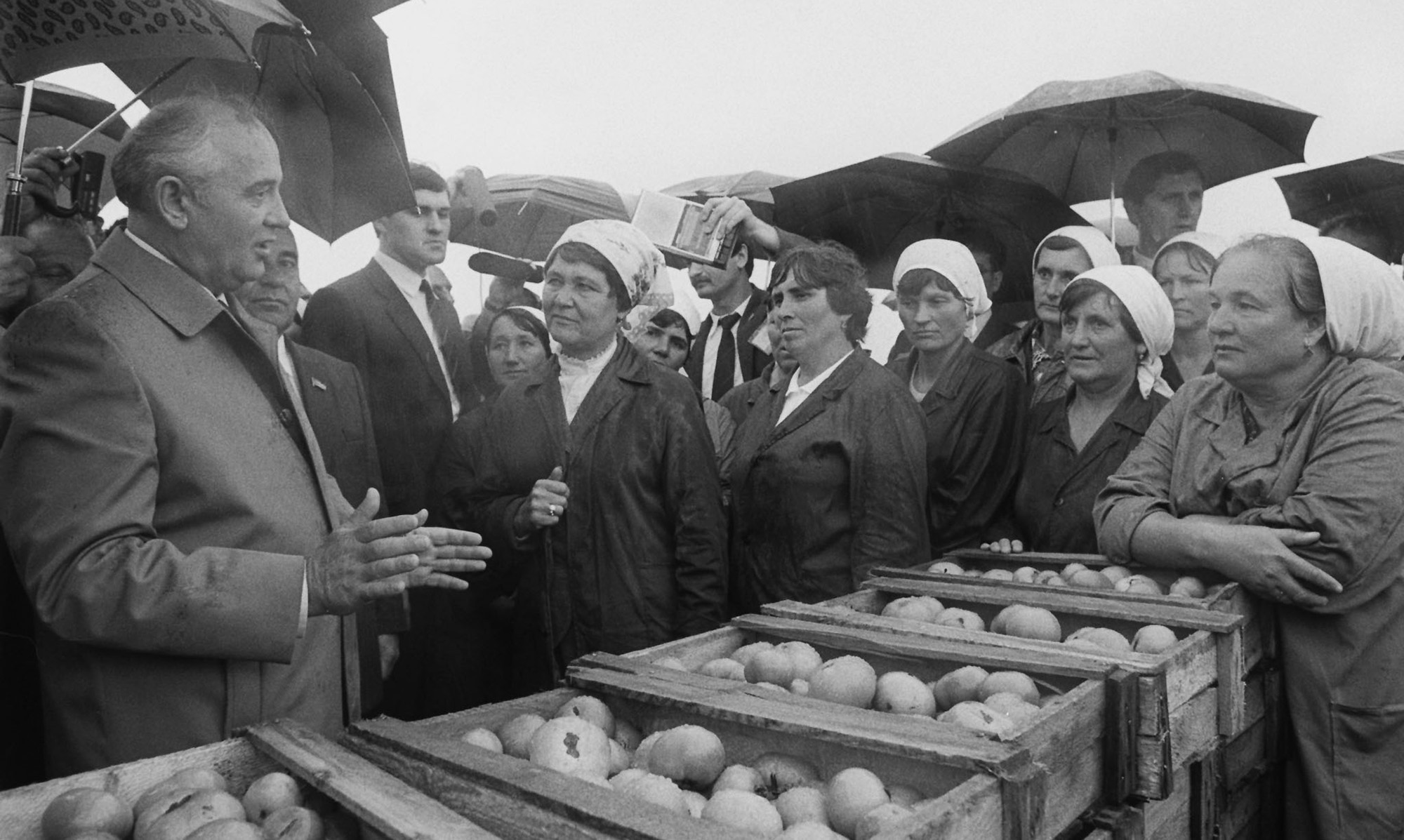
Gorbachev traveled a lot around the country and met people. Khabarovsk Territory, state farm "Rologechensky", 1986 photo: ITAR-TASS
Personal freedoms
The private life of people has changed radically. Publishers did not have time to print new and new volumes of previously prohibited literature: Akhmatova, Babel, Bulgakov, Bunin, Mandelstam, Pasternak, Platonov, Solzhenitsyn, Tsvetaeva, Shalamov. Restrictions on religious life were lifted - Fr. Alexander Men. The law “On the Freedom of Conscience and Religious Associations”, adopted in October 1990, has legislatively guaranteed the freedom of religion in the USSR.
In 1989, restrictions on emigration from the USSR were significantly weakened , due to which hundreds of thousands of people took advantage of the right to repatriation and reunification of families.
Under Gorbachev, party and other organs intervened less and how people live, what they wear, what kind of music they listen to, with whom they sleep, whether they wear a cross or Magenovid. The acquisition of freedom largely depended on the initiative from below : in one school they could choose the director and cancel the form, and the Komsomol meetings under the portrait of Lenin were still going through the road. But the trend was unequivocal - towards more and more freedom, against inertness and dogmatism.
“There is no other ... this seeming simple, but the conclusion that suffered by our society is the need for revolutionary transformations every day acquires more and more convinced supporters,” the editors of the perestroika journalistic collection *** claimed. “Another is always given,” the Theodore Shanin objected more and more often the British sociologist attended Russia. The experience of subsequent decades, alas, makes us make sure the last one.
* Boff J. from the USSR to Russia. The story of an unfinished crisis. 1964-1994. M., 1996
** "New World" No. 6, 1987
*** Yu. Afanasyev, T. Zaslavskaya, A. Sakharov, D. Furman and others. M., 1988