
Translated material
Our man in Mukden
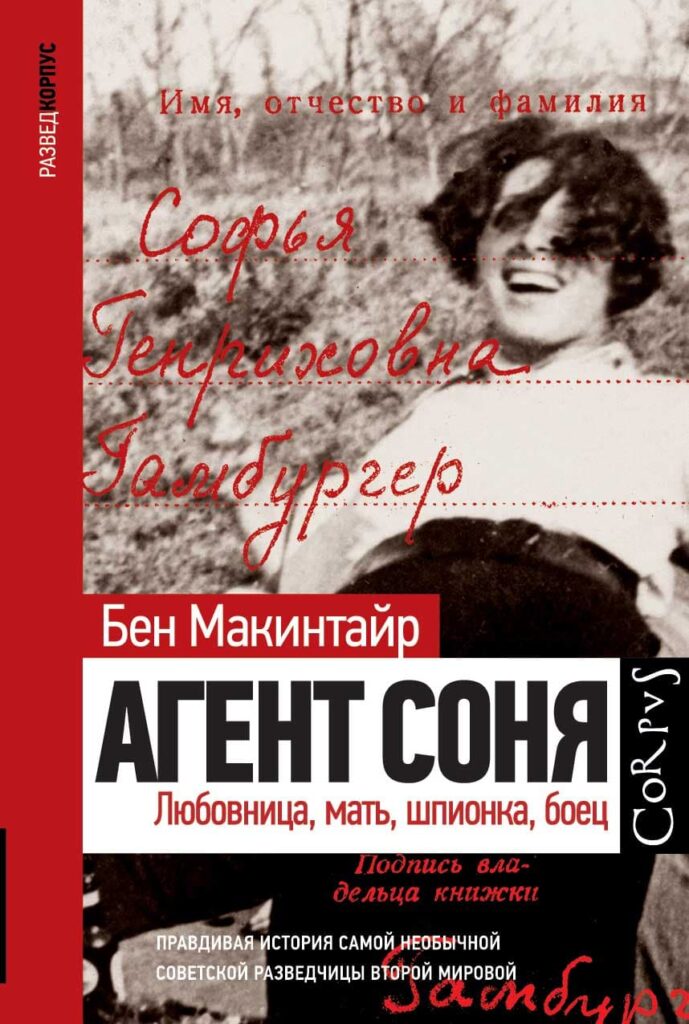
Fragment of Ben Mcyntai's book "Agent Sonya"
Ursula Kuchinski was born in Berlin in a wealthy Jewish family, in 1926 she joined the Communist Party of Germany, after which she married architect Rudolf Hamburger and left with him in Shanghai. There, in the fall of 1930, Richard Sorge recruited it, and since then Ursula began to work for Soviet intelligence. The documentary book by Ben Mcyntay “Agent Sonya” describes in detail her life. We publish a fragment, which refers to the arrival of Ursula and her comrade in the agent work of Johan Patra, a former sailor from Klaipeda, to Mukden. Manchuria in 1934 was already under the Japanese occupation, and they had to make contact with local Chinese partisans.Starting from February 24, 2022, we were all in the face of the advancing barbarism, violence and lies. In this situation, it is extremely important to preserve at least the remnants of culture and support the values of humanism - including for the sake of the future of Russia. Therefore, the editorial office of Gorky will continue to talk about books, reminding our readers that the world remains in the world and fiction.
Ben Mcyntair. Agent Sonya. Mistress, mother, spy, fighter. M.: Corpus, 2022. Translation from the English Polina Zhernovskaya. Content
 The whole long road to Mukden Misha sat between Ursula and Johan, chatting incessantly, while the train rushed past soy fields and tiny villages. The radio -tubs were hidden in rolled socks at the very bottom of the suitcase. Johan tried to take Ursul by the hand:
- This stupid trifle in Shanghai should not ruin everything. It doesn't matter ... Well, become fun again, as before.
Ursula did not answer. “I did not see the point of accusing him that we are completely different and he is not able to understand how deeply he wounded me.”
On the border, the Japanese border guards watched all the suitcases, dumping all their contents on the platform. Johan prudently put the radio lamps between the seats of the coupe.
Mukden, an old city surrounded by fortress walls, was a reduced and more modest copy of Shanghai: the labyrinth of narrow streets and low brick houses interspersed with impressive municipal buildings. A large, shabby city spilled outside the fortress walls. Foreigners lived in their own enclave. Expatriants here were in a more distress, the income was significantly lower, because the competition for foreigners was made up of the rolled Japanese. A colorful international rabble flocked to Mukden: adventurers, small rogues, tramps who tried to flee from their past or looking for a new future. The next wife, who escaped from an unhappy marriage to her lover, did not cause much curiosity. The city was flooded with opium merchants, criminals and prostitutes. “Johan will have a lot of chances to replenish his photo collection,” Ursula thought sarcastically.
In the Yamato Hotel, the couple unpacked things, specially leaving in sight for the spies their business cards "Reinmetal" and "Evans and Co.". On that day, Johan went to look for a cache for radio components. Ursula left one suitcase unspented, wrapping the castle with a thin thread. When they returned from dinner, the thread disappeared. The issue was visited in the room. "At the hotel we did not talk about anything significant." The waiters caught every word of them.
Initially, it was stipulated that the connection with the partisans, the most dangerous part of the upcoming task, will fall on the shoulders of Ursula. General Berzin was categorical: Patra "should not be subjected to the most serious risk." As the youngest by rank in their team, Ursul was to take risky tasks for themselves. The first contact was planned 400 miles north of Mukden, in Harbin. Johan suddenly stated that he would go there instead of her. She asked why he decided to change the strategy agreed?
- Well, you can not stand it, you are a woman and mother.
“And this was already known for a long time,” she retorted Kolko. “I'll take Misha with me.”
“Will you drag a small child on such a long road and leave him one for several hours in the hotel?” This is not discussed. If you go, I will stay with Misha.
Johan memorized the child’s daily routine: how much it is necessary to feed him, what to change clothes, how much to give spoons of fish oil. “You can’t worry about Misha,” he said. “Just return to the whole and unharmed.”
Ursula did not like Harbin, the largest city of Manchuria, which became a shelter for thousands of white emigrants who fled from the revolution. Of course, they deservedly became victims of historical events, but, brought to extreme poverty, forced to steal, become ricksham and prostitutes, they represented a miserable sight. “Many asked for alms at the intersections,” wrote Ursula. “Of all the cities I have known to me, Harbin was the most gloomy.”
In accordance with the instructions of Ursul, I was supposed to meet with a partisan named Lee in a cemetery in a remote area of the city, an hour after sunset. She was always afraid of the dark. “It oppressed me, because in our work a lot happens at night.” We passed by, staggering and singing songs, two drunkards. One man stared at her and tried to flirt. She waited for him to utter a code word, but by his face she realized that he was not here for the sake of espionage. Having run away, she hid behind the monument. After waiting for an hour in excess of the appointed time, she was glad to return to a brightly lit hotel. The next evening, she again went to the cemetery, as agreed, but the partisan never appeared. “Why didn't he come? Suddenly he was arrested? " Definished, she sat on the train to Mukden.
At the Yamato Hotel, Johan was so carried away, feeding the boy with dinner that he did not notice how Ursula entered the dining room. “He put Misha on a chair, placing a pillow for him, so that it would be higher, carefully so that the hair on the back of the head would not get into the knot, and tied a napkin to him. I tried the soup to make sure that it was not too hot, and brought a spoon to Misha's mouth. He washed a drop from the boy’s chin and was completely absorbed in this process. ” Ursula was again imbued with tenderness.
Johan turned only when she was already behind him.
“Thank God,” he said quietly.
- Johan, what should I do with you?
She hugged him. "He squeezed me in his arms for a long time."
However, later, when she told him about the failed meeting, Johan again could not restrain his anger. “You have an amazing ability to spoil everything,” he flashed. The same could be said about him. That night they slept again in different beds.
The reserve meeting with Lee was planned in a week. This time, Johan insisted that he himself would go to Harbin. He scolding herself for this, Ursula could not control the growing anxiety when she approached - and passed - the hour of his return. “It is strange how quickly you get used to a person,” she thought. She walked back and forth around the room, unable to concentrate on the book. “What if he was arrested? Suddenly they tortured, he could not stand it and gave them a meeting place? "
At midnight, Johan finally slipped into the room. He looked exhausted. Lee never appeared.
Johan climbed under her blanket. A sense of relief caused a surge of passion, which she no longer even tried to resist.
“Everything else was good that night,” she wrote.
The alternative place of the meeting - in case the meeting in Harbin will not take place - was the city of Fusun, 30 miles to the east. Pacing his library and selling a total of five books in a juna, Ursula returned in high spirits. The partisans appeared on the agreed place for sure on time - "tall, calm, sparingly gestured by a northerner." He explained in a simple Chinese, interspersing Pijin in places and making pencil sketches for clarity, which is headed by an underground communist detachment consisting of workers, peasants, teachers, students and street merchants. “So, very good,” he repeated more than once. Lee, according to him, was "scared." The partisan who called the name of Chu said that he urgently needs explosives for the planned sabotage on the South Manchu Railway.
“Finally, we can get down to business,” Ursula thought, returning to the hotel and sewing up notes made at the meeting in the hem of the lower skirt.
There were two more significant obstacles left: they needed transformers to power the transmitter and a reliable place to install it. The Japanese tracked illegal radio broadcasts. It would be dangerous to install an antenna on the roof of the hotel and is probably impossible. Ursula went in search of a permanent point that will become their radio station.
Meanwhile, Patra went around all the radio stores of Mukden and never found suitable transformers in them. Reluctantly, he got on the train to Shanghai: he will have to buy them there and find some way to drag bulky metal products across the border. Ursula invited him to consult with Rudy, insisting that, despite the oddity of circumstances, her husband could be implicitly trusted.
Japanese officials confiscated most of the property in Mukden, but several large houses abandoned by the fled Chinese generals were empty. One of them, a luxurious villa behind a high fence, once belonging to a relative of the Manchu military leader General Zhang Suelyan, was located next door to the German club. Ursula looked in a cursory gaze, deciding that she was too luxurious, gloomy and would be beyond their means. However, in the same site, she noticed a smaller stone house shelter in a corner. The servant, giggling, said that the house was built specifically for the mistress of the owner of the villa. From the garden to the main house led an underground passage, providing a quick and invisible access to the concubine in love with the general. There was no water supply in this small house, it was heated only with a wood stove, but otherwise it was perfect: three small rooms sheathed with wooden panels on the second floor, the kitchen on the first, a huge bed for the general and his mistress and access to the underground tunnel. From the street no one could look out the windows, and the neighborhood with the German club was delivered by a kind of satisfaction: it would fight fascism right under the side of the building with a fluttering swastika. For the first time in a year, Ursula had a house, his nest: “How nice it was to put a mat on the floor, hang a picture, buy a vase.”
In Shanghai, Johan bought two heavy transformers of eight inches long: only a blind border guard could not notice them. Rudy came up with a way to get out of the situation. They bought a heavy Voltaire chair with a dense stuffing, “ugly green-brown monster”, and ordered him to deliver him to Avenue Joffra. Turning the chair in the back, Johan and Rudy pulled out nails that attached the upholstery, and attached two transformers to the inner springs with wire and ropes. Putting the stuffing material in place, they returned the upholstery to the place. "Nothing was striking, and the weight of the chair did not attract excess attention." The chair was sent to Mukden in a cargo car. Rudy, probably, still did not know about the novel that flared up between his wife and her boss; And if he knew, he was too well brought up to arrange scenes. Ursula’s husband and her lover coped with the first joint task, combining spy skills with competence in the field of upholstered furniture.
When Johan returned to Mukden, Ursula showed him a new house.
“Perhaps the bedroom should be here, in front,” he said. - Near Mishina, and in the third room there may be a living room with a transformer ... Why are you looking at me like that?
She frowned.
- I did not know that you decided that we would settle together.
- I believed that now everything is very clear between us. Everyone knows that you are with me.
Ursula was determined. Joint accommodation was not included in her plans.
- I will rejoice at every minute spent together, and this will be most of our time, and day and night.
“So why not all the time?”
“Because I have a different rhythm of life, and you demand that I completely adapt to yours.” Sometimes I need to stay alone.
Ursula began to fall in love with Johan for his caring tenderness, love for Misha and revolutionary zeal. But he could flare up, loved to command, was an old -fashioned chauvinist who admitted that “men should have more opportunities than women,” and considered her independence to insult his dignity.
Dissatisfied Johan occupied a free room from one German merchant. Ursula was convinced that she was right, insisting on a separate house; As often happens with offensive and inclined to command men, the ego patra required skillful and neat treatment. “Gradually, I coped with his resentment. I openly showed love for him, sometimes wondering how humble, supple and patient I can be in all work matters. But it is unlikely that I could cope with this, if I had my own time. ”
The ugly green chair arrived in Mukden on time. Having inserted him into the house and turning it on his back, Ursula and Johan “with horror” saw that one of the transformers was barely covered with upholstery: the wire was torn from shaking on the train, and the sharp edge was perforating the fabric. He kept only thanks to a battered rope. “One or two unnecessary movements-and the transformer would have fallen, alerting even the most incompetent Japanese-railway worker.”
Johan began to collect the transmitter - Hartley with three switching scales. He was an experienced technician with agile fingers, endless patience and phenomenal ability to concentrate. "He never looked at his watch, never took a break." Finally, the transmitter was assembled: a bulky homemade monstrous machine with a heavy rectifier and transformers, large radio lamps and coils made of thick copper wire wrapped around empty beer bottles. The radio components were stored at the bottom of an old campford wood chest under the false regiment made by Johan, on which the folded blankets lay. This cache could not stand a thorough inspection, but the equipment was hidden from the curious eyes of the servants. Under the lid of Ursula laid a feather. So she can find out if someone opens a chest. The last task was to place the Fuchs antenna on the roof: the outside observer would not find “no differences from the antenna” for a conventional radio, but if someone saw how they mount it, this could attract unnecessary attention. I had to engage in installation at night. And Ursula asked Johan to provide it to her.
After waiting for Misha to fall asleep, Ursula got out onto the roof through the attic window, taking with her two bamboo sticks and a backpack with a rope and a hoe wire for the antenna. She tied the first stick to one pipe, passing the wire through it, like through a bamboo needle. Having passed the ridge of the roof with a second bamboo with a wire missed in the same way, Ursula tied it to the opposite pipe, securely fixing the end around its base. “Hence the blurry contours of the tops of trees and roofs were barely visible.” Having lost balance for a moment, she "leaned on a pipe, which inspired confidence in her solid look." But then she made a mistake, "looking down into the endless gloomy darkness." Suddenly, fear defeated her. “Trush,” she reported herself. - A miserable coward. Why on earth should it fall, continuous fantasies. ” Then Mishin was heard crying. “Usually the boy slept tightly. Now he shouted heartily. "
Having made his way back on the roof, she threw the backpack into the attic window and ducked after. The cry of the child probably woke up the neighbors. Misha, sobbing, sat in bed. “I have soda in my fingers,” he sobbed. The boy leaving his hand. “Another argument against children with professional revolutionaries,” Ursula thought depressedly, but could not resist laughter. She rubbed a little Mishina pen and stroked his head until he calmed down.
After that, she returned to the roof.
By the next evening, the receiver could be tested. According to a preliminary agreement, they could go on the air only at night, at different times and only at one of two coordinated frequencies, establishing a connection with the host of the Red Army in Vladivostok under the code name Visbaden. Ursula was sitting at the table, Johan connected the batteries, and she nervously tapped a brief encrypted message. A few moments later, confirmation was received, a timid signal on the ABC Morse from distant Russia, from the center. "We smiled joyfully at each other."
The messages of Ursula were caught not only by the Red Army. In the afternoon and night, Japanese spions flew in the sky, trying to detect radio waves: if the two cars were simultaneously detected by the signal, they could determine the location of the radio. In this situation, the Japanese secret police could soon come, and Ursula's days would be numbered.