
Translated material
"I do not believe in historical doom"
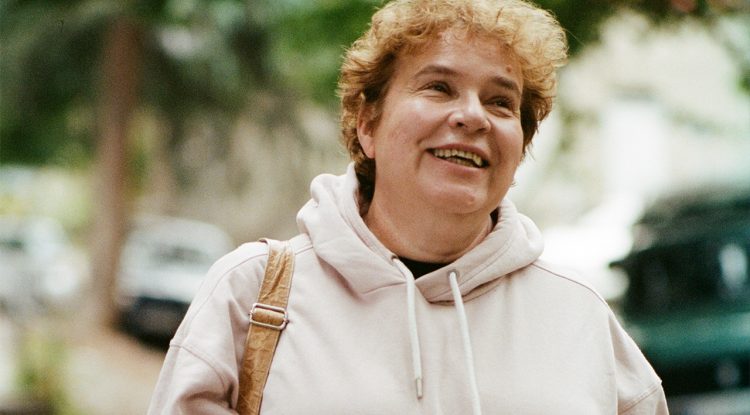
Historian Tamara Eidelman - about the dictatorship in Russia and Ukrainian democracy
Tamara Eidelman is a historian and teacher, author of books and lectures on propaganda and dictators of the 20th century. The editor-in-chief of Kholoda Taisiya Bekbulatova talked with her about modern Russia-how the country went to tightening the regime, why democracy has settled in historically close Ukraine and whether the Putin regime with the USSR of the 1930s or fascist Germany could be compared.
This is an abbreviated version of the conversation. About the colonial heritage of Russia, the reconstruction of empires, propaganda and modern history lessons-watch in the video interview with Tamara Eidelman on the YouTube channel "Cold".
About Russia and the USSR of the 1930s
You emigrated from Russia, although you said that you never wanted to leave. At the same time, you were born, raised and taught in the USSR. It turns out that the current mode is worse for you?
- Oddly enough, but in many ways it is worse today than in the USSR, where I lived in the last decade, in a “lazy” regime. Of course, everything was clamped, no freedom of speech, Afghanistan. But before you, sorry for the jargon, they did not dug up every minute. Sometimes everyone was lazily portrayed something, and then life went on and walked, and everyone, in general, did not give a damn about what was happening. And today is not so. Today this desire to mobilize the public is much stronger, and just sitting in your small niche is very difficult.
You said that you would compare the current regime with the 1930s ...
-No, no, I would not compare. I don’t really like the idea of comparing different periods at all. Such a terrible mass terror, when people stand at the window at night and wait for whether they will come to them, as it seems to me, now. And most importantly, the situations are always different.
Firstly, in the 1930s people had one historical experience, today-another. We know how it happened in the 1930s, and we know much more. Secondly, there is the Internet, and relations between people are different, openness is different. In the 1930s, a man sat at home, came after him, and he disappeared-everything. I'm not saying that no one knew what was happening in another city. And today there is a connection between people, there is an opportunity - albeit small, and let it clamp it - the opportunity to provide support. There is an opportunity to express your opinion.
Silence and apathy that Russia fell into - is this the standard stage of development of the dictatorship?
- No. The tougher the dictatorship, the more she calls on people to speak out only in her favor: go to rallies, vote. There are not very democratic regimes as in Latin America. Everything is disgusting there, there is no freedom, but you are sitting at yourself, you do not stick out - and okay. In Stalin's times, if you did not run into the forest, like the Lykov family , it was impossible to sit out: at work you should be at meetings, go to demonstrations. If you are not going, it’s already difficult.
The dictatorship, of course, wants everyone to sit quietly and not intervene in the situation. But, on the other hand, as the regime is tightened, she will more and more demand the participation of everyone. As Peter Verkhovensky said in the novel "Demons", to fasten everyone with blood - this is important.
About Russian dictatorship and Ukrainian democracy
Is the Putin regime a dictatorship?
- Certainly.
How did she become possible?
- Of course, now they like to say that Russia was doomed. I don't believe it. I do not believe in historical doom that emerges from the roots. I see two reasons. The first is that lustration was not carried out. The same secret services remained, the KGB renamed the FSB. And if there are the same people left? They quiet down for a while, and then crawled out again.
And the second reason is my generation. We just started with the fact that I lived when no one seriously perceived the ideology, but we participated in these games: you sit at the Komsomol meeting and read the book, then they offer to vote for something-and everything, you go home. This was perceived as an annoying loss of time. The history of the CPSU was passed at the university - and went on. Double standards for us did not seem terrible for us, but we are not doing anything wrong. Why did many foremen of perestroika become thieves? There was no superchiness before that, which means that you can continue to develop like that. Therefore, I have hope for a new generation - for those who are not healed, like us.
Russia and Ukraine have long been one country. Why does some manage to build democracy, albeit with their flaws, while others do not?
- Now they are very fond of resting on the fact that Ukraine has a different historical heritage. At first, South and Northern Rus' seem to develop in one channel, and then in the south Daniil Galitsky tries to resist the horde, and in the north Alexander Nevsky goes to agreement. The southern lands go to Lithuania, where there is more freedoms, where you do not have to pay tribute, where the cities of liberties. This is all true and important. But I do not believe that the events of the 600-year ago all decide for us. There were also periods of liberties in Russia, there were people who defended freedom. There was Novgorod, zemstvo institutions, a jury and much more interesting. And in Ukraine, too, everything was not perfect. Therefore, we can say that some traditions are favorable, and some are not, but still the question, it seems to me, is, first of all, what the last two generations did or did not do. In Ukraine, there were many people oriented to the West, another position of the church. All the time I recall how during the Maidan Mikhailovsky Zlatoverhiy Cathedral opened its gates for the protesters.
Still, you say: "There were many people." But they take from somewhere?
-Yes, but I do not believe that they are taking up the fact that once the Cossacks on the island of Khortitsa felt independent. The Don Cossacks also felt wow what independent. Perhaps the fact is that the national idea associated with liberation, as in Ukraine, is quite mobilizing and unites everyone. And in Russia, the national idea turns out only: "We will close everyone, we will crush everyone, and you obey us." This is completely different.
Alexei Antystovich promoted the idea that real Russia is Ukraine. And you need not to renounce this, but to say that Russia is the perverted development of Rus'. From the point of view of a historian, is this a correct approach?
- This was not Armovich invented. Many historians think so. This comes from an outstanding historian and politician Mikhail Grushevsky. In general, when he wrote about the most ancient times - even before the appearance of the state, he used the word “Ukrainians”. For him, this is one world, and the Russian world is completely different. It is clear to me that the difference between southern and northern Russia even in antiquity was very great. If we are talking about the first centuries of Kievan Rus, there is a difference in language. For example, the Novgorod language and the language of Kyiv glades were distinguished.
About Russian colonialism
Is it possible to say that in Russia there were metropolis and colonies?
- Certainly. It is no coincidence that in the USSR, when they wrote about the development of the North, about Siberia, it was extremely not recommended to use the word “colonization”. Although colonization is just the settlement of [territories], it sounds not good. We do not have a colony, the colony is somewhere with the vile imperialists. Indeed, Russia's relations with annexed lands developed differently. They were really exploited, they were terribly treated. I also catch myself on the fact that in my youth I did not notice this: I do not despise, I do not oppress. When I taught history, I never liked what we were talking about the Russian, Russian, Moscow state. Even about the history of Tver or Novgorod - already [much less]. And even more so about parts of the empire - we mention them when we conquer them. All.
On the propaganda and post-truth of Putin
Why did Russian society turn out to be so susceptible to propaganda?
- Propaganda, based on hatred, works better than based on bright feelings. It contributes to mobilization more: "Enemies go to us." In Brezhnev’s time, of course, everything was false, but we were always talking about the friendship of the peoples, about how everyone lives freely - this is positive propaganda. It would never have occurred to anyone to say that in some republic-the Nazis, that the Ukrainian people are Russian.
How do you evaluate Putin's quasi -stroke performances that preceded the war?
-Well, Vladimir Vladimirovich does not know the story, he showed this, when his boyfriend was corrected (on September 1, 2021, Putin, speaking to schoolchildren, said that Peter I waged a seven-year war with the Swedish king Charles XII. In fact, it was a northern war.-approx. “Cold”) . He is a man who served in Germany - cannot distinguish a seven -year war from the northern one. It seems to me that this is invented by his environment, which applies to him the ideas of the Russian world, the greatness of the Russian people, the older brother of other peoples. And they act slyly. This is a post-truth: they take some real facts, and then they reduce everything: “It was so!”
Why is America for Putin the worst enemy?
- And I'm not sure that America is the worst enemy. It seems to me that this is Georgia and Ukraine. America puts propaganda as the worst enemy. This country is not loved at all, because no one loves rich and strong. It is necessary to form the image of the enemy, and the Americans are great: they are so large, strong, they climb everywhere, you can hang everything on them. But the one you consider to be your own and who does not obey you is even worse. From the point of view of Putin, Georgia and Ukraine (as well as everyone else, they just haven’t reached them yet) - his subordinates, who do not think so. It seems to me that these are the main enemies.
History remembers dictators who calmly retired?
- I know in the world history of one person - the ancient Roman dictator Sulla. For several years, he ruled Rome, poured everything with blood, created proprietary lists (a list of persons outlawed. For the issuance or murder of these people, a reward was assigned. - Approx. "Cold") , and then left. And in the last years of his life, he spent a lot of time with actors and musicians.
About democratization from the outside
You said that you approved the invasion of the Americans in Iraq when it only happened. If you imagine that the Americans invaded Russia and overthrew Putin, would you be happy?
- No. Because I see - Irak did not work. Of course, Saddam was terrible, but the Americans released the forces even more terrible. I think that we would not work either. Moreover, I do not want someone to invade Russia. I want Russia to come up with something itself.
Democracy is impossible, like water in a bucket, to transfer and leave?
- It is possible, but this is only the beginning of a long process. Denazification in Germany, in the late 1940s, and, probably, it was necessary, but it turned out to be very bureaucratic, corrupt-and little has changed inside. And real changes occurred only somewhere by the 1960s. But this impulse was probably needed.
Zelensky said that the Russians who left due to the war should return to Russia and defeat Putin. There are examples in history when a peaceful protesting people without weapons overthrew such regimes?
- When I was preparing for a lecture on civil disobedience, I read an interesting American study . Its author analyzed the manifestations of peaceful protest in the twentieth century. There were a huge number of them. They included hunger strikes, boycotts, pickets, protests, and came to the conclusion that peaceful protests win in about 53% of cases, and armed - in 26%.
But at the same time, the researchers calculated several conditions under which, from their point of view, a peaceful protest wins rather. And this is an unpleasant conclusion for Russians and Belarusians. Firstly, he wins quickly. Secondly, there should be the transition of elites to the side of the protesters, primarily security forces. Thirdly, you need support for the international community. Here are three factors in which a peaceful transition of power occurs. And something I do not see any, nor the other, nor the third, unfortunately.
If people who fled from the USSR basically sympathize, then those who escaped from Putin Russia are more likely to cause irritation. The most negative rhetoric is now the Baltic countries. Can this be explained historically?
- Certainly. The Baltic countries have a lot of complaints about Russia after they were captured, annexed after the deportations of the peoples. This is a blow to the being of the people. But I am sorry that they very much interpret the idea of collective responsibility in the forehead, that they do not distinguish people and the state. They practically play the hand. Students of the University of Tartu, who will be forced to return to Russia, will go to the army because they do not have a delay. And did Estonia achieve this?
About school education and history lessons
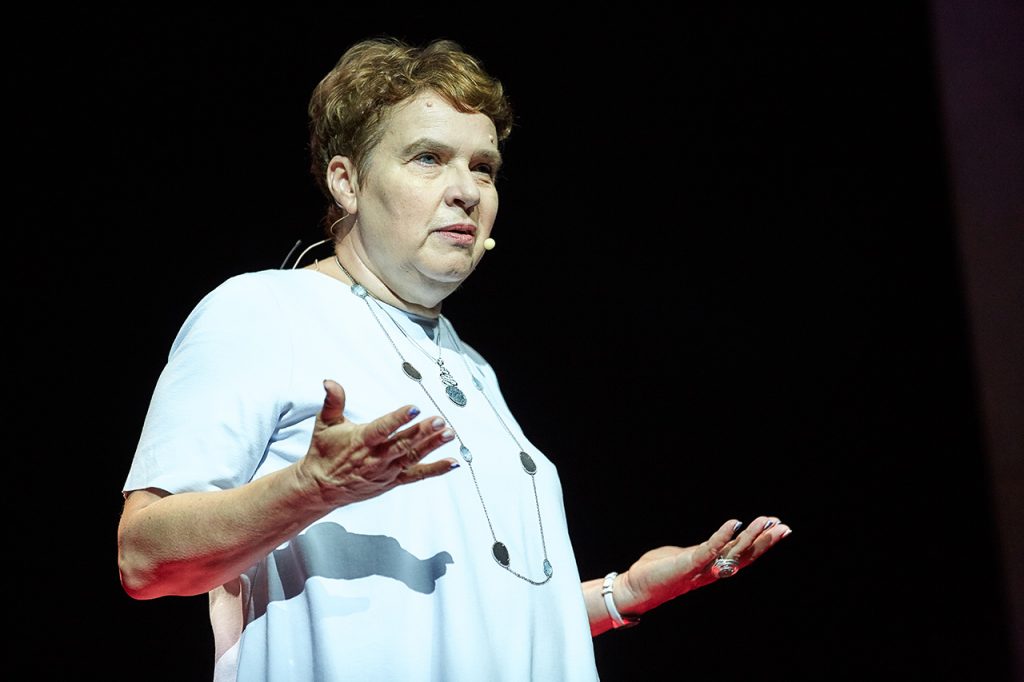
You found very different periods, being a teacher: first a dying dictatorship, then freedom, then again the dictatorship. How did the situation in schools change all this time?
- I started working in 1982. At this time, you just told the children in the lesson that Stalin was a killer - and shock: your class! What they told us! Then I saw a great interest in history in the late 1980s, but now I understand: the turbulenter the changes in the country, the more people feel in history, and it becomes more interesting for them. In the late 1980s, there was a strange situation when everyone came to the lesson and discussed the program “View” or “Results”. Then the 1990s came: everyone taught what they wanted, and it was completely impossible to bring everyone into a normal state. And then slowly began to calm down, and there was less and less interest in history: we live and live.
But the educational bosses, who sat quietly in the 1990s, have not gone anywhere. In the 2000s, they got out, adapting to new circumstances, but remained the same. I recall how in 2010 the district methodologist sent everyone a letter from his husband’s address: “Bring flash drives with reports to Lobachevsky Street.” That is, she does not even know that the report can be sent on the Internet. Now these people are in rapture are fake activity: contests, reports, hold a patriotic event.
Do you consider teachers and doctors a support for the regime?
- No. What kind of collective responsibility is this? I want to hope that I was not a support for the regime, and many of my colleagues too. And there are people who own business who support this regime. This is a simplification. When they say that teachers are falsifying the results of voting, I, as an observer in the elections, can say that usually in the election commission the main falsifiers are the chairman and secretary. They are very rarely teachers. Teachers are included in the commission, because it should be representatives of the institution where the elections are held, and this is very often schools. Usually, some workovik, a physical culture was sent to the commission, so that he would sit there-and that’s it. And these aunts - chairmen and secretary - are usually people from the council.
What would you advise parents who are afraid of propaganda in schools?
- Honestly talk with your children. The more the independence of thinking is developed, the less a person lends itself to propaganda. That is, to develop the independence of thinking in their children, realizing how this can lead to trouble.