
Translated material
The flags of our bosses
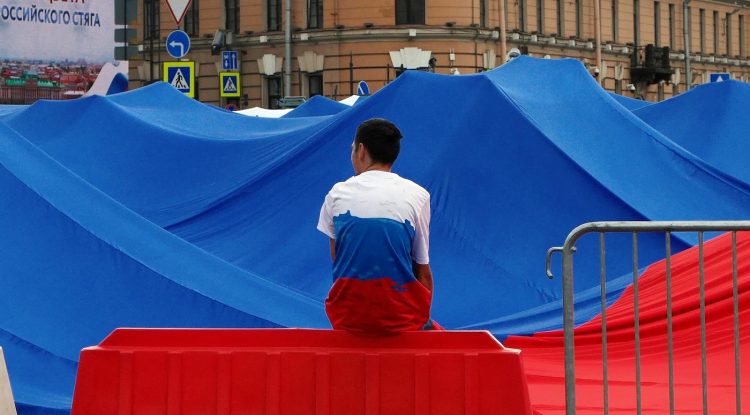
Ivan Davydov - what to do with state symbols if the state does not like
Since September 1, in Russian schools, every Monday is performing a hymn and raised a tricolor. At the same time, new state symbols appear that split the public opinion: the anti-war white-blue-white flag or militaristic z and V. In his weekly column on the “cold” the poet and publicist Ivan Davydov wonders what is more important: sign or signed.
In the country - the season of love for state symbols. In schools, they are now executing the anthem and raised the flag (well, at least they should). True, it turned out that not all schools have flagpoles, but this is not scary: there will probably be a good thing for the right thing.
This is on the country's scale, but at the local level a flash of passion is felt: deputies of the Legislative Assembly of St. Petersburg, for example, are going to instill respect for the city dwellers with a special law for the city flag, a boat on the spire of the Admiralty and the Copper Horseman.
By the way, there was a time when ordinary Russians were forbidden to use the state flag, if we are not talking about "the delivery of military honors to the deceased and other particularly agreed cases." Not so long ago it was and only in 2008 ended .
I don’t want to immerse myself in the dark abysses of history, and there was no need: before, it happened, the Columnists lacked them out, and in almost any edition every year on August 22 (this is an official holiday - the day of the State Flag of Russia) came an article telling where our tricolor came from: about the Orel ship built under Alexei Mikhailovich, about Peter Alekseevich, about Boris Nikolayevich, about Boris Nikolayevich, Putch, about other glorious events. I myself wrote such articles, perhaps, a couple.
In general, you will find, if it is interesting, so far some sites have not yet been blocked in the Russian Federation, but this is what it is worth noting: during the romantic period when the union has not yet collapsed, but the contours of future independent republics have already begun to appear on the map, the future leaders of the future country had to be from the union, firstly, as much as possible, and secondly, to emphasize the unobvious relationship with history, with Russia, with Russia, with Russia Which we lost ”(there was such a fashionable meme, although the word“ meme ”was not yet). The tricolor was suitable - they took him. Well, then it was not up to symbols: local conflicts, the prospect of further collapse, a completely non -illusory threat of hunger ... There is a flag - there is nothing to argue about.
Of course, not everyone liked him. The most zealous of the Communists called a tricolor "Vlasov rag." And some democrats-but this later, when it became more or less clear where the second president leads the country (it became clear that somewhere towards the bottom, but who could have assumed how deep it would have to be dived)-rushed to prove that it was their flag, that he was about freedom and that the state was losing its rights to it.
But even Putin did not try to do something with the flag. His ideological statement (back in 2000!) Was a hymn, which was first returned to the music of Stalin's times, and then poems: Sergey Mikhalkov managed to write another version under the curtain of a long life. The president himself could hardly understand in the fall of 2000, which would eventually come to, but extremely eclectic, Soviet in form and pseudo-imperial in terms of hymn, quite accurately expresses its ideology. The flag is still more difficult.
It is the eclecticism of this unfinished ideology that creates difficulties: the Putin empire does not have the task of distance from the union - rather, everything is exactly the opposite. But there is still an eschatology turned inside out, where the main event of world history has already happened (this is the victory of 1945). The connection with him personifies the banner of victory, which, incidentally, began to use even under Yeltsin. It is not a state flag, but inside the Putin myth, perhaps even more important than the state flag. Because not a tricolor was raised over the Reichstag.
The state has a clear request for the loyalty of the majority. This loyalty is understood as an unconditional approval of any state actions. Actually, about this - the entire domestic policy of the last 10 years (“10 years” is still a modest assessment). Moreover, a significant part of foreign policy actions is also for this. And even what is happening is now quite fading into such logic. Collection of land and overcoming resentification is an effective method of increasing loyalty. In 2014, in any case, it worked.
Let us recall Putin’s conversation with Simonyan in June at the St. Petersburg Forum, regarding international and almost economic. There, the president stated in direct text that citizens are now divided into two nonequilibrium categories: those who certainly support their (these are all remaining in Russia), and those who oppose the homeland and all the brightest (these emigrated, there and the road there). The design, of course, is controversial, but it will not work to argue, because the pacifist position for the remaining is prohibited: it is literally declared a crime. The only question is that you will receive an administrative or a criminal, deciding to argue.
However, it seems that Putin also has any doubts about his own calculations. Talking on September 1 in Kaliningrad with selected schoolchildren, he said: “Our guys who are fighting there, protect the inhabitants of Donbass and protect Russia itself. Of course, this deserves all support from society. ” From these words, a dangerous conclusion is possible: it is possible that so far the “whole society” is still supporting our children. And this, of course, is wrong and even unacceptable. It is necessary that everything. "I wish everything!" - There was such a toast of one movie hero.
So, we need, firstly, universal loyalty. In this, people, in whose hands are power, see a guarantee that power will never fall into other, that is, bad hands. All actions of the state, including combat ones, are aimed at solving this problem. And if so, you need a simple symbol, a intelligible sign of this loyalty.
At first there were searches: the letter Z, “Grandmother with a red flag”, even “Boy Alyosha”. They quickly forgot about grandmother, although in some places the murals dedicated to her remained in the outback. There are, they say, and statues , but I myself have not seen. Alyosha was fitting for a chocolate wrapping, but Z does not want to take root. Of course, it is actively promoted: TV presenters run along the studios of endless talk shows in outfits with the letter Z, Ella Pamfilova comes to a meeting with the president, decorating a strict jacket Z-Brozha, especially zealous educators build the letter z of children in kindergartens ... This is all, but if we distract from the official activity, we will not see the people. Even the governors treat him differently-in the suburbs, for example, there are a lot of Z, and in Moscow there are few, and this, as a rule, is someone’s personal initiative ( Russian Railways , headquarters of the Party of Prilepin and the like). In Novgorod and in the Ryazan region, for example, I did not see a single Z, although I looked closely. And to see this letter on a private car or on a T-shirt of some ordinary citizen is generally luck. If such a word is appropriate here, of course.
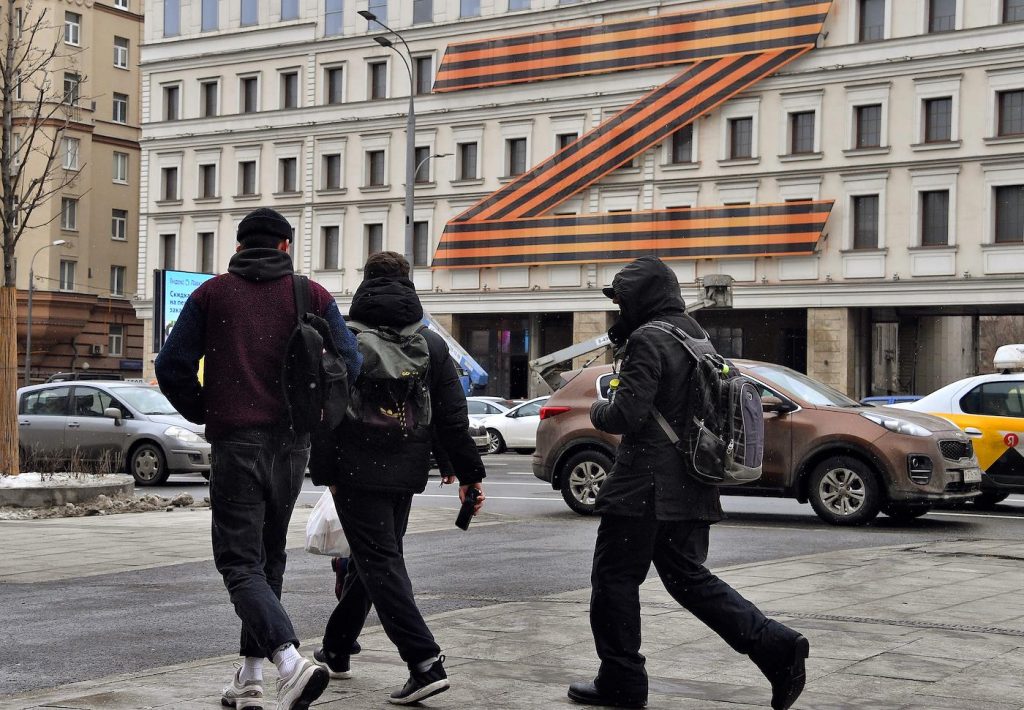
I think the fact is that Z has no story, but there is a rigid binding to his. And the degree of approval of its, as already mentioned, is a controversial question, although we were forbidden to argue about it.
In addition, the state does not like amateur performances. What kind of search? No search. Only what is approved by the authorities is permissible. The real sign of loyalty should be at the same time a sign of the state of the state, a sign of its widespread penetration, a sign that it is everywhere.
And here the old good tricolor remains the perfect symbol. Both the putsch and the Eagle ship burned under the Astrakhan Stenka Razin (a remark for erudites: there is a version that he did not burn; just after the suppression of the uprising, there were no foreign specialists capable of serving the ship, and he quietly rotted in one of the Volga factories), all this was a long time ago. Nobody remembers about it, no one is interested in this, no one except school stuffed, preparing reports for “talking about the important”, will tell you about the history of the flag and the importance of its flowers. He is deprived of content, and what else does the state need, the real ideology of which is that the power always remains in the same (good) hands?
Therefore, there is now a tricolor at school, and everywhere where you can stick new flagpole, of course, they will stick. So that, having rushed past the Aurus, the boss knew that he was supported, and saw intelligible signs of this support.
Yes, and good. Let it remain. Maybe it will come in handy: we remember that he is actually about freedom. Some, however, say that the Russian flag is finally discredited and you need to urgently come up with a new one for new associations. Suppose, there is our own reason, but let's first unite around ideas and values that have not yet been discredited; Let's look for them, and only then we will come up with colors for the flag. So it is somehow more correct, or, by the way, 14% of the fellow citizens, of among those surveyed by the VTsIOM , are sure that the flags over the schools have always been raised. "So it was always and it should be so."