
Translated material
How to get to the Baltic countries after a ban on entry for tourists?
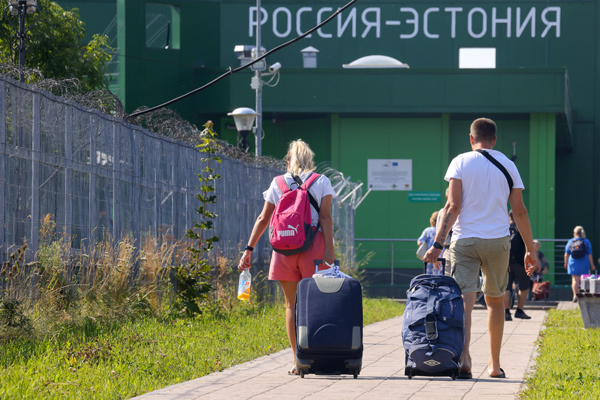
Estonia, Latvia, Lithuania and Poland close the entrance for Russians with tourist Schengen. Who and how can get there now?
Estonia, Latvia, Lithuania and Poland since September 19 banned the entry of Russians with tourist purposes. However, some categories of citizens can still get there.
“ Paper ” replies who has the right to enter the Baltic countries and how to draw up documents that allow it to be done.
For what grounds will they no longer let in Latvia, Lithuania and Estonia? ↓
These countries will not fall into Russians entering tourist, cultural, business and sports purposes.
What grounds are the entry into the Baltic countries allowed? ↓
These countries remain open to those who live there close relatives (who belong to them - read below), for owners of a residence permit and a “humanitarian visa” of these countries, diplomats, truckers. In addition, the Baltic countries are allowed to enter foreigners who go there transit through Kaliningrad.
Estonia authorities have published a memo in which cases of Russian citizens will be able to enter the country. This applies to Russians who issued a short -term working or educational visa, and owners of the Estonian Schengen visa, which are sent to other countries through Estonia. The clarification says that “transit” through Estonia is allowed. At the same time, Estonian Foreign Minister Urmas Reinsalu stated: “On the night of September 19, a ban on Russian citizens on entry through external borders will begin to operate, regardless of which state was issued by the Schengen visa.”
Can I get to the Baltic countries if I have a relative or husband there? ↓
If a member of your family is a citizen of the EU and you will prove the fact of kinship with him, then you will be obliged to issue a visa to stay in the country where he lives.
If your husband or parent has a residence permit of the EU country, issued for at least a year, you can use the right to reunite the family. It is guaranteed by the EU directive. To do this, your loved one must draw up an invitation and prove that he has everything necessary for receiving a guest: this applies to the presence of an income source, and housing, and medical insurance. If the checks are passed, the state will give you a visa, and in the future it will be possible to get a residence permit.
However, a long -term visa of your loved one may be an insufficient basis for providing you with a visa.
Russians can enter the country to attend the wedding, anniversary or funeral of a close relative (they include children, parents, grandchildren, grandparents), spouse or person with whom they have common minor children.
Without restrictions, those who have citizenship or residence permit in the EU will be able to visit close relatives in Estonia.
What is a "humanitarian visa"? ↓
Directly at the EU level, the concept of “humanitarian visa” is not fixed.
The “humanitarian visa”, like a tourist one, is rather a domestic name, Vitaliy Sleepak, senior lawyer of the Pen & Paper Bar Association, told Paper . He explained that usually “humanitarian” is understood either national visas for a long -term stay (type D visa), or a single Schengen visa (type A visa) issued for various humanitarian purposes, for example, treatment in one of the EU countries.
How to request a humanitarian visa from Russia? ↓
Regardless of the purpose of the trip, all unified Schengen visas are issued according to the unified rules established by the visa code. Therefore, if we are talking about obtaining a visa for a short -term stay, then the order will be the same as with obtaining a tourist visa. Only documents confirming the purpose of the trip will differ: it will be necessary to prove the presence of precisely those goals that, according to the applicant, will fall under the humanitarian (as an example with treatment, you can provide a medical report).
For trips, the term of which is obviously more than three months within six months (this is the most permitted stay on a single Schengen visa), the rules for submission and grounds for refusal to issue each country will be determined independently. The list of grounds is usually open, the main thing is to prove that you really exist. The rest will already depend on the authorities of the receiving state.
Should I try to get refugee status in the Baltic countries? ↓
According to the Convention on the status of refugees and the EU legislation, a visa is not required to recognize a person. But it will be necessary to prove that by virtue of “quite reasonable concerns to become a victim of persecution,” including on the basis of political beliefs, the person “is outside the country of his civil affected and cannot enjoy the protection of this country.”
The refugee status can be requested directly at the border point or already entering the country (for example, if a valid visa or visa is still not needed for entry), the expert said.
Also, the legislation of individual countries provides for the possibility of issuing a visa for potential refugees - in theory they are given by Poland and Latvia, but now there are additional restrictions on the issuance of visas in Russia, they explained to Pen & Paper. In any case, upon arrival in the country, it will be necessary to confirm the circumstances giving the right to receive refugee status, the lawyer commented. If the country's authorities refuse status, the applicant is deported and may prohibit him with entry into the EU for years.
In addition, refugee status in different countries may be associated with restrictions on work and place of residence. And the procedure itself takes a lot of time. Therefore, other methods of legalization can be more acceptable.
Updated 12.09. A source of commentary on the concept of humanitarian visas and the procedure for obtaining refugee status in the EU countries has been added.
Get the main news of the day - and a story giving hope 🌊
Subscribe to the evening newsletter of "Paper"
SubscribeWhat else to read:
- Estonia, Latvia, Lithuania and Poland from September 19 will close the entrance for most Russians. Updated.
- Officially: the European Union will stop the simplified visa regime for Russians from September 12, as "Russia undermined trust."
Photo: Peter Kovalev/TASS