
Translated material
The daughter of her father
This year, the new book prize "Politzerosvet" will be awarded for the first time.
“After February 24, the conversation about enlightenment is impossible outside the ethical and political context. Therefore, this year a special Polit-Svetvet award was established-for a book dedicated to the current socio-political process and helps to understand its nature, ”says Boris Zimin, the head of Zimin Foundation, with the support of which is presented with Politicosvet.
Not only books, but also the cycles of articles, multimedia projects, podcasts and YouTube shows were sent to the competition, but the qualifying committee decided to stop this year only on a book format: these publications turned out to be so significant. The long list of Politsevvet includes 10 books of Russian publishers - of which in October the jury will choose 5 finalists, and in December - a laureate.
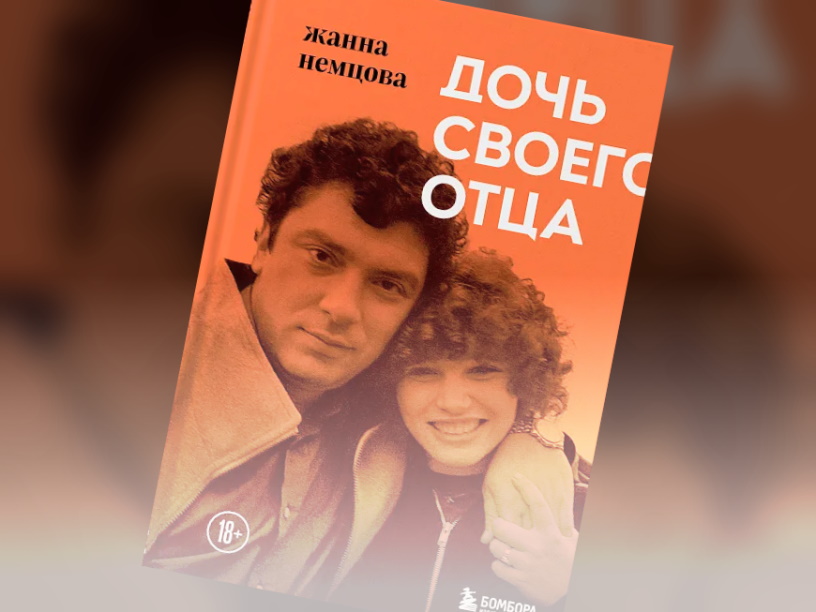
The Bomborch Publishing House is presented in a long list by the book of Zhanna Nemtsova , “The daughter of his father” .
And during the life of Boris Nemtsov, and even more so after his death, his name is often mentioned in articles and investigations, in election programs and commemorative speeches, in the texts of the Kremlin press services and blogs of opposition. It seems that they all know well what Boris Nemtsov was, but sometimes their opinions diverge so that it is very difficult to distinguish the truth from fiction. This biography was written by a man who was really close to Nemtsov and knew his present - his daughter Jeanne. In the book, she tells not only about the history of her family and relationships with her father. Zhanna Nemtsova with her inherent directness tells the book about how the political career of her father began, and how relations in their family were built, and what changed with the move to Moscow and work in the government, and, of course, about the day of the murder and about the reactions of society that followed this.
We offer to read an excerpt from the chapter telling how the young physicist Boris Nemtsov became a politician.
On April 26, 1986, a fourth power unit exploded at the Chernobyl nuclear power plant. In the USSR they tried to hide the disaster, but it still became known about it. People were incredibly frightened by the threat of distribution of radiation: they bought a Geiger counters and went to the store and to the market - they checked the products for radioactivity.
At the same time, in Gorky, in fact, in the city there was a construction of AST - a heat supply atomic station: from it to the border of Gorky could be reached on foot. My grandmother was categorically against AST and went to one of the central streets of the city to collect signatures against its construction.
Grandma had never participated in public campaigns before. But AST seemed to her a deadly project, so she was not afraid to go outside and find the support of the city’s inhabitants.
But the grandmother lacked knowledge: after all, she was not an expert on nuclear energy. And then she turned to my father for help. The father supported the initiative of his mother and began to actively oppose AST. The ability to speak brightly, convincingly and in the case quickly made it popular in the city. Subsequently, his father, answering the question of who brought him to politics, always said: "My mother."
In 1988, his father went to Moscow and interviewed academician Andrei Dmitrievich Sakharov about the Gorky project of AST. Sakharov was an ardent opponent of nuclear weapons and one of the initiators of the conclusion of the Moscow Treaty on the prohibition of nuclear tests in three environments (atmosphere, space and the ocean) between the USSR and the USA in 1963. Nevertheless, Sakharov did not oppose nuclear energy, he believed that nuclear power plants should be built underground to avoid the destructive consequences of technological disasters.
Here I have to explain: since 1980, Academician Sakharov was in exile in Gorky for criticizing the authorities, in particular for his objections to the introduction of Soviet troops into Afghanistan. Sakharov was sent to the exile without trial with his wife Elena Bonner. The purpose of this type of punishment was to isolation of a person from the outside world, he could not communicate with anyone. One of the inventors of the first hydrogen bomb in the USSR and the most famous Soviet dissident, Sakharov in 1975 became a laureate of the Nobel Prize of the World. He received the prize "for fearless support for the fundamental principles of the world between people and the courageous struggle with the abuse of power and any form of suppression of human dignity." He was a world -famous person who was forced to live in exile until 1986, when Mikhail Gorbachev allowed him to return to Moscow. In 1984, as a sign of solidarity in Washington, the area near the USSR Embassy was renamed in honor of Sakharov. 33 years later, in 2017, the square in front of the embassy in Russia in Washington will be renamed Boris Nemtsov.
In the 1980s, my father often talked about Sakharov, and therefore he aroused incredible admiration and interest to me. I poorly understood what the “link” was, and in all seriousness I thought that my father could easily introduce me to Sakharov. This did not happen, but I called my cat Andrei Dmitrievich Sakharov.
The conversation with Sakharov was published by the Leninsky Shift newspaper-in the late 1980s it was more free than, say, Gorky Worker.
The interview came out in two parts. The first was called “We should not keep ourselves in fear” and was published at the end of October 1988. The second, “we live in a new era”, in which Sakharov spoke about human rights, was published a little later, when, as his father said, everyone had already relaxed and said: “Do what you want, anyway ...”
Sakharov made it clear: he against the construction of AST in Gorky. In the late 1980s, it was frozen. Father is not a journalist, an interview with Sakharov was the first and last in his life. But he got what journalism exists for: he changed reality largely thanks to this interview.
In 1990, elections of people's deputies of the RSFSR were held. By that time, the registration system of candidates was simplified. This was primarily due to the request of society for changes and the accumulated discontent of the CPSU. The father was nominated in the National-Territorial District No. 35-it included all Gorky. In total, eight candidates competed in this district. Father held many meetings with voters, including at the Orbit plant, in the hostel of the Polytechnic University and in other places. The authorities no longer interfered with the holding of such meetings. Father also participated in television battles with other candidates. Two minutes of airtime were allocated for free agitation. There was no particular interest in such programs-perhaps because of the repeated banal speeches. Nina Zvereva, the famous Gorky journalist, who greatly helped her father at the beginning of a political career, recalls that his father was thinking for a long time what he was talking on these debates. He and Nina discussed different options, but during the air, having listened to their rivals, who promised endlessly, he said: “I can only promise one thing. I will not lie. " And that's it. He won the election - and became the People's Deputy of the RSFSR.
At the first meeting of the deputies of the Supreme Council, the father met Boris Yeltsin. He invited the deputies who won under democratic slogans to the meeting, and asked his father the question: “You are from Gorky. Do you have any ideas on how to equip Russia? " True, it sounds like “How do we build a beautiful Russia of the future?”? In the summer of 1991, Yeltsin became the first president of the new Russia, and his father becomes his representative in the Nizhny Novgorod region. A little later, Yeltsin appoints my father, who was only 32 years old, the head of the administration of the Nizhny Novgorod region. Nina Zvereva approached him with a microphone and asked:
- Boris Nikolaevich, are you not afraid to appoint such a young Nemtsov governor? After all, the Nizhny Novgorod region is very problematic.
“I'm not afraid,” Yeltsin answered. “I believe him that he will go democratically.” His mind, his responsibility, activity are all positive features. Disadvantages - which ones? Youth is not considered a drawback. The lack of production experience affects a slightly theoretical approach. But this passes over the years, so I believe that this is a good candidate for Nizhny Novgorod.
Then, after many years, his father loved to joke: "When I was little, I worked as a governor." The word "governor", by the way, was introduced into the circulation of my father. Yeltsin did not like at first, but then he got used to it.
I recently discovered an interesting fact. There is a feeling that in the 1990s in the country there were completely progressive scientists, human rights activists, and public figures-new people of the new Russia.
This is not true. Nizhny Novgorod region, in which the young scientist-physicist became the governor, was not a rule, but an exception to him. In most regions, representatives of the party -propeller sat in the governor chairs. That is, in fact, the same people who held certain positions before the collapse of the USSR.
And it is not surprising that in the mid-1990s, the Russian and world press wrote a lot about the Nizhny Novgorod region: the region became the capital of market reforms.
Boris Nemtsov interviews Academician Andrei Dmitrievich Sakharov and his wife Elena Bonner. October, 1988. Author - Nikolai Moshkov
Earlier, in the “Slow Reading” section, the following books were presented, included in the long list of the Polit.
Lev Gudkov. Refusal totalitarianism . In 2 volumes-M.: New Literary Review, 2022.
Ilya Zhegulev. The course of the king. The secret struggle for power and influence in modern Russia. From Yeltsin to Putin. - M.: Howard Rork, 2022.
Karin Cleman. Patriotism from below. “How is it possible for people to live so poorly in a rich country?” - M.: New Literary Review, 2021.
Ivan Kurill. Battle for the past. How politics changes history. - M .: Alpina Plisher, 2022.
Evgenia Lesin. XX century: study of the past. Practices of transitional justice and memory policy in former dictatorships. Germany, Russia, countries of Central and Eastern Europe. - M.: New Literary Review, 2021.
Mikhail Fishman. Successor. The story of Boris Nemtsov and the country, in which he did not become president. - M.: Corpus, 2022.