
Translated material
Guns and cursor

The military government of Mali hired the Wagner PMC to fight
with the Islamists
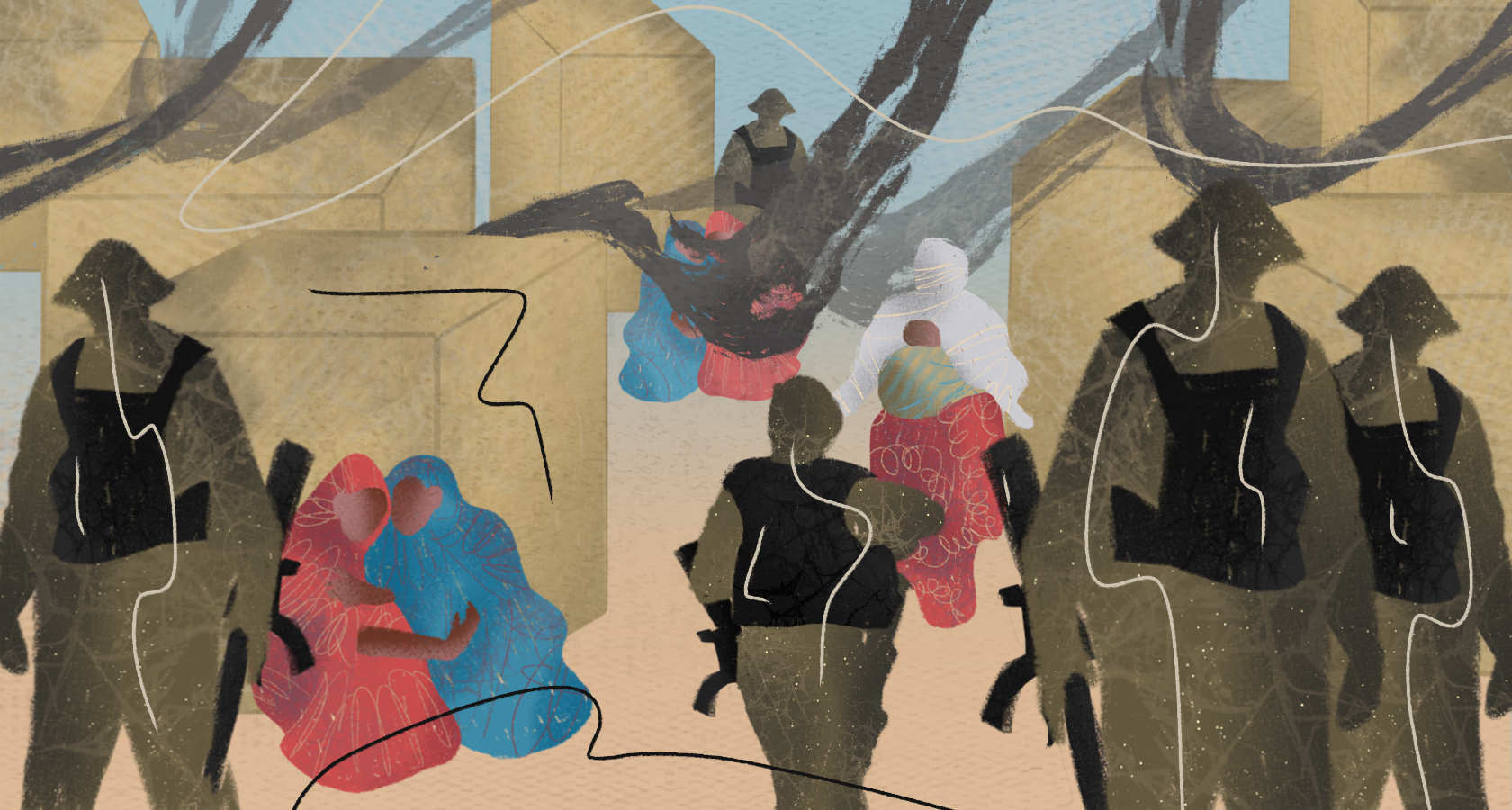
Authors: Phil Smirnov, Matthew.
With the participation of Yabloni
Illustration: Sasha Rogova
April 5 Human Rights Watch published a report that at the end of March, the Malian armed forces and the private military company associated with them, Wagner, killed more than 300 civilians near the Gossi military base. The appearance of Russian mercenaries in the country occurred against the backdrop of a rapid deterioration in relations between the ruling military junta in Mali and the French military contingent, which for nine years helped carry out an “anti-terrorist operation” against Islamists.
Witnesses to the events in the city of Mura told The New York Times that civilians and unarmed militants became victims of the Malian army and the Wagnerites. During a raid on the city, soldiers gathered people in groups of 15 and examined them for bruises and marks, for example from gun butts. This is how the military tried to identify hidden jihadists. After inspection, they executed most of the men. Russian mercenaries snatched people running through the streets and broke into the houses of civilians. According to surviving eyewitnesses, "white soldiers killed everyone who tried to escape."
Against the backdrop of the ten-year-long war in Mali, the Russian PMC is strengthening its presence in the region.
What are the Wagnerites accused of?
In Mali, the war between government forces and Islamist militants is still ongoing. After another defeat in the clash with the Islamists, the military junta, which seized power as a result of another coup in August 2020, turned to Wagner mercenaries for help. According to human rights organizations, PMCs and the Malian army are killing hundreds of civilians while carrying out “anti-terrorism operations.” The Malian government is blocking independent investigations into such incidents.At the end of December 2021, information appeared in the media about the arrival of mercenaries in the country, and in January 2022, the Malian military confirmed that “Russian instructors” were in the country. Now the contingent of “Wagnerites” in Mali is estimated at more than a thousand people.
Accusations of “Wagnerites” of human rights violations began to appear from the very beginning of their arrival in the country in December 2021. Recorded crimes occurred in settlements throughout the country. The most terrible crime in terms of the number of victims, which is attributed to the “Wagnerites,” occurred in the city of Mura, next to the Gossi military base. The UN is still unable to launch a full-scale investigation into the tragedy. The Malian authorities did not allow the organization's experts to visit the burial site next to the military base. They told the UN mission that permission for access would be "considered" once their own investigation had been completed. Since then, nothing has been known about the results of the investigation.
Mali authorities did not blame anyone for the crimes, but said that, judging by the state of the bodies found, “the mass grave existed long before” the French soldiers left the base. At the same time, the French military provided satellite photographs that allegedly showed attempts by the Wagnerites to fake French involvement in the killing of civilians. Mali's defense minister said that from March 23 to March 31, 2022, the army "neutralized" 203 terrorists and another 51 were arrested. According to the official version, all these people are “jihadists.”
Since the beginning of 2022, the UN has noted an increase in the number of killings and violations of the rights of civilians by Malian soldiers. According to a UN report, in the first three months of 2022, 248 civilians were killed due to their fault - ten times more than at the end of 2021. And according to The Armed Conflict Location & Event Data Project, from January to mid-April 2022, 456 civilians were killed by government forces and Wagnerites.
The New York Times, based on eyewitness accounts in the city of Mura, reported that both civilians and unarmed militants became victims of the Malian army and the Wagnerites. Malian soldiers examined 15 men at a time for bruises and marks left by the shooting, then executed most of the men just meters from the prisoners. At the same time, Russian mercenaries snatched people running through the streets and broke into houses. Malian soldiers used loudspeakers in the mosque to order anyone still hiding in the houses to come out, while Russian mercenaries made sure no one escaped. “White soldiers killed everyone who tried to escape,” one witness told the NYT.
Some residents who had carts were ordered by the military to collect bodies, while others were ordered to collect dry grass. The soldiers covered the bodies with dead wood, doused them with fuel and set them on fire in front of the prisoners. The killings and torture continued for four days.
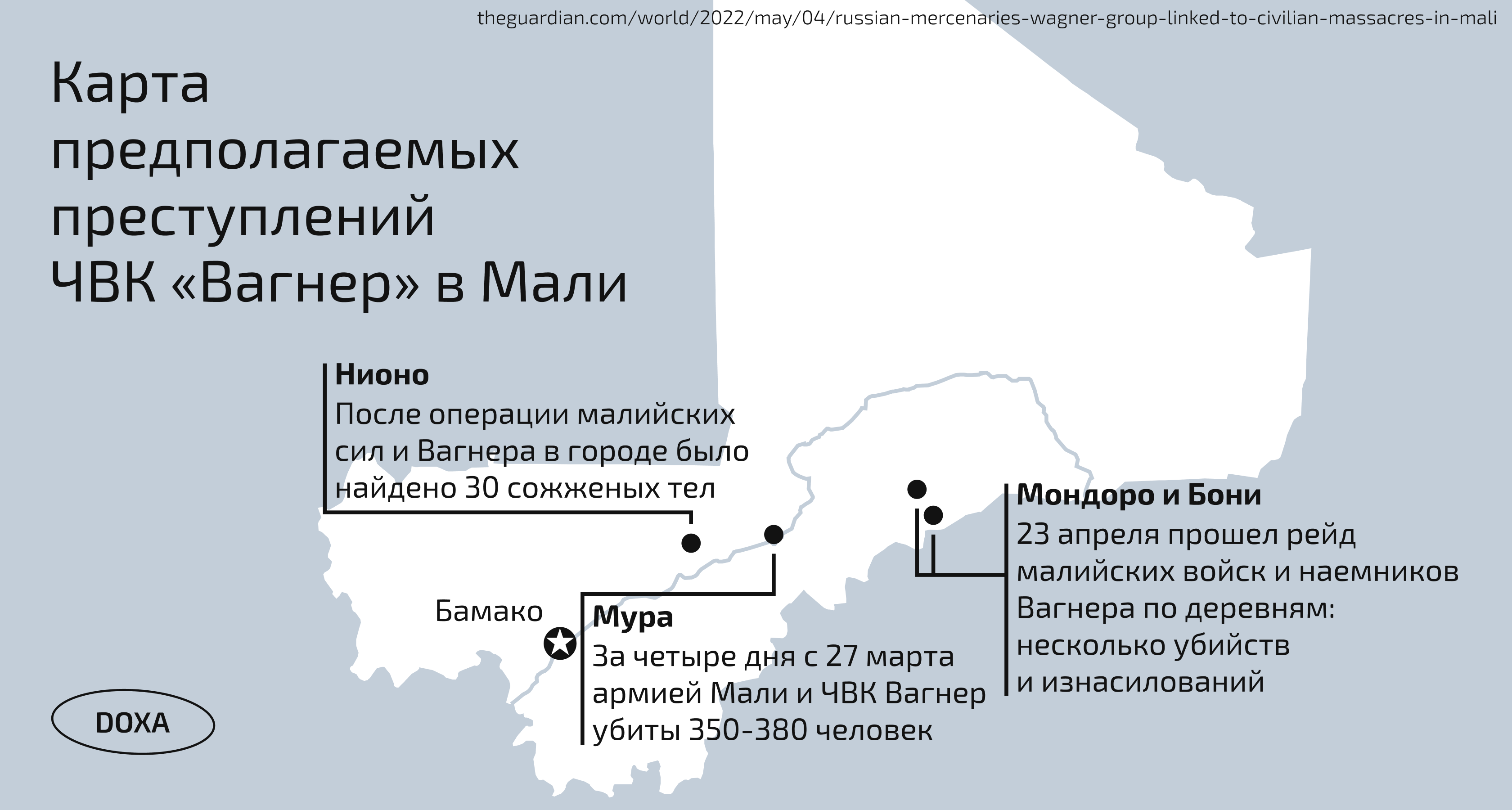
The Guardian refers to internal documents of the Malian army, which mention the participation of “Russian instructors” in “joint operations”, as a result of which civilians were killed - the number of victims is in the hundreds. Officials reject the accusations, calling them unverified and aimed at smearing the Mali army.
The Russian Federation blocked a UN Security Council request for an independent investigation into the events in Mura. “Given the traditional tendency of the French media, and often some European officials, to shift all sins “from a sore head to a healthy one,” it can be assumed that some will be tempted to throw into the media space versions directed against Malian military personnel, whose successes in clearing the republic of the terrorist threat so irritate Paris, which has failed to do this over the years of its presence in Mali,” the Russian Foreign Ministry said .
What are French troops doing in Mali?
Wagner PMCs are not the first foreign military contingent in Mali. France's mission in the region began in 2013, when, at the request of the government of Mali, France led a military operation against the Islamists: then they took control of the north of the country. The deployment of troops was authorized by the UN Security Council. Later, the geography of the operation expanded into neighboring countries: Burkina Faso, Niger and Chad.
As a result of a nine-year “anti-terrorist operation,” the Malian army and its allies were able to regain control of cities in the north of the country, but they were not able to completely defeat the terrorists: they regrouped and continued fighting.
French troops participate in peacekeeping operations in West Africa
Photo: GETTY IMAGES
There have been several coups d'état in Mali in 2020 and 2021. As a result of the latter, a military junta came to power, which did not have good relations with the French army. In March 2022, the Mali government demanded the withdrawal of French troops “without delay,” and on June 13, most of them left the Menaka base and relocated to Niger. The UN notes that the Mali peacekeepers and armed forces remaining in this area of the country may not be enough to ensure the safety of local residents. One way or another, on August 15, 2022, France completed the operation and withdrew its troops. Despite this, tension between the two states did not subside.Immediately after the withdrawal of the last French units from the territory of Mali, the country’s authorities appealed to the UN Security Council with a request to initiate proceedings regarding the actions of the French military, calling for an end to “acts of aggression.”
On August 17, Malian Foreign Minister Abdoulaye Diop said in a letter to the head of the UN Security Council that France was violating Mali's airspace and supplying weapons to armed groups: airspace has been violated more than 50 times this year, mostly by French drones, military helicopters and fighter jets. “Blatent air violations were used by France to collect information about terrorist groups operating in the Sahel and to drop weapons and ammunition on them,” the letter said. Authorities in Bamako, the capital of Mali, have so far only announced evidence they have of French arms supplies to armed groups that Paris has spent ten years and billions of dollars fighting. But the Mali government did not provide this evidence in its letter to the UN.
Civilians indeed became victims of the actions of the French military. In March 2021, a French airstrike on a wedding party killed 10 people. Despite assurances from the French military that 30 extremists were killed in the operation, the UN commission acknowledged that the attack killed civilians.
Foreign Ministers Sergei Lavrov and Abdoulaye Diop in Moscow, 2021
Photo: AFP/YURI KOCHETKOV
In addition to the French military, there is a UN contingent of 15 thousand peacekeepers in Mali. But their presence also does not go smoothly. At the end of June 2022, the UN mandate for the peacekeeping operation ended, but a new agreement was not reached, and UN troops continue to remain in the country under temporary arrangements with the government. Negotiations on troop rotation were frozen and resumed several times. One of the most notorious scandals occurred on July 14, when the Malian authorities, according to them, captured 49 soldiers from Cote d'Ivoire - the military was charged with “assault and criminal conspiracy” against the state and “undermining external security.” Only on September 5, three female soldiers were released , the remaining forty-six people remain under arrest.Despite the fact that the military junta does not have clear agreements on the further extension of the peacekeeping mission, it is still impossible to talk about stability and security in the country: terrorist attacks continue to occur every month with dozens of deaths: on August 10, near the city of Tessi, after an attack by jihadist drones, forty-two Malian soldiers and four civilians were killed . A week earlier, a group of Islamists fired small arms and rocket-propelled grenades at a convoy of UN peacekeepers; one peacekeeper was killed and three were wounded during the attack.
The situation is further aggravated by the humanitarian crisis. The junta's refusal to hold democratic elections has led to international sanctions, and a number of NGOs are concerned that the restrictions could lead to a humanitarian disaster due to food shortages, much of which is supplied to Mali from abroad. Russia is also playing on this. On August 10, Vladimir Putin discussed possible supplies of food, fertilizers and fuel to Mali with the acting president of the country in a telephone conversation. The Russian President also promised additional cooperation in the security field and invited the leader of Mali to the St. Petersburg Russia-Africa summit, which will be held in 2023.
Who are the “Wagnerians”?
Vladimir Putin with commanders of the Wagner PMC, 2017. Far right - Dmitry Utkin.
Photo: Fontanka
The PMC became famous for its participation in hostilities in Syria, the Central African Republic and eastern Ukraine. The Wagnerites also took part in the civil wars in Sudan and Libya, and the suppression of the Islamist insurgency in Mozambique.
Questions about the methods used by the Wagnerites during hostilities arose even before the events in Mali. In October 2021, the Office of the UN High Commissioner released a statement accusing Russian mercenaries of involvement in human rights violations, sexualized crimes and the persecution of civilians in the Central African Republic. According to the UN, the Wagnerites resorted to arbitrary detention, torture and extrajudicial killings. Human Rights Watch came to the same conclusions in May 2022, studying war crimes committed by the Russian military in Ukraine.
Wagner soldiers on guard during a parade in Bangui, Central African Republic, 2019.
Photo: Ashley Gilbertson for The New York Times
The Russian authorities do their bestto deny ties with the Wagnerites, but they do not deny the very existence of PMCs. At the same time, mercenary activity is prohibited in Russia , and participation in armed conflicts on the territory of other countries is punishable by imprisonment from seven to fifteen years.What is the Russian Federation doing in Africa?
From July 23 to July 27, 2022, the Russian Foreign Minister went on a tour of Africa. Sergei Lavrov visited Egypt, Uganda, Congo and Ethiopia. Many African countries are dependent on food supplies from Russia and have not condemned the war in Ukraine. There are also many authoritarian and dictatorial regimes in Africa; they sympathize with Putin. One of the goals of Lavrov’s trip was trade agreements: Rosatom will build a four-reactor power plant in Egypt, and in the Republic of Congo, a Russian company is working on the construction of a main oil pipeline. A couple of days before Lavrov’s visit, newspapers in African countries published an article by the minister in which he accused Western countries of lying. Sergei Lavrov argues that Russia, unlike the “West,” “has not tarnished its reputation with the bloody crimes of colonialism.”Russia-Africa Summit, 2019
Photo: The Independent
Former employee of the Russian Institute for Strategic Studies under the President of the Russian Federation and specialist on West Africa, teacher at RUDN University:
“The Wagnerites began to appear in Africa around 2017, immediately after big Russian business arrived there. The PMC agreed with the President of the Central African Republic to ensure security in the country, including the protection of government officials. And already in 2017, our trade turnover began to grow: they bought mainly diamonds from the Central African Republic.
It is important to understand that Prigozhin is not only Wagner and not only a military presence. These are also political consultants who were sent through the International Anti-Crisis Center . The Foundation for the Protection of National Values, which has sent sociologists to Libya, often works together with him.
Relative successes have come to the Central African Republic and now to Mali. “Wagnerites” are not even interested in some kind of economic benefit; the benefit there is initially geopolitical. If we are talking about Yevgeny Prigozhin, then the goal was simply to “take and occupy” the country, so that later we could report to the high authorities how much we managed to expand our geopolitical presence in the new region. This was not some cunning, well-thought-out plan that led to success.
After Prigozhin came to West Africa, other people of ours also became interested in the region: roughly speaking, the same Malofeev and Kadyrov. Someone in Nigeria has a charitable organization, and Malofeev has an investment attraction agency. Russian corporations have been present there since the 2000s: Rusal and partially ALROSA. They had high hopes for Angola in the mid-2010s. It was believed that this was a very large promising market. But now the economic situation there has changed. Plus, as far as I remember, in Zimbabwe, even with the regime of Robert Mugabe, ALROSA had agreements, after he was overthrown in 2017, everything went up in flames again.
When we enter the region, anti-colonial rhetoric is used to present Russia's presence as a kind of liberation. In the same loyal publications about the situation in Mali, the Wagner PMC is spoken of as liberators.
Currently, Russia’s main resources in the military-political sphere are concentrated in Ukraine. But, nevertheless, it is important for Russia to show that it can maintain its military presence in other regions. This is an important propaganda step for the international arena. But I don’t think we should expect any serious expansion and allocation of additional resources in this area.”
Billboard on the streets of Bangui, dedicated to cooperation between Russian and Central African armed forces, 2019
Photo: Ashley Gilbertson for The New York Times
Why is France still one of the key players in West Africa?
Former employee of the Russian Institute for Strategic Studies under the President of the Russian Federation and specialist on West Africa, teacher at RUDN University:
“The Wagnerites began to appear in Africa around 2017, immediately after big Russian business arrived there. The PMC agreed with the President of the Central African Republic to ensure security in the country, including the protection of government officials. And already in 2017, our trade turnover began to grow: they bought mainly diamonds from the Central African Republic.
It is important to understand that Prigozhin is not only Wagner and not only a military presence. These are also political consultants who were sent through the International Anti-Crisis Center . The Foundation for the Protection of National Values, which has sent sociologists to Libya, often works together with him.
Relative successes have come to the Central African Republic and now to Mali. “Wagnerites” are not even interested in some kind of economic benefit; the benefit there is initially geopolitical. If we are talking about Yevgeny Prigozhin, then the goal was simply to “take and occupy” the country, so that later we could report to the high authorities how much we managed to expand our geopolitical presence in the new region. This was not some cunning, well-thought-out plan that led to success.
After Prigozhin came to West Africa, other people of ours also became interested in the region: roughly speaking, the same Malofeev and Kadyrov. Someone in Nigeria has a charitable organization, and Malofeev has an investment attraction agency. Russian corporations have been present there since the 2000s: Rusal and partially ALROSA. They had high hopes for Angola in the mid-2010s. It was believed that this was a very large promising market. But now the economic situation there has changed. Plus, as far as I remember, in Zimbabwe, even with the regime of Robert Mugabe, ALROSA had agreements, after he was overthrown in 2017, everything went up in flames again.
When we enter the region, anti-colonial rhetoric is used to present Russia's presence as a kind of liberation. In the same loyal publications about the situation in Mali, the Wagner PMC is spoken of as liberators.
Currently, Russia’s main resources in the military-political sphere are concentrated in Ukraine. But, nevertheless, it is important for Russia to show that it can maintain its military presence in other regions. This is an important propaganda step for the international arena. But I don’t think we should expect any serious expansion and allocation of additional resources in this area.
Damaged French Total gas station in Dakar, Senegal, 2021
Photo: John Wessels/Agence France-Presse - GETTY IMAGES
There is also a connection between the elites: West African leaders still have real estate on the Cote d'Azur and very close political contacts with the French establishment. One can even trace how the political struggle in France is reflected in the political struggle within African countries.
For Mali and neighboring Niger, the most significant resource [for export] is uranium, since the French energy system is largely dependent on nuclear power. In the last 10 years, not only France, but also China have been interested in the uranium resources of Mali and Niger.
Militarily, France has always sought to attract local allies. This is how the “Sahel Five” emerged: Burkina Faso, Mauritania, Mali, Niger and Chad. They tried to conclude military agreements and obtain funding from the Gulf countries - Saudi Arabia and the Emirates. This helped France solve resource problems, because the available financial and military forces were quite limited.”
Why did war start in Mali?
In 2012, a political crisis began in Mali. It was originally associated with the Tuareg, one of the divided peoples of the Sahara-Sahel region. Some Tuaregs lived in Libya. After the overthrow of the dictator Gaddafi, whom they supported, the Tuaregs were forced to leave the country. Some of them returned to Mali, and a large number of weapons from Libya began to be supplied to the country. The rebels, who received weapons, tried to seize power in the north of the country, and in order to prevent the fall of the country's capital, Bamako, the direct intervention of the French army was required.

When the French received UN sanction and entered Mali as part of a peacekeeping operation, it became clear that the problem of jihad needed to be solved not only on the territory of Mali, but also in neighboring states, since the borders were quite transparent and it was quite easy to cross them through the desert. Therefore, the mandate had to be expanded - so, in parallel with the French operation, the UN itself began an operation in Mali and nearby states.
Asymmetric warfare is a war between opponents who use radically different strategies. Most often, these are wars between opponents of unequal strength, when the weaker side uses methods practically unknown to its enemy. The US war in Iraq, when American soldiers were unexpectedly confronted with such tools of destruction of manpower as improvised explosive devices, is an example of asymmetric warfare.
Games of Empire: Global Capitalism and Video Games
https://www.upress.umn.edu/book-division/books/games-of-empire
In the book, the authors critique popular video games such as Full Spectrum Warrior or Warcraft, showing how they reproduce the logic of global capitalism.