
Translated material
Good intentions against working rules. Amnesty International report about Ukraine as an attempt to change the limits of the permissible in war
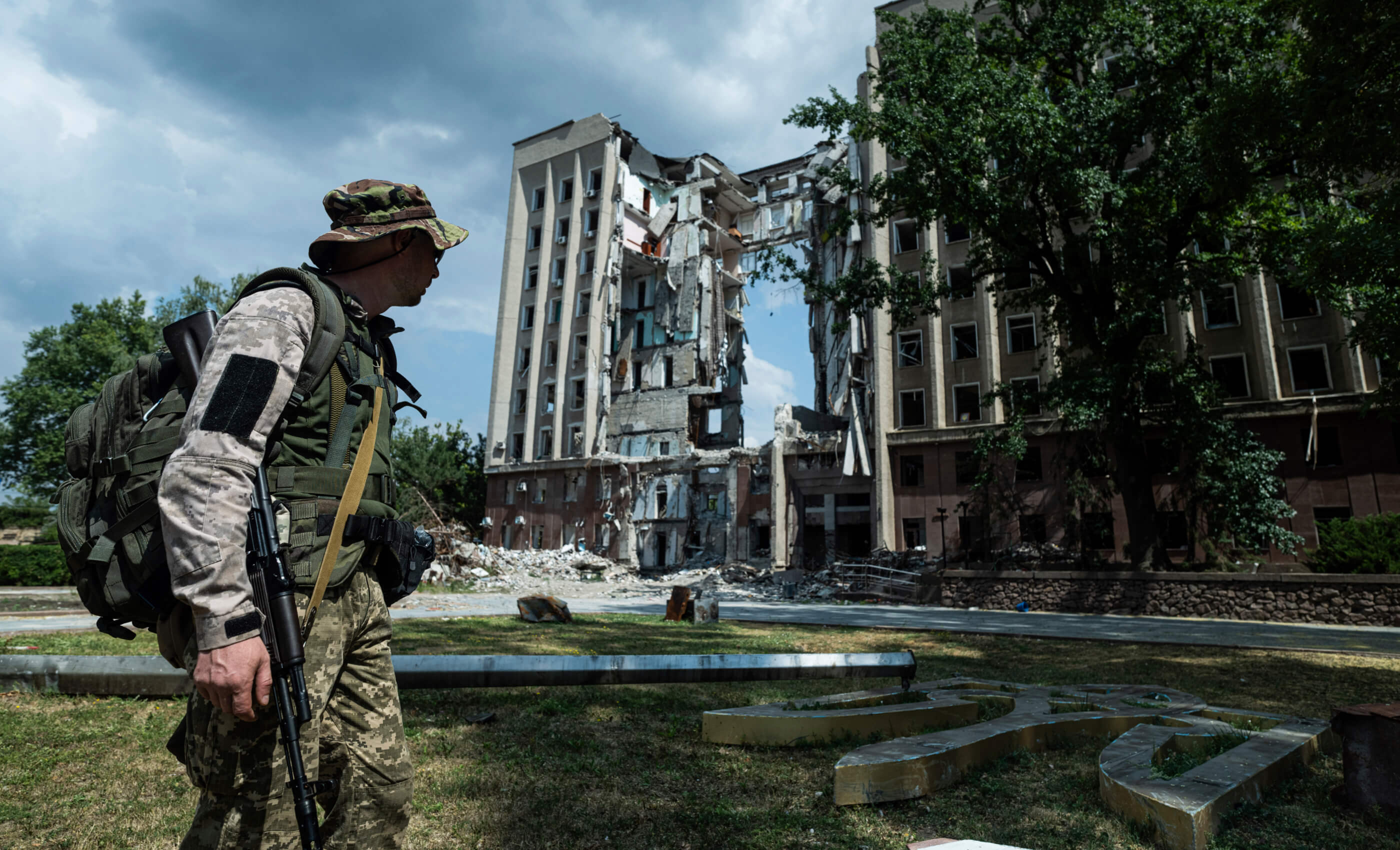
Ukrainian soldier at the destroyed building in Nikolaev, August 5, 2022. Photo: Evgeniy Maloletka / Ap
In early August, Amnesty International issued a report on the actions of the Ukrainian military, accusing them of the placement of equipment and personnel of civil buildings during the defense of cities from the Russian army. He caused sharp criticism both in Ukraine itself and from military experts and law enforcement officers. "Mediazona" publishes translations of two texts dedicated to the report. Journalist Tom Manch tells how Amnesty made a report literally before his eyes and why he warned the organization that he should not be published. And below - the text of Willa Wright, a researcher at the Institute of International Law of Peace and War (IFHV) in German Bochum, who summarizes, as the report was perceived by specialists directly involved in the issues of the rules of war.
On August 4, Amnesty International published its report on the tactics of the Armed Forces of Ukraine, which danger the civilian population when they fire or place potential military purposes - personnel and weapons - in settlements. The report caused serious criticism from the experienced military , who considered the expectations of the organization unrealistic. The Ukrainian representative office of Amnesty International accused the organization of that they were not suffered sufficiently to work on the report; The head of the Ukrainian unit of the organization Oksana Palchuk resigned. The lawyers had to return to the discussions about and the question of the inequality of the warring parties in an aggressive war. In response to this reaction, the organization was forced to apologize - but only for the "experiences" caused by the publication of the report.
A large -scale resonance indicates that the conclusions contained in the document do not join with norms and principles. So, American professor Michael Schmitt released a detailed legal analysis of the report and came to the conclusion that neither evidence of the mentioned violations, nor specific norms and rules that were allegedly violated are given.
Be that as it may, the report gave impetus to the current discussion about the protection of the civilian population when using artillery and missiles in settlements. In this text, we will only briefly touch upon accusations from the report, since numerous experts have already spoke on this subject - instead, we will try to understand what role he will play in a wider context of the discussion around the rights of the civilian population in the war zones. We will also pay attention to the dangerous discrepancy between the desired (calls for a more stringent regulation of warfare) and reality (real position in the conflict zone).
Report and reaction
The Amnesty report itself is quite brief. He indicates three main problems, which, according to the authors, are characteristic of the operational actions of the Armed Forces of Ukraine and endanger the civilian population: this is the location of firing positions in settlements, as well as the use of hospitals and schools for military purposes. The attitude of international law towards these problems is quite different.
The use of schools causes the smallest concern, since the authors of the report themselves recognize that schools do not work now, that is, they are less protected from the point of view of law. Even in the “Declaration on the Security of Schools” mentioned in the document, it is said that the parties should not use closed schools, “with the exception of mitigating circumstances when they are not suitable for alternative.” From the very beginning of the war, the soldiers of both sides of the conflict were located in schools - simply because these are one of the few city structures that can accept a large number of people. At the same time, the report does not provide enough information about the specific circumstances of the use of schools.
The placement of soldiers in settlements and the launch of shells from there is a more difficult question, but in the report this topic is not properly disclosed. Professor Schmitt notes that the “choice” of the violation is incorrect: the ban on the use of civilian as “living shields” implies their intentional placement somewhere for defensive purposes- the Amnesty itself does not write about this.
Military adviser to the Netherlands Human Rights Office Mark Garlaska emphasizes that international humanitarian law did not initially provide for the “protection” of civilians from the defenders of the military, when armed actions are in the city itself. Although both parties are equally required to comply with the norms and principles of warfare, during street fighting it is impossible to equate defenders and attackers. Choosing goals, the Russian armed forces give Ukrainians two opportunities: to defend or surrender the territory. Although the war in cities pose an obvious danger to the civilian population, it is unrealistic to expect that the Armed Forces of Ukraine will abandon some defensive positions due to potential shelling of enemy forces or stand on a obviously disadvantageous open area in front of the enemy who has superiority in the air. Garlaska believes that otherwise Russia will have additional excuses for the use of weapons of indiscriminate action in the conduct of hostilities in cities.
The most justified accusation of the report applies to hospitals. There is a direct ban on the shelling of hospitals, and the responsibility for this is assigned to the attacking side. In addition, ordinary international law requires the creation of neutral zones around hospitals and prohibits the use of these buildings for military purposes - as well as buildings with “ international recognized emblems ” (although it is unclear from the report whether such symbols were examined by human rights activists). Professor Schmitt emphasizes that Articles 12 and 13 of the additional protocol I to the Geneva Convention prohibit the placement of hospitals near military facilities, and in the case of using hospitals for shelling the enemy or with the aim of covering weapons and soldiers, they lose the right to protect the convention after unambiguous warning. Although the report mentions cases of using the Armed Forces of Ukraine, the authors again do not provide enough specific information, and also do not affect the topic of obligations lying on the Russian military.
Using explosive weapons in cities
The conclusions of the report do not necessarily reflect the opinion of the authors about violations of international law. Rather, they are repelled from ongoing discussions about the potential introduction of a ban on the use of explosive weapons in urban areas. In Ukraine , it was such a weapon that claimed a larger number of lives of the civilian population from the beginning of the invasion. During the siege of the city, all types of such weapons - from ballistic missiles and air bombs to artillery mines and grenades - are particularly dangerous for those who may not have been their goal, but simply were near the scene of the explosion.
Since there are no individual rules or practices to protect the civilian population from these threats, and general principles, such as the principle of proportionality, seem insufficient, many began to raise the issue of expanding the list of international restrictions on methods of conducting hostilities. The International Red Cross Committee over the past decade has published many materials on this topic, including theexpert discussion protocol in 2015, and also carefully monitored the news on this issue. The partnership of non -governmental organizations "International Weapons of the Explosive Action" (INEW) is trying to draw attention to this problem since 2011. The efforts of the ICRC and Inew led to the emergence of a political statement in June this year - the first step to the complete ban on such weapons. At the same time, the wording and the proposed practical solutions are still blurry.
It seems that the authors of the Amnesty report tried to say their word in this discussion, but could not bring the harmonious legal basis under their conclusions. The document provides examples when the presence in the village of Ukrainian soldiers subjected the civilian population to an increased risk of blowing from heavy weapons. Yes, such situations are extremely dangerous. Nevertheless, it does not follow from the evidence presented in the report that the actions of the Armed Forces of Ukraine were illegal. Rather, the authors are trying to expand the understanding of international law so that it regulates actions, which, despite all the tragedy of this, in reality cannot be completely excluded under an armed confrontation.
On the contrary, the news from the conflict zone and because of its limits, it seems, does not just testify to the unpreparedness for such expansion interpretations, but other, the already established aspects of international humanitarian law are called into question. In 2021, the current US Military Army Prosecutor Charles Pid called for more legal flexibility in potential future conflicts. In his opinion, lawyers and human rights activists insisting on the ban on explosive weapons in settlements do not understand military realities and mix international humanitarian law with more rigid rules of warfare. And he is not alone confident in the possibility of a more flexible approach to the use of explosive weapons in settlements.
Why is it all important
The current report and the discussion on the use of explosive weapons in settlements do not have much significance outside the Ukrainian context. And of course, attempts to expand the rights of the civilian population in wartime can only please. But it is important to understand that while the military questioned existing norms, tightening the rules carries new risks.
History is full of examples of how the customs of warfare changed sharply due to political and technological progress. In ancient Greece, traditions that restrained the militancy of policies for centuries during the Peloponnesian war became inappropriate . The customs of warfare of the indigenous inhabitants of Central America and Spanish invaders underwent changes during their conflict. There are also examples in history when attempts to limit the methods of warfare did not take root - as, for example, attempts to prohibit crossbows in wars between Christians. The established customs can survive for a long time without experiencing threats from individual violations, but when they are stopped taking them seriously, the entire formed order changes.
Military thought and practice of waging wars may now conflict with the current norms of international humanitarian law, and work on its expansion can only undermine confidence in these norms. If the defense of the city, instead of transferring it to the enemy, is already equal to violation of the right due to the threat of civilian life, then how is the ordinary Ukrainian soldier to the issues of protecting prisoners or the use of soldier children? I believe that at present it is more important to ensure the implementation of existing international norms, and not go beyond their framework.
Author: Will Wright
Original: “ Imploding Protection Throuch Exploding Norms? ”, Völkerrechtsblog, 08/12/2022, DOI: 10.17176/20220812-181522-0.
Translation: Ivan Ignatiev